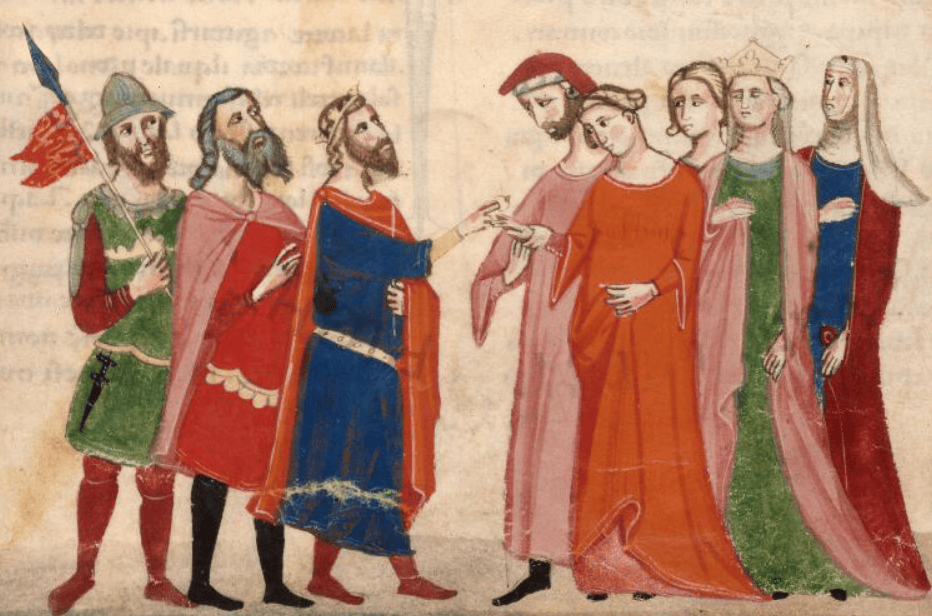
St. Paul’s, London, August 21st 2026
I’m sat on a wall looking at the ruin of Christchurch Greyfriars Church, and I’m here to gather Marguerite of France. I’m feeling quite emotional. I mean I always do, but in most places, Westminster Abbey for example, there’s a general understanding that each tomb, plague or plinth is dedicated to a person, a real human being, who though they may have lived hundreds of years ago, actually lived and is remembered for something. Here lies Henry V, Isaac Newton, William Shakespeare. Each has a ‘something’, and even my queens, as long as the abbey stands, they will never be wholly forgotten; there will always be a helpful verger who can point you to even the most obscure of consorts, even the one buried under the organ. But Marguerite is among those women who are, if not the most forgotten, then the least remembered. All that is left of this church is the tower and north wall. The aisle is now a footpath, the pews are shrubberies, the whole is a remembrance garden to those who died in the Blitz, including the church itself. There are benches almost entirely occupied by builders on their break. Its a throughfare. An orientation point. A place to stop and get your bearings, not a destination in and of itself. Parts of it have been incorporated into nearby modern buildings, steel and glass creeping like ivy over the stone carcass. There is nothing here that says ‘Marguerite’. Not even the nearby streets – we are on King Edward Street, and next to Queen Isabella Way, but there is no Margaret Lane. And yet this church would not be here without her. This was her tomb, but it is also her monument, and her legacy.
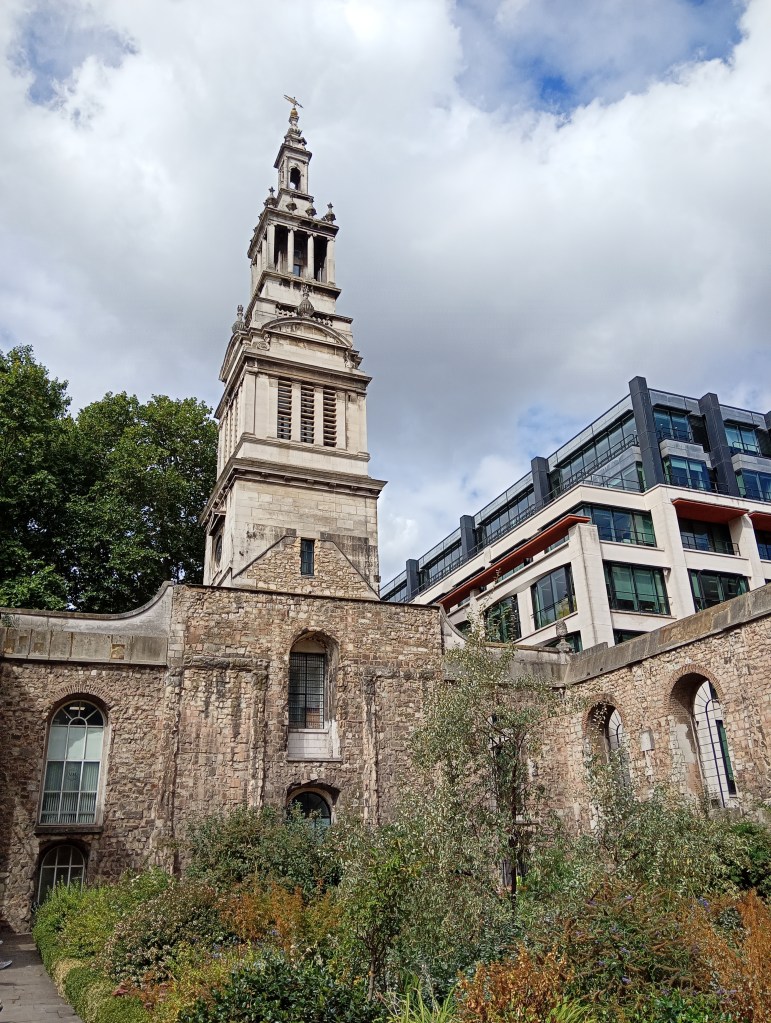
Marguerite left a light, almost imperceptible imprint on English history. She was married to Edward I at the reasonable age of 20 as part of the peace negotiations with France. It is said that she was swapped in by her family, preferring to give her to Edward rather than a more marriageable elder sister. In the same treaty Marguerite’s niece was contracted to her new step-son Edward of Caernarfon. As queens, they would be polar opposites, but Isabella’s story will come later. Marguerite was 40 years younger than her husband, and there is no doubt she lived in the shadow of his first wife Eleanor of Castile. Edward hasn’t needed to remarry, but with only one surviving son, it was a prudent move and peace with France freed him up to fully move against the Scots. So Marguerite’s purpose was clear; have sons, have them quickly. The couple stayed together for a month or so before Edward travelled north, by which time she was already pregnant. In studying Philippa of Hainault, I learned she was the progenitrix of the great lines descended from John of Gaunt who’s heirs and their conflicts would dominate the next century. Katherine of Valois was the fountainhead from which sprang the mighty Tudor dynasty. Marguerite was never crowned queen because she was never expected to provide an heir to the throne, but her first child, Thomas of Brotherton, would be named the 1st Duke of Norfolk, and anyone who has studied any period of English history will have felt the power and influence of that family. Her second son, Edmund of Woodstock would be granted the earldom of Kent, and they would both play key roles in their step-brother’s and nephew’s tribulations. Marguerite’s third child was a girl and named for her mother’s predecessor in what I hope was a joint decision, and not an insensitive imposition by Edward.
Marguerite’s married life seems to have been a long round of travelling between castles, following Edward to Scotland – she was present at the siege of Stirling and with Edward after the capture of William Wallace – and looking after both her own children and Edward’s grandchildren. She seems to have been seen as a generic mother-figure, the appropriate administrator of the younger generations, which was not always appreciated. Edward’s daughter Joan of Acre refused to put her son into Marguerite’s custody after being ordered several times, and eventually men were sent to remove the boy.
But Marguerite was not only wife and mother – no woman ever is – and besides her travels and children and having to deal with her many parks being poached, she also had her own interests. Eleanor of Castile had built the crown’s land portfolio from the ground up, encompassing land in almost every county and only slightly earning the reputation for hard business dealings. Marguerite built just one thing: this church. As early as 1301, just two years after her marriage, she was already buying up land in the area with the idea of building, or rebuilding, a church for the Franciscans in London. The Greyfriars were a mendicant order, fully committed to the rule of poverty and they were held dearly by both Marguerite and Isabella. The order was far more popular in France, as opposed to the Cistercians whom Edward favoured. Marguerite wanted a church that reflected her French Capetian heritage, built in that style and even incorporating a chapel dedicated to her grandfather St. Louis. It remained unfinished by the time of Edward’s death in 1307, but she still managed to arrange for his body to spend a night there lying in state before his funeral. In fact she would never see it completed, that final work would fall to Isabella.
Life changed drastically for Marguerite after Edward’s death. The transition from queen to dowager is hard for every woman faced with it, and Marguerite seems to have made a conscious decision to fully withdraw. It will be interesting to see when I come to research Isabella if a maternal, queenly influence might have changed things. It doesn’t matter, what happened happened. Of immediate interest is that her dealings with the new Edward II did a complete 180. While Edward I lived, she was the peace-weaver, tolerating her step-son’s rebellions and interceding between father and son, even making joint requests for leniency or preference. After, faced with this same petulant child now on the throne and in complete power, she became a quiet antagonist. In a French pamphlet she is credited as sending £40,000 to the men trying to curb the worst of Edward’s excesses. And that was a lot of money for a woman who had to ask for a royal mandate to get a 40 shilling bill paid.
Marguerite doesn’t disappear entirely from the record towards the end of her short life: there are the numerous trespasses against her parks to be investigated, and a lot of passports are granted for her clerks going ‘beyond the seas on the queen’s business’, which might cover a multitude of sins. Edward visits a variety of small humiliations upon her, sequestering her (and Isabella’s) castles as negotiations with the French break down and she is seen as a potential foreign agent, then simply taking her castles and granting them to his favourites and lovers. She sees many of her French family die before her, though her hardy mother Marie of Brabant would outlive them all. Marguerite herself died in 1318 of an unknown illness while living at Marlborough Castle, that quiet centre of English queenly domesticity. She had received papal licence to have a multiple burial – she had wished her heart to be buried in one church and her body in another – but despite her sons Thomas and Edmund being the executors of her will, her wishes were ignored and she was buried intact before the altar at the church she had founded and funded. Her funeral was attended by her sons and step-children, in a show of if not love, then dutiful respect.
Marguerite probably lived the best and most successful kind of life a queen could hope for. In her short reign she saw only distant triumph and small, local melodrama. She enjoyed her marriage with Edward – she would play chess with him in the evenings as he had done with Eleanor – and she knew and cared for her children as evidenced by her household accounts. She had the chance to spend time with her natal family, and would not live to see her step-son’s fall – though she would also not see her niece’s infamous rise. She interceded for mercy, she embraced her heritage and spirituality, she managed her home and while Eleanor had monuments built in her memory, Marguerite herself built a tangible and beautiful work of art as her legacy. Marguerite of France, Queen of England, I honour you.
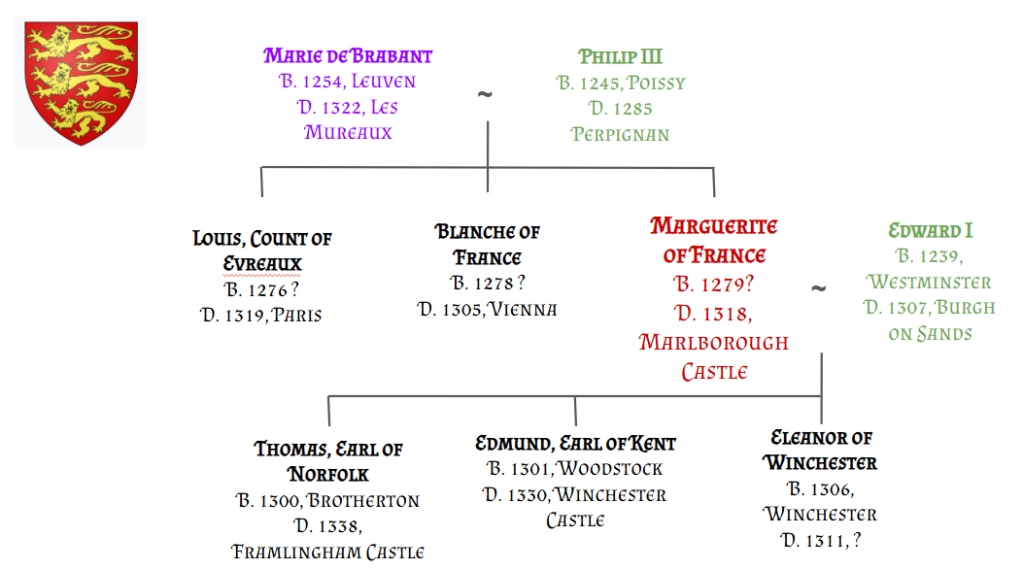
The Life of Marguerite of France (or what we know of it)
Once again we’re battling with regnal years and French vs English calendars so there is some slippage. During the period immediately preceding Edward I’s death, different authors have claimed that she was either at nearby Lanercost, or having travelled as far as Canterbury. As there are accounts, if only for her household stores, that indicate the latter, I feel that is more likely.
1279-1282
- Marguerite is born in Paris to Marie of Brabant, daughter of Henri III of Brabant, and Philip III of France. [13, 16]
1285
- October 5: Marguerite’s father Philip III of France dies at Perpignon of dyssentry. He is succeeded by Marguerite’s half-brother Philip IV, under whose guardianship she is raised [13, 18]
1299
- May: Marguerite is assessed by Edward I’s representatives Henry de Lacey Earl of Lincoln, Amadeus, Count of Savoy and Guy de Beauchamp, Earl of Warwick. The Count reports her as being a ‘fair and marvellously virtuous lady’ [17]
- August 3: Marguerite, in her marriage contract, would receive a £15,000 dowry left by her father Philip III, and any sons she had with Edward I would receive 10,000 marks each, under the Treaty of Chartres. Unlike her predecessors, Marguerite would come into her dower lands immediately on her marriage, and her lands would pass to Isabella of France when she became queen. Her lands included the castles of Cambridge, Marlborough, Porchester, Devizes, Southampton, Guildford,Gloucester and Hertford, and Edward would augment her dower by a further 3,000 livres ‘abundantly regarding the honour and estate of Margaret’ [11, 18]
- September: Marguerite sails from France to England, accompanied by the Robert II, Duke of Burgundy and John II, Earl of Brittany. She spends the night at Dover Castle before traveling to Canterbury. She brings two French ladies, Agnes de la Croise and Mathilde de Val. On arriving in England, her apartments are not yet ready, so she is forced to lodge at the Archbishop of York’s palace on the River Thames [11, 13, 17, 18]
- September 8: Marguerite marries Edward I at Canterbury Cathedral. The ceremony is officiated by Archbishop Winchelsey, and was followed by days of feasting and sporting. Edward had taken out a loan from Florentine bankers to pay for the extravagance. The couple spend two weeks at Leeds Castle, after which Edward travelled north to Scotland and Marguerite retires to Langley near St. Albans with her step-children. As she is a second wife, and not expected to produce an heir to the throne, Marguerite is never crowned queen, despite Edward commissioning two crowns, a plain gold circlet and a state crown valued at £400, to be made for her. [2, 10, 13, 15, 18]
- November 3: Marguerite remains in the household of her step-son Edward of Caernarfon while Edward travels north to York. She remains there until at least November 18, by which time she had already conceived her first child. [2]
- December : Marguerite and Edward of Caernarfon stay at St Albans Abbey where she is praised for her piety, but she and her extensive train rather outstay their welcome [18]
- December 25: Marguerite celebrates the Christmas holidays at Windsor Castle with her step-son Edward of Caernarvon [18]
1300
- May 5: Marguerite, Edward I and Edward of Caernarfon make a pilgrimage to the shrine of Our Lady at Walsingham in Norfolk, where Marguerite offered a gold clasp. The shrine is popular with ladies either praying to conceive, or for a safe delivery [18]
- May 13: Marguerite is granted the wardship of Edward I’s grandson Gilbert de Clare, heir to the earldom of Gloucester and son of Joan of Acre [18]
- May 31: Marguerite begins her lying in at Brotherton in Yorkshire, and would remain there until September 9 [2]
- June 1: Marguerite gives birth to her first child, a son named Thomas at Brotherton in Yorkshire. She is hunting when she begins her labour and has to be helped to a nearby house. The child is named for St. Thomas Beckett, to whom she cried out during her labour. The child is slightly premature, and as soon as she has recovered from the labour, Marguerite is transported to Cawood House where she had intended to have her lying in. Thomas is given two cradles, each furnished with 13 ells [approximately 50 feet] of cloth in scarlet and blue, as well as having his chamber adorned with striped hangings and decorated with heraldic arms. [2, 12, 13, 15, 16, 18]
- August 14: Marguerite is granted Leeds Castle for her and her son Thomas’ upkeep [18]
- September 18: Marguerite is with Edward I, their son Thomas, and her step-daughter Elizabeth of Rhudlan at Holmcultram Abbey in the Scottish borders, and remain with him until November 20 [2, 18]
- September 27: Marguerite’s step-daughter Joan of Acre is ordered to hand over her son Gilbert to Marguerite’s household by Edward I, suggesting a less than cordial relationship between the two women. [18]
- November: Marguerite and her step-son Edward of Caernarfon jointly request and are granted 20 oaks from Inglewood forest for the prior and convent of Carlisle [2]
- November 8: Marguerite’s step-daughter Margaret of Windsor gives birth to her first child, a son named Jan for his father. Marguerite gives the messenger who brings the news 50 marks [15]
1301-1302
- Marguerite begins to acquire land in London, specifically in the parish of St. Nicholas Shambles, with the intent of enlarging the Greyfriars Franciscan church [14]
1301
- January: Marguerite’s son Thomas’s household servants are to be dressed in the same livery as his mother, indicating some standardisation across their households despite living dseparately [2]
- May 13: Marguerite is given the marriage rights of her step-daughter Joan of Acre’s son Gilbert de Clare. Despite being ordered to hand over the child, by September she still had not done so. [15]
- August 5: Marguerite gives birth to her second child, a son named Edmund, at Woodstock Palace, Oxfordshire. Edmund would eventually be sent to be part of his brother Thomas’s household, and between 1303 and 1305 they would be joined by Marguerite’s step-granddaughter Margaret de Bohun, daughter of Elizabeth of Rhuddlan [2, 12, 13, 15, 16]
- September: Marguerite, attended by her step-daughters Joan of Acre, Mary the nun, and Joan’s son Gilbert de Clare, goes on pilgrimage to Hereford, making offerings at shrines along the way in thanks for a safe delivery. [18]
- September 20: Marguerite is at Woodstock when she writes to Edward I requesting Ralph de Sodbury be presented to a vacant church [8]
- November: Marguerite accompanies Edward I on his march through the Tweed Valley [18]
- December 25: Marguerite and Edward I celebrate the Christmas holidays at Linlithgow Castle. While there, Edward asks Marguerite to read through the documents compiled to mark the peace between England and Scotland in case she can see something he had missed. [18]
1302
- January: Marguerite’s oldest son Thomas is given his own household, or hospicium, and he would be joined by his brother Edmund by then end of the year. The princes’ household was managed for 11 years by Master John de Claxton. Lady Edeline de Venuse was mistress of their household, who would have arranged for the paying of alms in their name, ordering clothing and purchasing for their kitchens, as well as managing all female servants. [12]
- February 19: Marguerite and Edward I depart from Linlithgow Castle for England [18]
- March 18: Marguerite is at Butterwick in Lincolnshire when she writes to John de Langton, chancellor, on behalf of the prior of Prittlewell [8]
- April: Marguerite and Edward I are together at Winchester Castle when their chimney catches fire and they are forced to escape through a previously unknown door. They remove to Wolvesey Palace near the cathedral [18]
- April 30: Marguerite is at Devizes when she writes to John de Langton requesting Ralph de Manton be presented to Brendon Church [8]
- May 24: Marguerite is at Westminster where she intercedes for the pardon of one William le Frend of Burnton for the death of William de Chatowe. The petition is jointly asked for by Marguerite and her step-daughter Elizabeth of Rhuddlan [5]
- July: Marguerite and Edward I are together at Windsor, where they are joined by their sons [18]
- July: Marguerite’s mother Marie of Brabant and brother Louis visit Westminster [18]
- July 28: Marguerite is at Westminster with Edward I when she requests certain houses in the King’s hands be given to her minstrel Guiliotus le Sautriour [5]
- August: Marguerite is granted wardships to the value of £5k to help pay down her debt [18]
- August 15: Marguerite is at Kempton when she intercedes on behalf of one Agnes de Chaumpvent in the matter of the death of Nicholas de Colevill, along with 9 other men involved in the death [5]
- August 23: Marguerite is with Edward I at Kempton when she asks for a portion of the wardship lands of Matthew de Lovaigne to be granted to Matthew de Monte Martini [5]
- August 23: Marguerite is at Kempton when she is granted 4,000l out of custodies and marriages to cover her debts to merchants and others [5]
- October: Marguerite and her step-daughter Mary the Nun make a joint request that Roger de Troye, one of Mary’s servants, be given the custody of Restormel and Peulyn parks in Cornwall [5, 15]
- November 14: Marguerite attends the marriage of her step-daughter Elizabeth of Rhuddlan to Humphrey de Bohun at Westminster Abbey [18]
- November 22: Marguerite is at Windsor with Edward I when she makes a joint request with her step-son Edward of Caernarfon that Robert Benedicite be allowed to enforce debts within the city of Norwich [5]
- November 25: Marguerite is at Caversham with Edward I when she grants the wardship and marriage of John Trenchard to the king’s clerk, John of Drokensford [5]
- December 25: Marguerite and Edward I celebrate the Christmas holidays at Langley, hosted by her step-son Edward of Caernarfon [18]
1303
- January 1: Marguerite receives a gold ring set with a large ruby from her step-son Edward of Caernarfon [18]
- January 10: Marguerite is at Odiham with Edward I when she requests that the custody of the hospital of St. Nicholas at York be given to John de Godele [5]
- February: Marguerite receives a new crown from Edward I to wear for the feast of St John the Baptist at a cost of £440, though he was very late in paying for it. At the same time her dower is increased to the value of £5,000 annually to help pay down her debts [18]
- February: Marguerite is mentioned in pleas made by Thomas de Frowyk and Robert le Convers for non-payment against a golden crown for the feast of John the Baptist and a set of 16 silver cups respectively made or bought for her use. Both men would be named in the inquisitiones into a theft from the king’s exchequer at Westminster as having purchased the stolen jewels. [11]
- February 20: Marguerite’s dower is adjusted in light of many of the properties allotted to her having been granted to other people. She now owns the honor of Berkhamsted, the manor of Ryseberge in Buckinghamshire, the manors of Dalham and Bradeeld in Suffolk, the castle and manor of Mere in Wiltshire, the hundreds of Redelane, Whyteweye and Broneshull in Dorset, an annual payment from Nicholas de Segrave aid to the king for the manor of Kynton, and the toll, pleas and perquisites due to the king from the town of Shafton. In each of these places she shall receive not only rents but all fines, ransoms, ammercements as well as the fees and goods of all felons. The grant is signed at Hertford, but it is not known if Marguerite is present for its signing. [5]
- March 7: Marguerite is granted 128l 6s and 10d dur to the exchequer from the prior of Prittewell for the manors of Estwode, Stokneyland and Raleye [5]
- March 6: Marguerite is at Westminster when she requests that Thomas Cockerel, the king’s yeoman, be given the right of marrige of Margery, daughter and heir of Salmon des Chaunz, currently in the king’s custody [5]
- March 6: Marguerite sells the rights of marriage of the heir of John de Coggeshale to Henry de Bluntesdon, the king’s almoner [5]
- April 16: Marguerite is at Laneham with Edward I when she requests that Matilda, widow of Matthew de Lovayn be permitted to marry Isenbert de Sancto Blymundo ‘if she will’ [5]
- April 23: Marguerite is with the court at Thixendale when she makes a joint plea along with the good men of Yarmouth, for the pardon of four men implicated in the death of William Gerberge, as it is found they acted in self-defense [5]
- April 29: Marguerite is granted any fines paid at the exchequer or treasury for trespasses against the king at his park of Cammel [Queen Camel] in Somerset [7]
- June 3: Marguerite is at Tynemouth when she writes to the men of Northumberland requesting assistance for her purveyors [8]
- June 4: Marguerite is permitted to send her men to hunt and take venison form the royal park at Skypton-in-Craven [7]
- June 4: Marguerite is staying at Tynemouth while Edward I is in Scotland, when a writ of aid is granted to Ralph de Dalton to purchase victuals for the queen’s household [5]
- June 6: Marguerite, attended by her sons and her step-daughters Joan of Acre and Elizabeth of Rhuddlan, breaks her journey at Tynemouth Priory. While there, Elizabeth would give birth to a daughter, named Margaret after her step-grandmother. They would remain at the abbey until August. [18]
- July 11: Marguerite is at Tynemouth, when Edward I commands 30 harts and 30 does to be killed in the park at Tyndale and carried to her for her receiver of stores. [7]
- August 1: Marguerite is staying at Newcastle when Edward I orders an investigation into vagabonds who have been running amok in the city at nights, and whom the authorities have not bothered to apprehend. ‘Lest terror or danger arise to Margaret, queen of England’, [5]
- September: Marguerite is at Tynemouth, when Edward I commands 60 pike, 60 bream and as many eels as possible be taken from the king’s stew of Fosse in York and delivered to her for the expenses of her household [7]
- September 4: Marguerite intercedes on behalf of Alexander de Cheveral and Robert le Parker, who were found guilty of poaching in her lands at Cammel, but whose sentence is commuted as they had shown good service to the king in Scotland [7]
- October 17: Marguerite receives 546l from the sale of lands of Robert de Tateshale, during his heir’s minority [5]
- October 20: Marguerite’s parks at Havering, Ralegh and Stok Neyland are entered unlawfuly and deer carried away, leading to Henry Spygurnel and Walter de Goucestre being commissioned to investigate [5]
- October 20: Marguerite is granted the wardship of the heir and lands of Alfred de Northgrave for her use [5]
- November 1: Marguerite requests that Idonia de Rocton be allowed to grant a part of her father’s lands in the Honour of Boulogne [5]
- November 28: Marguerite sells the custody during the minority of the heir of the manor of Hunmanby to raise part of the money owed to her for her dower. The sale raises 246l 13s 4d [5]
- December 25: Marguerite and Edward I celebrate the Christmas holidays at Dunfermline, having sent their children south for their safety as William Wallace is sending out regular raiding parties in the area [18]
1304
- March 16: Marguerite is at St. Andrews when she writes to William de Greenfield requesting a respite for Alexander de Cheverel [8]
- April: Marguerite is present with Edward I at the siege of Stirling [1, 18]
- June 28: Marguerite sells off six separate custodies to raise money towards her dower [5]
- July 3: Marguerite is granted 60 oaks from the forest of Savernake for the repair of Marlborough Castle and the manor of Sevenhampton [7]
- July 6: Marguerite is granted custodies to the sum of 200 marks, after pardoning the same amount due to her from John Lovel of Tychemarsh after he trespassed on her parks [5]
- July 7: Marguerite requests that the custody of the heir of John de Lyngayn be granted to Walter de Wodeham, the king’s yeoman [5]
- August 23: Marguerite’s man John, prior of Pritelwell is granted a protection with clause volumus (halting any legal preoceedings against him while he is away) while he travels beyond the seas on the affairs of the queen [5]
- September 4: Marguerite intercedes on behalf of one Mary Heyron, who had married without licence and was fined 100 marks. Having already paid 60 marks, Marguerite’s influence caused Edward to cancel a further 20 marks, and to allow her to pay the remainder in small installments [7]
- September 8: Marguerite and Edward I are again at Tynemouth on their triumphant journey south after the capture of William Wallace [18]
- September 16: Marguerite is at Tynemouth when she writes to William de Greenfield, chancellor, requesting the respite of an exigent against men accused of damaging Queen Camel Park, Somerset [8]
- October 5: Marguerite is granted the marriage rights of Thomas, son and hair of Hugh Bardolk [5]
- October 6: Marguerite is granted 80 oaks from the forest of Savarnak for the repair of Marlborough Castle and Manor of Sevenhampton [7]
- October 10: Marguerite is at Tynemouth when she writes to William de Greenfield, chancellor, requesting the acquittance of a ‘man who has made fine with her’ [8]
- October 15: Marguerite sells the custody of the younger daughter of Hugh de Mortuo Mari to Walter, bishop of Coventry and Lichfield [5]
- November 1: Marguerite is granted permission to levy tallage on her properties [5]
- December 6: Marguerite and Edward I are at Burstwick, Yorkshire [18]
- December 25: Marguerite and Edward I celebrate the Christmas holidays at Lincoln [18]
1305
- Marguerite commissions a St. Louis chapel for her church at Greyfriars, in honour of her grandfather, and the church was styled, on a slightly smaller scale, on Les Cordeliers in Paris, both of which suggest her desire to underline her Capetian heritage. The work would be carried out by carried out by master mason Walter of Hereford. In 1306 she would be listed as one of its founders, having given more than 2,000 marks for its contruction, and further bequest of 100 marks after her death. She wouldn’t see it completed, but her neice Isabella of France would finish the job [2, 9], 14
- January 15: Marguerite is granted the custody of the heirs of Hugh de Sancto Phileberto in exchange for the custody of the heir of Hugh de Mortuo Mari, which the king took from her [5]
- February 21: Marguerite is at Windsor when she writes to William de Hamelton requesting letters of presentation for her physician [8]
- February 24: Marguerite receives plate and jewels worth £134 as a victory gift [18]
- March: Marguerite’s sister Blanche dies aged 27, possibly from complications arising from a miscarriage. Edward I requests her confessor break the news to the queen, reassuring her that since Blanche had married into the Austrian royal family, she had essentially been dead to Marguerite since then [18]
- March 9: Marguerite’s weirs have deteriorated due to weirs being constructed elsewhere along the River Severn, leading to Walter de Gloucestre and John Abel being commissioned to investigate, and also to Edward I ordering the steward of the Forest of Deane to make the necessary repairs [5, 7]
- March 19: Marguerite sells the custody of the heirs of John of Daubeny to John de Monte Acuto for 250 marks towards her dower [5]
- March 29: Marguerite is granted 500 marks in fines due from the men and tenants of the city of Winchester [7]
- April 13: Marguerite is granted the marriage of Matilda de Mortuo Mari, or the fine if she marries without licence [5]
- April 16: Marguerite’s deerparks in seven different counties are found to have been raided, and Hugh Despenser, Henry Spigurnel and John Abel are commissioned to investigate [5]
- April 21: Marguerite is assigned the forest of Savernak [Sevenoak] as part of her dower, and as the forest is needed for repairs to her various properties, it should have been included from her marriage [5]
- April 26: Marguerite intercedes on behalf of one Thomas Yate of Radeclyve for the death of John Hanne, and any subsequent outlawry [5]
- April 28: Marguerite makes a joint request with her son Thomas of Brotherton for Richard de Harwedon to have the custody of the park of Northampton [5]
- May 12: Marguerite is granted a set of silver vessels and other jewels up to the value of 1,044l, and for embroideries to be made for her to a value of 194l, paid for from a loan from the Bellardi of Lucca company [7]
- May 27: Marguerite is granted 2,000l extension to her dower out of fines and rents from properties in Northampton [7]
- May 28: Marguerite has her dower lands confirmed and ‘in case of the king’s death before her she is not to be removed therefrom’ [5]
- June 19: Marguerite is due 20l from the prior and convent of Bath, and as a royal madate has to be issued for its payment, it would appear the prior has been behind in payment [5]
- June 29: Marguerite is at Corneslee when she writes to William de Hamelton asking him to consider urgently an inquest as quod damnum [request to see harm a royal grant would cause] into fairs and markets at Tynemouth, Northumberland [8]
- July 6: Marguerite is ordered to allow the abbot of Nottele, parson of the church in her manor of Ryseburgh, to take a tithe of colts born in her park, as her bailiffs have apparently been ‘hindering’ this [7]
- July 16: Marguerite’s debtor, John Abel, who paid 120l to the Spini merchants of Florance to clear her debts is reinbursed from the treasury. This money was originally given to Marguerite on top of the 4,000l of her dower [5]
- July 22: Marguerite intercedes on behalf of her step-son Edward of Caernarfon that the ban on the mayor and citizens of London from making any gift or loan to the prince be lifted, and they may aid him on the understanding he repay them fairly [7]
- August 4: Marguerite is strongly encourage by her step-son Edward of Caernarfon, through his sister Elizabeth of Rhuddlan, to intercede with the king to restore Piers Gaveston to the prince’s household, after he had been banished. It would take until October but she is eventually successful in bringing them together [15, 17, 18]
- September 16: Marguerite intercedes for the pardon of Matilda de Mortuo Mari for the murder of her husband [5]
- October: Marguerite gives gifts of £10 to Lady Edeline de Venuse, her sons’ household mistress, £4 to Mabille de Raundes, Thomas’s wet-nurse, and 11s to Perrette de Porssy, Edmund’s rocker [12]
- October 26: Marguerite is named in a complaint to the treasury that Richard le Convers has not yet been paid 54l for the 16 silver gilt cups provided for her use. Edward I orders that he be satisfied after Christmas [7]
- November 7: Marguerite’s man John, prior of Pritelwell, is again given a Protection with clause volumus for going beyond the seas on her affairs [5]
- December 25: Marguerite and Edward I celebrate the Christmas holidays together at Kingston Lacey in Dorset [18]
1306
- January 1: Marguerite is granted the lands held by Juliana de Teny during the minority of her heir. Five months later she would sell this wardship to John de Uvedale for 120 marks [5]
- January 20: Marguerite’s bill of 20l 10s for jewels bought from Thomas de Frowyk is finally paid from the treasury [7]
- January 20: Marguerite is due 40s yearly rent from the abbot and convent of Reading, and a royal madate is issued to see it paid [5]
- February: Marguerite is granted papal licence to choose her own confessor, to have mass said to her in places under an interdict, to have divine service celebrated according to the Paris use and to have a portable altar [3]
- February 7: Marguerite grants the wardship of the heir of Ralph de Bluho to Hugh Beaurepeir, her yeoman [5]
- March 7: Marguerite is at Winchester when she writes to William de Hamelton on behalf of the proctor, archbishop and dean and chapter of Rouen [8]
- March 9: Marguerite’s bill for the upkeep of her horses is settled at the treasury for the sum of 16l [7]
- March 11: Marguerite is at Hyde when she writes to William de Hamelton requesting the presentation of John de Langton to Heyford Warren church, Oxford [8]
- April 7: Marguerite is at Wolvesy when she writes a letter to William de Hamelton regarding her debts [8]
- April 11: Marguerite is at Wolvesey when she writes to Adam de Osgodby, king’s clerk, on behalf of the abbot of Woburn [8]
- April 14: Marguerite is granted the wardship of the heir of Matilda de Lovayne. A year later this is expanded to include all knight’s fees, advowsons ‘and other things belonging to that custody’ [5]
- April 17: Marguerite is at Wolvesey when she writes to William de Hamelton on behalf of Ogbourn Priory and the cardinal deacon of St. Maria Nova, who is promoting the priory’s affairs [8]
- April 22: Marguerite is granted the manor of Lesnes in Kent, previously held by John earl of Atheles but forfeit due to his rebellion against the crown. In July this is expanded to include all knight’s fees, advowsons, wards, marriages and escheats [5]
- May 4: Marguerite gives birth to her third child, a daughter named Eleanor, at Winchester. The child is likely named after her Marguerite’s predecesor Eleanor of Castile. [2, 13, 15, 16, 18]
- May 8: Marguerite’s daughter Eleanor is the subject of marriage negotiations between Edward I and Robert of Burgundy, heir to the county palatinate of Burgundy. [15]
- June 17: Marguerite intercedes for the pardon of one John de Haukeserde, currently in Newgate gaol, for counterfeiting the privy seal of the Bishop of Coventry and Lichfield [5]
- June 18: Marguerite is present for Edward I’s 67th birthday celebration at Westminster [18]
- June: Marguerite and her sons are lodging at Northampton Castle, possibly joined by her step-daughter Mary the Nun [18]
- July 11: Marguerite’s parks and manors of Eston, Kyngesclyve and Briggestok in Northampton have not yet been surrendered to her, and Edward I issues a mandate for them to be handed over [7]
- August: Marguerite’s daughter Eleanor is named in a bond requiring her father Edward I and her step-brother Edward of Caerarfon to provide 10,000 marks for her marriage and 5,000 marks for her trousseau [15]
- August 29: Marguerite is at Newbrough when she writes to William de Hamelton requesting credence for Richard de Hatherlee [8]
- August 31: Marguerite’s son Thomas of Brotherton has settled on him land to the value of 10,000 marks a year form that held by Roger Bygod, earl of Norfolk, should he die without an heir, and to Marguerite’s son Edmund of Woodstock a further 7,000 marks in land. [5]
- August 31: Marguerite’s daughter Eleanor has assigned to her a further 1,000 marks towards her wedding [15]
- October 1: Marguerite is with Edward I at Lannercost Priory where he suffers an attack of dyssentry. Edward tries to leave but is forced to return and the couple remain there while he convalesces until the following March. Their winter spent at the Priory is at the expense of the canons, and while there, Edward orders for Marguerite’s windows to be glazed for her comfort [1, 18]
- December 25: Marguerite and Edward I celebrate the Christmas holidays at Lanercost Priory [1, 18]
1307
- January: Marguerite intercedes with Edward I for the pardon of 16 out of a party of 22 knights who had deserted during the Scottish campaign [18]
- January 10: Marguerite intercedes for the pardon of one William Charles for taking a horse before paying for it, so long as he satisfy the vendor for the price [5]
- January 23: Marguerite intercedes on behalf of one Roger de Mortuo Mari, who had all his goods and chattels seized after he deserted the king’s service in Scotland [7]
- February 22: Marguerite receives post facto permission for taking timber from the forests near her various properties for their repair and upkeep. Two days later she is issued a grant for life to take whatever wood she needs from any forest, and also that she may grant oaks to whoever she will [5]
- March 1: Marguerite and Edward I depart from Lanercost Prioery and travel to Carlisle [1, 18]
- March 3: Marguerite is granted a renewal of her papal licence permitting her to have non-English clerks in her household [3]
- March 20: Marguerite intercedes for the pardon of one Geoffrey de Coigners, who hid the coronet with which Robert the Bruce had been crowned [5]
- March 20: Marguerite requests that William Bevercote, the king’s clerk and chancellor of Scotland, be granted his choice of churches or prebends in the king’s presentation to the amount of 100l per year [5]
- May 29: Marguerite leaves Edward I’s company in Carlisle and makes her way south to Canterbury, where she remains until after his death. According to her household accounts, Marguerite left on her trip with only four days of bread and other stock items, having to buy the remainder on the road. It is possible she left the king after his winter illness to go directly to Canterbury to pray or make offerings for his health [1]
- June 4: Marguerite’s household is gifted four whole pigs for her kitchen [1]
- June 5: Marguerite’s household is gifted 8 whole sheep for her kitchen [1]
- June 15: Marguerite and her household, according to her accounts, consume more than 3 tuns of wine while on the road to Canterbury. [1]
- June 20: Marguerite receives 37 tuns of wine for her households at Northampton, Stoni Stratford, Leighton Busard, Berkhamsted, St. Albans, La Bernete and Benstede [7]
- June 27: Marguerite’s household accounts list 1s 1d in alms ‘of lords T and E’, suggesting that her young sons Thomas and Edmund were with her for the last leg of her journey, and would remain with her until 6th July. They appear to have rejoined her by the 7th, so they may have followed a different route to Canterbury [1]
- June 28: Marguerite is named in an order by Edward I to the mayor and sheriffs of London: prohibiting the burning of kilns in the city and other places adjoining the Tower or the plying in any way of this craft for so long as the Queen Margaret, the king’s consort, shall stay at the Tower, whereby the air may be in any way infected or corrupted, as the queen is going to the Tower shortly to stay there for some time, and the king wishes to avoid the dangers that may arise to her and other magnates who are coming to her there from the infection and corruption of the air by such burning of kilns. A further edict reads ‘that ‘our most beloved consort will in a short time come to the Tower of London and will there remain for a certain time: we, fearing the dangers which our consort and her attendant nobles may incur from the infection and corruption of the air by access of petitioners from the city, and from other places near the Tower, we command you to proclaim publicly in the city, that no petitioner should presume to come thither, or others belonging to them, in any way whereby the air may be infected or corrupted, on pain of heavy forfeiture’. The order was sent before she reached London on her way to Canterbury. On the same day she is granted all profits of wastes, assarts [clearing and uprooting] and purprestures [unlawful enclosure or appropriation] from the forests of New Forest, Severnak, Gillingham and others. [1, 11, 7]
- June 30: Marguerite’s household is gifted a whole tun of wine, which they consume the same day [1]
- June 30: Marguerite intercedes for the pardon of one Eleanor de Stutevill for 40l of the 120l debt she is repaying for her late husband [5]
- July 2: Marguerite’s household burns 100lb of wax, suggesting she was hosting visitors while she was progressing south. Marguerite’s accounts also show that she was paying the wages of the servants of her guests, suggesting it may have been family members travelling with her [1]
- July 7: Marguerite’s husband Edward I dies at Burgh-on-Sands, Northumberland. In his final moments he demands his son Edward of Caernarfon treat his mother with respect. He is succeeded by his son as Edward II [15, 16, 18]
- July 8: Marguerite is informed of Edward I’s death by letter. Some sources have her at Lanercost while others have her having already arrived at Canterbury. Shortly after his death Marguerite commissions John of London to write a panagyric. It is inscribed to her, and the final line reads ‘When Edward died, all men died to me’. [18]
- October: Marguerite receives £53 from Edward II to cover the expenses of her children [18]
- October 26: Possibly at Marguerite’s request, the final laying-in-state of Edward I’s body is at Greyfriars Church in London [11]
- October 27: Marguerite’s husband Edward I is buried at Westminster Abbey alongside his first wife Eleanor of Castile [10, 15]
- November 1: Marguerite’s castle at Berkhamsted is used for the wedding of Piers Gaveston and Margaret de Clare. It is not known if Marguerite attends in person [18]
- December 5: Marguerite is at Canterbury when she writes to John de Langton, Bishop of Chichester requesting letters of safe-conduct for her bachelor going abroad for her [8]
1308
- January 22: Marguerite and Edward II sail from England to Boulogne for the marriage of Edward to Isabella of France, Marguerite’s neice. [13, 15, 18]
- January 24: Marguerite and the royal entourage arrive at Boulogne and are greeted by her half-brother King Philip IV of France [18]
- January 25: Marguerite attends the wedding of her 12-year old neice Isabella of France to her step-son Edward II. The ceremony is held at Our Lady of Boulogne, and her mother the Dowager Queen of France, Marie of Brabant is also in attendance. Marguerite would remain with her family in Paris until Easter. She may have given a silver casket to Isabella, bearing both their arms [10, 17, 18]
- April 14: Marguerite departs Paris and returns to England. She takes up residence at Marlborough Castle with her daughter Eleanor. [18]
- May: Marguerite is named in a French report as having sent £40,000 to the earls of Lincoln and Pembroke to finance their quest against Piers Gaveston. Marguerite’s half-brother Philip IV is said to have sent a huge gift of wine to the same men, also being an enemy of Gaveston for Edward’s treatment of Isabella [18]
- September 17: Marguerite receives papal licence to have her body divided in death and placed in various churches according to her last will. Ultimately this would not be carried out [3, 9]
1309
- Spring: Marguerite loses custody of Berkhamsted Castle and two others, instead given to Piers Gaveston by Edward II [18]
- December 25: Marguerite celebrates the Christmas holidays at Langley with Edward II and Isabella of France [18]
1310
- March 17: Marguerite’s castles are returned to her [18]
1311
- August: Marguerite’s daughter Eleanor dies aged 5. Edward II pays £113 for her funeral at Beaulieu Abbey in Hampshire [15, 16, 18]
- September 4: Marguerite is at Devizes [17]
- December 25: Marguerite celebrates the Christmas holidays at Berkhamsted Castle which has been newly restored to her [10, 17, 18]
1312
- March: Marguerite is styaing at Berkhamsted when she is alerted by letter that her niece Isabella of France is pregnant [18]
- September: Marguerite is at Windsor Castle with her neice Isabella of France for her lying in [10, 17]
- November 13: Marguerite is in attendance on Isabella of France at Windsor Castle as she gives birth to her first child, a son named Edward [15, 18]
- November 17: Marguerite is present for the baptism of Isabella of France’s first child, Edward, at Henry III’s chapel Windsor [10, 17, 18]
- December 16: Marguerite’s oldest son Thomas is created Earl of Norfolk by his half-brother Edward II [12, 16]
1313
- November 14: Marguerite is granted the custody of the heirs of Barholomew de Badelsmere and his wife Margaret of Lesnes in Kent, should they die before the heir reaches their majority [6]
1314
- January 26: Marguerite complains that at properties in 12 different counties someone has ‘broke her houses and walls, felled her trees growing in her woods and gardens there, hunted in her parks, free chaces and free warrens, fished her stews and carried away the trees etc’. A month later a further complain is made by the queen for the same properties, the issue clearly not having been resolved, despite oyer and terminers being commissioned. On May 13 of the same year, she is still trying to get some resolution [6]
- March 28: Marguerite is granted the right to repair the roofs of her various propertes where the shingles have rotted, to re-tile them with stone or earthen tiles, and to fell and sell as many trees in nearby parks as necessary to cover the work [6]
- April 14: Marguerite is granted the right to reclaim the manor of Sham in Suffolk, should the current holder Hugh le Despenser the elder predecease her [6]
- April 24: Marguerite’s castle at Leeds is removed from her and granted to her neice Isabella of France [6]
- April 28: Marguerite is due 50l from the abbot of Hayles, and a royal mandate is issued for it to be paid [6]
- April 29: Marguerite is at Princes Risborough when she writes to Walter Reynolds, archbishop of Canterbury, requesting his help in recovering debts owed to her [8]
- May 10: Marguerite is named in royal mandates to 11 separate heads of holy orders and hospitals demanding they do their fealty and pay the assignments which are due to her as part of her dower. [6]
- May 26: Marguerite gives her assent that her castle at Leeds be put into the custody of Thomas de Cotingham [6]
- June 6: Marguerite’s complaint about her parks being forcibly entered in Sussex is upheld against John de Dalyngerugge, William de Dalyngerugge and others [6]
- June 7: Marguerite receives back payment of debts from the abbot of Hayles at 100l a year until the debt is paid [6]
- June: M visits her step-grandson Edward of Windsor at Bisham Priory in Berkshire [18]
- June 10: Marguerite gives her assent to three men to view the state of the houses, towers, bridges and the head of the pond at Ledes castle, which she holds for life [6]
- July 10: Marguerite nominates Nicholas de Eton and John de Vilers as her attorneys for one year [6]
- July 20: Marguerite is still pressing for the investigation into the persons who broke into her various properties in Essex, Suffolk, Kent, Hertford, Surrey and Cambridge [6]
- November 29: Marguerite’s half-brother Philip IV of France dies of a stroke while hunting. He is succeeded by his son and her nephew Louix X [18]
1315
- February 28: Marguerite is named as an instigator of the betrothal of her step-daughter Elizabeth of Rhuddlan’s daughter Margaret de Bohun, aged 4, to Hugh Courtenay. Young Margaret was probably Marguerite’s goddaughter. [15]
- March 10: Marguerite nominates Henry de Lutegershale and Adam de Eglesfeld as her attorneys for three years [6]
- June 3: Marguerite’s man Matthew de Medunta, dean of the free chapel of St. Berian in Cornwall is granted protection without clause until the following Christmas while he goes beyond the seas on her business. On the same day Marisco de Pissiaco, chaplain also goes beyond the seas on the queen’s business. [6]
1316
- February 10: Marguerite is granted to the right to tallage [arbitrarily tax] her dower lands whenever the king does the same, and to keep the money raised for herself. [6]
- May 18: Marguerite is still waiting for an investigation into the trespasses at her properties in Southampton, Somerset, Wiltshire, Worcester and Berkshire. [6]
- June 5: Marguerite’s nephew Louis X of France dies of pneumonia, and her other nephew Philip is appointed governor of France until Louis’s pregnant wife could give birth [8]
- June 26: Marguerite’s man Matthew de Medunta is again issued a protection with clause volumus for one year to go beyond the seas on the queen’s business [6]
- July 25: Marguerite is still waiting for resolution about her properties being broken into in Northampton and Lincoln [6]
- August 2: Marguerite makes a complaint that after she had seized and closed up some of her houses and stalls in Oxford to force payment from their tennants, the seals were broken by person or persons unknown. [6]
- August 26: Marguerite is still waiting for an investigation into the trespasses at her properties in Hertford [6]
- September 29: Marguerite is at her manor of Bansted when she grants to one Gilert de Wygeton, clerk, the wardenship of the hospital of St. Julian in Southampton. From the date of Marguerite’s death, de Wygeton would be granted custody of all her lands with powers to appoint and remove staff as he saw fit. [4]
- November 10: Marguerite is still waiting for an investigation into the trespasses at her properties in Oxford and Southampton [6]
- November 18: Marguerite has appointed William de Ottington to the custody of the hospital of St. John without the East Gate of Oxford [6]
1317
- Marguerite’s lands in England are sequestered as war with France increases in likelihood, suggesting that Edward II does not wholly trust her, or could not be seen to trust her publicly [18]
- January 17: Marguerite is still waiting for an investigation into trespasses at her properties in Sussex [6]
- January 24: Marguerite receives the outcome of the investigation into trespasses at her properties in Kent, with John de Frenungham and Thomas Reyner of Farlegh named as the guilty parties. [6]
- March 9: Marguerite confirms the appointment of the custody of her park of Devises to Henry Hert for life [6]
- June 11: Marguerite requests an investigation into a theft of corn from her properties in Farnbegh, Kent [6]
- June 15: Marguerite is at Christchurch when she writes to John de Sandal, bishop of Winchester requesting letters of protection for her chaplain going to France [8]
- June 24: Marguerite is at her manor of Twynham when she grants the custody of the hospital of St. Bartholomew by Oxford to one Robert de Sutton, chaplain [4]
- October 24: Marguerites surrenders Gloucester castle on the request of Edward II, which is handed to Roger Dammory, a favourite of the king [4]
- November 1: Marguerite surrenders Berkhamsted castle on the request of Edward II, which is handed to Aymer de Valencia [4]
- December 14: Marguerite requests of Edward II that the custody of the Hospital of St. Katherine by the Tower be handed to one Adam de Eglesfeld [4]
1318
- February 14: Marguerite dies at Marlborough Castle of an unspecified illness. Her body is wrapped in a Franciscan habit and conveyed to London by Sir John Haustede. [10, 13, 15, 16, 17, 18]
- March 13: Marguerite’s body arrives at St Mary Overie, also known as Southwark Cathedral, to lie in state. Two pieces of Lucca cloth had been placed on her coffin for transport, and a further three are placed on it by Edward II as it sits in the cathedral. Marguerite’s step-daughter Mary the Nun offers two further pieces and Sir Roger Dammory, possibly a superintendent of Marguerite’s household, a further two. [15, 18]
- March 15: Marguerite’s intact body is laid to rest in Greyfriar’s church, London despite her receiving papal dispensation for a multiple burial. She has a large tomb before the high altar which was broken up and scattered at the reformation. Her funeral is attended by her step-son Edward II and her step-daughter Mary the Nun. Her sons Thomas, Earl of Norfolk and Edmund, Earl of Kent act as her executors, though in 17 years time, pleas are still being made for payment of the late queen’s debts. [11, 15, 18]
References
- Armstrong, A. S. (2025) Case study: the household accounts of Margaret of France (29 May-7 July 1307) in ‘Approaching Records of the Household and Wardrobe’. UK, Routledge.
- Benz St. John, Lisa (2012) Three Medieval Queens. New York, Palgrave Macmillan
- Bliss, W. H. (1895) Calendar of Papal Registers Relating To Great Britain and Ireland: Volume 2, 1305-1342. London, HMSO. British History Online https://www.british-history.ac.uk/cal-papal-registers/brit-ie/vol2/i-ii [accessed 5 August 2026].
- Deputy Keeper of the Records (1898) Calendar of Patent rolls preserved in the Public Record Office Edward II V. 3 AD 1317-1321, London, HMSO
- Deputy Keeper of the Records (1898) Calendar of Patent Rolls preserved in the Public Record Office; Edward I AD 1301-1307, London, HMSO.
- Deputy Keeper of the Records (1898) Calendar of Patents Rolls preserved in the Public record Office; Edward II AD 1313-1317. London, HMSO
- Deputy Keeper of the Records (1908) Calendar of close rolls preserved in the Public Recrd Office Edward I V. 5 AD 1302-1307. London, HMSO
- Discovery: The National Archives Catalogue. www.discovery.nationalarchives.gov.uk Accessed 24.07.2026
- Gee, Loveday Lewes (2002) Women, art and patronage from Henry III to Edward III 1216-1377. Woodbridge, Boydell Press.
- Hilton, Lisa (2008) Queens Consort: England’s medieval queens. London, Weidenfeld & Nicholson
- Lawrance, Hannah (1840) Historical memoirs of the queens of England from the commencement of the twelfth century V. 2. London, Edward Moxon.
- Marshall, Alison (2006) The Childhood and household of Edward II’s half-brothers, Thomas of Brotherton and Edmund of Woodstock in ‘The Reign of Edward II: new perspectives’. Yorki, Boydell & Brewer
- Norton, Elizabeth (2011) England’s Queens: the biography. Stroud, Amberley Publishing
- Slater, Laura (2015) ‘Defining Queenship at Greyfriars London, c.1300-58’, in Gender & History, v. 27 No. 1, pp53-76
- Warner, Kathryn (2021) The Daughters of Edward I. Yorkshire, Pen & Sword
- Weir, Alison (2002) Britain’s Royal Families: the complete genealogy. London, Pimlico
- Weir, Alison (2012) Isabella: she-wolf of France, queen of England. London, Vintage
- Weir, Alison (2023) Queens of the Age of Chivalry: five consorts in turbulent times 1299-1409. Great Britain, Vintage
 Anglica Regina
Leave a comment