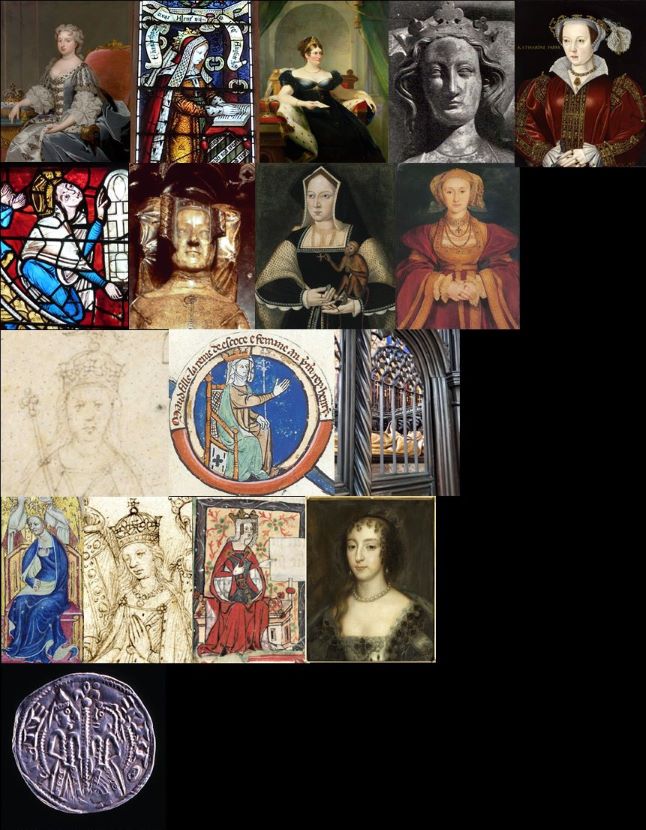
One of the outcomes I wanted from the start of this project was to be able to see English history (and sometimes French and German and Spanish and Dutch and Scottish history) through the eyes of our queens. In the timelines attached to each blog post, I’ve recorded what we know of their movements: where they were on exact or as near to it dates, what they were doing, who they were with. It means that a lot of ‘real’ English history is missed out (Katherine of Valois wasn’t at the Battle of Agincourt, so it doesn’t get included even though it changed her life) but that history is already recorded somewhere else. This is my opportunity to view the last 1,000 years through the eyes of 46 vastly different women who all had one thing in common. Sometimes they’re in the thick of it (Margaret of Anjou, Henriette Maria of France) and sometimes they’re just trying to get their dowry paid (Anne of Cleves). Sometimes they even had to deal with each other, and those crossovers tell us a lot about their characters and priorities.
This is a work in progress, like the rest of the project, and queens will be added to the overall timeline as they’re completed. We know more about some women than others, so there are likely to be some frustrating gaps (the entire Peasant’s Revolt happened between two queens, which means as far as we’re concerned, it never happened!) There are also occasional disparities between dates given by different sources: I’ve tried to make sure events follow logically, but sometimes that means fudging the dates a little. To avoid any confusion between queens, I’ve used the full names they would be known by in posterity, rather than their given names (Margaret of Scotland’s daughter was called Maud, but became known as Empress Matilda, and she crosses over A LOT with Matilda of Boulogne, so even though it’s a bit clunky, that’s what she’ll be called here)
1080
- Matilda of Scotland is born under the given name Edith, to Margaret of Wessex and Malcolm III of Scotland
1086
- Matilda of Scotland is sent with her sister Mary to Romsey Abbey, to be educated under the care of her aunt Christina, who has taken orders there. The relationship is not happy
1093
- Matilda of Scotland refuses a marriage with William of Warenne, 2nd Earl of Surrey on account of ‘having taken orders’. She actually has not.
- August: Matilda of Scotland is recognised in her habit at Wilton Abbey by King William Rufus
- Summer: Matilda of Scotland’s father King Malcolm, enraged at finding her in a nun’s habit, removes her and Mary to Scotland
- 13 November: Matilda of Scotland’s father King Malcolm of Scotland is killed with his oldest son and heir Edward at Alnwick while leading a raid in revenge for being snubbed by William Rufus
- 16 November: Matilda of Scotland’s mother Margaret of Wessex dies of grief, leaving her children in the care of Turgot, Prior of Durham
1094
- February: Anselm of Acosta writes to Osmund, Bishop of Salisbury to complain about Matilda of Scotland leaving the convent, and asking him to compel her to return. It is likely both Matilda and Mary returned to Wilton Abbey as lay boarders
1097
- Matilda of Scotland’s brother Edgar Atheling overthrows King Donald III and takes the crown of Scotland. Her position now as sister to a king makes Matilda’s situation more favourable.
1100
- 4 August: Henry I is crowned at Westminster Abbey. As a way of uniting the Normans and Saxons in England, he begins to consider a marriage with Matilda of Scotland, a Saxon princess who can trace her lineage directly to Edward the Confessor
- Autumn: Matilda of Scotland agrees to marry Henry I on condition he rule England according to the laws of Edward the Confessor, to which he agrees
- October: Anselm returns from banishment to advise Henry I against the marriage as Matilda of Scotland was believed to be a nun. Under questioning Matilda affirms she was forced to wear the habit by her aunt Christina but never took orders. She is confirmed in this by childhood witnesses and the sisters at Wilton Abbey. A panel of bishops agree with the custom of wearing the veil to avoid the unwanted attentions of Norman men, and proclaim her free to marry. Anselm agrees and Matilda is free to marry Henry I
- 11 November: Matilda of Scotland marries Henry I at Westminster Abbey and formerly changes her name from Edith to the Norman Matilda, in recognition of her Norman husband. Henry I settles on her most of the lands of Edith of Wessex, including property in London, dues and taxes from Exeter, Winchester, Rockingham and Rutland, and Malmsbury and Barking Abbeys. He also issues a charter to Abingdon Abbey, which would become Matilda’s favourite religious house.
- 14 November: Matilda of Scotland is consecrated queen and crowned by Archbishop Anselm
1100-1107
- Matilda of Scotland commissions Turgot, Prior of Durham, to write a life of her mother.
1101
- Matilda of Scotland, with Henry I and Archbishop Anselm, confirm Norwich church as a cathedral
- 31 July: Matilda of Scotland is reported to have given birth to her first child at Winchester, named Euphemia. It is more likely that she was in the early stages of pregnancy and the dates have been misunderstood.
- Summer: Robert Curthose, brother of Henry I, invades England to reclaim his lands from William de Warenne. Hearing Matilda of Scotland is in confinement at Winchester Castle, he leaves the castle in peace. Matilda later convinces him to pay her for the restitution of his lands.
1102
- Henry I arranges for Matilda of Scotland’s sister Mary to marry Eustace III, Count of Boulogne.
- Summer: Early in her pregnancy Matilda of Scotland removes to Abingdon Abbey so she could be cared for by the Abbot, Fabricius
- 7 February: Matilda of Scotland’s first child is born at Abingdon Abbey. She is named Aethelice by her mother, but known as Maud, and later as Empress Matilda
- 25 May: Matilda of Scotland presides over the Whitsun court at Westminster while Henry is away quelling a rebellion
1103
- Spring: Matilda of Scotland goes against Henry I by siding with Anselm in a dispute about who has the right to appoint bishops and abbots.
- October: Matilda of Scotland’s second child is born at Winchester. He is named William Aetheling, and is baptised by Gundulf, Bishop of Rochester
- Matilda of Scotland is instrumental in the repeal the unpopular curfew law, banning fires from burning or being lit after 8pm
1103-1105
- Matilda of Boulogne is born to Mary of Scotland, daughter of Malcolm III of Scotland, and Eustace III, Count of Boulogne. As her father is highly involved in Henry I’s political affairs, and signed or witnessed many charters with him, it is likely Matilda is raised at or near to the English court
1104
- Anselm convinces the Pope to excommunicate all the bishops invested by Henry I, who immediately forbids Anselm to return to England. Matilda of Scotland convinces Henry I to return the revenues of the See which he has seized.
- 4 August: Matilda of Scotland acts as regent when Henry I leaves for Normandy
- 15 August: Matilda of Scotland is present at Abingdon Abbey to celebrate the feast of the assumption with Abbot Faricius
- December: Matilda of Scotland spends the winter at Northampton, joined by Henry I after Christmas
1105
- Anselm writes to Matilda of Scotland criticizing her for exacting high rents from her churches. 200 priests walk barefoot to Matilda’s court to beg her to intercede against Henry I’s punitive tax on married clergy, though she does not attempt to assist. It is suggested she sensed her influence has waned after her support for Anselm.
1106
- Easter: Matilda of Scotland and Henry I send the holiday at Bath
- July: Matilda of Scotland acts as regent while Henry I is in Normandy
- 28 September: Henry I defeats Robert Curthose at the battle of Tinchebrai, imprisoning him in England and claiming Normandy for himself. Matilda of Scotland’s uncle, Edgar Aetheling is also captured, but at her intercession he is pardoned and pensioned
1107
- January: Matilda of Scotland’s brother Edgar, King of Scotland dies, succeeded by her other brother, Alexander the Fierce
- March: Matilda of Scotland and Henry I are together at Rouen
- Easter: Henry I returns to England, spending the holiday at Windsor while Matilda of Scotland remains at Lillebonne, follwing him home by Whitsun
- August: Matilda of Scotland and Henry I are at Canterbury to witness Anselm consecrate the bishops invested in his absence
1107-1108
- Matilda of Scotland is instrumental in founding the 2nd Augustinian Abbey in the country, part of general religious reform moving away from the Benedictine order which is seen as lax. The new foundation is built in London at Aldgate, dedicated to the Holy Trinity.
1108
- July: Anselm acts as regent when Henry I returns to Normandy but his ill health means that Matilda of Scotland takes over by 1109. Matilda is granted the ‘soke’ at Ethelred’s Hythe in London. By 1152 this is known officially as the Queenhithe after Matilda, and would be enjoyed by future queens
1108-1109
- Heinrich V, Holy Roman Emperor, asks for the hand of Matilda of Scotland’s daughter Maud in marriage
1109
- 24 May: Contracts are finalised for the marriage between Matilda of Scotland’s daughter Empress Matilda and Heinrich V , including a dowry of 10,000 marks to be raised through land tax
- 13 June: Matilda of Scotland is present at the Whitsun court held at Westminster. Also present is an embassy from Heinrich V, who stood proxy for him during the first formal betrothal ceremony
- 17 October: Empress Matilda attends her first royal court, in recognition of her elevated status as Heinrich V’s future wife, and witnesses her father’s charter creating the see of Ely
1110
- February: Matilda of Scotland bids farewell to 8 year old Empress Matilda as she sets sail for Germany. This is the last time they would meet. It would be the first time young Matilda would meet her future husband.
- 10 April: Empress Matilda and Heinrich V are formerly betrothed
- Whitsun: Matilda of Scotland and Henry I hold the holiday at the newly completed Windsor Castle
- 25 July: Empress Matilda is crowned Queen of Germany, and Queen of the Romans at Mainz
- Summer: Empress Matilda is established in her own household at Aula Palatina, in Trier, to be raised in good language and custom by the Archbishop Bruno
- Matilda of Scotland and Henry I personally assist in the exhumation of Edward the Confessor and Queen Ealswith at Newminster, to be reinterred at Hyde Abbey, which Matilda and Henry I had founded for this purpose
1111
- Summer: Henry returns to Normandy, leaving Matilda of Scotland as regent
1113
- Spring: Matilda of Scotland’s 9 year old son William Aetheling is betrothed to Mahaut, daughter of Fulk V, Count of Anjou
- July: Matilda of Scotland is suffering from an unknown illness, forcing William to return from Normandy
1114
- 7 January: Empress Matilda and Heinrich V are officially married at a ceremony in Worms, as Matilda comes of age
- September: Matilda of Scotland acts as regent while Henry returns to Normandy. While there, he has his barons swear fealty to William Aetheling as his heir
1115
- Easter: Matilda of Scotland spends the holiday at odiham Castle in Hampshire
- 31 May: Matilda of Scotland’s sister Mary dies of an unknown cause at Bermondsey Abbey. Mary’s only daughter, Matilda of Boulogne is immediately betrothed by Henry I to Stephen of Blois
- 25 December: Empress Matilda and Heinrich V hold court at Speyer
- 28 December: Matilda of Scotland, Henry I and William Aetheling attend the consecration of the new abbey church at St. Albans
1116
- Empress Matilda and Heinrich V travel towards Rome, staying at Canossa Castle for a year while Henry invades Italy and fights with the Pope
- April: Matilda of Scotland is left as co-regent with William Aetheling while Henry returns to Normandy
- Spring: Matilda of Scotland oversees the release and celebration of a man who claimed to have been released from his chains of incarceration by the spirit of St. Etheldreda. She has the London church bells rung and masses sung in honour of the miracle
- May 30: Matilda of Boulogne’s mother, Mary of Scotland, dies and is buried at the Cluniac abbey of Bermondsey
- August: Matilda of Scotland heads a council of Bishops deciding the terms on which papal legates might be allowed to visit England. They uphold the ancient liberties of England and ‘annihilate’ the Pope’s demand that they be permitted entry.
1117
- 13 April: Empress Matilda’s husband Heinrich V is crowned Holy Roman Emperor. There is some question as to whether Matilda was also crowned. She asserted she was, but there is no evidence
- Christmas: Matilda of Scotland is in ill-health and Henry I returns to spend the holidays with her. She would spend her final few months at Westminster.
1118
- Heinrich V departs for Germany, leaving Empress Matilda as his Imperial Regent in Italy
- Matilda of Scotland founds a leper hospital outside Chichester. Her final public act is to issue a writ protecting a chapter of eremetical monks living in the forest of Luffield in Northamptonshire. Matilda’s brother David visits her, and she witnesses two charters issued to Durham Cathedral.
- 1 May: Matilda of Scotland dies at Westminster. Henry I funds 47,000 masses to be sung for the salvation of her soul. He does not, however, return home. Matilda’s body is carried to Westminster Abbey, angering the monks of Aldgate Abbey who believed Matilda would have wanted to be laid to rest with them. Matilda is laid to rest in the sacristy of Westminster Abbey, later being moved to a new site south of Edward the Confessor’s shrine. No monument was raised but the inscription on her grave read ‘Here lies the renowned Queen Matilda, the second, excelling both young and old of her day, she was for everyone the benchmark of morals and the ornament of life’
1119
- Empress Matilda travels to Lotharingia to reunite with Heinrich V
1120
- 25 November: Empress Matilda’s brother William Adelin dies in the White Ship disaster. Matilda becomes her father’s only heir
1121
- 24 January: Empress Matilda’s father, Henry I marries his second wife, Adeliza of Louvain
1122
- Eleanor of Aquitaine is born at Poitiers or Bordeaux to Aenor, daughter of Aimery I de Rochefoucauld and William X Duke of Aquitaine
- Empress Matilda and Heinrich V are present at the Council of Worms
- Empress Matilda attempts to travel to England but her passage is blocked by Charles I of Flanders
- Spring: Empress Matilda and Heinrich V travel down the Rhine attempting to suppress unrest
- Christmas: Empress Matilda and Heinrich V hold court at Strasbourg
1125
- Matilda of Boulogne is married to Stephen of Blois, nephew of Henry I of England and cousin of Empress Matilda
- Spring: Matilda of Boulogne’s father Eustace of Boulogne retires to the Cluniac monastery at Romilly, devolving all his lands and responsibilities on his daughter and son-in-law. Matilda is present and affixes her personal seal to her father’s abdication charter. As countess of Boulogne, Matilda inherits not only the county of Boulogne in France, along with its important trading ports of Boulogne and Wissant, but the honour of Boulogne in England, encompassing vast land-holdings in London, Essex and Kent. Between them, Stephen and Matilda become the 7th richest family after the king. Matilda’s father dies at his monastery later that year
- 23 May: Empress Matilda’s husband Heinrich V dies of cancer in Utrecht. Matilda is left in charge of the Imperial insignia, but without an heir she can no longer rule as regent
- December: Empress Matilda’s father Henry I recalls her to Normandy: they travel to Windsor for Christmas
1126
- Matilda of Boulogne gives birth to her first child, a son named Baldwin
1127
- January 1: Henry I compels his great council at Westminster to accept Empress Matilda as his heir – the nobles agreed as long as Matilda was not married off to a foreign power without their consent
- 10 February: Eleanor of Aquitaine’s grandfather William IX dies
- December: The royal court swears an oath of allegiance at Northampton to Empress Matilda as her father’s heir to his crown and lands in England and France
- Marriage arrangements begin for Empress Matilda to wed Geoffrey V, Count of Anjou
1128
- 17 June: Empress Matilda is married to Geoffrey of Anjou at Le Mans Cathedral. Many nobles believe their oath to Matilda is broken because they had no say in her marriage.
1129
- 15 July: Geoffrey of Anjou repudiates Empress Matilda and sends her to Rouen with her household
1130
- Matilda of Boulogne gives birth to her second child, a son named Eustace
- March: Eleanor of Aquitaine’s mother Aenor and brother William Aigret die at their hunting lodge Talmont. Eleanor becomes heir-presumptive to her father’s land
1131
- May: Empress Matilda witnesses her father’s charter to the abbey of Cluny
- June: Empress Matilda returns to England with Henry I and Queen Adeliza
- June: Empress Matilda is recalled to her husband’s household
- 8 September: Barons and nobles agree for Empress Matilda to be returned to her husband, at Northampton Great Council. They also renew their oath to Matilda as heir to the throne
1133
- Matilda of Boulogne gives birth to her third child, a daughter named Matilda
- 25 March: Matilda gives birth to her first child, a son named Henry, at Le Mans
- Easter: Matilda’s first son Henry is baptised at Le Mans cathedral
1134
- Spring: Empress Matilda and her son Henry travel to Argentan
- 1 June: Empress Matilda gives birth to her second child, a son named Geoffrey. Matilda comes close to death and makes her will bequeathing a vast amount of her estate to the Abbey of Bec
1135
- Spring: Empress Matilda and Henry I quarrel about his not paying her dowry of Norman castles
- Autumn: Empress Matilda escapes from the continuing arguments by travelling to Angers
- 1 December: Empress Matilda’s father, Henry I dies in Normandy. On his deathbed he confirms Matilda as his heir.
- December: Stephen of Blois is informed by High Bidgod that on his deathbed Henry I disinherited Empress Matilda and adopted him as his heir. Bidgod was not present at Henry’s deathbed. Matilda of Boulogne is with Stephen in Boulogne where they hear news. Stephen immediately leaves France and sails for England
- December: Believing Bidgod’s account, William Corbeil, Archbishop of Canterbury declares all oaths sworn to Empress Matilda void
- December: Stephen of Blois arrives in England and declares himself King having secured the royal treasury
- 22 December: Matilda of Boulogne’s husband Stephen of Blois is crowned King Stephen of England by the Archbishop of Canterbury at Westminster
- December: Matilda of Boulogne gives birth to a her fourth child, a son who is given the Anglicised name of William. It is probably this pregnancy that nearly ended in catastrophe, and during which Matilda is reported to have run out of the city to find Bernard of Clairvaux. During her labour, having made preparations for death, she invokes his name and begged for his help, and is safely delivered.
1136
- Eleanor of Aquitaine’s father William X demands his nobles swear and oath of fealty to Eleanor as his heir
- January: Matilda of Boulogne arrives in England in advance of her coronation
- Spring: Empress Matilda learns what has happened and claims the crown for herself. She begins advancing into Normandy to forcibly take her dowry castles
- March: Earl Robert of Gloucester, previously Empress Matilda’s staunchest supporter, declares his support for Stephen
- March: Matilda of Boulogne is crowned queen of England at Westminster Abbey by William de Corbeil, who had also officiated St Stephen’s coronation. The service is better attended than his, including by the couple’s son and heir Eustace. During the festivities, Matilda’s daughter Matilda, aged just 2 years is married to Waleran de Beaumont, Count of Meulan and 1st Earl of Worcester. Henry of Huntingdon describes it as ‘…more splendid for its throng and size, for gold, silver, jewels, robes and every kind of sumptuousness than any that had ever been held in England…’. As part of the crowning ceremony, after the ring is placed on her, the prayer reads ‘…the English people rejoice, being ruled by the authority of the king and being governed by the prudence of the queen’s virtue…’
- May: Matilda of Boulogne is present at Winchester where she and Eustace witness a charter to the abbey of Cluny
- June: Matilda of Boulogne is with Stephen and Eustace at Winchester for a great court, during which she witnesses a charter granted by Stephen to the abbey of Cluny
- 22 July: Empress Matilda gives birth to her third child, a son named William at Argentan
- Summer: Matilda of Boulogne spends the summer at Corfe Castle while Stephen and Robert of Gloucester besiege Exeter
- 1 October: Empress Matilda heads a company of 200 men to support Geoffrey of Anjou’s attack on Le Sap
- Matilda of Boulogne gives birth to her fifth child, a daughter named Mary or Marie, and who was immediately dedicated to a convent at Lillechurch in Kent
- December: Matilda of Boulogne acts as an advocate for the plaintiff in a corum rege by Prior Norman of Holy Trinity, Aldgate. The fact that she is named first among the advocates points to her importance, her status, and the attractiveness to appellants of having her on their side
1137
- Eleanor of Aquitaine and her sister Petronilla travel with their father as far as Bordeaux, where they are left in the care of Geoffrey of Leroux, Archbishop of Bordeaux, while William is on a pilgrimage to Santiago de Compostela
- March: Matilda of Boulogne, Stephen and Eustace land at La Hougue with a large retinue ready to besiege the Empress Matilda’s husband Geoffrey of Anjou
- March-April: Matilda of Boulogne is in Evreaux with Stephen and Eustace, where she grants a charter giving Cressing Temple and St. Mary’s church, both in Essex, to the Knights Templar, likely in honour of her father Eustace III’s crusade to the Holy Land
- 9 April: Eleanor of Aquitaine’s father William X dies of dysentery at Santiago de Compostela. Eleanor becomes Duchess of Aquitaine and Gascony and Countess of Poitou in her own right
- July: Empress Matilda’s cousin Stephen and her husband Geoffrey of Anjou conclude a 3-year truce
- July: Matilda of Boulogne is with Stephen at Rouen where she witnesses a charter of 100 marks to the abbey of Fontevrault
- 25 July: Eleanor of Aquitaine marries Louis the Younger of France at the Cathedral of Saint Andre, Bordeaux
- Summer: Matilda of Boulogne is with Stephen at Lyons-le-Floret where she witnesses a charter confirming the possessions of Mortemer Abbey
- 1st August: Louis VI dies of dysentery. Louis the Younger becomes Louis VII, King of France. Eleanor of Aquitaine and Louis arrive in Poitiers
- 8 August: Eleanor of Aquitaine and Louis VII are invested as Countess and Count of Poitou
- Autumn: Matilda of Boulogne has returned to England and is at Westminster to execute a charter in her own name, ordering the return of a ship and belongings to the abbot of St. Augustine
- December: Matilda of Boulogne is with Stephen at Marlborough, possibly on his way to Dunstable, where she witnesses a charter confirming Roger FitzMiles in the lands of his father.
- 25 December: Eleanor of Aquitaine is crowned Queen of France. Louis had already been crowned, but went through a symbolic re-crowning with Eleanor
- December 25: Matilda of Boulogne and Stephen are at Kingsbury Palace, Dunstable, for the Christmas holidays
1138
- January: Matilda of Boulogne is with Stephen at Eye, and attests a charter confirming its holdings.
- February 2: Matilda of Boulogne accompanies Stephen part of the way north as he moves to quell border plundering by King David of Scotland
- May: Robert, Earl of Gloucester returns to Empress Matilda’s camp, being left unimpressed by Stephen’s kingship
- Summer: Empress Matilda requests aid from her uncle, David I of Scotland. His army was eventually defeated, but the brutality of his men became associated with Matilda’s rule
- Summer: Matilda of Boulogne personally directs the siege and blockade of Dover Castle, aided by her kinsman Pharamus of Boulogne, and her military commander William of Ypres. She likely brings in knights and soldiers from her own lands in Kent and Essex, along with ships from Boulogne to blockade the castle form the sea
- August-September: Matilda of Boulogne likely receives the capitulation of Dover Castle in person from Walchelin Maminot
- September: Eleanor of Aquitaine attends the Festival of Our Lady at Puy L’Eveque
- September: Matilda of Boulogne begins peace negotiations with King David of Scotland, supported by the papal legate Alberic, Cardinal of Ostia. She is reported as using ‘her female shrewdness and address’
- December 24: Matilda of Boulogne attends the election ceremony of the Archbishop of Canterbury, Theobald, formerly abbot of Bec-Hellouin
- December 25: Matilda of Boulogne and Stephen are at Westminster for the Christmas holidays
1139
- January 8: Matilda of Boulogne attends the consecration at Battle Abbey of Archbishop Theobald, performed by Cardinal Alberic. Theobald’s translation would cause difficulties with Henry of Blois, Stephen’s brother, who had wanted the role but had been side-lined by Matilda and Stephen as potentially making him too powerful
- January 9-12: Matilda of Boulogne is present at the consecration of Godstow Abbey, to which she makes a grant of ten marks a year
- January 13: Matilda of Boulogne and Stephen are together at Oxford for the confirming of gifts to the abbey, including those from Matilda. While there she continues into negotiations with Alberic of Ostia over a truce between Stephen and her uncle King David of Scotland
- April: Empress Matilda appeals to the pope to uphold her claim to the English crown. At the Lateran Council, Bishop Ulger declared Matilda’s claim valid and that Stephen had perjured himself. Archdeacon Arnulf declared that Matilda was unfit as the product of an incestuous union. The pope, who was allegedly bribed, found for Stephen.
- April 9: Matilda of Boulogne is present for the ratification of the peace treaty at Durham between Stephen and King David of Scotland. The treaty is described as having been arrived at through the ‘persistent, prolonged pressure’ applied by Matilda on Stephen. In Richard of Hexham’s account of the treaty, he says ‘the ardor of woman’s heart is unconquerable’
- June: Stephen confiscates the castles of three bishops, alienating his brother Henry of Blois, who then begins to urge Empress Matilda and Geoffrey of Anjou to invade England
- August: Empress Matilda sends Baldwin de Redvers to capture Wareham Castle in Dorset as a distraction for Stephen
- 30 September: Empress Matilda, Earl Robert and 3,000 troops land at Littlehampton in Sussex and moved immediately to Arundel Castle where Queen Adeliza was living.
- Autumn: Empress Matilda is permitted to leave Arundel Castle and removes to Bristol under noble escort
- November: Empress Matilda removes to Gloucester Castle, recently taken by Earl Robert
- December: Matilda of Boulogne and Stephen are at Salisbury for the Christmas holidays
1140
- February: Matilda of Boulogne is present for the betrothal ceremony between her son Eustace and Constance, the sister of King Louis VII of France. As part of the ceremony, Matilda persuades Louis to invest Eustace as Duke of Normandy
- August: Matilda of Boulogne is present for a conference at Bath between herself representing Stephen, his brother Henry of Blois as papal legate, and Archbishop Theobald, to discuss the mounting lawlessness driven by Empress Matilda’s continued military actions against Stephen. This is likely the first time the succession of Empress Matilda’s son Henry was suggested, though Matilda was opposed. As a result of Stephen’s prevarications over several days, the talks stagnate and collapse. Afterwards, Matilda meets in secret with Henry of Blois at Guildford to discuss the excommunication of Stephen’s supporters
1141
- February: Stephen is captured at Lincoln Castle by Empress Matilda’s supporters and brought to her at Bristol Castle, where he is held prisoner.
- February 9: Matilda of Boulogne is with Eustace in London to hear the news of Stephen’s capture and imprisonment at Bristol. While at the Tower of London, intending to leave and take her daughter in law Constance with her, she is physically restrained by Geoffrey de Mandeville, who forcibly takes Constance, leaving Matilda to depart alone. From his captivity, Stephen demands the girl’s return, which is done with poor grace. While there, they jointly give a charter granting rent to Arrouaise Abbey, in Artois. It is likely they granted this charter together as a way of Matilda teaching Eustace about ruling the county, while still in his minority
- 2 March: Empress Matilda and her cousin Henry of Blois sign a pact of peace at Wherwell Abbey, Hampshire. It meant that he would accept her as queen as long as she made him her chief counsellor
- 3 March: Empress Matilda arrives at Winchester, and she is granted the rule of the capital and Winchester Castle
- 30 March: Empress Matilda holds her Easter court at Oxford
- Spring: Louis VII of France lays claim to Toulouse in Eleanor of Aquitaine’s name
- 7 April: A legatine court is held at Oxford, hosted by Henry of Blois at which he argues that Stephen was permitted to rule while Empress Matilda was in Normandy but she is now their true queen, under pain of excommunication. She is elected ‘Lady of the English’
- 9 April: Empress Matilda refuses a deputation of London citizens who request the freedom and reinstatement of Stephen.
- April 10: Matilda of Boulogne sends a letter to the Empress Matilda’s court, requesting the release of Stephen. There was an initial attempt not to have the letter read, but Christian, Matilda’s clerk, reads it aloud anyway. In it, Matilda begs the release of her husband, the acknowledgement of Eustace’s claim to Boulogne, and the offer that on release, both Matilda and Stephen would retire to a religious life. It is likely Matilda didn’t attend to speak herself for fear of being arrested and imprisoned. The suggestion to enter religious houses would almost certainly have come from Matilda, since she and Stephen would have to dissolve their marriage to take vows.
- June: Empress Matilda enters London and rides in procession to Westminster to be received by the citizens. Shortly after she threatens to revoke Stephen’s grant making London a self-governing city
- June: Matilda of Boulogne and her forces encamp on the southern bank of the Thames and begin to lay siege to London as Empress Matilda is within arranging her coronation. On the 24th, the citizens rise up in Queen Matilda’s name and the Empress and her cohort are forced to flee.
- 24 June: Londoners revolt against Empress Matilda, supporting Matilda of Boulogne’s forces encamped outside the city. Empress Matilda, with Earl Robert, Henry of Blois and King David I escape on horses to Oxford, leaving everything behind. During their flight Empress Matilda quarrels with Henry of Blois and he leaves her court
- 24 June: Eleanor of Aquitaine and Louis VII depart Paris for Toulouse
- July: Matilda of Boulogne is admitted to the city of London by the citizenry with a great welcome
- July 31: Matilda of Boulogne, William of Ypres and an impressive force of Kent men and angry Londoners arrives at Winchester where Empress Matilda is recovering from her flight. She begins a blockade of Wolvesy Castle, securing all roads lest any supplies be smuggled through to the Empress. The siege would last for two months, which a greater part of the town being destroyed by fire from within. Matilda’s lieutenant William of Ypres attacks the Empresses forces as they try to establish a supply route to the besieged castle, forcing them to hide in a nearby nunnery. William sets fire to the nunnery to force out the rebels, capturing many and reclaiming their supplies for the Queen
- 2 August: On Empress Matilda’s orders, Earl Robert and others besiege Wolvesey Castle, but are blockaded by Matilda of Boulogne. Henry of Blois firebombs the town and the abbeys of Hyde and Nunnaminster are destroyed
- 14 September: Empress Matilda’s forces are forced to withdraw from the siege due to disease and lack of provisions. The party is chased by men of Henry of Blois who gave orders for them to be captured and killed. She escapes to Devizes, but Winchester is sacked by London residents
- September 14: Matilda of Boulogne’s forces surround the fleeing Empress and her retinue, and the men brought from London enter the city and loot it. As Matilda’s forces pick off sections of the Empress’s party, their orderly retreat becomes a running battle along the road to Stockton
- 1 November: Empress Matilda arrives at Bristol: Stephen is released in exchange for the freedom of Robert, Earl of Gloucester
- November 1: Matilda of Boulogne and Eustace arrive at Bristol Castle, where, having treated directly with Robert of Gloucester’s wife Countess Mabel, chatelaine of the castle, she sees Stephen released from his 9-month imprisonment. Matilda and her sons were to remain in custody at Bristol until Robert of Gloucester had likewise been released
- November 4: Matilda of Boulogne and her sons are released from captivity at Bristol Castle. The family then enter London in triumph. In honour of the victory, Matilda’s son Eustace is knighted as the Count of Boulogne.
- Winter: Matilda of Boulogne’s daughter Matilda and son Baldwin die in the Tower of London, where the royal family is lodging. They are both buried by the high altar of the Priory of the Holy Trinity, Aldgate
- 7 December: Henry of Blois convenes a legatine court at which Empress Matilda’s right to the crown is quashed and Stephen restored. Nobles are release from their oaths of fealty.
- December: Matilda of Boulogne is present at Canterbury Cathedral as Stephen is re-crowned by Archbishop Theobald. In celebration, Stephen has a coin minted showing the full-length figures of the king and queen, acknowledging his debt to Matilda
1142
- Easter: A truce is declared and Empress Matilda settles at Devizes
- April: Matilda of Boulogne and Stephen depart on a royal progress, stopping at York to help break the siege between William Earl of York and Alan Earl of Richmond
- Spring: Eleanor of Aquitaine’s sister Petronilla marries Roaul of Vermandois
- 14 June: Empress Matilda convenes a court where she is told by her husband’s messengers that he favours her endeavours but is essentially too busy pacifying Normandy to come to England
- June 21: Matilda of Boulogne and Eustace are in Lens, where she grants a charter giving her tithe for Merck to the church of St. Nicholas in Arrouaisse
- 24 June: Earl Robert arrives in France to discuss the matter with Geoffrey of Anjou. Geoffrey is entangled in Norman battles but permits Empress matilda’s eldest son, Henry Fitzempress, to travel to England
- 14 September: Stephen arrives at Oxford and demands Empress Matilda’s surrender
- Autumn: Matilda of Boulogne returns to England and is immediately required by Stephen to raise troops to reinforce his own at Oxford, where he is besieging the Empress Matilda
- 26 September: Empress Matilda is besieged at Oxford Castle as Stephen’s men fire the town
- October: Matilda of Boulogne grants a charter to the abbey of Clairmarrais with her son Eustace, which is witnessed by Bernard of Clairvaux
- December: Empress Matilda, dressed in white is lowered from Oxford Castle by rope, sneaks through the besieging soldiers and walks across the frozen river Thames and a further 9 miles on foot to Abingdon, and then by horse to Wallingford Castle, where she meets with Earl Robert and her son Henry Fitzempress
1143
- The degree of consanguinity between Eleanor of Aquitaine and Louis VII is made public in a pedigree written by the Bishop of Laon
1144
- 11 June: Eleanor of Aquitaine, Louis VII and Queen Dowager Adelaide travel to Saint-Denis in Paris for its consecration
1145
- April: Eleanor of Aquitaine gives birth to her first child, a daughter named Marie
- 25 December: Louis VII announces he is taking the cross and launching a Second Crusade to reclaim the Holy Land. Eleanor of Aquitaine announces her intention to do the same
1146
- 31 March: Eleanor of Aquitaine and Louis VII publicly dedicate themselves to the crusade preached by Bernard of Clairvaux
- December: Matilda of Boulogne and Stephen are at Lincoln for the Christmas holidays
1147
- Spring: Geoffrey of Anjou sends his 14 year old son Henry Fitzempress to England with a small force to relieve Empress Matilda at Wiltshire. The plan fails and young Henry is forced to ask Stephen for funds to return to Normandy
- June: Eleanor of Aquitaine departs France on the Second Crusade from Vezelay
- July 6: Matilda of Boulogne receives a letter from Pope Eugenius III, begging her to intervene with Stephen in the case of Robert de Sigello, Bishop of London. Sigello had been the Empresses Matilda’s man, and Stephen was angry at his refusal to swear an oath to him. There is no evidence of Matilda’s intervention, but Sigello retains his post until his death in 1150
- 3 October: Eleanor of Aquitaine and Louis VII arrive at the gates to Constantinople
- 20 October: Eleanor of Aquitaine and Louis VII arrive at Chalcedon, to cross the Bosphorus
- 31 October: Empress Matilda’s half-brother and closest ally Earl Robert of Gloucester dies of a fever at Bristol
- December: Matilda of Boulogne and Stephen are in London for the Christmas holidays
1148
- Matilda of Boulogne’s son William marries Isabel, 4th Countess of Surrey, daughter of William de Warrenne
- Matilda of Boulogne founds the convent and hospital of St. Katherine by the Tower
- 20 January: Eleanor of Aquitaine and Louis VII arrive at Antalya
- February: Empress Matilda travels from Devizes to Arundel and from there to France. The crossing was so violent she vowed to found an abbey wherever they landed: she eventually re-dedicated the abbey of St. Marie of the Vow at Cherbourg.
- 19 March: Eleanor and Louis VII arrive by ship at Antioch
- March: Eleanor of Aquitaine is suspected of relationships with other men, including her uncle, Raymond of Poitiers
- March: Eleanor of Aquitaine tells Louis it is not lawful to be his wife, that they are related in the fourth and fifth degrees of consanguinity, and demands a separation.
- 28 March: Eleanor of Aquitaine is summarily arrested by soldiers and the French force leaves Antioch
- April: Matilda of Boulogne and Stephen are in London for the Easter holidays
- April-May: Matilda of Boulogne intercedes on behalf of Theobald, Archbishop of Canterbury, after he is evicted from England by Stephen for secretly attending a papal council, and requests he stay with her at St. Omer so he can be available to negotiators from Stephen
- May-August: Matilda of Boulogne is a regular visitor to St. Augustine’s Abbey, Christchurch, Canterbury as she oversees the foundation of Faversham Abbey in her own and Stephen’s name. As St. Augustine’s is a silent order, she has monks brought from a nearby house to sing and pray with her
- 10 June: Empress Matilda formally apologises to Bishop Joscelin for occupying his castle at Devizes
- December: Matilda of Boulogne and Stephen are at Lincoln for the Christmas holidays
1149
- Easter: Eleanor of Aquitaine and Louis VII sail from Acre for Calabria in Southern Italy
- May: Eleanor of Aquitaine and Louis VII’s ships are attacked by Byzantine forces trying to take them hostage on their way home from the crusade
- July: Eleanor of Aquitaine’s ship finally arrives at Sicily
- 9 October: Eleanor of Aquitaine and Louis VII arrive at Frascati to rest with Pope Eugenius
- November: Eleanor of Aquitaine and Louis VII finally arrive in Paris
1150
- July: Eleanor of Aquitaine gives birth to her second child, a daughter named Alix, in Bordeaux
1151
- Summer: Empress Matilda and Geoffrey of Anjou visit Louis VII at court to ratify a peace and agree to the secession of Normandy to Henry Fitzempress
- September: Eleanor of Aquitaine and Louis VII go on tour of Aquitaine
- 14 September: Empress Matilda’s second husband Geoffrey of Anjou dies of a chill after swimming in the Loire
1152
- March: Matilda of Boulogne is present for a great council, convened by Stephen in London, at which the magnates are asked to swear an oath of allegiance to Eustace
- 11 March: Eleanor of Aquitaine and Louis VII are divorced at the castle of Beaugency
- 21 March: Eleanor of Aquitaine’s marriage to Louis VII is annulled by four archbishops on the grounds of consanguinity
- April: Matilda of Boulogne is present with Stephen at a synod where Archbishop Theobald refuses to crown Matilda’s son Eustace, who had grown into an unpleasant and dissolute man.
- April: Matilda of Boulogne visits a former serving damsel, Euphemia de Cantilupe, Countess of Oxford, at Hedingham Castle in Essex. While there she catches a fever and being afraid for her life, summons her confessor and Stephen. She asks for a grant to Holy Trinity to be drawn up on her deathbed, which is witnessed by Stephen, and requests the presence of her personal confessor, Prior Ralph of Holy Trinity, Aldgate. Personal lay confession had not yet migrated to England from the continent, and her reliance on Prior Ralph suggests she was aware of and embraced modernity within Christian doctrine
- May 3: Matilda of Boulogne dies of a fever at Hedingham Castle, Essex, with Stephen and Eustace with her. Her body is later carried to London, and then to Faversham Abbey, where it is buried in the choir
- 18 May: Eleanor of Aquitaine marries Empress Matilda’s oldest son Henry Fitzempress, after Eleanor is almost kidnapped by Theobald of Blois and Matilda’s younger son Geoffrey of Nantes
1153
- January: Empress Matilda meets Eleanor of Aquitaine when the newlyweds visit the her at Rouen
- August: Empress Matilda’s cousin Stephen and her eldest son Henry Fitzempress agree a treaty providing that on Stephen’s death, Henry would succeed to the throne.
- 17 August: Eleanor of Aquitaine gives birth to her third child, a son named William, later styled William IX of Poitiers
- 6 November: Stephen formally acknowledges Empress Matilda’s eldest son Henry, now Duke of Normandy, as his heir
1154
- Spring: Eleanor of Aquitaine and her family gather at Rouen to celebrate Easter, and Eleanor meets her mother-in-law, the Empress Matilda for the first time
- 25 October: Empress Matilda’s cousin Stephen dies of acute appendicitis at Dover Priory. He is succeeded as King of England by Matilda’s son and Eleanor of Aquitaine’s husband, Henry II
- 8 December: Eleanor of Aquitaine and Henry II arrive at Osterham after a rough channel crossing
- 19 December: Eleanor of Aquitaine is crowned Queen of England, consort to Henry II. The Royal Court is held at Westminster
1155
- 28 February: Eleanor of Aquitaine gives birth to her fourth child, a son named Henry, later styled Henry the Young King
- Michaelmas: Empress Matilda returns to England after an absence of 7 years
1156
- 10 January: Henry II departs for France, leaving Eleanor of Aquitaine and her household, including her sister Petronilla, in the care of Archbishop Theobald and John of Salisbury
- 2 February: Empress Matilda attends a fraught family gathering at which Geoffrey, her son, argues that Henry II had reneged on their father’s wish that he should become Duke of Anjou on Henry’s accession
- April: Eleanor of Aquitaine’s son, William IX of Poitiers dies aged 2 at Wallingford Castle
- June: Eleanor of Aquitaine gives birth to her fifth child, a daughter named Matilda, later styled Matilda of England, probably in London
- July: Eleanor of Aquitaine travels with her children Princess Matilda and Prince Henry to meet Henry II at Saumur
1157
- 15 June: Empress Matilda re-founds the Cistercian abbey of Notre-Dame du Voeu at Valasse
- 8 September: Eleanor of Aquitaine gives birth to her sixth child, a son named Richard, at Beaumont Palace, Oxford
1158
- 26 July: Empress Matilda’s second son Geoffrey dies at Nantes. Matilda donates land to the abbey of Valasse in his memory
- 14 August: Eleanor of Aquitaine acts as regent as Henry II departs for France
- 23 September: Eleanor of Aquitaine gives birth to her seventh child, a son named Geoffrey, later styled Geoffrey II, Duke of Brittany
1159
- Eleanor of Aquitaine’s daughter Marie marries Henry of Champagne
- 29 December: Eleanor of Aquitaine sets out from Normandy to Winchester to escort money from the treasury back to Henry II in France
1160
- 2 November: Eleanor of Aquitaine’s son Prince Henry is betrothed to Margaret of France, daughter of Eleanor’s first husband Louis VII
1161
- 13 October: Eleanor of Aquitaine gives birth to her eighth child, a daughter named Eleanor Plantagenet, at Domfront, Normandy
1164
- Eleanor of Aquitaine ‘s daughter Princess Alix marries Theobald V, Count of Blois
- 30 January: Empress Matilda’s third son William Fitzempress dies, allegedly of a broken heart
- December: Eleanor of Aquitaine and Henry II spend Christmas at Marlborough
1165
- Spring: Empress Matilda advises Henry II in his ongoing battle with Thomas Beckett over the trial of clergymen in ecclesiastical courts. Beckett asks her to be a mediator but she tactfully declines
- April: Empress Matilda opposes Emperor Frederick Barbarossa’s request that Eleanor of Aquitaine’s daughter Matilda marry Henry the Lion, Duke of Saxony
- May: Eleanor of Aquitaine, accompanied by Prince Richard and Princess Matilda, travel to Normandy to meet with Henry II, before moving on to Angers, where Eleanor is entrusted with the government of Anjou and Maine
- October: Eleanor of Aquitaine gives birth to her ninth child, a daughter named Joanna, at Chateau D’Angers, Anjou
1166
- Empress Matilda founds the Cistercian abbey of La Noe near Evcreaux
- August: Empress Matilda negotiates a truce between Henry II and Louis VII over funds for the Holy Land
- 24 December: Eleanor of Aquitaine gives birth to her tenth child, a son named John, later styled John Lackland
1167
- August: Empress Matilda’s health, which has been in decline for a while takes a turn for the worse while she is at Notre-Dame de Pre.
- 10 September: Empress Matilda dies of a debilitating fever while at Rouen. She is sewn into an ox-hide and buried before the high altar of the Virgin Mary at Bec-Hellouin, presided over by the Archbishop of Rouen
1168
- 1 February: Eleanor of Aquitaine’s daughter Princess Matilda marries Henry, Duke of Saxony at Brunswick
- 27 March: Eleanor of Aquitaine is attacked on the road to Lusignan by Guy and Geoffrey de Lusignan. She is rescued by William Marshall, who is himself taken hostage
- Eleanor of Aquitaine initiates a separation from Henry II, and remains in Poitiers, making regular progresses and making amends with her vassals
1170
- 14 June: Eleanor of Aquitaine’s son, Prince Henry, is crowned King of England in Westminster Abbey
1172
- 11 June: Eleanor of Aquitaine has her son Prince Richard invested as Duke of Aquitaine at Limoges
- 27 August: Eleanor of Aquitaine ‘s son Henry the Young King is married to Margaret of France at Winchester Cathedral and Henry is re-crowned, this time alongside his wife
1173
- February: Eleanor of Aquitaine and Henry II hold a lavish week-long banquet in honour of Alfonso II of Aragon, and the betrothal of Eleanor’s son Prince John to Alice of Maurienne is finalised
- March: Eleanor of Aquitaine’s son Henry the Young King begins the Revolt of 1173, encouraging his brothers and mother to join him
- March-May: Eleanor of Aquitaine is arrested and taken to Henry II at Rouen
1174
- 8 July: Eleanor of Aquitaine and Henry II sailed for England from Barfleur. Eleanor is transported to either Winchester or Sarum and held prisoner. Henry begins living openly with his mistress, Rosamund Clifford
1175
- 1 November: Henry II meets with Papal legate Cardinal Pierlone to discuss an annulment of his marriage to Eleanor of Aquitaine on the grounds of consanguinity
1176
- Easter: Eleanor of Aquitaine appeals to the Pope in response to Henry’s offer that she become a nun
- August: Eleanor of Aquitaine travels under guard to Winchester to bid farewell to her daughter Joanna, betrothed to William II of Sicily
- 28 September: Eleanor of Aquitaine’s youngest son Prince John is betrothed to Hawise, or Isabella, of Gloucester
1177
- 19 June: Eleanor of Aquitaine’s daughter-in-law Margaret of France gives birth to a son, William, who dies after three days
1179
- 26 August: Eleanor of Aquitaine’s first husband, Louis VII of France suffers a stroke, and his son Phillip is crowned King of France
- 18 September: Eleanor of Aquitaine’s first husband Louis VII of France dies in Paris
1181
- July: Eleanor of Aquitaine’s son Prince Geoffrey marries Constance of Brittany
1183
- 11 June: Eleanor of Aquitaine’s son, Henry the Young King, dies at Quercy from dysentery. On his deathbed he asks to be reconciled with his father, but Henry II, suspecting a trap, refuses to go
- August: Eleanor of Aquitaine travels to join Henry II in Normandy
1184
- Easter: Eleanor of Aquitaine spends the holiday at Berkhamsted
1186
- 19 August: Eleanor of Aquitaine’s son Prince Geoffrey dies trampled to death at a jousting tournament in Paris
1187
- 29 March: Eleanor of Aquitaine’s daughter-in-law Constance of Brittany gives birth to a son, Arthur, later styled Arthur I Duke of Brittany
1188
- Isabella of Angouleme is born to Aymer, Count of Angouleme and Alice de Courtenay. It is possible her birth was as late as 1192, but she was described as twelve years old in 1200 because that was the legal age of marriage
1189
- 28 June: Eleanor of Aquitaine’s daughter, Matilda of Saxony, dies at Brunswick
- 6 July: Eleanor of Aquitaine’s husband Henry II dies at Chinon. Eleanor’s son Richard becomes Richard I of England: he immediately arranges for the release of his mother
- 29 August: Eleanor of Aquitaine’s son Prince John marries Hawise, or Isabella, of Gloucester
- 3 September: Eleanor of Aquitaine’s son Richard is crowned Richard I, King of England at Westminster Abbey
1190
- 14 April: Eleanor of Aquitaine arrives in Rome on her route back to England
- 12 May: Eleanor of Aquitaine’s son Richard I and Berengaria of Navarre are married at Cyprus
- June: Eleanor of Aquitaine arrives in England in the company of Walter de Coutances, Richard I’s Chief Justicier
- July: Eleanor of Aquitaine is named regent during Richard I’s absence
- Winter: Eleanor of Aquitaine orders all Normandy castles and fortifications to be repaired and strengthened in preparation for conflict with Philip of France
1192
- Spring: Eleanor of Aquitaine convenes a Great Council and demands the nobles swear fealty to the absent Richard I, to stop Prince John from starting a war with France
- 21 December: Eleanor of Aquitaine’s son Richard I is taken prisoner by Duke Leopold of Austria
1193
- February: Eleanor of Aquitaine’s son Richard I is handed over to the Holy Roman Emperor
- Easter: Eleanor of Aquitaine’s son Prince John demands the regency be turned over to him. When it is refused, he begins to muster forces of mercenaries, but they are easily defeated
- 1 June: Eleanor of Aquitaine appoints a council to oversee the raising of the 100,000 mark ransom demanded for the return of her son Richard I. Some of this, 50,000 marks, is raised in exchange for Richard not helping the Holy Roman Emperor attack Tancred of Sicily
- December: Eleanor of Aquitaine appoints Hubert Walter as justiciar, and sets sail for Germany with the balance of the ransom
1194
- 6 January: Eleanor of Aquitaine celebrates the Feast of Epiphany in Cologne
- 17 January: Eleanor of Aquitaine arrives with the ransom in Speyer, to discover Richard I’s release date has been delayed
- 2 February: Eleanor of Aquitaine is reunited with Richard I at Mainz, but discovers Prince John and Philip of France have outbid her for Richard’s freedom
- 4 February: Eleanor of Aquitaine negotiates Richard I’s release in exchange for the ransom, and acknowledging the Holy Roman Emperor as his overlord
- 12 March: Eleanor of Aquitaine and Richard I arrive at Sandwich, the first time the king had been in England in 5 years
- Easter: Eleanor of Aquitaine and Richard I celebrate at Northampton, and in celebration of his restoration, Richard adds a third leopard to his and Eleanor’s arms, which has been in use by the royal family of England ever since
- 12 May: Eleanor of Aquitaine and Richard I sail from Southampton to Barfleur. Neither would ever set foot in England again
1196
- Spring: Eleanor of Aquitaine , reluctant to name her son Prince John as her heir, instead nominates her grandson, Otto of Saxony
1197
- Eleanor of Aquitaine’s daughter Alix of France dies
1198
- 11 March: Eleanor of Aquitaine’s daughter Marie of France dies, allegedly from sorrow after her own son died
1199
- 6 April: Eleanor of Aquitaine’s son Richard I dies at Chalus from an arrow wound, leaving his kingdom to his brother Prince John
- 14 April: Eleanor of Aquitaine’s son Prince John arrives at Chinon to take control of the royal treasury
- 4 May: Eleanor of Aquitaine signs a charter granting Poitiers the right to self-government
- 27 May: Eleanor of Aquitaine’s son Prince John crowned King John of England at Westminster Abbey
- Summer: Eleanor of Aquitaine’s son John has his marriage to Hawise, or Isabella, of Gloucester annulled on the grounds of consanguinity
- 4 September: Eleanor of Aquitaine’s daughter, Joan, Queen of Sicily dies in childbirth at Fontevraud Abbey
1200
- Isabella of Angouleme is betrothed to Hugh IX of Lusignan, and is sent to live in his uncle Raoul’s household until she is old enough to be married
- March: Having selected Blanche, her granddaughter, as a fit bride for the King of France’s son, Eleanor of Aquitaine escorts the princess across the Pyrenees to Paris
- May: Isabella of Angouleme and John exchange formal betrothal vows. Isabella and Hugh IX of Lusignan had also exchanged marriage vows and were formally married although due to Isabella’s age Hugh had not ‘espoused’ her. No record of the dissolution of this marriage exists
- Summer: Isabella of Angouleme meets John for the first time during his progress through Poitou. John secretly arranges for Hugh of Lusignan to be sent to England while he negotiates with Count Aymer for Isabella’s hand
- August 23: Isabella of Angouleme is informed by her parents that she is to be married to John
- August 24: Isabella of Angouleme marries John of England in Bordeaux Cathedral. The marriage is witnessed by the Bishops of Burgundy, Saintes, Perigaux, Limoges, Angouleme and Waterford, who all sign a document testifying to the legality of the marriage. Isabella’s marriage portion at her wedding amounts to around £400 per year, made up of the cities of Bauge, Beaufort-en-Vallee, Chateau-du-Loir, La Fleche, Niort, Saintes, Saumur and Trou, many of which were part of the dower of Berengaria of Navarre, who is given 2,000 marks in exchange. Niort and Saintes were granted possibly as a snub to the de Lusignans, and in reality remain in the hands of Eleanor of Aquitaine. Many of these were immediately re-taken by the Capetian kings of France
- August: One day after assigning Niort to Isabella of Angouleme, John gives it to William Cocus for an annual rent of £200. During John’s reign, Isabella would not see the income from any of the lands assigned to her
- October 8: Isabella of Angouleme is crowned queen of England, alongside John in a joint ceremony at Westminster Abbey, presided over by Hubert Walter. She stands under a concealing canopy so she can strip to the waist and be anointed with holy oil, suggesting she would be able to exercise vice-regal powers, though in reality she would have almost none.
- November: Isabella of Angouleme is at Marlborough Castle while John travels north for the funeral of Bishop Hugh
- December 25: Isabella of Angouleme and John celebrate the Christmas holidays at Guildford
1201
- Easter: Isabella of Angouleme and John travel to Canterbury on a pilgrimage to the shrine of Thomas a Beckett
- April: Isabella of Angouleme and John are at Exeter and Wells
- May 13: Isabella of Angouleme and John sail from Portsmouth to France in separate ships
- May 31: Isabella of Angouleme and John are installed at chateaux Gaillard, and are joined by the French king Philip Augustus
- June 1: Isabella of Angouleme and John visit the French king Philip Augustus in Paris, and are presented with gifts and champagne
- July: Eleanor of Aquitaine is trapped inside Mirebeau Castle by her grandson Arthur of Brittany and the Lusignan family
- 1 August: Eleanor of Aquitaine’s son John lays siege to Mirebeau, killing most of the soldiers, and taking Arthur and the Lusignans hostage.
- December 25: Isabella of Angouleme and John celebrate the Christmas holidays at Caen
1202
- June 16: Isabella of Angouleme’s father Aymer dies in Limoges. On his death, John appoints Bartholomew de Puy as governor of Angouleme to control its lands in his interest, and de Puy holds that position until John’s death
- Summer: Isabella of Angouleme and John travel to Angouleme, where the barons and knights swear fealty to her as Countess of Angouleme, though it would be her mother, the Dowager Countess Alice, who would rule in her name
- August: Eleanor of Aquitaine returns to Fontevraud and takes the veil to formally join the community as a nun
- December 25: Isabella and John celebrate the Christmas holidays at Caen
1203
- January 23: Isabella of Angouleme is besieged while staying at Chinon castle. She sends word to John to rescue her, but fearing that it would make him vulnerable, he waits at Le Mans castle, and sends hired mercenaries led by Peter de Preaux to rescue her instead
- December 6: Isabella of Angouleme and John sail from France to Portsmouth
- December 25: Isabella of Angouleme and John celebrate the Christmas holidays at Canterbury
1204
- 1 April: Eleanor of Aquitaine dies at Fontevraud. She is laid to rest in the crypt of Fontevraud Abbey between Richard I and Henry II
- April: Shortly after Eleanor Aquitaine’s death, Isabella of Angouleme is assigned some of her estates including Exeter, Ilchester, Malmesbury, Chichester and Queenhithe, Waltham, Berkhamsted, Rockingham and the whole county of Rutland, as well as towns in Normandy. She is also promised that if any of her French estates are lost through conflict with France, they would be replaced by lands in England. In fact, they had already been overrun and retaken by the French.
- May 5: Isabella of Angouleme is briefly granted the rights to Queen’s Gold. Not long after, John sends her to live in Isabella of Gloucester’s household at Winchester, where he pays £80 per year for their joint upkeep
- December 25: Isabella of Angouleme and John celebrate the Christmas holidays at Holme Castle, near Tewkesbury
1205
- May: Isabella of Angouleme’s lands in Rutland are granted away by John to Ralph de Normanville and his heirs; no substitute is given
1206
- April: Isabella of Angouleme receives a gold cup, foundered from 3 gold marks John received from his Jewish lenders. John had been holding back Isabella’s Queen’s Gold for his own use, and would occasionally grant such gifts as tokens to placate her
- June 1: Isabella of Angouleme and John cross cross the Channel to France
- November: Isabella of Angouleme is formally recognised as the Countess of Angouleme, after her father’s death in 1202
- December 12: Isabella of Angouleme and John sail from France to Portsmouth
- December 25: Isabella of Angouleme and John celebrate the Christmas holidays at Winchester. This would be where she would conceive her first child
1207
- April 22: Isabella of Angouleme is at Clarendon for the Easter holidays, and around this time John provides her with a gilded saddle and harness, and among others items, half an otter skin
- September: Isabella of Angouleme is in her confinement at Winchester
- October 1: Isabella of Angouleme gives birth to her first child, a son named Henry, at Winchester Castle. John is present at the castle for the birth.
- November: Isabella of Angouleme looses access to the queen’s gold again: an order is issued by John that henceforth all Queen’s Gold would be accounted for in the King’s treasury
- November 22: Isabella of Angouleme has access to her queen’s gold, after John orders it to be administered separately from his own income. This is likely the first time in her marriage she had any source of personal income, and was possibly a kind of reward for providing John with an heir
1208
- December 25: Isabella of Angouleme and John are at Bristol Castle for the Christmas holidays
1209
- January 5: Isabella of Angouleme gives birth to her second child, a son named Richard, at Winchester Castle. He is baptised by Peter des Roches, Bishop of Winchester, despite the entire county being under a papal interdict. His nurse is named Eva, and for the first seven years of his life he remains with his mother.
1210
- June: Isabella of Angouleme is begged to intercede on behalf of Maud, wife of William de Braose. John has demanded that she give up her son as a hostage, and Maud offers 400 head of white cattle to Isabella if she would change her husband’s mind. There is no written outcome of the plea, but mother and son are imprisoned in Corfe Castle and starve to death
- July 22: Isabella of Angouleme gives birth to her third child, a daughter named Joan, at Gloucester. She is sent to be raised at Romsey
1214
- Spring: Isabella of Angouleme gives birth to her fourth child, a daughter named Isabella. Her nurse is named Margaret Bisset.
- February 2: Isabella of Angouleme, with John, her mother Alice and their children Richard, Joan and Isabella, set sail from Portsmouth to France to treat with the Lusignans
- Isabella’s lands in Saintes are granted away by John to their daughter Joan as part of her marriage portion to Hugh de Lusignan X. No substitute is given
- May 25: Isabella of Angouleme is present for the peace between John and Hugh of Lusignan at Parthenay. In exchange for Hugh protecting Angevin lands in Poitou, his son Hugh X will marry Isabella’s daughter Joan. The princess is immediately handed over to the Lusignan family to be brought up in one of their households
- June 17: Isabella of Angouleme and John are at Angers
- October 1: Isabella of Angouleme and John sail from Poitou for Dartmouth
- November 3: Terric the Teuton is ordered to ensure Isabella of Angouleme’s safe passage under armed escort from Freemantle via Reading to Berkhamsted for her fifth confinement
- December 3: Isabella of Angouleme is ordered to remove to Gloucester for her safekeeping by John, who is being threatened by the barons to revolt against him. [There is some confusion as to whether she is there for her safety, or actually held against her will]
- December 25: Isabella of Angouleme spends the Christmas holidays at Gloucester
1215
- March: Isabella of Angouleme gives birth to her fifth child, a daughter named Eleanor, at Gloucester
- May: Isabella of Angouleme is escorted to Winchester for her safety in light of the barons taking London. Isabella stays with her son Prince Henry, and is joined later by John
- May 5: Isabella of Angouleme’s lands are confirmed by John, but with the possibility of needing to make exchanges if war breaks out, in response to his barons withdrawing their fealty from him
- May 27: Isabella of Angouleme is staying at Marlborough Castle when John orders fish especially for her, particularly roach and small pike
- August: Isabella of Angouleme is sent to Corfe Castle for her safety as the First Baron’s War escalates. She and Prince Henry are guarded by the castle’s custodian Peter de Maulay, who was also Prince Richard’s guardian. John also has a man placed in Isabella’s custody who had signed Magna Carta. He has sufficient trust in his wife to allow her to hold his hostages. This had happened on numerous occasions before with young sons of wayward barons being forced to act as pages for the Queen and serve at her table.
1216
- May 20: Isabella of Angouleme is staying at Bristol Castle when she hears news of the invasion by the Dauphin Louis and his progress into London
- Summer: Isabella of Angouleme is at Bristol
- July: Isabella of Angouleme is at Corfe Castle where she receives John, who is in the middle of a constant battle for the country after the French invade, led by Philip Augustus’ son Louis, and take London, Winchester and other cities
- October 18: Isabella of Angouleme’s husband John dies of dysentery at Newark Castle. His last act is to entrust the care and regency of his son Henry to William Marshall. Isabella’s whereabouts when she hears the news of his death are unknown, possibly Bristol, Devizes or Corfe. John is later buried at Worcester
- October 28: Isabella of Angouleme arranges for the hasty coronation of her eldest son as Henry III at Gloucester Cathedral. As the crown jewels had been lost by John, Henry is crowned wearing one of Isabella’s gold collars. He is crowned by Bishop Peter of Winchester, assisted by the Bishops of Exeter and Worcester. The feast that follows is attended by Isabella, five knights, and many abbots and priors.
- November 1: Isabella of Angouleme is finally granted her dower lands by the minority council. Her son Henry III, at just 9 years old, writes to the Abbot of Waltham Abbey demanding payment be made to Isabella what she is owed, and apologises at not yet having a great seal, instead using that of his justiciar, William Marshall
1217
- February: Isabella of Angouleme receives a papal grant of protection
- March 23: Isabella of Angouleme receives royal letters of protection, without term, from her son Henry III
- April 5: Isabella of Angouleme is granted the castle at Exeter by her son Henry III, having written to Robert de Courtenay demanding it be handed over and his mother be received honourably
- June: Isabella of Angouleme, having no political role and experiencing difficulties in securing her property, plans to return to Angouleme, leaving her children in England.
- July 23: Isabella of Angouleme’s son Henry III writes to the counts, barons and citizens of Poitiers requesting they receive her honourably and allow her to enjoy her dowry in their lands
- August: Isabella of Angouleme is staying with her son Henry III at Windsor when she takes part in peace talks with Herve, Count of Nevers on behalf of the French Dauphin Louis, who is still in England after his failed attempt to take the English crown
- August 13: Isabella of Angouleme is granted the castles of Melpins and Bordeaux, currently in the hands of Reginald of Pontus
- August 13: Isabella of Angouleme is granted the fees from stables across Devon, payable by Robert de Courtenay, and those of Somerset, payable by Peter de Maulay, as part of her dowry
- September 18: Isabella of Angouleme stands with William Marshall and the Papal legate Gualo Bicchierei on the banks of the River Thames, shouting across to the French Dauphin Louis and his advisors standing on the opposite bank, conducting further peace talks. Ultimately Louis is forced to concede and the Treaty of Lambeth ends the conflict
- September 18: Isabella of Angouleme is at Merton Priory for the conclusion of the peace with Louis VIII of France
- December 2: Isabella of Angouleme is granted Queenhithe in London for three years
1218
- Isabella of Angouleme, believing that Bartholomew of Puy, mayor of Angouleme, is plotting against her, strips him of his title and property, and takes his two sons as hostage
- July: Isabella of Angouleme successfully negotiates with the pope to receive the sacrament by her personal chaplain during the general interdict
1219
- February 12: Isabella of Angouleme’s mother Alice de Courtenay dies
- March 17: Isabella of Angouleme is excommunicated by the Bishop of Saintes, possibly as a result of the dispute over Bartholomew de Puy, or because she continues to demand the reinstatement of her dower lands of Saintes and Oleron.
- April: an indult (papal mandate overriding local ecclesiastical authority) is issued ” to Isabella, queen of England, that no one without special apostolic mandate shall pronounce against her sentence of interdict or excommunication, notwithstanding the sentence which the bishop of Saintes is said to have pronounced”. This essentially gives her personal exception from the interdict, allowing her to receive the sacrament from her personal chaplain. This privilege is normally reserved for monarchs
- June: Isabella of Angouleme writes to the Bishop of Norwich regarding being instructed by the minority council to reinstate Bartholomew de Puy. She refuses to give back his sons until she is sure he means her no harm, and threatens them with dire consequences if she is ‘removed from our son’s council’
- July: Isabella of Angouleme is presented with letters from her son’s minority council, by Bartholomew of Puy, directing her to reinstate him and his property. It is not known if she obeys.
1220
- February 7: Isabella of Angouleme is instructed to receive the fidelity of the newly elected Bishop of Limoges and hand over the royalties which she owes him, and which both she and Hugh de Lusignan have been witholding, by her son Henry III
- Spring: Isabella of Angouleme marries Hugh de Lusignan X. Her daughter Joan is currently living in his household as she had been betrothed to Hugh. Isabella then refuses to give back her daughter to Henry III, holding her as a hostage until her dower lands have been fully granted, along with 3,500 marks which Isabella claimed John bequeathed her on his deathbed. The joining of Isabella’s lands to Hugh is exactly the situation which John tried to avert in 1200 by marrying Isabella.
- May: Isabella of Angouleme writes to her son’s minority council regarding her marriage to Hugh de Lusignan “…it was proposed that he should take a wife in France; which if he should do, all your land in Poitou and Gascony, and ours too, would be lost. We, therefore, seeing the great danger that might arise if such a marriage should take place, and getting no support from your councillors, have taken the said Hugh, count of La Marche, to be our lord and husband…”. At the same time, she informed the councillors that she would be very happy to return her daughter Joan to England, who had been raised in Hugh’s household since they were betrothed, if they would reinstate her dower lands. This leads to a stalemate between England and Angouleme, with Henry drafting in the Pope to try to fix it, though throughout the letter, he describes Joan as being held in the custody of Hugh, either suggesting he is misinformed, or has more regard for Isabella than is justified.
- September 25: Isabella of Angouleme and Hugh X are threatened with excommunication by the Pope for not complying with Henry III’s wishes that Hugh come to England and bring his sister Joan with him
- September 29: Isabella of Angouleme’s dower lands in Rockingham are granted away to Richard de Redvers
- October: Isabella of Angouleme receives a letter from the Pope, astonished at her imprisonment of Bartholomew de Puy, ordering her to free her hostages and restore his sons and castles. Isabella’s response is not known
- November: Isabella’s daughter Joan is escorted to the French coast by Hugh X
November 1: Isabella’s husband, and most likely Isabella herself, are at Merpin besieging the castle held by Henry III, to which Henry writes to the citizens of Cognac complaining of his behaviour and asking their help
1222
- April: Possibly as a result of Isabella’s marriage to Hugh X, which displaced her own daughter Joan who had been betrothed to him, and the refusal to send her back to Henry III’s minority council, Isabella of Angouleme is granted her full dower.
1223
- June 16: Isabella of Angouleme’s lands and estates in Wilshire are granted away to Thomas of Cirencester by her son Henry III
- October 15: Isabella of Angouleme’s lands at Queenhithe in London are granted away to Thomas of Cirencester by her son Henry III
1224
- April 23: Isabella of Angouleme’s daughter Eleanor marries William Marshall, son of the regent William Marshall who died in 1219, and becomes Countess of Pembroke
- June: Isabella of Angouleme and Hugh X ally with the new French King, Louis VIII, against Henry III, in exchange for Saintes, Oleron and Bordeaux. The English council counter with the lands and money she is still owed, but she refuses.
1226
- May: Isabella’s lands in Poitou are confiscated by Henry III and given to Henry’s brother Richard Duke of Cornwall, in response to Hugh X renewing his fealty to the French king.
- November: Isabella and Hugh X ignore an invitation to attend the coronation of the new French king, Louis IX, mostly because they felt constantly attacked in their lands by the French army.
- December 18: Isabella is granted the city of Niort as part of her dower for her lifetime and that of any of her direct heirs, after which it will be returned to the English crown
- December 18: Isabella receives a letter from her son Henry III, letting her know that she may have the 3,500 marks she claims was bequeathed to her by John on his deathbed, if she can find anyone who was at John’s death to corroborate her story
1227
- Isabella of Angouleme’s final lands remaining in England, including estates in Exeter, Ilchester, Wilton, Kenton, Edrichston, Wick, Lefton, Maumesbury, Waltham and Queenhithe, are all granted away into the keeping of Thomas of Cirencester, presumably held on behalf of Richard Duke of Cornwall. The assignment is meant to be temporary for in reality lasts for years
1228
- May 15: Henry III writes to the Bishop of Vasa and Dean of Saint Severin of Bordeaux, who have until now been investigating the spiritual legality of Isabella of Angouleme’s marriage to her own daughter’s betrothed, and requests they make no further inquiries
1235
- May: Isabella of Angouleme’s marriage to Hugh de Lusignan, and its potential as ‘spiritual incest’ is still being investigated by Pope Gregory IX, at Henry III’s instigation
- July 20: Isabella of Angouleme’s daughter Isabella marries Frederick II of Sicily at Worms Cathedral, and becomes Holy Roman Empress and Queen of Sicily, Italy and Germany
1236
- February 8: Isabella of Angouleme receives special mention in the truce between Henry III and Louis IX of France, ‘the king is not to implead or to vex H[ugh] count of La Marche and Isabel his wife, the king’s mother, at any time during the truce’
- April 13: Isabella of Angouleme and Hugh promise military aid to Thibaut, count Palatine of Champagne against the French crown, which ultimately fails
1238
- January 7: Isabella of Angouleme’s daughter Eleanor marries Simon de Montfort, 6th Earl of Leicester in secret at Westminster Abbey
1241
- June: Isabella of Angouleme leaves her marital home when her husband Hugh of Lusignan pledges his fealty to Louis IX’s brother without informing her. Hugh follows her to Angouleme and begs her forgiveness and eventually the couple are reconciled
- November: Eleanor of Castile is born in Valladolid, Castille, Spain to Ferdinand III of Castille and his wife Joan/Jeanne, Countess of Ponthieu
- December 25: Isabella of Angouleme and Hugh X are at Poitiers for the Christmas holidays, staying with Alphonse, Count of Poitou. The couple announce to their host they are withdrawing their support, believing him to be a usurper of Isabella’s son, Richard, Duke of Cornwall’s, rightful title. On leaving the count, they set fire to their lodgings assigned to them and head for Lusignan
1242
- February 28: Henry III sends 3,000 marks via two couriers to Isabella of Angouleme and Hugh X with instructions they are to do with it what they please, presumably in anticipation of Henry’s invasion of France
- May: Isabella of Angouleme meets her son Henry III for the first time since she left for France, and greets him ‘very sweetly’ as he and his army come to challenge the French. Ultimately the rebellion would fail due to Henry not raising enough troops and the Poitevin nobles being too faint-hearted. Richard of Cornwall blames Hugh of Lusignan, and Hugh blames Isabella, claiming he never wrote letters, signed by him, encouraging Henry in the first place
- July 26: Isabella of Angouleme and Hugh X renew their fealty to the French King, having given their eldest son Hugh XI as a hostage of their good intent. Louis’s price for their forgiveness is the loss of their pensions and the town of Saintes, and they have to agree to fight with Louis against Henry III
- Winter: Isabella of Angouleme is accused of attempting to poison the French king. If found guilty, the punishment would be torture followed by being drawn apart by four horses. She attends the court but on recognising one of the witnesses she flees
1243
- Eleanor of Castile’s mother Joan gives birth to a son, Louis, who does not live long
- March: Isabella of Angouleme and Hugh draw up a division of their estates between themselves and their children, possibly hoping the French crown will allow the children to keep their estates [9, 19, 21]
- Summer: Isabella of Angouleme flees from her family and claims sanctuary at Fontevrault Abbey, while her husband Hugh X and their children are seized. Hugh offers trial by combat against Alphonse of Poitou to prove Isabella’s innocence but Alphonse refuses. Isabella, on hearing this, takes the veil officially at Fontevrault, planning to spend the rest of her life as a nun
1244
- Eleanor of Castile’s mother Joan gives birth to a son, Simon, who does not live long
1245
- Eleanor of Castile’s mother Joan gives birth to a son, John, who does not live long
- July: Isabella of Angouleme, in an enquiry into the marriage of one of her children by the Holy See, is referred to as ‘the wife of the count of La Marche’, a sign that she is being taken less seriously by those who know her after taking the veil at Fontevraud
1246
- June 2: Isabella of Angouleme authorises a letter to the French king Louis IX asking that her sons by Hugh be allowed to take possession of her lands, which he does permit, and their eldest son becomes Hugh XI.
- June 4: Isabella of Angouleme dies at Fontevraud Abbey, having never left it since claiming sanctuary there. In her will she leaves 1,000 marks to the abbey, including 100 to pay for a chantry priest. She requests her body be interred in the common ground with the other nuns. Her funerary effigy is in wood showing her ‘habited in a camise, fastened with a fibula, a robe, and a loose mantle; she also has a wimple and veil. The whole of these effigies have been elaborately painted and gilt…’. Henry III orders the English court into mourning but only for three weeks, but does provide 50s a year for a chaplain to celebrate divine service for her soul. Matthew Paris says of her that she is ‘very much in need of the intercession of endowed prayers for her soul…’
- November: Eleanor of Castile probably attends the funeral of her grandmother Berengaria, at Las Huelgas Abbey
1248
- 22 December: Eleanor of Castile takes part in the formal procession into Seville after it’s capitulation to her father Ferdinand III
1249
- December: Eleanor of Castile probably attends the wedding of her older brother Alphonso to Violente at Valladolid
1250
- 5 August: Eleanor of Castile is granted permission to marry anyone within the fourth degree of consanguinity by special dispensation, issued by Pope Innocent IV
1251
- Eleanor of Castile’s grandmother Marie of Ponthieu dies, and Eleanor’s mother Joan becomes Countess of Ponthieu
1252
- 30th May: Eleanor of Castile’s father, Ferdinand III of Castille, dies of dropsy and is buried in Seville Cathedral. He is succeeded by his son Alfonso X. Eleanor, and the rest of his family, is at his side when he dies. He would be canonised in 1671.
- Late May: Eleanor of Castile’s marriage to Edward of Caernarfon and dowry is negotiated in Castile by John Maunsel and the Bishop of Bath on behalf of Henry III, and her brother Alphonso X. Eleanor would bring no dowry, but Alphonso would cease his claim to Gascony, saving the English crown a vast outlay.
1253
- July: Eleanor of Castile is almost betrothed to Theobald II of Navarre, which would have made it easier for her half-brother Alphonso X to claim Gascony, but the match is opposed by Theobald’s mother.
1254
- 8 February: John Mansell & Peter Aigueblanche return to Castile with an offer of £1k per year dower for Eleanor of Castile, to increase by 500 marks on Edward of Caernarfon’s accession. The bond between Henry III and Alphonso X would also be strengthened by a marriage between Eleanor’s half brother and Henry’s daughter Beatrice.
- 20 July: Edward of Caernarfon assigns the towns of Stamford an Grantham, the manor of Tickhill and the castle of the Peak to Eleanor of Castile as part of her dower.
- 1 November: Eleanor marries Edward of Caernarfon, son of Henry III of England, at Las Huelgas, Burgos, Spain
- 11 November: Eleanor of Castile and Edward of Caernarfon are at Vittoria in Spain on their route to Gascony
- 21 November: Eleanor of Castile and Edward of Caernarfon are at Bayonne, with Edward now ‘reigning’ as lord. They would spend the following year travelling through the area.
1255
- 29 May: Eleanor of Castile gives premature birth to her first child, a daughter known as Anonyma who dies almost immediately. The child is buried at Bordeaux Priory.
- 17 August: Eleanor of Castile and Edward of Caernarfon are recalled by Henry III, who commands them to transfer their court to Ireland
- October: Eleanor of Castile arrives at Dover with a large retinue, including her half brothers Sancho and Enrique, but only everyday clothes. She is gifted 100 marks by Henry III to improve her wardrobe. She is placed in the custody of Reginald de Cobham at Dover Castle
- 17 October: Eleanor of Castile arrives in London, being received at the city gates by Henry III
- 29 November: Eleanor of Castile is joined at Westminster by Edward of Caernarfon, newly arrived from Gascony, and the couple soon remove to Windsor where she would be based for the next few years
- December: Eleanor of Castile intercedes on behalf of Garcia Martinez, a Jew, charged with murder. Henry III pardons him.
1256
- Whitsun: Eleanor of Castile is probably present at a tournament to honour Edward of Caernarfon’s return to England, held at Blyhe in Nottinghamshire
1257
- Eleanor of Castile permits mortgages to be raised on her properties at Stamford, Grantham and Tickhill to fund Edward of Caernarfon’s campaign in Wales
- October: Eleanor of Castile attends a pilgrimage to St. Albans with her mother-in-law Eleanor of Provence, following an illness
1258
- September: Eleanor of Castile attends the consecration of Salisbury Cathedral with her mother-in-law Eleanor of Provence
1259
- 1 January: Eleanor of Castile is at Mortlake where she receives a knight of the Viscount at Bearn, to whom she gives sapphire rings
1260
- November: Eleanor of Castile is pardoned by Henry III for hunting and killing 8 hinds without permission at St. Briavel’s Castle, Gloucestershire
- December: Eleanor of Castile is probably with Edward of Caernarfon as he and his retinue arrive in Gascony
1261
- July: Eleanor of Castile and Edward of Caernarfon leave England for Gascony
- 27 October: Eleanor of Castile’s half brother Sancho, Archbishop of Toledo, dies aged 28
- November: Eleanor of Castile gives birth to a second child, a daughter named Katherine, while the couple are in Gascony
1262
- 14 July: Eleanor of Castile accompanies her father-in-law Henry III, her mother-in-law Eleanor of Provence and Edward of Caernarfon to France to meet with King Louis and attend parliament. In the September both Henry and Edward fall seriously ill so the negotiations have to be postponed
1263
- February: Eleanor of Castile and Edward of Caernarfon return to England bringing an army of mercenaries which Eleanor has raised from her mother’s lands in Ponthieu
- March: Eleanor of Castile is installed at Windsor while Edward of Caernarfon prepares to advance into Wales
- October: Eleanor of Castile is at Windsor as Edward of Caernarfon and Henry III arrive to garrison it
1264
- April: Eleanor of Castile is granted the manor of Ashford in the Peak at Edward of Caernarfon’s insistence, probably to provide for her subsistence at Windsor while he is campaigning
- 16 June: Eleanor of Castile is granted by Edward of Caernarfon the custody of Windsor Castle, where she resides with her daughter Katherine
- 17 June: Henry III countermands Edward of Caernarfon order granting Eleanor of Castile Windsor Castle and she is ordered to remove to Westminster, under instruction from Simon de Montfort, as a way of minimising Eleanor’s influence and her ability to command her foreign troops
- September: Eleanor of Castile’s daughter Katherine dies
- 3 October: Eleanor of Castile’s daughter Katherine is buried at Westminster Cathedral. Eleanor has to borrow money to pay for the funeral.
- 7 December: Eleanor of Castile goes into confinement for her third pregnancy
1265
- January: Eleanor of Castile gives birth to her third child, a daughter named Joanna
- January: Eleanor of Castile’s incomes from her lands is stripped after Simon de Montfort annexes all of Edward of Caernarfon’s properties
- January: Eleanor of Castile intercedes with Henry III to grant an exemption to jury service for a petitioner
- 3 February: Eleanor of Castile is churched after the birth of her daughter
- March: Eleanor of Castile is granted the wardship of Cecily de Fortibus and through her, 3 manors and their rents
- April: During Edward of Caernarfon’s captivity, Eleanor of Castile is unable to access her rents and is forced to borrow money from Hugh the Dispenser
- April: Eleanor of Castile’s manors received through the wardship of Cecily de Fortibus are seized by the barons and again she is forced to borrow money for her expenses
- 30 April: Eleanor of Castile is granted the manor and hundred of Somerton. It is likely she requested this manor as it was held by her Fiennes relatives
- 4 August: Edward of Caernarfon routes Simon de Montfort and his followers at Evesham, effectively ending the Barons’ War and freeing Eleanor of Castile
- 7 September: Eleanor of Castile’s daughter Joanna dies and is buried at Westminster Abbey. Henry III donates a cloth of gold for her tomb.
- 18 September: Eleanor of Castile is granted the manor of Barwick in Somerset as part of the distribution of spoils. After the manor is taken back, she writes a letter requesting two other manors instead, but is careful not to seem covetous
- 30 September: Eleanor of Castile is granted the manor of Haselbuy in Somerset in response to her letter
- October: Eleanor of Castile and Edward of Caernarfon are reunited, though at what location is unknown
- 13 October: Eleanor of Castile is probably with Edward of Caernarfon and Henry III at the Feast of the Confessor at Westminster Abbey
- 17 October: Eleanor of Castile is granted manors at Bakewell, Haddon and Codnor in Derbyshire, all close to her existing property at Ashill
- 30 October: Eleanor of Castile and the rest of the royal family are resident at Canterbury
1266
- February: Eleanor of Castile is granted the manors of Pitney and Wearne in Somerset, near to Somerton
- 13 July: Eleanor of Castile gives birth to her fourth child, a son named John, at Windsor Castle. London workers have a day’s holiday in celebration
- 24 August: Eleanor of Castile is churched after birth of John
- October: After the dictum of Kenilworth, all rebels are granted their lands back on payment of a fine, meaning Eleanor of Castile loses all her recently acquired manors
1268
- April: Eleanor of Castile is granted the debts of William FitzWilliam of Hartnell, which he owed to Jacob son of Moses of Oxford
- 6 May: Eleanor of Castile gives birth to her fifth child, a son named Henry, while at Windsor Castle
- December: Henry III pays to have Eleanor of Castile and her ladies outfitted to match the queen Eleanor of Provence
1269
- 18 June: Eleanor of Castile gives birth to her sixth child, a daughter named Eleanor, while at Windsor Castle
- October: Eleanor of Castile attends the translation of Edward the Confessor’s body to its new tomb at Westminster Abbey
- December: Eleanor of Castile is with the royal family at Windsor for Christmas
1270
- 7 August: Eleanor of Castile and the Crusaders are at Portsmouth wating for fair weather to cross the channel
- 20 August: Eleanor of Castile and the Crusaders eventually cross at Dover
- 9 November: Eleanor of Castile and the Crusaders arrive at Turin to find Louis IX, the head of the Crusade, has died from dysentery and his heir, Philip III is still recovering. Fighting against the Sicilian rebels had already finished, but the rebellion had included Eleanor’s brother, Fadrique
- 14 November: The entire fleet of French Crusader ships is destroyed while at anchor in a huge storm. The French contingent decides to return to France. The English fleet, anchored elsewhere, was unaffected. The decision was made to winter in Sicily and press on to the Holy Land in the Spring, the delay contributed to by Eleanor of Castile’s being pregnant, though the date of its birth and identity are not known, though it is believed the child died shortly after Eleanor’s arrival at Acre.
1271
- 9 May: English Crusaders arrive at Acre. It is likely that while staying here, Eleanor of Castile commissioned her clerk Richard to translate and bind a copy of Vegetius’ De Re Militarii for Edward
- 3 August: Eleanor of Castile’s son John dies while in the custody of his uncle Richard Earl of Cornwall at Wallingford Castle. He is buried at Westminster Abbey. When news reached Eleanor and Edward of Caernarfon, Edward does not go into mourning, suggesting the loss was felt only moderately, and Eleanor was already pregnant again
- Eleanor of Castile gives birth to her seventh child, a daughter possibly named Juliana, while in Palestine
1272
- 2 April: Richard Earl of Cornwall dies, who was the appointed custodian of Eleanor of Castile and Edward of Caernarfon’s children. In his absence, Eleanor’s mother-in-law Queen Eleanor of Provence takes over their care.
- May: Eleanor of Castile gives birth to her eighth child, a daughter named Joan of Acre [2]
- April/May: Eleanor of Castile’s husband Edward of Caernarfon refuses the terms of the peace with Baibars, and refuses to vacate Acre with the other crusaders. As a result Baibers ordered Edward’s assassination.
- 17 June: Eleanor of Castile’s husband Edward of Caernarfon is stabbed by Baibers’ assassin, who is killed by Edward in the struggle.
- 18 June: Edward of Caernarfon, fearing for his life after the attack, makes his will. There are a variety of stories around Eleanor of Castile’s role in his recovery, some suggesting she is lead away weeping, others that she personally sucks out the poison and infected matter, saving his life. There are no strictly contemporary reports.
- 22 September: Eleanor of Castile and Edward of Caernarfon leave the holy land for Sicily, arriving in October or November
- 16 November: Eleanor of Castile’s father-in-law Henry III dies, after a long period of ill health
1273
- January: Eleanor of Castile receives a letter from the Pope asking her to bring the new Edward I to Rome
- 5 February: Eleanor of Castile and Edward I arrive at Rome
- 20 May: Eleanor of Castile and Edward I arrive at Reggio. The slowness of their return may be because Edward was ill again.
- June: Eleanor of Castile and Edward I part on the road home, likely because of Eleanor’s pregnancy
- 26 July: Eleanor of Castile is in Limoges, where the townspeople ask for Eleanor’s intercession against their viscountess. Edward I provides military support, which Eleanor directs, and victory is secured. Shortly after Edward himself arrives at Limoges
- 8 September: Eleanor of Castile and Edward I arrive at Gascony and take care of some local political business
- 9 October: While staying in Aquitaine, Edward I arranges for Eleanor of Castile’s daughter Eleanor to be married to Alfonso of Aragon. At the time Eleanor was 4 years old and Alfonso nearly 8. At the same time an arrangement is made for Eleanor’s son Henry to marry Juana of Navarre, though this never comes to fruition.
- 24 November: Eleanor of Castile gives birth to her ninth child, a son named Alphonso, while at Bayonne in Gascony. The name suggests the closeness between Eleanor and her brother, and also between her brother and Edward I. During the meeting, as Alphonso stands as godfather to his new nephew, Eleanor asks him to discuss her dower with Edward
1274
- 27 February: Eleanor of Castile receives as a gift 16 oaks for timber for repairs to her houses at Longbeniton
- June/July: Eleanor of Castile and Edward I at are Ponthieu, where Eleanor is reunited with her mother for the first time since her wedding. On their departure, their daughter Joan of Acre is left in her grandmother’s care
- 2 August: Eleanor of Castile and Edward I finally arrive at Dover
- 19 August: Eleanor of Castile and Edward I are jointly crowned at the newly refurbished Westminster Abbey. Eleanor wears a simple, unbelted robe and her hair long, with a simple gold circlet. The robe would have hidden her latest pregnancy. During the ceremony she is anointed with holy oil, and crowned with a wreath of golden lilies. She is required to bow before Edward, and the proclamations are about limiting her influence and encouraging her production of heirs.
- 21 August: Eleanor of Castile, Edward I and the royal court moved to Kempton on the river Thames to relax
- 14-17 October: Eleanor of Castile’s son Henry dies at Guildford in Surrey, nursed by his grandmother Eleanor of Provence. He is buried at Westminster Abbey
- 8 November: Eleanor of Castile is granted the lands and heirs of Nicholas de Haversham, during his heirs minority, and the right to their marriage
- 28 November: Eleanor of Castile’s brother Felipe dies, aged 47
- 26 December: Eleanor of Castile is granted the lands and heirs of John le Poer, during his heirs minority, and the right to their marriage
1275
- January: Eleanor of Castile and Edward I return from the peregrinations at the New Forest, where they also attend the wedding of Edward’s brother Edmund to Blanche of Artois
- 10 February: Eleanor of Castile is granted a remission of her debts incurred during her pilgrimage to the holy lands, with the rents from her lands for five years after her death going to pay those debts, unless they are paid off before in which case the lands and rentals revert to the crown.
- 18 February: Eleanor of Castile is granted the debts of Norman de Arcsy which he had incurred to Hagin, Jew of London and Jacob de Oxonia, Jew, for a total of £413
- 15 March: Eleanor of Castile gives birth to her tenth child, a daughter named Margaret, while at Windsor Castle. She resides there in her older brother Alfonso’s household.
- 27 June: Eleanor of Castile is granted all the debts owed to the king by Alan of Arundel and all his heirs
- 28 July: Eleanor of Castile grants to her servant Richard de la Garderobe the serjeanty of the sea-shore of Bristol for his many years of service to her
- October: Eleanor of Castile’s dower settlement is revised to £4,500 per year across estates in England and Gascony
- 15 October: Eleanor of Castile’s sale of the custody of lands of Gayelard de la Mote is ratified
- 13 November: Eleanor of Castile is granted land to the value of £60 per year from the ownership of Norman de Arsey in lieu of her paying his debts to Hagin and Elias, Jews of London
1276
- 10 January: Eleanor of Castile is granted 30 live does from Odyham Park to restock her deerpark at Langley
- 20 January: Eleanor of Castile is granted a moiety of houses in Melkstrete in London, previously in the ownership of Master Mosseus, jew of London
- 21 January: Eleanor of Castile is granted a further messuage in Melkestrete, London, also in the ownership of Master Mosseus, Jew of London
- 5 February: Eleanor of Castile grants to Albreda the custody of the heirs of the manor of Sinbury in recognition of her service to Eleanor
- 7 April: Eleanor of Castile has confirmed a grant to Stephen Cheynduyt to hold the houses in Melkestrete, formerly in the possession of master Mosseus, Jew of London
- 1 May: Eleanor of Castile is granted the manors of Kamel and Kingesbury with their oxen, ploughs, corn and other goods
- 1 May: Eleanor of Castile gives birth to her eleventh child, a daughter named Berengaria, while at Kempton near London
- 26 May: Eleanor of Castile is appointed custodian of the king’s houses in Southampton
1277
- 15 September: Eleanor of Castile’s brother Fabrique is executed for rebellion by her older brother Alfonso X
- 25 September: Ambassadors from King Rudolf Habsburg of Germany arrive at the English court to discuss a marriage between Eleanor of Castile’s daughter Joan of Acre and King Rudolf’s second son Hartmann. Edward I offers 10,000 marks as dower, and a wedding date is set for 8 September the same year. Due to illness and outbreak of war, the wedding is delayed, followed by Hartmann’s death by drowning in 1281.
1278
- 3 January: Eleanor of Castile gives birth to her twelfth child, a daughter who is not named and does not survive
- 24 January: Letters are received from Jan I of Brabant exploring the idea of a marriage between his son Jan and Eleanor of Castile’s daughter Margaret, or if that is not satisfactory, then their next oldest daughter.
- Easter: Eleanor of Castile and Edward I translate the bodies of Arthur and Guinevere to new tombs at Glastonbury Abbey. The bodies are wrapped in silk and re-interred, minus their skulls
- June: Eleanor of Castile’s daughter Berengaria dies
- August: Eleanor of Castile lays a foundation stone for herself and another for her son at the founding of the abbey of Vale Royal in Cheshire
- 9 November: Eleanor of Castile is probably with Edward I at Rhuddlan Castle when he receives the submission of Llewellyn after the Welsh revolt
1279
- 11 March: Eleanor of Castile gives birth to her thirteenth child, a daughter named Mary, while at Woodstock near Oxford
- 16 March: Eleanor of Castile’s mother Joan of Ponthieu dies at Abbeville, leaving massive debts. Eleanor becomes Countess of Ponthieu. Eleanor and Edward I charge Edward’s younger brother Edmund to go and hold Ponthieu in Eleanor’s name. From this date Eleanor begins using the Pontevin arms in her crest
- 23 March: Eleanor of Castile is granted the lands and heirs of Henry Dyve, during his heirs minority, and the right to their marriage
- 9 April: Eleanor of Castile holds an enquiry into the proposed marriage of one of her ladies in her lying-in chamber
- 21 April: Eleanor of Castile is granted all the wines of the king’s right at the port of Sandwich, to be delivered to Leed’s Castle
- 13 May: Eleanor of Castile and Edward I depart from Dover for Ponthieu
- 23 May: Eleanor of Castile’s claim to Ponthieu is recognised at the Treaty of Paris, ratified by Edward I and Philip III of France, despite some objections from her relatives. Eleanor and Edward spend some time touring their new properties and appointing custodians
- 19 June: Eleanor of Castile and Edward I arrive back in England after surveying the county of Ponthieu
1280
- 25 June: Eleanor of Castile arbitrates a dispute between Walter, Bishop of Exeter and Edmund, Earl of Cornwall: she personally pays 100 marks towards the replacement of cattle stolen from Walter, and Walter agrees therefore to take no further action. Witnessed at Odiham.
1281
- 5 July: Eleanor of Castile is granted all the fines and possessions of all felons within the hundreds of Somerton and Horethorne in Somerset
- 9 September: Eleanor of Castile’s son Alphonso is betrothed to Floris V of Holland’s daughter Margaretha
1282
- July: Eleanor of Castile and Edward I, accompanied by their daughters Eleanor and Joan, arrive at Rhuddlan Castle as Edward tries to subdue the Welsh
- 7 August: Eleanor of Castile gives birth to her fourteenth child, a daughter named Elizabeth, while at Rhuddlan Castle in Denbighshire
- 6 September: Eleanor of Castile is churched following the birth of Elizabeth
1283
- 5 April: Eleanor of Castile intercedes on behalf of Thomas le Normant who is acquitted of owing £30 after 6 prisoners escape his custody at the Tower of London
- 27 August: Eleanor of Castile and Edward I narrowly escape a fire at Caergwrle Castle in Wales
1284
- 4 April: Eleanor of Castile’s half-brother Alfonso X dies, aged 62, and is succeeded by his son and Eleanor’s nephew Sancho IV of Castile
- 25 April: Eleanor of Castile gives birth to her fifteenth child, a son named Edward, while at Caerarfon Castle in Gwynedd. It is likely the location was chosen deliberately as a continued expression of Wales being English territory
- 19 August: Eleanor of Castile’s son Alphonso dies at Windsor Castle, aged 10 years, possibly due to drinking contaminated water. His heart is buried at Blackfriar’s Abbey in London, his body at Westminster Abbey. Eleanor and Edward I were too far from London to attend the funeral
- September: Eleanor of Castile and Edward I are staying at Acton Burnell, with the royal nursery transported there and lavish preparations made for their comfort, possibly a sign of the parents’ grief
- 1 November: Eleanor of Castile and Edward’s 30th wedding anniversary
1285
- 11 January: Eleanor of Castile receives the lands of John, son of Richard di Hispania, as he ‘has been entirely an idiot from his birth’ so they can be kept safe in her hands for his heirs
- 10 April: Edward I starts negotiations with Floris V of Holland for a marriage between Eleanor of Castile’s daughter Elizabeth and Floris’ son Jan in lieu of the match made for the late Alphonso
- 4 May: Eleanor of Castile and Edward I progress through London from the Tower of London to Westminster Abbey, on foot, carrying the Cross of Neith in celebration of their victory over the Welsh
- 15 August: Eleanor of Castile’s daughter Mary enters Amesbury Priory as companion for her grandmother Eleanor of Provence, along with 13 other aristocratic daughters. The whole royal family is present, though her taking the veil aged 6 was against her mother’s wishes [2
1286
- March: Eleanor of Castile falls ill, and a mensura, a ritual candle the same height at the subject is lit as a remedy
- 13 May: Eleanor of Castile and Edward I leave England from Dover so Edward can negotiate the peace between Alfonso X of Aragon and Charles of Anjou. Edmund of Lancaster is named keeper of the realm in their absence
- July: Eleanor of Castile is given a crystal and jasper chess set by Edward I for the fest of the Trinity. On her death he would reclaim it in remembrance of her.
- December: Eleanor of Castile and Edward I spend Christmas at Saint Macaire priory near Bordeaux. Eleanor is gifted chargers, a hound and a quantity of cheese by members of the court.
1287
- 29 May: Eleanor of Castile gives a gold cloth to Bordeaux Priory marking the anniversary of the death of her first child, who was buried there
- June: Eleanor of Castile suffers another period of ill-health, so a second mensura is lit and two page boys are paid to stand watch over it
- December: Eleanor of Castile is recorded as suffering from a ‘double quartan fever’, possibly as a result of contracting malaria
1289
- 9 March: Eleanor of Castile is presented with a lion and a lynx by Otho de Grandison, as a gift on his release from captivity. The two beasts are added to the menagerie at the Tower of London
- 12 August: Eleanor of Castile and Edward I return to England, landing at Dover, and are welcomed by their children
- 6 November: Treaty of Salisbury arranges the betrothal of Eleanor of Castile’s son Edward of Caernarvon and Margaret ‘the maid’ of Norway
1290
- February: Eleanor of Castile gives £100 to Blackfrairs Abbey for the preparation of her burial chapel, and purchase stone for her tomb
- 17 April: As part of the marriage preparations for Eleanor of Castile’s daughter Joan of Acre and her fiancee Gilbert de Clare, Edward I signs a document outlining the succession should he have no surviving male heirs. On the understanding Gilbert de Clare will swear fealty to Edward of Caernarvon, but should he die, he will swear fealty to Eleanor of Windsor, Eleanor’s oldest surviving daughter, and her heirs. Thus Edward I specifies he would prefer the kingdom to pass to his daughter, than to his brother and nephews. The bride and her maids have only repaired dresses rather than new, possibly because the wedding had been expedited as a result of Eleanor’s failing health
- 30 April: Eleanor of Castile’s daughter Joan of Acre marries Gilbert de Clare, 30 years her senior. Gilbert surrenders all his lands to Edward I before the wedding, and they are then granted back to the couple jointly afterwards, giving precedence of inheritance to Joan’s children with Gilbert over his existing family.
- June: Eleanor of Castile and Edward I, while on tour, stay in Thurrock, the home of William Tonel, who would craft her tomb effigy
- 24 June: Eleanor of Castile and Edward I attend the wedding of Roger Bigod and Alicia Hainault at Havering at Bower
- 3 July: Eleanor of Castile’s daughter Margaret of Windsor marries Jan of Brabant at Westminster Abbey
- July: Eleanor of Castile’s son Edward of Caernarfon sends medicines to her mother, knowing her to be in poor health
- 8 September: Eleanor of Castile’s daughter Margaret uses her mother’s seal to enclose a joint letter from her and her husband, knowing that her own would not yet be recognised
- 20 November: Eleanor of Castile and the royal party arrive at Harby in Nottingham after a series of painfully slow journeys of only a few miles each day due to Eleanor’s poor health. They rest in the home of local justice Richard de Weston.
- 28 November: Eleanor of Castile dies, sometime in the evening, possibly as a result of contracting malaria or from heart disease, reports vary. After receiving the last rites, she requests an inquest be made into her land holdings, and if any land had been wrongfully taken that it be given back. She is closely attended at the end by Edward I and her household.
- 2 December: Eleanor of Castile’s body is eviscerated and embalmed and received to lie in state in Lincoln Cathedral, with her body dressed in loose robes with a crown and sceptre, exposed to view
- 3 December: Eleanor of Castile’s viscera are interred at Lincoln Cathedral
- 4 December: Eleanor of Castile’s funeral cortege leaves Lincoln and makes its way to London over the following 9 days. The towns where the cortege rests – Grantham, Stanford, Geddington, Hardingstone, Stony Stratford, Woburn, Dunstable, St. Albans and Waltham – as well as Charing Cross all have large commemorative crosses erected by Edward I
- 17 December: Eleanor of Castile’s body is buried at Westminster Abbey, with the funeral conducted by the Bishop of Lincoln
- 19 December: Eleanor of Castile’s heart is deposited at Blackfriar’s Abbey for interment with her son Alphonso’s. Every Tuesday for the year after her death Edward I would give alms to anyone who approached him, 47,000 masses were said during the first six months, and anyone who said the Pater Noster and Ave Maria in Eleanor’s name was granted a 40 day exemption from penance.
1314
- January-February: Philippa of Hainault is born in Valenciennes to William I, Count of Hainault and Jeanne de Valois, Countess of Hainault
1323
- Philippa of Hainault’s mother gives birth to Isabella of Hainault
1324
- 26 February: Philippa of Hainault probably travels to Cologne to attend the double wedding of her sisters Margarethe and Johanna
- 5 July: Philippa of Hainault probably attends the wedding of Charles IV of France and his third wife Jeanne d’Evreaux at Annet-sur-Marne
1325
- Philippa of Hainault’s mother gives birth to a son, Louis
- 1 December: Philippa of Hainault travels with her mother to Paris to spend time with Charles of Valois, Jeanne’s father, as he is in poor health
- 6 December: Philippa of Hainault and her mother Jeanne arrive in Paris and stay with the Bishop of Cambrai for a night
- 9 December: Philippa of Hainault and her mother Jeanne visit Charles of Valois at Perray-en-Yvelines near Rambouillet. He dies a week later and is buried in Paris on 20th December, attended by Philippa and Jeanne
- December: Philppa of Hainault and her mother Jeanne spend the Christmas holidays in Paris, probably at Hotel Osteriche, owned by Philippa’s family
1326
- 4 January: Philippa of Hainault and her mother Jeanne arrive home in Hainault
- 11-12 January: Philippa of Hainault and her family receive a visit from Marie d’Evreaux, sister of the new Queen of France
- 11 May: Philippa of Hainault probably attends the coronation of Jeanne d’Evreaux as Queen of France in Paris. Edward of Windsor and his mother Queen Isabella of England were also present and it is likely they met
- 27 August: Philippa of Hainault and Edward of Windsor are betrothed in person at Mons in Hainault. As Edward II is in opposition to the betrothal, and Edward of Windsor is already betrothed to the Infanta of Castille, the betrothal is not lawful
1327
- February: Philippa of Hainault probably attends jousts arranged by her father at ‘s-Gravenzande in Holland
- 4 August: Philippa of Hainault is probably present at Le Quesnay as her mother receives envoys from England
- 30 August: Papal dispensation for the marriage of Philippa of Hainault to Edward III is issued by Pope John XXII as they are second cousins
- September: Papal dispensation for the betrothal of Philippa of Hainault and Edward III is received
- October: Philippa of Hainault is with her parents at Valenciennes as celebrations for her forthcoming marriage begin
- October: Philippa of Hainault takes part in a proxy-marriage ceremony, officiated by the Bishop of Coventry and Lichfield
- 2 December: Philippa of Hainault and her retinue depart from Hainault
- 16 December: Philippa of Hainault and her retinue embark at Wissant and sail for Dover
- 22 December: Philippa of Hainault and her retinue arrive in England, arriving in London just before Christmas
1328
- Philippa of Hainault’s younger brother Louis dies
- 23 January: Philippa of Hainault and her retinue arrive in York
- 24-25 January: Philippa of Hainault and Edward III are married by William Melton, Archbishop of York, as the new Archbishop of Canterbury had not yet been consecrated. The couple are married in Malton’s private apartments. More than £2,000 was borrowed from Italian lenders just for Philippa’s jewels. Two petitions were presented by the poor and tradesmen of York complaining they had been ruined through non-payment of wedding debts, one of which was turned down flat. On Philippa’s marriage and accession to the throne she also becomes Lady of Ireland, Duchess of Aquitaine, Countess of Chester and Ponthieu, though she was not granted the right to any of these titles until her own coronation in 1330, probably as a result of Queen Isabella’s determination to maintain power. Immediately after the wedding Philippa travels to London to live in a separate household.
- 1 February: Philippa of Hainault’s maternal uncle, Philip of Valois accedes to the French throne as Philip IV after the death of Charles IV of Frances without male issue. Philippa’s mother-in-law Queen Isabella sends envoys to Paris registering Edward III’s right to the French crown, but the coronation goes ahead regardless
- 1 April: Philippa of Hainault dictates a letter begging for the release of a prisoner while staying at Eltham in Kent
- 15 May: Edward III confirms his promise of a dowry for Philippa of Hainault, settling £15,000 on her
- 23 November: Philippa of Hainault receives gifts from the mayor, sheriffs and aldermen of London on the event of her marriage including 12 pigs, 12 swans and 2 barrells of sturgeon
1329
- 16 April: Philippa of Hainault is finally granted an annuity of 1,000 marks as an interim payment. Up to this point she had no money of her own
- 26 May: Philippa of Hainault and Edward III depart for France to pay homage to the new French king for their lands in Aquitaine and Ponthieu. Philippa goes as far as Dover, where Edward gives her a crown worth 200 marks.
- 10 June: Philippa of Hainault is reunited with Edward III on his return from France
- 21 September: Philippa of Hainault and Edward III are at Gloucester as rumours begin to circulate that Edward II is alive and living at Corfe Castle in Dorset
- September: Philippa of Hainault conceives her first child, either at Gloucester of Worcester
- 20 October: Philippa of Hainault is present at a jousting tournament held at Dunstable, Bedfordshire
- October: Philippa of Hainault experiences difficulties during her first pregnancy, and as a result the court settles at Kenilworth Castle until January 1330
1330
- 12 February: Philippa of Hainault is finally granted her first lands: the lordship of Glamorgan, the manor of Loughborough in Leicestershire and the town and castle of Pontefract in Yorkshire
- 18 February: Philippa of Hainault is crowned queen of England at Westminster Abbey in a shortened ceremony out of respect for her heavily pregnant state. The couple retire to Windsor Castle after the ceremony
- March: Philippa of Hainault and Edward III retire to the palace of Woodstock in Oxfordshire
- 15 June: Philippa of Hainault gives birth to her first child, a son named Edward and later known as Edward of Woodstock
- 1 November: No longer beholden to Queen Isabella for her finances, Philippa of Hainault sends agents to the great fairs of Boston and St. Ives to purchase Flemish and Italian cloth
- December: Philippa of Hainault, Edward III, Queen Isabella and Prince Edward spend Christmas at Guildford in Surrey. Philippa is granted her proper annual dower of £3,000 plus an additional £1,000 and her lands including the city and castle of Bristol, town and castle of Knaresborough, towns and castles of Devizes and Marlborough
1331
- January: Philippa of Hainault is assigned £4,000 of dower lands, including Pontefract, Knaresborough, Tickhill and High Peak, previously in the hands of Isabella of France
- 25 February: Philippa of Hainault’s sister-in-law Eleanor of Woodstock, 12 year old daughter of Edward II becomes part of Philippa’s household
- 15 April: Philippa of Hainault is staying at Sturry in Kent
- Summer: Philippa of Hainault’s mother Jeanne, sister Johanna and brother-in-law Willen visit the English court. Celebratory tournaments are held, during which the stand the Queen and ladies were sat on collapsed. Philippa intercedes with Edward III on behalf of the carpenters, and rides around the site calming the spectators
- 14 July: Philippa of Hainault attends the wedding of one of her ladies, Helen, to Robert Mauley
- 22 July: Philippa of Hainault and Edward III are in the city of Lincoln
- 23 August: Philippa of Hainault and Edward III are at Rockingham Castle, Northamptonsnhire
- September: Philippa of Hainault conceives her second child
- 30 November: Edward III sends envoys to Philip VI of France concerning a journey to the Holy Land, and to open the negotiations on the marriage of Edward of Woodstock and Philip of Hainault’s daughter Jeanne
- December: Philippa of Hainault and Edward spend the Christmas holidays at Wells in Somerset
1332
- March: Philippa of Hainault founds a chantry with three chaplains in Suffolk to celebrate divine service for the soul of Alix, her paternal aunt
- May-June: Philippa of Hainault gives birth to her second child, Isabella, at Woodstock in Oxfordshire
- 8 October: Philippa of Hainault and Edward III arrive at Clipstone hunting lodge in Nottinghamshire
- Winter: Philippa of Hainault and Edward III spend the winter at Knaresborough and Pontefract Castles
1333
- 12 February: Philippa of Hainault is at Pontefract where she sends letters to the Chancellor of England, John Stratford appointing attorneys to the exchequer
- March: Philippa of Hainault is granted a further 500 marks to supplement the income of her household…it is not enough!
- 4 April: Philippa of Hainault and Edward III are at Kanresborough when Philippa begs for the life of a thief, Agnes of Scarborough, to be pardoned after stealing a coat and 3 shillings
- April: Philippa of Hainault conceives her third child
- May: Philippa of Hainault and Edward III set out for the north of England, staying a night at Durham Cathedral where they agree to sleep apart out of respect for the patron Saint Cuthbert. Later Philippa was not permitted to remain at all and had to remove to Durham Castle, allegedly in her nightclothes. While Edward III continued his journey, Philippa remained at Bamburgh Castle
- 23 September: Philippa of Hainault’s mother Jeanne visit the English court for a month at Philippa’s expense
- 19 December: Philippa of Hainault gives birth to her third child, a daughter named Joan, at the Tower of London
1334
- December: Philippa of Hainault and Edward III spend the Christmas holidays at Roxburgh in Scotland
1335
- May: Philippa of Hainault attends a meeting of Parliament called by Edward III
- 21 July: Philippa of Hainault entrusts John de Laundes with a gold ring, a velvet robe and assorted jewels and asks him to transport them to London. He is robbed and murdered on the road
- December: Philippa of Hainault and Edward III spend the Christmas holidays at Newcastle upon Tyne
1336
- April: Philippa of Hainault and Edward III are at the Tower of London, where Philippa conceives her fourth child
- July: Philippa of Hainault rests at Rockingham in Northamptonshire while Edward III continues north on a campaign in Scotland
- 2 September: Philippa of Hainault summons a council including the Archbishop of Canterbury, 7 bishops and other lords and knights to discuss the issue of Scotland
- 5 September: Philippa of Hainault is absolved by Pope Benedict XII after she uses her brother-in-law Ludwig of Bavaria’s correct title of Holy Roman Emperor, even though he has been excommunicated several times
1337
- January: Philippa of Hainault gives birth to her fourth child, a son named William, at Hatfield. The prince dies within a few days and is buried at York Minster on 10th February
- March: Philippa of Hainault creates Edward of Woodstock Duke of Cornwall, the first time the title of Duke has been bestowed on an Englishman separate to their French land holdings
- 7 June: Philippa of Hainault’s father Willem of Hainault and Holland dies after a long illness, possibly gout. Her mother Jeanne becomes a nun at Fontanelle, later becoming abbess
- December: Philippa of Hainault and Edward III spend the Christmas holidays at Guildford in Surrey and at the Tower of London
1338
- January: Philippa of Hainault’s debts to Bardi of Florence bankers rises to £4,500, which is several millions in today’s money
- February: Philippa of Hainault conceives her fifth child
- 8 March: Philippa of Hainault and Edward III are at Langley Manor in Hertfordshire when she writes to Paolo Montefiore to prepare passage for them both overseas. They would spend the next two years travelling around northern Europe, looking for allies against Philip VI. They take their daughters with them but leave 8 year old Edward of Woodstock at home as nominal regent
- 22 July: Philippa of Hainault, Edward III and their daughters arrive in Antwerp. While staying there their house burns down, forcing them to flee to St. Bernard’s abbey in their nightclothes. They also receive a visit from Philippa’s sister-in-law Eleanor of Woodstock and her husband Reynald II of Guelders
- 29 November: Philippa of Hainault gives birth to her fifth child, a son named Lionel, at St. Michael’s Abbey in Antwerp.
1339
- 6 January: Philippa of Hainault is purified after Lionel of Antwerp’s birth
- June: Philippa of Hainault conceives her sixth child
1340
- 6 March: Philippa of Hainault gives birth to her sixth child, a son named John, at Ghent. He is to be known as John of Gaunt
- June: Philippa of Hainault travels to Ghent and stays on board the ‘Thomas’ to congratulate Edward III on his victory over the French at the sea battle of Sluis
- Summer: Philippa of Hainault and Edward III set up a separate household for their younger children, overseen by Isabella de la Mote, and sent back to England for their safety. Philippa and Edward III remain on the continent
- September: Philippa of Hainault conceives her seventh child
- December: Philippa of Hainault and Edward III spend the Christmas holidays at Reading
1341
- 31 January: Philippa of Hainault stays at Langley in Hertfordshire
- 18 March: Philippa of Hainault removes to Windsor Castle
- 5 June: Philippa of Hainault gives birth to her seventh child, a son named Edmund, at Langley. Edward III grants Philippa all the lands of the late Duke of Brittany for the sustenance of his five younger children. Edmund would remain in his mothers custody until he is 13 years old
- 23 July: Philippa of Hainault awards the advowson of a Westmorland church to Robert Eaglesfield after he founds Queen’s College Cambridge in her name
1342
- 21 January: Philippa of Hainault’s son John of Gaunt is made Earl of Richmond, though Philippa herself is at Langley while the ceremony takes place at Castle Rising
- 11-12 February: Philippa of Hainault is at Dunstable for the great tournaments celebrating the betrothal of her son Lionel of Antwerp to Elizabeth de Burgh
- March-June: Philippa of Hainault gives birth to her eight child, a daughter named Blanche, at the Tower of London. Blanche does not live more than a few months and is buried at Westminster Abbey in February 1343
- May-August: Philippa of Hainault’s brother Willem of Hainault and Holland visit the English court to take part in the jousting tournaments. He and his sister would not meet again.
- 15 August: Philippa of Hainault’s son Lionel of Antwerp marries Elizabeth de Burgh. All Elizabeth’s Irish lands are placed in Philippa’s hands for safekeeping
- November: Philippa of Hainault is granted official custody of all her children except Edward of Woodstock, as well as Lionel of Antwerp’s wife Elizabeth de Burgh
1343
- 28 February: Philippa of Hainault is staying at Westminster Abbey
- April-May: Philippa of Hainault’s eldest son Edward of Woodstock is invested as Prince of Wales
- 13 August: Philippa of Hainault is staying at Reading Castle
- 4 November: Philippa of Hainault is staying at Langley Castle
1344
- 30 January: Philippa of Hainault is staying at Reading Castle
- 20 March: Philippa of Hainault is staying at Marlbrough Castle in Wiltshire
- 10 October: Philippa of Hainault gives birth to her ninth child, a daughter named Mary, at Bishop’s Waltham in Hampshire
1345
- 5 February: Philippa of Hainault and Edward III attend the wedding of Richard Fitzalan, Earl of Arundel and Eleanor of Lancaster
- 17 September: Philippa of Hainault is at Westminster when she intercedes with Edward III on behalf of Cicely le Clere, convicted of theft and sentenced to death. Edward III agrees to defer the death sentence on account of Cicely’s pregnancy.
- 26 September: Philippa of Hainault’s brother Willem of Hainault and Holland is killed in battle near Staveren in Friesland. This leads to extensive tensions regarding to inheritance of his lands. By English law it should be split between the four remaining sisters, including Philippa, but by continental law it passes whole to Philippa’s eldest sister, Empress Margarethe.
- 10 October: Philippa of Hainault is with Edward III at Westminster when she writes to the mayor and aldermen of London asking for a small tower on the banks of the Thames to be given to her. She is politely rebuffed.
- December: Philippa of Hainault and Edward III spend the Christmas holidays at Woodstock in Oxfordshire
1346
- 15 January: Philippa of Hainault, Edward III and Queen Isabella attend the funeral of Isabella’s uncle Henry of Lancaster, at Leicester
- 23 February: Philippa of Hainault and Edward III visit Edward of Woodstock at Berkhamstead
- 1 May: Philippa of Hainault and Edward III are staying at Guildford
- 31 May: Philippa of Hainault is with Edward of Woodstock at Reading
- 14 July: Philippa of Hainault is staying at Southwick in Sussex
- 20 July: Philippa of Hainault gives birth to her tenth child, a daughter named Margaret, at Windsor
- August: Philippa of Hainault’s uncle Charles of Alencon and her first cousin Louis de Chatillon are killed at the Battle of Crecy, where Edward III and Edward of Woodstock deliver a decisive victory over the French.
- 10 September: Philippa of Hainault sets out for the continent to join her husband and son. Lionel of Antwerp is left as nominal ‘Keeper of the Realm’
- 21 September: Philippa of Hainault arrives at Calais
- October: Philippa of Hainault meets her eldest sister Margarethe at Ypres
1347
- January-February: Philippa of Hainault is staying at Calais with her son Edward of Woodstock
- 12 October: Philippa of Hainault and Edward III return to England
1348
- February: Philippa of Hainault is with Edward III at Westminster when she successfully requests pardons for five men accused of murder
- 23 April: Philippa of Hainault’s eldest son Edward of Woodstock is the first member knighted into newly created Order of the Garter.
- May: Philippa of Hainault gives birth to her eleventh child, a son named William, at Windsor. The prince dies shortly after his birth and is buried at Westminster Abbey
- 24 June: Philippa of Hainault is purified after the birth of her son William
- June: Philippa of Hainault’s daughter, Joan of Woodstock, dies of the plague in Gascony en-route to her marriage to Pedro of Castille
- 15 July: Philippa of Hainault is with Edward III at Westminster when she grants Piers de Routh custody of Sandal Castle in Yorkshire
- 9 December: Philippa of Hainault is staying at Otford in Kent, joined by Edward III later in the month to spend the Christmas holidays together
1349
- 1 July: Philippa of Hainault is staying at Devizes Castle in Wiltshire
- 8 October: Philippa of Hainault is staying at Sheen Palace in Richmond
- December: Philippa of Hainault and her family spend the Christmas holidays at Havering-atte-Bower manor
1350
- 3 March: Philippa of Hainault and Edward III are staying at Croydon
- 22 May: Philippa of Hainault is staying at Colchester Castle
- 22 August: Philippa of Hainault’s maternal uncle King Philip VI of France dies. He is succeeded by Philippa’s first cousin, King John II
- 10 October: Philippa of Hainault is staying at Mortlake
1351
- 12 January: Philippa of Hainault is staying at Reading Castle
- 25 February: Philippa of Hainault is staying at Westminster
- 7 August: Philippa of Hainault is staying at Henley on Heath
- 28 August: Philippa of Hainault is staying at Chertsey
1352
- Spring: Philippa of Hainault and Edward III attend the wedding of Maud of Lancaster to Philippa’s nephew Wilhelm of Bavaria. Philippa’s eldest sister and Wilhelm’s mother, Empress Margarethe also attends – it is likely this is the last time the sisters met
- 7 March: Philippa of Hainault’s mother, Jeanne de Valois dies, and is buried at Fontanelle Abbey
1353
- December: Philippa of Hainault and Edward III spend the Christmas holidays at Eltham in Kent
1354
- 6 March: Philippa of Hainault is staying at Colchester Castle
- April: Philippa of Hainault conceives her twelfth and last child
- 23 May: Philippa of Hainault is with Edward III at Westminster when she requests a licence for the priory of St. Frideswide in Oxford to enlarge their house
- 24 June: Philippa of Hainault’s 40th birthday
- December: Philippa of Hainault and Edward III spend the Christmas holidays at Hamstead Marshall in Berkshire
1355
- 7th January: Philippa of Hainault gives birth to her twelfth child, a son named Thomas, at Woodstock in Oxfordshire.
- April-May: Philippa of Hainault and Edward III receive news that Edward III’s sister, Eleanor of Woodstock had died. She is buried at Deventer Abbey
- 1 July: Philippa of Hainault’s youngest son, Thomas of Woodstock, is named guardian of the realm while Edward III and his four older sons go on a military campaign in France
- 16 August: Philippa of Hainault’s son Lionel of Antwerp and his wife Elizabeth de Burgh have a daughter, Philippa, the first of Queen Philippa’s legitimate grandchildren
- October-November: Philippa of Hainault is staying at Westminster
1356
- 11 March: Philippa of Hainault’s uncle, Jan van Beaumont, dies
- 23 June: Philippa of Hainault’s oldest sister, dowager Empress Margarethe dies at Le Quesnoy Castle of infectious tuberculosis. She is buried at Valenciennes
- 19 September: Philippa of Hainault’s eldest son, Edward of Woodstock, wins a decisive victory over the French at the Battle of Poitiers, capturing King John II of France and bringing him to England. John would be held under house arrest in a series of English castle and would never return to France
1357
- 26 October: Philippa of Hainault and Edward of Woodstock accompany Edward III to visit with the now elderly Queen Isabella
- December: Philippa of Hainault and Edward III spend the Christmas holidays at Bristol Castle and Marlborough Castle in Wiltshire
1358
- 22 February: Philippa of Hainault and Edward III are staying at Westminster
- April: Philippa of Hainault and Edward III are at Windsor for St. George’s day and the celebrations for the Order of the Garter
- July: Philippa of Hainault is staying at Marlborough in Wiltshire
- Summer: Philippa of Hainault falls from her horse while hunting, resulting in a broken shoulder blade. She would suffer considerable pain for the rest of her life and could never go hunting again
- 22 August: Philippa of Hainault’s mother-in-law Queen Isabella dies at Hertford Castle
- 24 November: Philippa of Hainault and Edward III meet Queen Isabella’s funeral cortege as it arrives in London
- 27 November: Philippa of Hainault’s mother Queen Isabella is buried at Greyfriars in London
- November: Philippa of Hainault and Edward III attend the wedding of their granddaughter, 4 year-old Philippa to 6 year-old Edmund Mortimer, grandson of the executed Roger Mortimer
1359
- 19 May: Philippa of Hainault’s son John of Gaunt marries Blanche of Lancaster at Reading Abbey. On the same day, Philippa’s daughter Margaret of Windsor marries John Hastings
- 6 June: Philippa of Hainault is staying at Reading Castle
- June: Philippa of Hainault appoints Richard Ravenser as her receiver, and decades of debt and poor management of her lands and finances begin to improve
1360
- 9 January: Philippa of Hainault is requested by Edward III to oversee the final months of pregnancy of their daughter-in-law Blanche of Lancaster
- 31 March: Philippa of Hainault’s daughter-in-law Blanche of Lancaster gives birth to a daughter, Philippa
- May: Philippa of Hainault’s finances and household are merged with the King’s, but it would take several more years for her massive debts to be paid off
- 26 July: Philippa of Hainault is awarded a further £2,000 to maintain her household
- 23 August: Philippa of Hainault is staying at Havering-atte-Bower in Essex, remaining until October while Edward III and his sons depart for Calais to sign the Treaty of Bretigny
1361
- March: Philippa of Hainault’s daughter, Mary of Waltham marries John de Montfort the younger, heir to the duchy of Brittany. Both she and her sister Margaret of Windsor die within the year.
- April: Philippa of Hainault, Edward III and all their children attend the funeral of Henry of Grosmont at Leicester
- 10 October: Philippa of Hainault’s eldest son Edward of Woodstock marries his cousin, Joan of Kent, daughter of Edmund of Woodstock who had been executed for trying to free Edward II
1362
- 9 June: Philippa of Hainault’s eldest son, Edward of Woodstock is invested as Prince of Aquitaine. He and his wife Joan depart for France. Philippa would never see her son again
- September: Philippa of Hainault’s sister-in-law Joan of the Tower dies, and is buried ay Greyfriars in London
1363
- February: Philippa of Hainault’s daughter-in-law Blanche of Lancaster gives birth to her second child and Philippa’s second grandchild, Elizabeth
- 6 August: Philippa of Hainault is staying at Rockingham in Northamptonshire when she makes a grant giving Robert atte Hethe custody of Odiham park in Hampshire in case of her death. She begins to frequently include such phrases in her grants, suggesting her health was poor and she did not expect to live long
- December: Philippa of Hainault’s daughter-in-law Elizabeth de Burgh dies in Dublin, and is buried at Bruisyard Abbey in Suffolk
- December: Philippa of Hainault spend the Christmas holidays at Windsor
1364
- 12 January: Philippa of Hainault is staying at Eltham in Kent
- 9 April: Philippa of Hainault’s cousin, King John II of France dies in English custody at the Savoy Palace. He is succeeded by his eldest surviving son, Charles V
- 24 June: Philippa of Hainault’s 50th birthday
- 1 December: Philippa of Hainault is staying at Windsor
1365
- 27 January: Philippa of Hainault’s daughter-in-law Joan of Kent gives birth to her first child, Edward, at Angouleme
- 27 July: Philippa of Hainault’s oldest daughter Isabella of Woodstock marries Enguerrand VII de Coucy, 1st Earl of Bedford
1366
- 11 May: Anne of Bohemia is born in Prague to Charles IV, Holy Roman Emperor, and Elisabeth of Pomerania
- 12 September: Philippa of Hainault has in her retinue one Philippa Chaucer, wife of Geoffrey Chaucer
1367
- 9 January: Philippa of Hainault’s daughter-in-law Joan of Kent gives birth to her second child, Richard of Bordeaux
- January: Philippa of Hainault is seriously ill, enough that Edward III commissions the construction of her tomb for Westminster Abbey
- 15 April: Philippa of Hainault’s daughter-in-law Blanche of Lancaster gives birth to a son, Henry Bolinbroke
1368
- 15 February: Anne of Bohemia’s mother Elisabeth gives birth to her second child, Sigismund of Luxembourg
- April: Philippa of Hainault’s son Lionel of Antwerp sets sail for Milan to marry Violante Visconti. Philippa would not see her son again
- June: Philippa of Hainault’s son, Lionel of Antwerp marries Violante Visconti at Milan
- 12 September: Philippa of Hainault’s daughter in law Blanche of Lancaster dies, and is buried at Westminster Abbey
- 17 October: Philippa of Hainault’s son Lionel of Antwerp dies and is buried at Pavia, later being transported to England an re-interred at Bruisyard
- 1 November: Anne of Bohemia’s mother Elisabeth is crowned Holy Roman Empress by Pope Urban
- 1 December: Philippa of Hainault sends an envoy to Louis, Count of Flanders to open negotiations for a marriage between her son, John of Gaunt, and Louis’ daughter Margarethe of Flanders. The marriage does not come about.
- December: Philippa of Hainault, Edward III and their children spend the Christmas holidays at Windsor Castle
1369
- January: Philippa’s son of Hainault, Edmund of Langley, leaves England for Aquitaine to lend support to his brother Edward of Woodstock
- June: Philippa of Hainault’s son John of Gaunt leaves England for Picardy to take up his captaincy and forestall a French invasion of England
- 22 June: Philippa of Hainault intercedes on behalf of Alice Marchant of Somerset, convicted of stealing goods worth 23 shillings. Her death sentence is deferred until she had given birth, but Philippa successfully begs Edward III to spare her life. Several other petitions and intercessions are dated this day, suggesting Philippa had been unwell up until this point and could not conduct the business
- 15 August: Philippa of Hainault dies of an apparent oedema at Windsor Castle after a decade of pain and ill-health. Edward III and her son Thomas of Windsor are by her side
- 9 January: Philippa of Hainault is afforded a state funeral and interred at Westminster Abbey. The solemnities last 6 days with her funeral cortege travelling from Windsor via Kingston-on-Thames, St. Mary Othery in Southwark, St. Paul’s Cathedral and finally to Westminster Abbey. Edward III grants Philippa’s Franciscan confessor 40 marks a year for the saying of divine service in Philippa’s honour
1370
- 22 June: Anne of Bohemia’s mother Elisabeth gives birth to her third child, John, Duke of Gorlitz
1372
- 13 March: Anne of Bohemia’s mother Elisabeth gives birth to her fourth child, Charles
1373
- 24 July: Anne of Bohemia’s younger brother Charles dies
- 29 September: Anne of Bohemia’s mother Elisabeth gives birth to her fifth child, Margaret of Bohemia
1375
- Anne of Bohemia’s mother Elisabeth gives birth to her sixth child, Mary
1377
- Anne of Bohemia’s mother Elisabeth gives birth to her seventh child, Henry
1378
- Anne of Bohemia’s younger brother Henry dies
- 29 November: Anne of Bohemia’s father, Charles IV dies at Prague and is buried in St. Vitus’ cathedral. Anne’s 17-year old step-brother Wenceslaus IV ascends to the throne of Holy Roman Emperor
1381
- January: Anne of Bohemia and her mother Elisabeth appoint three men to arrange the marriage treaty with Richard II: they are given safe passage to England for the negotiations. The French court is disturbed by the negotiations, and Charles V of France offers his daughter Catherine as a replacement bride for Richard II and his son who would become Charles VI as replacement groom for Anne
- 2 May: the contract for the marriage of Anne of Bohemia and Richard II is finalised: Anne comes with no dowry, and in an unpopular move Richard pays her brother Wenceslas 20,000 florins for her hand
- September: Anne of Bohemia departs from Germany and travels to Brussels where she spends a month blockaded by French pirates in the English Channel
- 18 December: Anne of Bohemia and her retinue arrive at Dover. Shortly after she disembarks her whole fleet is destroyed by a storm, seen as an omen of ill-will by chroniclers
- December: Anne of Bohemia spends the Christmas holidays at Leeds Castle
1382
- 18 January: Anne of Bohemia arrives in London
- 20 January: Anne of Bohemia and Richard II are married at Westminster Abbeybby Archbishop of Canterbury William Courtenay
- 24 January: Anne of Bohemia is crowned queen of England at Westminster Abbey
- 25 February: Anne of Bohemia, while staying at Westminster, begs for the pardon of Thomas de Faryngdon for his part in the Peasant’s Revolt
- 2 May: Anne of Bohemia begs for the pardon of Hugh Garwell of Lincoln, arrested for his part in the Peasant’s Revolt of the previous year
- 12 May: Anne of Bohemia is granted the lands of the late Edmund de Stonore, knight, in lieu of her dower lands for the minority of de Stonore’s heir, as long as she maintains the land without wastage
- 18 May: Anne of Bohemia, while staying at Westminster, intercedes for the pardon of one Godschalk van Han Kon after he breaks down a coat of arms of the King on display for the her coronation
- 24 May: Anne of Bohemia is granted her dower lands for her life, including the Honour of Eye and the hundreds of Heartesmere and Stowe, and the manor of Combes in Suffolk, the manors of Causton and Burgh and the rents from the manor of Costesey in Norfolk, the manor of Gestyngethorpe in Essex, the castle and town of Bristol, part of the manor of Kirketon in Lincoln, the manor of Havering-atte-Bower, castle and town of Leeds and the manor of Middleton in Kent, the castle and manor of Odiham in Southampton, and others. The total was worth £4,500 per year, or £2.7 million in today’s money
- 12 June: Anne of Bohemia is granted £33 per year from the production of cloth in Westminster
- 26 June: Anne of Bohemia pays for workmen to make repairs to her newly acquired properties at Havering-atte-Bower in Essex
- 8 July: Anne of Bohemia complains that her newly acquired manor of Kirekton in Lincoln, which should be producing £200 per year towards her dower, are not, and two clerks are dispatched to investigate. It is found they are only producing £130 a year, and Anne is compensated with lands of the late Isabelle of Bedford, the King’s aunt
- 16 July: Anne of Bohemia, while staying at Westminster, successfully begs for the pardon of one John Mylot of Micham in Surrey for his part in the Peasant’s Revolt, as long as he was not involved in the murder of the Archbishop of Canterbury
- 23 July: Anne of Bohemia is awarded the king’s prise of wine, or wine compulsorily bought for the royal household, from the ports of Bristol and Southampton towards the expenses of her household while she is not co-habiting with Richard II
- 12 August: Richard II commands that Robert de Asston, constable of Dover and the Cinque Ports provides archers and knights as protection for Przimislaus, Duke of Teschen and his retinue who are returning to Prague after accompanying Anne of Bohemia to England
- 3 September: Anne of Bohemia, while staying at Westminster, pleads for the right of the bailiff and constable of St. Albans to bury the men executed after the Peasant’s Revolt
- 16 November: Anne of Bohemia is granted the town and castle of Conwey in Wales, the farm and castle of Nottingham and forest of Sherwood, and the castle, town and lordship of Vise, with all their rents, rights and advowsons
- 18 November: Anne of Bohemia, while staying at Westminster requests a licence for Robert Playn, John Boys and Nicholas Poynter of Cirencester to found a perpetual chantry where divine service will be said for the good estate of the king while he lives and his immortal soul after he dies
- 20 November: Anne of Bohemia, while staying at Westminster, pleads for the pardon of one Robert de Castel of Newcastle upon Tyne of all crimes except for any murder, treason or rape
- 1 December: Anne of Bohemia, while staying at Westminster, begs for the pardon of one Philip Parker of Hereford for all crimes except murder, treason or rape
1383
- 28 January: Anne of Bohemia, while staying at Westminster is granted 20 marks a year to be paid by the prior of Bromholm
- 3 February: Anne of Bohemia, while staying at Westminster, begs for the pardon of one John Colles of Buckingham for his part in the Peasant’s Revolt
- 20 February: Anne of Bohemia, while staying at Westminster grants her tenants of Kirketon an exemption from paying any toll on their goods and produce in the city of Lincoln
- 15 March: The sheriff of Kent appears to be reprimanded for trying to collect gold on behalf of Anne of Bohemia from the Archbishop of Canterbury, to which she has no right
- June: Anne of Bohemia and Richard II go on a pilgrimage to the shrine of Our Lady of Walsingham in Norfolk, associated with fertility
- 24 June: Anne of Bohemia, while staying at Westminster, is granted 1 mark in 10 that is collected for the king by the lieutenant or justice of Ireland
- 4 August: Anne of Bohemia, while staying at Nottingham, begs for the pardon of one William de Benyngton of Essex, one of the ringleaders of the Peasant’s Revolt
- 24 November: Anne of Bohemia is granted the castle and town of Conwey in Wales, along with it’s fines, rents advowsons and wreck of the sea
- 12 December: Anne of Bohemia commissions eight men, including her chaplain Richard of Adderbury, to hear the legal case of Walter Faucomberge, knight, and others who she claims have illegally erected a sluice on her lands at Brustwyck manor, and assaulted her servants when she sent them to dismantle it. Early the next year she sends two men to investigate a water-mill having been built stopping the water flowing to her mill at Burgh in Norfolk, inundating the lands around
1384
- 5 February: Anne of Bohemia, while staying at Westminster, grants her tenants of the manor of Havering atte Bower exemption from paying toll on goods and produce anywhere in the kingdom
- April: Anne of Bohemia is made a Lady of the Garter
- 7 May: Anne of Bohemia, while staying at Salisbury, begs for the pardon of one John Haukewoode of Salisbury for his part in the Peasant’s Revolt
- 16 May: Anne of Bohemia, while staying at Salisbury, appoints her treasurer and others to take charge of Queen’s Hall, Oxford as they are so impoverished that they cannot conduct divine service
- 10 June: Anne of Bohemia begs for the pardon of John de Milne of Morpath, indicted for killing Robert Sherwynd. She is successful
- July: Anne of Bohemia and Richard II probably attend the wedding of Thomas Mowbray to Elizabeth, daughter of the Earl of Arundel
- 7 July: Anne of Bohemia, while staying at Arundel Castle, begs for the pardon of one Robert Freer. Freer stole a black horse with bridle and saddle, ravished and abducted Joan Laverock with her goods, stole clothes, cash and another horse, and then broke out of Nottingham gaol.
- 3 August: Anne of Bohemia, while staying at Westminster petitions for the pardon of one Robert Germayn, convicted of killing Robert Ketyng of Wolwich
- 30 September: Anne of Bohemia grants Simon de Burle, knight, the manor of Milton in Kent at a rent of 200 marks, providing he allow the farmers working it to remain
- 18 November: Anne of Bohemia grants the use of a house in Ropery, London to her confessor, Nicholas de Mount, which has been seized by the crown, as long as he resides in her service and is not promoted
- 22 November: Anne of Bohemia is granted further lands and manors in compensation for a shortfall in her dower to the value of £800 per year, and has a further £750 grants confirmed from July that year
- 22 December: Anne of Bohemia is granted lands stripped from John Duke of Brittany and Joan his wife for their adherence to France, amounting to a further £1,000 per year. On the same day her grant of the manor of Woodstock in Oxfordshire and others, with all their rights, is confirmed
1385
- 6 February: Anne of Bohemia demises to John de Dynyngton her manor of Burgh by Aylesham in Norfolk for the rent of £54 for life plus one year
- 20 February: Anne of Bohemia is granted the lands of the late Fulk Corbet, knight, for the minority of his daughter Elizabeth, as well as the right to decide Elizabeth’s future spouse
- 3 April: Anne of Bohemia is staying at Elthem in Kent
- 29 April: Anne of Bohemia awards Hanekin Grys and Thomas Gower, yeomen of her chamber, goods and chattels to the value of £20 from the houseold of one Reginald Drowery of Salisbury after he is branded an outlaw
- 24 July: Anne of Bohemia’s younger sister Mary dies
- 14 August: Anne of Bohemia’s mother-in-law Joan of Kent, Richard II’s mother dies. She is buried in January of the following year, though the king and queen do not attend the funeral
- 29 August: Anne of Bohemia, while staying at Nottingham Castle is granted the castle of Devizes, plus £80 towards repairing the castle
- 30 August: Anne of Bohemia, while staying at Leicester, is granted the custody and marriage of the heir of Fulk Corbet in their minority
- 10 September: Anne of Bohemia, while staying at Sheen Manor, is granted the county and lordship of Meryenn in North Wales
- 26 September: Anne of Bohemia, while staying at Westminster, is granted all amobyrs throughout Wales. An amobyr is a tax payable to the lord for the marriages of all maidens
- 10 October: Anne of Bohemia, while staying at Westminster, intercedes for the pardon of one John Muller of St. Neots in Cornwall for all felonies committed
- 12 November: Anne of Bohemia, while staying at Westminster commissions a sergeant-at-arms to investigate the robbery of goods washed ashore at her lands of Holdernesse which were intended to be given to the Scots, currently at war with Richard II, and to decide if either she or the king should have the right of them
- 16 November: Anne of Bohemia, while staying at Westminster, is granted £167 5s and 11d a year from the great custom of St. Botolph’s port in lieu of her dowry
- 1 December: Anne of Bohemia, while staying at Westminster, has granted to her tenants of Causton and Burgh in Norfolk exemption from any toll on their goods and produce
- 3 December: Richard II orders the abbot of St. Edmunds to investigate why the men of Bury St. Edmunds have not paid the £2,000 they owe to Anne of Bohemia. The demand is repeated in the following January
- December: Anne of Bohemia and Richard celebrate the Christmas holidays at Eltham in Kent, joined by Levon V, King of Armenian Cilicia, in modern day Turkey
1386
- January: Anne of Bohemia’s mother in law, Joan of Kent, is interred with her fomer husband Thomas Holland at Stamford. Richard does not attend the ceremony
- 8 March: Anne of Bohemia, while staying at Westminster, releases from bondage her servitor, John Frankish of Hedon and all his heirs, making him a free man
- 24 May: Anne of Bohemia, while staying at Westminster, grants her tenants of Bassynegurne and Badburgham exemption from paying any toll on goods and produce
- 27 June: Anne of Bohemia, while staying at Westminster, is granted £60 per year from the great custom in the port of Boston as compensation for the rent of the farm at Gloucester which Richard II took back from her and gave instead to Thomas Duke of Gloucester
1387
- February: A whale is beached on Anne of Bohemia’s lands in Lincolnshire and subsequently stolen by ‘certain evildoers’
- 16 February: Anne of Bohemia, while staying at Westminster, commissions John Prince and John Lynde to organise workmen, timber and carriage to prune the vines at her palace of Windsor
- 4 April: Anne of Bohemia, while staying at Nottingham Castle, intercedes for the pardon of one John Cook of Dukmanton for the death of John Grobber
- 2 May: Anne of Bohemia, while staying at Westminster, intercedes for the pardon of one John de Louthe, chaplain, for all felonies, prison-breakings, outlawries and abjuations of the realm
- 12 June: Anne of Bohemia, while staying at Westminster, intercedes for the pardon of one Florence, wife of Simon Lucas, for the death of Richard Exeter
- 18 July: Anne of Bohemia, while staying at Westminster, is granted the manor of Istelworth in lieu of £100 of the custom of the port of Southampton which had been a part of her dower and was now surrendered
- 24 October: Anne of Bohemia, while staying at Westminster, intercedes for the pardon of one Alice Foster of Dover for various felonies for which she had been condemned to death and had abjured the realm
- 8 November: Anne of Bohemia, while staying at Westminster, has Robert Markele, the king’s sergeant-at-arms, appointed to arrest and bring before her three men acused of assaulting her ministers in the hundred of Falweale in Northamptonshire
- 11 November: Anne of Bohemia, while staying at Westminster, intercedes for the pardon of one John Taliour of Barneby for the murder of William Cauntelieu, knight
- 12 November: Anne of Bohemia, while staying at Westminster has appointed John Taunton as her pelterer, who is commissioned to round up as many other pelterers from anywhere in the country as necessary to supply the queen’s wardobe, and given the power to imprison contrariants
- 14 December: Anne of Bohemia is requested to pay for the recovery of 40 lasts, 4 barrels of herring, and two barrells of oil after the ship they are being carried on is wrecked in a storm on the Humber and washed up on the queen’s lands
- December: Anne of Bohemia and Richard celebrate the Christmas holidays at Windsor
1388
- 10 February: Anne of Bohemia’s brother, John of Gorlitz marries Richardis of Sweden and Meckelnburg in Prague
- 28 May: a gifts is granted to the abbot of Westminster Abbey of a chasuble of gold cloth and others with Anne of Bohemia and Richard II’s coasts of arms, so they may more fully celebrate divine service
- 1 June: Anne of Bohemia, while staying at Westminster, has appointed William Selot, carpenter to arrest any carpenters and labourers necessary for the repair of her manor at Istelworth, at her expense, and the power to imprison contrariants
- 20 June: Anne of Bohemia, while staying at Westminster, intercedes for the pardon of one Robert Ammory of Swalefield for the murder of William atte Grene
- 12 November: Anne of Bohemia, while staying at Westminster has appointed William atte Syke and John Sergeant to gather all necessary carpenters, masons and other workmen to repair her manors in Norfolk, and to imprison contrariants
1389-1394
- Anne of Bohemia is granted the right by Pope Boniface IX to enter into any monastery of enclosed religious women, accompanied by up to fifty honest persons to eat and drink therein, but not to stay the night
1389
- 18 February: Anne of Bohemia, while staying at Westminster, intercedes for the pardon of one John Ranes, chaloner, for the theft of a silver mazer and sword and buckler from John Stoke, canon of Haughmon
- 26 February: Anne of Bohemia, while staying at Windsor, intercedes for the pardon of one Adam Lygthfot of Wennslydale for the murder of James Chery
- 26 February: Anne of Bohemia, while staying at Windsor has confirmed her licence to permit the prior of the Augustinian abbey of Bristol to elect an abbot with her assent
- 10 May: Anne of Bohemia, while staying at Westminster, intercedes for the pardon of one John de la Wyche of Nottingham for the murder of Henry Snayth
- 2 July: Anne of Bohemia sends two woollen cloths, two cloths of worsted and a piece of cloth called Raynes (Rennes linen) to her mother Elisabeth. No other cargo may be put on board the ship without paying a duty.
- 6 July: Anne of Bohemia, while staying at Westminster, commissions three men to to take sufficient carters to transport timber from Cheshunt to London to repair her houses there, and to imprison any contrariants
- 14 July: Richard II demands payment from the men of Ireland of the Queen’s Gold to Anne of Bohemia as they seem to be trying to avoid payment
- 12 November: Anne of Bohemia, while staying at Westminster, is granted the manor and lordship of Lowestoft in Suffolk, stripped from the recently deceased Michael de la Pole
- 1 December: Anne of Bohemia, while staying at Westminster, intercedes for the pardon of one Robert Hodersal, master in theology and parson, to be excused from paying a pension from his living so long as he serves in St. Mary’s, Berkhampstead
- December: Anne of Bohemia and Richard celebrate the Christmas holidays at Woodstock. During a festive joust, 17 year-old John Hastings, heir to the earldom of Pembroke is accidentally killed
- 28 December: Anne of Bohemia, while staying at Westminster, grants John de Drayton 100s a year in consideration of his poverty and his good service to her
1390
- 2 February: Anne of Bohemia, while staying at Westminster, is granted a further year of the rents of Mansfield and Lynby for the repair of Nottingham Castle as they have turned out to be more expensive than expected
- 4 February: Anne of Bohemia, while staying at Westminster, has appointed four men to ship timber from Sussex to Boston, and to compel mariners and vessels for such use as her expense
- 20 February: Anne of Bohemia, while staying at Westminster, has eight men appointed to investigate an illegal diversion of the river Trent on her lands, meaning no ships can pass to Nottingham Castle
- 9 March: Anne of Bohemia, while staying at Westminster, is granted any pensions or annuities that landholders within her dowry may be paid, after their death
- 28 March: Anne of Bohemia, while staying at Westminster, has her grant ratified to Margery de Molyns of some dilapidated houses of small value which she holds at farm from the queen
- 8 April: Anne of Bohemia, while staying at Westminster, appoints three men to cart timber from Cheshunt to London for the repair of her houses there, at her expense, and the right to imprison contrariants
- May: Anne of Bohemia and Ricard are witness to a series of exhibition duels between English and Scottish knights in honour of the arrival inn London of Wilhelm of Guleders and Julich
- 30 May: Anne of Bohemia, while staying at Westminster, co-signs a grant to John Parker, usher of the queen’s chamber, exempting him from having any of his goods or chattels seized for the use of the crown, for his long service to them both
- 30 May: Anne of Bohemia, while staying at Westminster, grants for her lifetime an annuity of £30 from the manor of Odiham to Roger Sigleam, his wife Katherine and their son Richard, Richard II’s godson
- 24 June: Anne of Bohemia, while staying at Woodstock, intercedes for the pardon of one William Hontyngfeld from theft of two sheets, three knives, 13 silver spoons and two chalices
- July: Anne of Bohemia and Richard are guests of his uncle John of Gaunt, newly created Duke of Aquitaine, at a lavish hunting party in Leicester
- 24 August: Anne of Bohemia, while staying at Westminster intercedes for the pardon of one Hugh Lylys, sentenced to death for stealing a horse, saddle and bridle, some motley green cloth and a cloak, and £25 in money
- 10 October: Anne of Bohemia and Richard attend the Smithfield tournament, which lasts more than a week
- 13 October: Anne of Bohemia and Richard are probably at Westminster for the fest of Edward the Confesssor, for which they wear their full coronation regalia. They both attend services at Prime, Vespers, Compline and Matins
- 24 October: Anne of Bohemia, while staying at Westminster, pleads for the pardon of one John Potter of Elyngton, convicted and sentenced to death, and has been waiting his sentence at Nottingham gaol
- 22 November: Anne of Bohemia, while staying at Westminster, has appointed six men to investigate John Maners of Gillingham, charged with hunting without a licence on her chace at Gillingham and assaulting her tenants and labourers
- 29 November: Anne of Bohemia, while staying at Westminster, intercedes for the pardon of one Thomas Herry of Braunston, convicted and sentenced to death for stealing a horse and refusing to answer questions when challenged by a justice of the peace
- December: Anne of Bohemia and Richard celebrate the Christmas holidays at Eltham in Kent
1391
- 1 January: Anne of Bohemia, while staying at Eltham in Kent, intercedes for the pardon of one John Kendale of Lostwithiel, for counterfeiting the king’s seal and currency for more than six years around Cornwall
- 5 January: Anne of Bohemia, while staying at Eltham in Kent, has granted to her the fee farm of Stradbrook in Suffolk, worth 40 marks, stripped from the recently deceased Michael de la Pole
- 13 January: Anne of Bohemia, while staying at Westminster intercedes for the pardon of one John Draper, wrongfully accused of murdering his master and stealing his goods and chattels
- 1 February: Anne of Bohemia’s tenants of the manor of Kyrketon are exempted from all tolls and taxes in accordance with ancient custom
- 27 March: Anne of Bohemia, while staying at Bristol, grants her messenger Walter Becles a mesuage in Farnham, Suffolk, rent free
- 28 March: Anne of Bohemia while staying at Bristol, has confirmed a lease of her lands in Richmondshire to Henry Fitzhugh, knight. Included in the terms of the lease are stated that if the country is attacked by the Scots, any taxes or tolls they owe will be paid by the queen, and that no tenant will take payment for housing any incoming people displaced by the war.
- 26 April: Anne of Bohemia is granted Rockingham Castle and the forest between Oxford Bridge and Staumforde Bridge under the same terms as her predecessor Queen Philippa of Hainault
- 24 May: Anne of Bohemia, while staying at Westminster, intercedes for the pardon of one John Sutton, for clipping surrency
- 3 June: Richard II, while staying at Westminster, grants to his brother John of Holland and his wife Elizabeth the manor of Lowestoft after the death of Anne of Bohemia
- 9 June: Anne of Bohemia, while staying at Westminster, confirms her grant to Henry London, burgess of Bristol, and his wife of a messuage called Wynchestret in Bristol for their lives, escheated to the queen after the death without heirs of Walter Brewere
- 30 November: Anne of Bohemia, while staying at Westminster, intercedes for the pardon of one Juliana Gylle of Hameldon in Buckinghamshire for robbery, housebreaking and attacking a woman called Agnes, gouging out her eyes and cutting out her tongue
- 8 December: Anne of Bohemia, while staying at Westminster, commisioned John Crowshawe and William Emle to appropriate carters and carts to gather stone, timber and the like for the repair of a sewer at her mills in Nottingham
- 14 December: Anne of Bohemia, while staying at Westminster is granted fee in tail in lieu of the castle and town of Richmond which was granted to her for her dower but was reassigned to John, Duke of Brittany
- December: Anne of Bohemia and Richard celebrate the Christmas holidays at King’s Langley
1392
- 14 January: Anne of Bohemia, while staying at Westminster, is granted the knight’s fees of the lands and tenements lately held by Thomas de Clifford as long as they are in her hands
- 12 February: Anne of Bohemia, while staying at Westminster, has commissioned six knights to investigate a group of men who have no rentals more than 40 shillings a year keeping greyhounds on Anne’s lands for hunting and carrying off her deer, against a previous statute
- 25 February: £60 is set aside for paying a new chaplain for St. Katherine by the Tower chapel in London for saying of daily divine service for the health of Richard II and Anne of Bohemia, for the late king and his wife Philippa
- 28 February: Anne of Bohemia, while staying at Westminster, is granted the sheriffdom of Westmorland for as long as she holds it
- 1 March: Anne of Bohemia, while staying at Westminster, commissions two men to take whatever carts and carters are needed to transport timber from Sherwood Forest to Nottginham Castle for the repair of the castle, mills and sewers
- 14 April: Anne of Bohemia, while staying at Eltham, intercedes for the pardon of one Henry Baldewyn for the murder of Richard Walker, and for all other felonies excepting treason, murder, lying in wait and rape
- 1 May: Anne of Bohemia, while staying at Westminster, confirms a grant of 10 marks a year to Nicholas Ryvenys, knight, in addition to the 70 marks on his marriage to Anne Gomnys
- 4 May: Anne of Bohemia, while staying at Westminster, is granted as part of her dowry the town of Mansfield with the manor of Lynby and the forest of Shirwood
- 18 June: Anne of Bohemia, while staying at Nottingham Castle, intercedes for the pardon of one Thomas de Norton of Wadingham, for the murder of John Annotson of Wadingham, and for the pardon of his brother John
- 30 August: Anne of Bohemia, while staying at Sheen, interceeded for the pardon of one John Cob, vicar, for the death of John Cherchestile at Windsor
- 19 September: Anne of Bohemia, while staying at Woodstock, intercedes on behalf of the mayor and aldermen of London, to be pardoned for their conviction of contempt against the king
- 19 September: Anne of Bohemia, while staying at Woodstock, grants the city, mayor and aldermen of London all their rights and liberties that they enjoyed before the seizure and their rebellion against Richard II
- 29 September: Anne of Bohemia, while staying at York, grants Philip Tilney and William Speight a licence to form a fraternity in Boston: this would become the St. Mary’s Guild, originally intended to provide for the saying of masses for members both living and dead, to provide candles to burn in front of effigies of Mary, and to provide burning torches for the funerals of members. The Guidlhall still stands in Boston
- 6 November: Anne of Bohemia, while staying at Westminster, is granted the remaining lands of Thomas de Clifford and the shrievalty of Westmorland, with the right to appoint an under-sherriff as Sir Thomas had enjoyed
- 28 November: Anne of Bohemia, while staying at Westminster, has confirmed her appointment of John Verdon in his position of constable of her castle at Conwey, and Richard also confirms that if Anne should die, the constableship will remain with Verdon for his lifetime
- 2 December: Anne of Bohemia, while staying at Westminster, interceded for the pardon of one Adam Saunsom of Coten on the Wold for his part in the death of Thomas Seweter of Knighton
- 6 December: Anne, while staying at Westminster, has five men commissioned to investigate the re-direction and closure of a tributary of the river Trent by Nottingham Castle, which no longer allows for ships to dock at the castle
- 11 December: Anne of Bohemia, while staying at Westminster, intercedes for the pardon of one John Welshman and his wife Margery for harbouring three actual Welshmen accused of murder
- December: Anne of Bohemia and Richard celebrate the Christmas holidays at Eltham in Kent
1393
- 5 January: Anne of Bohemia, while staying at Eltham, intercedes for the pardon of one William Londe, minstrel and his wife Christina for the murder of William Rigge, butcher
- 9 January: Anne of Bohemia, while staying at Westminster, intercedes for the pardon of one William Rysum for the death of Alan Claymond
- 12 February: Anne of Bohemia, while staying at Alton, intercedes for the pardon of one Richard Sutton, chaplain, for the ravishing of Clemence Maskarell and attacking the men who came to stop him
- 15 April: Anne of Bohemia’s mother Elisabeth of Pomerania dies in Hradec Kralove and is buried in St. Vitus’ Cathedral
- 9 May: Anne of Bohemia, while staying at Westminster, intercedes for the pardon of three men convicted of freeing a fourth from the stock in Nottingham before his time, and helping him and his 29 stolen sheep to flee the county
- 20 June: Anne of Bohemia, while staying at Westminster, commissions two men to appropriate masons and carpenters to repair her manor at Havering atte Bower, and two further men the same for her castle at Nottingham
- 13 July: Anne of Bohemia, while staying at Westminster, confirms a grant to Edward Homas and James Baker, two of her tenants, to enclose 12 acres of coastal land on her lands in Sussex prone to flooding at a charge of 8 pence per acre
- 6 October: Anne of Bohemia, while staying at Westminster, confirms an enlargement of a former grant to her esquire, Robert Buckton, of some pasture and woodland known as Godewold at Eye without rent
- 17 November: Anne of Bohemia, while staying at Westminster, is granted all the fees and fines of the manor of Macclesfield, which she holds for life in exchange with the lady de Mohun
1394
- 12 January: Anne of Bohemia while staying at Westminster, has granted to her the lands of the late Richard de Chedle, along with any profits and the marriage of his heirs after she complains this was not included in a former grant. It is granted on the understanding it does not set a precendent
- 12 February: Anne of Bohemia, while staying at Westminster, commisions William Frome to appropriate what carters, carpenters, masons etc are needed for the repairs of her castle at Bristol
- 5 March: Anne of Bohemia, while staying at Westminster, grants a licence to John Parker, esquire and usher of her chamber, the pannage, herbage, dead-wood, croppings, cablish, stocks and fallen twigs at her forest of Rockingham for £10 a year on the understanding he repair and keep the fencing on the said manor, and the same licence for her park at Havering atte Bower
- 10 May: Anne of Bohemia, while staying at Westminster grants to John, Bishop of Salisbury and treasurer to the king and Thomas Percy, steward of the king’s household, all her lands and rights for one year after her death, and all payments of her lands should go to them for the payment of her debts
- 24 May: Anne of Bohemia, while staying at Westminster, confirms her appointment of William Dygeley at the post of porter of her castle and manor of Moresende for her life, which is later enlarged to being for the term of his life.
- 3 June: Richard II pays for the newly cast statue of Anne of Bohemia, intended as her mortuary effigy, to be transported from London to Sheen, suggesting she was close to death for the days before her demise
- 7 June: Anne of Bohemia dies, most likely from influenza, at Sheen Manor
- 10 June: Richard II orders members of the nobility and bishops to accompany Anne of Bohemia’s body on it’s progress from Sheen to Westminster
- 10 July: Richard II pays £7 6 shillings and 8 pence to send messengers to all the archbishops, bishops, abbots, priors and deans of cathedral churches in England to say prayers for Anne of Bohemia’s soul
- 3 August: Anne of Bohemia’s funeral cortege travels from Sheen to St. Paul’s and finally to Westminster Abbey where she is buried in the shrine area near to Edward the Confessor. During the ceremony, the Earl Richard Fitzallen arrives late and Richard II is so overcome with grief and rage he strikes the Earl with a stick, knocking him to the ground and drawing blood. The ceremony is delayed while the abbey is reconsecrated. After the funeral Richard makes arrangements for mass to be said for his good health and Anne’s soul on the anniversary of her death every year, and any poor person who visited the abbey on the anniversary would receive 1 pence in alms and be fed in the precincts of the abbey, in return for saying the Lord’s Prayer for Anne’s soul. Ten months after her death Richard orders the palace of Sheen to be razed to the ground as he could no longer bare to visit it without her, and around the same time probably had all her household accounts and letters destroyed.
1401
- October 27: Katherine of Valois is born at Hotel Saint Pol, Paris to King Charles VI of Frances and Isabeau of Bavaria
1402
- July 1: After his first bout of insanity, Katherine of Valois’s father Charles VI grants her mother, Isabeau of Bavaria, the authority to essentially rule in his stead, should he become unwell again.
1403
- February 22: Katherine of Valois’s mother Isabeau gives birth to her 11th child, a son named Charles. He would eventually rule as Charles VII
1404
- During an attack of bubonic plague in Paris, Katherine of Valois and her younger siblings are removed from the Hotel St. Pol by their mother Isabeau, possibly to the castle at Melun.
1405
- Winter: Katherine of Valois’s father’s mental illnesses reaches such a state that he cannot be trusted near the queen Isabeau, and he is provided with a concubine, Odette de Champdivers. The queen continues to see him during his returns to lucidity.
1406
- June 29: Katherine of Valois possibly attends the betrothal ceremony of her older brother John of Tourraine and Jacqueline of Bavaria at Compiegne
1407
- November 10: Katherine of Valois’s mother Isabeau gives birth to her twelfth and final child, a son named Philip who dies within days
- December 15: Katherine of Valois and her siblings wait upon Valentina, wife of the murdered Louis, Duke of Orleans, as she meets with the king and his council to investigate the crime.
1409
- Katherine of Valois and her siblings are sent to Mont St. Michel by their mother Isabeau to pray at the shrine for the health of their father
- September 13: Katherine of Valois’s older sister and former queen of England, Isabella of Valois, dies in childbirth
1413
- May: A riot breaks out in the streets of Paris, led by the Duke of Burgundy against the unpopular Queen Isabeau. Neither she nor her children are to be found, and she possibly took Katherine of Valois and her younger siblings again to the castle at Melun.
1415
- December 18: Katherine of Valois’s brother, Louis the dauphin, dies aged 18 years old, likely of tuberculosis. He is succeeded by their brother John of Touraine.
1417
- April: Katherine of Valois’s brother John of Touraine the dauphin, dies. Many suspect it to be poisoning by their mother Isabeau. He is succeeded by their brother Charles of Blois.
- May: Katherine of Valois’s mother is imprisoned and stripped of her household and wealth by Bernard of Armagnac. Katherine is likely with her sister Marie at a convent in Poissy during this period.
1418
- January: Katherine of Valois of Valois’s mother Isabeau, having been released, proclaims herself regent of France at Troyes, naming her ally the Duke of Burgundy as her Governor. Katherine’s brother Charles the dauphin is in the custody of his mother-in-law Yolande of Anjou
1419
- May 29: Katherine of Valois meets Henry V for the first time at a meeting of the English and French courts. Katherine’s father Charles VI is confined during a period of poor mental health, so her mother Isabeau attends with the Duke of Burgundy on Charles’ behalf. There is some squabbling over Katherine’s dowry, as her sister Isabella of Valois’s dowry and jewellery had never been recovered after she was widowed, and the discussions break down by July
- August: Katherine of Valois and her family remove to Troyes for safety as Henry V resumes his military campaign by sacking Pointoise
- December 2: In the terms of the truce between Henry V and Charles VI, Katherine of Valois would be married without dowry, and Henry and his heirs would succeed to the French crown, bypassing Katherine’s brother the dauphin Charles of Blois, who had recently been implicated in the murder of the Duke of Burgundy
1420
- May: The Treaty of Troyes is signed, signalling peace between England and France, which includes the terms of marriage for Katherine of Valois to Henry V of England. Katherine would be granted 40,000 ecus in lands and money in England per year, and a further 20,000 ecus of land and coin in France per year on Henry’s death. The treaty also allowed that his heirs did not necessarily have to come from Katherine, but could be of a later wife, or if he had no heirs, his oldest surviving brother would inherit. English law allowed for the heirship to be transmitted via a female line, or for a queen regnant to inherit, but French law did not, and such a transmission had been expressly forbade in law: the treaty undid this law, should Henry V have only female heirs.
- June 2: Katherine of Valois and Henry V are married at St. Peter’s Church in Troyes, following the French marriage service and customs. Katherine is granted a new personal household consisting mainly of English noblewomen and headed by Margaret Holland, Duchess of Clarence and sister-in-law of Henry V. Katherine would also bring three French noblewomen with whom she could more easily converse. After two days of wedding festivities, Henry and his army, with Katherine and Isabeau in attendance, march on Paris
- Winter: Katherine of Valois is referenced in the monk John Lydgate’s poem in Troy Book, describing her as having ‘grace emprentid in hir wommanhede’ [
- December 2: Katherine of Valois and her mother Isabeau enter Paris a day after Henry V and Charles VI, and spend the Christmas holidays there, despite intense cold and starvation in the populace.
- December 27: Katherine of Valois leaves Paris with Henry V after he receives an urgent message calling him back to England
1421
- January 6: Katherine of Valois and Henry V arrive at Rouen where the townspeople present her with gifts
- February 1: Katherine of Valois and Henry V’s fleet arrives at Dover, where they are greeted by the townspeople, and carried from their ships to shore by the barons
- February 23: Katherine of Valois is crowned queen of England at Westminster Cathedral by the Archbishop of Canterbury Henry Chichele. There follows a banquet, from which Henry is required to be absent, with Katherine in the seat of honour flanked by the Archbishop and James, King of the Scots, who was being held captive for ransom by Henry, and who it is reported fell in love with Katherine from this point. The table is decorated with a banner reading ‘par marriage pur, ce guerre ne dure’ [by pure marriage, this war does not last]
- March 1: Katherine of Valois’s childhood friend Jacqueline, titular queen of Holland, Hainault and Zeeland is granted a passport by Henry V to travel first to Calais and then across to England. In recompense for Henry’s kindness, Catherine donates £1,333 to his war campaign.
- March 23: Katherine of Valois and Henry V are re-united after his progress through the West Country and spend Easter at Leicester
- December 6: Katherine of Valois gives birth to her first child, a son named Henry, at Windsor, despite Henry V specifically requesting that she not have her lying in there, as he believed no lucky king of England had been born there. The relic, known as the Lord’s Foreskin, had been sent from France to sit in her chamber and help proceedings. The baby was baptised within a few days, with Henry’s uncle Henry Beaufort and brother John, Duke of Bedford standing as godfathers and Jacqueline of Hainault as his godmother.
1422
- May 21: Katherine of Valois arrives at Harfleur with 1,000 men to reinforce Henry V’s army, having left her son behind in the care of Elizabeth Ryman
- May 26: Katherine of Valois arrives at Paris, escorted by James, King of the Scots, to be reunited with Henry V and her mother Isabeau.
- May 30: Katherine of Valois formally enters Paris with Henry V, with two ermine cloaks carried ahead of her signifying her queenship of two countries. While in Paris, Katherine and Henry had rooms in the Louvre
- June 12: Katherine of Valois and Henry V, along with both English and French courts remove to St. Denis, and then to Senlis outside Paris. While at Senlis he begins exhibiting symptoms of an illness he had contracted during his siege of Meaux.
- July 7: After trying to continue while ill, Henry removes to Vincennes to recover. A doctor is sent for from England and processions are arranged to pray for his recovery. Henry does not send for Katherine of Valois, and she remains at Senlis.
- July 8: Katherine of Valois’s older sister Michelle of Valois dies aged 27 in Ghent
- August 31: Katherine of Valois’s husband Henry V falls sick with dysentery contracted during the siege of Meaux, and dies, leaving his infant son Henry as his heir. Henry chose not to name Katherine as regent of either country during his son’s minority, nor did he even leave his son in her care. His brother the Duke of Bedford is named guardian of his son and regent of France, and his brother Humphrey of Gloucester is regent of England. To avoid his corpse rotting in the summer heat, the flesh was stripped from his bones and his skeleton was carried to St. Denis where it laid in state.
- September 24: Katherine of Valois arrives at Rouen and meets Henry V’s funeral cortege
- October 5: A commission is granted to Henry Bromley, Henry VI’s sergeant at arms, to arrange for ships to carry the corpse of Henry V and the now Queen Mother, Katherine of Valois, from France to England
- October 5: Katherine of Valois and the funeral cortege leaves Rouen towards Calais, lead by Henry V’s brother John of Bedford and James, King of the Scots. Katherine is said to have been part of the mass of followers behind the procession.
- October 22: Katherine of Valois’s father Charles VI dies, leaving her son Henry VI of England also king of France
- November 6: Katherine of Valois is granted all the rights of the manor of Whittechirche in Oxford for life as part of her dower
- November 7: Katherine of Valois’s husband, Henry V, is laid to rest near to Edward the Confessor in Westminster Abbey. Katherine would live at Windsor Castle with her son, Henry VI, just 11 months old. Around this time, Owen Tudor became a part of her household as the keeper of her wardrobe [9]
- November 9: Katherine of Valois is granted £23 per year for life from the subsidies on the sale of cloth in the city of London
1423
- February 13: Katherine of Valois likely attends the wedding of her friend James, King of the Scots to Lady Joan Beaufort, at Southwark Cathedral.
- October 20: Katherine of Valois is granted 60l a year for life from the subsidies on the sale of cloth in the city of Bristol
- November 18: Katherine of Valois continues in Henry VI’s household, and travels with him as he is taken to the opening of parliament, despite a tantrum halting proceedings the day before
- December: Katherine of Valois and her son Henry VI spend Christmas at Hertford Castle, which had been given to her as part of her marriage settlement
1424
- January: Katherine of Valois and Henry VI’s household remove back to Windsor Castle.
- July 1: At the request of Katherine of Valois, the Great Council awards the manor of Coombe in Surrey to the prior and convent of Merton, as long as they celebrate divine service in their church for the good estate of the king and his mother while alive, and for their souls after death as well as Henry V, Henry IV and Katherine’s father Charles.
- November 8: A grant of 20l a year and the manor of Oldeshorham in Sussex is confirmed to Elizabeth Ryman, who had been commanded to travel to France to work for Katherine of Valois during the later stages of her pregnancy and then to take care of the infant Henry VI, (presumably as mid-wife and wet-nurse) which she had done without recompense and which has now made her unfit for labour.
1425
- February 26: Katherine of Valois is granted by the Great Council the inn in the City of London, formerly held by the Earl of March, during that earl’s son’s minority, provided she pay for the upkeep to buildings and gardens
1426
- December: Katherine of Valois and Henry VI spend Christmas at Eltham Palace
1427
- December: Katherine of Valois and Henry VI spend Christmas at Eltham Palace
1427-1428
- A bill of attainder is passed in parliament stating that should any queen dowager marry without the king’s consent, her husband would forfeit all lands and titles, though their children would suffer no punishment. However, as the bill was never ratified by the House of Commons, or entered into the rolls, it was essentially invalid, and was merely a propaganda tool to stop any wayward potential husbands from getting involved with Katherine of Valois. The bill was later cut out of the informal rolls, probably sometime in the 17th century. It would seem this bill was mainly the work of Humfrey, Duke of Gloucester, who had recognised the likelihood of Katherine marrying Edmund Beaufort, one of his sworn enemies and used the bill to stop it. She is said (without reference) to have told him in reply ‘Then I shall marry a man so basely, yet so gently born, that my lord regents may not object’
- December: Katherine of Valois and Henry VI spend Christmas together, but at an unknown location. As Henry was now 7 years old, as decreed by the great council, he would live in his own household separate from his mother.
1428
- March 1: A commission is granted to John Petylysden to gather and transport carpenters, sawyers, stone-cutters, plumbers and other labourers to Ledes Castle for the repair of the hall and other houses, at Katherine of Valois’s expense
- April: Katherine of Valois joins Henry VI to celebrate Easter at Hertford Castle, and later at the Abbey of St. Albans
1429
- November 6: Katherine of Valois’s young son Henry is crowned as Henry VI at Westminster Abbey. By this time Katherine has retired from court almost entirely and is living on her estates in Hertfordshire, and has kept Owen Tudor within her household.
- December 12: Katherine of Valois is granted 53l per year for life from the Welsh lands of the recently deceased earl of March
1430
- Katherine of Valois gives birth to her second child, a son named Edmund Tudor, at Much Hadham Place, Hertfordshire. He would be created earl of Richmond in 1452, and would be father to the future Henry VII.
- March 23: Margaret of Anjou is born to Isabella, Duchess of Lorraine and Rene of Anjou, King of Naples at Pont-a-Mousson. Margaret is baptised at St. Stephen’s Cathedral in Tours, with her maternal grandmother Margaret and Louis, King of Naples standing as godparents. Her nurse was Theopaine le Magine, from her grandmother Yolande’s court.
1431
- July 2: Margaret of Anjou’s father, Rene of Anjou, is captured at the Battle of Bulgneville and held prisoner for several years by the Count Antoine de Vaudemont, Duke of Burgundy, in a disagreement over Rene’s inheritance of Lorraine. Margaret’s mother Isabelle negotiates his release, appealing to the Holy Roman Emperor and the king, as well as raising an army to engage with Vaudemont
- November: Katherine of Valois gives birth to her third child, a son named Jasper Tudor, at Hatfield House, Hertfordshire
- December 16: Katherine of Valois’s son Henry VI is crowned king of France in Paris. Katherine does not attend, either because it was not Henry’s ancestry through her that played the strongest part in the royal narrative, or because she was still recovering from her third pregnancy. The coronation was in spite of Katherine’s brother, Charles of Blois having been already crowned king of France at Rheims
1432
- Katherine of Valois gives birth to her third child, a son variously known as Owen or Edward, and widely believed to have become a monk at westminster Abbey
1433
- Katherine of Valois gives birth to her fourth child, possibly a daughter named Jacina or Iacina, and who may have later married into the Grey de Wilton family
- September 27: Katherine of Valois’s older sister Joan, Duchess of Brittany dies aged 42 at Morbihan
1434
- February 5: Katherine of Valois is granted 80 marks a year for life from the castle and cantred of Buelt, a debt owed to the exchequer by Roger de Mortuo Mari
1435
- Margaret of Anjou’s mother, Isabelle, leads an army to conquer Naples, leaving her children with their grandmother Yolande of Aragon. It is believed that it is from Yolande, as well as her mother, that Margaret learns how to exert power as a woman
- September: Katherine of Valois’s mother, Isabeau of Bavaria, dies at the Hotel Saint Pol in Paris
1436
- Summer: Katherine of Valois is arrested on the orders of her son Henry VI as a result of her relationship with Owen Tudor, but more likely on the orders of Humfrey of Gloucester, and sent to the Benedictine Abbey at Bermondsey
1437
- January: Katherine of Valois gives birth to her 5th child, a daughter named Margaret. Sources differ as to her fate, either dying very soon after birth or becoming a nun and dying in early adulthood.
- January 3: Katherine of Valois dies, most likely of septicaemia from her last pregnancy. Before dying she dictates her will to her son Henry VI, asking that he take care of her children ‘in tender and favourable fulfilling of mine intent’. Her body lay in state in St. Catherine’s Chapel at the Tower of London
- February 18: Katherine of Valois is laid to rest in the Lady Chapel of Westminster Abbey, following a royal funeral. Henry VI provided an alter tomb for her on which she is described as the widow of his father.
- April: Margaret of Anjou is present with her father Rene at Angers for the marriage of her brother John of Calabria
1442
- November: Margaret of Anjou’s grandmother Yolande of Aragon dies, and Margaret returns to her mother’s care.
1443
- February 4: Margaret’s marriage contract to Charles, Count of Neves is signed at Tarascon, outlining 50,000l dowry and the inheritance of Sicily, Provence and Bar to go to Margaret’s children. The marriage is delayed by the Count Vaudemont while the king deliberates the legality of the union
1444
- April: Margaret of Anjou’s father Rene meets with William de la Pole, Earl of Suffolk, to discuss her marriage to Henry VI. The dowry was controversial, in that she would bring no money and take around £3k a year in revenues from the Duchies of Lancaster and Cornwall as well as direct from the Exchequer, her entire journey and household would be paid for by England, the counties of Maine and Anjou would be returned to French control, and the English would support Rene’s claims to the crowns of Majorca and Menorca on behalf of Margaret
- May 4: Margaret of Anjou is present as the Earl of Suffolk and his council meet with her father Rene to discuss her marriage to Henry VI. A papal dispensation is provided by Peter de Monte as both Margaret and Henry are descended from John II of France
- May 23: Margaret of Anjou marries Henry VI of England at the church of St. Martin in Tours, with William de la Pole, the Earl of Suffolk standing as the groom’s proxy. The wedding is officiated by the papal legate Peter de Monte and attended by the bride’s family and the King and Queen of France. The ceremony is followed by a grand procession, a banquet at which Margaret is treated as the Queen of England, and an Arthurian tournament
- November 13: Margaret of Anjou is at Caudebec-en-Caux on her way to Rouen by boat
- December 12: Margaret of Anjou is at Vernon from where she travels to Honfleur. The party remains there while her father Rene lays siege to Metz, which ends in March 1445
- December 25: Margaret of Anjou’s marriage settlement to Henry VI is executed
1445
- March: Margaret of Anjou sets out from her home towards England with a retinue of c.1500 attendants, paid entirely by Henry VI as her father Rene was penniless. The Earl of Suffolk lays out more than £5k for her travel and expenses. He brings with him from England 5 barons, 17 knights, 65 esquires and 174 valets for an estimated travelling time of 91 days, though this would end up being extended to 182 days. Among the ladies to become Margaret’s household are Alice Marchioness of Suffolk, Alice Countess of Salisbury and Beatrice Countess of Shrewsbury
- Mid-March: Margaret of Anjou is presented with relics in Paris, and is formally handed over to the care of the Earl of Suffolk at St. Denis. Her party then sails up the Seine towards Rouen
- March 18: Margaret of Anjou arrives at Pontoisse, the border between English and French lands
- March 19: Margaret of Anjou pauses her journey in Mantes to distribute alms and clothing to the poor
- March 24: Margaret of Anjou enters Rouen where she is met by the Duke of York, Henry’s regent in France, and is presented with a hackney and saddle from Henry VI. It has been suggested that Margaret was too ill to take part in the formal entry to the city, and her place is taken by the Countess of Salisbury or Shrewsbury wearing Margaret’s betrothal gown
- March 31: Margaret of Anjou visits the abbey at St. Georges de Boscheville
- April 1: Margaret of Anjou has reached Pont-Audemer, moving on to Honfleur the following day
- April 8: In advance of Margaret of Anjou’s entry into London, the commons council orders all roofs and window lattices to be reinforced as it is likely people will stand on them to catch a glimpse of her
- April 9: Margaret of Anjou’s ship, the Cok John, accompanied by a fleet of 55 ships lands at Portchester, but having seen terrible seas and lost both masts, Margaret has to be helped ashore to a nearby cottage where she passes out from sickness. She is also locally described as being sick with smallpox
- April 14: Margaret of Anjou meets her husband Henry VI for the first time, at Portchester Castle. Henry dresses as a page and brings a letter to her, escorted by the Earl of Suffolk. Margaret has him wait on his knees, and while she reads Henry observes her, believing this is the best way to view a woman. It is only after he departs that Suffolk tells her that had been the king
- April 16: Margaret of Anjou has not yet recovered from her channel crossing, so Henry VI writes that he will not attend the Garter Celebrations in London so her can remain with her
- April 23: Margaret of Anjou marries Henry VI at Titchfield Abbey. Henry has the ruby ring he had worn to his French coronation remade into Margaret’s wedding ring. The marriage is presided over by William Ayscough, Archbishop of Salisbury, who would later be dragged from his church and murdered during Cade’s Rebellion: a special dispensation is been granted allowing them to marry during Lent, and the 128th Psalm is one of the readings. As a wedding present, Margaret is gifted a lion, which costs 65s 4d to transport to the royal menagerie at the Tower of London
- May 28: Margaret of Anjou arrives at Black Heath and begins her formal entry into the city of London
- May 30: Margaret of Anjou is crowned queen of England at Westminster Abbey by the Archbishop of Canterbury John Stafford. She wears a white damask dress decorated with gold, and a gold and pearl coronet on her loose hair. She also wears the Ilkyngton Collar, gold set with rubies, sapphires and pearls with a diamond pendent which cost £4k. The pageants surrounding her coronation focus heavily on her being a peacebringer, as well as her maternal duties.
- June 12: Margaret of Anjou and Henry VI are at Canterbury as part of their first royal progress
- December 17: Margaret of Anjou writes to her uncle Charles VII of France to say she would do all she could to convince Henry VI to release Maine back to the French. 5 days later Henry VI also writes to Charles VII, agreeing as a favour to Margaret. It is a very unpopular move as it had been won by Henry V. In exchange for Maine, Renee offers a lifetime alliance to Henry VI and a 20-year truce through Charles VII’s ambassadors
1446
- February 10: Margaret of Anjou and Henry open parliament in Bury St. Edmunds
- February 18: Margaret of Anjou’s steward, Viscount Beaumont, arrests Henry VI’s uncle, the Duke of Gloucester, on suspicion of treason. Five days later he is found dead in his cell
- February 24: Margaret of Anjou receives £333 6s 8d from estates in Lancaster after the execution of the Duke of Gloucester
- September: Margaret of Anjou visit’s Becket’s shrine at Christchurch, Canterbury, which has associations with fertility
1447
- September: Margaret of Anjou visit’s Becket’s shrine at Christchurch, Canterbury, which has associations with fertility
1448
- March 2: Margaret of Anjou is on her estates at Pleshey in Essex, from where she writes to Edith Bonham, prioress of St. Edward’s Abbey of Shaftesbury in Dorset regarding the rectorship of Corfe Castle and its bestowal on her chaplain Michael Tregury
- March 18: Margaret of Anjou writes to the three executors of the will of Henry Beaufort, Bishop of Winchester, asking them to provide alms from the estate to a poor couple, W. Fruter and Alice Knoghton to enable them to marry
- April 15: Margaret of Anjou issues letters patent founding Queen’s College in Cambridge ‘to conservacion of oure feith and augmentacion of pure clergie…and to laud and honneur of sexe femenine’. She is the first queen to sponsor such an institution
- July 24: Margaret of Anjou is granted taxes levied on wool and woolen products passing through Southampton, London and Kingston on Hull
- December 16: Margaret of Anjou requests that Geoffrey William, a page of her kitchen be granted two mills and their watercourses in Abertive in South Wales, in lieu of lands in Ireland which he will forfeit
1449
- July: Margaret of Anjou’s uncle Charles VII of France declares war on England
1450
- July: Margaret of Anjou and Henry VI take refuge at Kenilworth Castle as the Jack Cade rebels reach London with their manifesto
- October 24: Margaret of Anjou begins a correspondence with the sheriffs of London regarding Alexander Manning, who has applied to her for her influence in helping him keep his job as keeper of Newgate jail. He had been summarily dismissed after allowing prisoners to escape during a riot. The sheriffs essentially ignored her first letter, and after a second, they reviewed his case and found him still ineligible. A year later she tries again, but Manning is never reinstated and her interference does nothing to endear her to the city administrators.
- November 5: Margaret of Anjou permits by letters patent for the Convent of Wix in London, part of her dower lands and in her advowson, to elect a new prioress after the death of the former prioress Katherin Welling
1451
- December: Margaret of Anjou and Henry VI spend Christmas together at Eltham
1452
- February 28: Margaret of Anjou is granted a collection of lands and rights as part of her dower, including: the manors of Devises and Marlborough, parts of the rentals of farms in Northampton and Queenhithe in London, a smaller part of the rates from two watermills under Oxford Castle, rents from the nearby meadows and fisheries, and rentals from farms in Scarborough and Waldegrave.
- December: Margaret of Anjou and Henry VI spend Christmas together at Bella Court, Greenwich, Margeret’s home which was granted to her from the Duke of Gloucester’s estate on his death
1453
- January 1: Margaret of Anjou gives a gold tablet engraved with the image of an angel to the Shrine of Our Lady at Walsingham. On the same day as part of her New Year gift-giving, she gives 66s 8d to the servants of both the dukes of York and Somerset. It is possible she gave the same amount to both men’s households as a conscious statement of her neutrality
- January 5: Margaret of Anjou is present with Henry VI at the Tower of London for the investiture of Henry’s half-brothers Edmund and Jasper Tudor as the Earls of of Richmond and Pembroke respectively
- March 6: Margaret of Anjou’s failure to conceive after 8 years of marriage leads to a parliament being convened at Reading where Henry VI’s half brothers Edmund and Jasper Tudor, sons of Catherine of Valois and Owen Tudor, are legitimised
- Spring: Margaret of Anjou makes a pilgrimage of thanks to the Shrine of Our Lady at Walsingham on discovering she is pregnant
- April: Margaret of Anjou is staying in Norwich during her visit to the Shrine of Our Lady at Walsingham: while there she attempts to arrange a marriage for Elizabeth Clere, a wealthy local widow. Clere, despite being summoned in person by Margaret, choses to remain unmarried and in sole control of her estate
- July 21: Margaret of Anjou is granted by parliament full royal judicial rights on her estates and a life right to all moveables forfeited to the king. It has been suggested that this was a ‘reward’ for finally getting pregnant
- August 15: Margaret of Anjou’s husband Henry VI suffers his first serious attack of paralysis, remaining uncommunicative and unable to move for many months
- September 10: Margaret of Anjou is conveyed by water to Westminster by the mayor and aldermen of London, dressed in scarlet, for her lying in. She is accompanied by the dukes of Somerset and Buckingham
- October 13: Margaret of Anjou gives birth to her first child, a son named Edward, at Westminster, and the Duke of Somerset and Duchess of Buckingham stand Godparents as his baptism, officiated by the Bishop of Winchester. Edward is created Duke of Cornwall at his birth. Margaret immediately has her household moved to Windsor Castle to be near Henry. Her son is presented to his father twice but Henry fails to respond, leading many to believe that Edward is not his child
1454
- February: Margaret of Anjou presents a bill of articles to parliament; she claims the regency for herself, that she would have the power to appoint the chancellor, treasurer and holder of the privy seal, as well as other high offices of the shires: it is not known what her fifth article was, but it has been assumed it would have been custody of her son. This is defeated and the Protectorate is granted to Henry VI’s cousin, the Duke of York. He is granted 2k marks a year for this position, but Margaret’s rights and possessions are explicitly protected from this
- March 15: Margaret of Anjou’s son Prince Edward is invested as the Prince of Wales and created Earl of Chester. His investiture comes with the revenues of the principality of Wales, to the Prince, or in his minority whoever controls his household, which at this time is Margaret, giving her some measure of financial security. It is not clear if this was the specific reason for his early investiture, but it was a concrete outcome.
- December: Margaret of Anjou’s husband Henry VI regains consciousness and recognises his son. The protectorate is removed from the Duke of York and the couple returned to London
1455
- December: Margaret of Anjou and Henry VI spend Christmas at Hertford Castle
- May: Margaret of Anjou and her household move to Greenwich for safety while Henry VI travels to Leicester to hold parliament. Henry’s train is attacked by the Duke of York at St. Albans, the Duke of Somerset is killed and Henry is taken prisoner and returned to London. Margaret retreats with Prince Edward into the Tower for safekeeping. This attack is widely seen as the first military engagement of the Wars of the Roses. In the same month, Margaret discourages parliament from paying the outstanding wages of the garrison at Calais, totalling £40k. This leads to the Earl of Warwick beginning to pay them out of his own pocket so they will continue fighting French attacks on the city
- July 24: Margaret of Anjou is censured during parliament, with Yorkists supporters declaring the country had been ruled ‘by the Queen, the Duke of Somerset, and their friends had been of later a great oppression and injustice to the people’.
- October 8: Margaret of Anjou is with Henry VI at Hertford Castle as he confirms the appointment of George Neville as Bishop of Exeter
1456
- March: Margaret of Anjou is escorted out of Coventry with the same ceremony as the king, shocking onlookers, which is apparently done as the city council had been informed she would be displeased if she was not shown this respect
- May: Margaret of Anjou and Prince Edward leave London and remove to Tutbury in Staffordshire. It is possible this was as a result of York’s removal from the protectorate or it may have been out of necessity to check on her land holdings.
- June 7: Margaret of Anjou and Prince Edward are at Chester. By the end of the summer Henry VI would join them
- 11 June: Anne Neville is born at Warwick Castle to Richard Neville, Earl of Warwick and Anne de Beauchamp
- June 15: Margaret of Anjou travels to Coventry to see the Corpus Christi pageants, but asks to enter quietly with no formal ceremony. While there she is given, among other victuals, 300 loaves of white bread by the mayor and council
- August: Margaret of Anjou and Prince Edward meet with Henry VI at Kenilworth Castle as she tries to influence him against the Yorkist threat, removing his men from the positions of chancellor and treasurer and appointing her own supporters. This is likely in response to warnings directly to her from the Dukes of Somerset and Buckingham that the Duke of York, though having resigned his Protectorate, still harbours ill will towards Henry.
- September 14: Margaret of Anjou is received into Coventry in advance of a Great Council meeting. The speeches and plays focus heavily on her role as wife and mother, rather than wielder of authority
- September 20: Margaret of Anjou, Henry VI and Prince Edward are at Coventry
- September 24: Margaret of Anjou’s chancellor Lawrence Booth replaces Thomas Lisieux as keeper of the privy seal. This is widely seen as Margaret’s influence to minimise Yorkist sympathisers in positions of power
- October: Margaret of Anjou attends the Great Council at Coventry where it is said the Duke of York leaves the king on good terms but not the queen
- December: Margaret of Anjou, Henry VI and the court remove to Leicester and large quantities of canon are removed from the armoury in London to Kenilworth Castle
1457
- Anne Neville and her sister Isabel likely cross the Channel to Calais, as her father takes up his post as Captain of Calais
- January: Margaret of Anjou and Henry VI are at Kenilworth, having spent more than a year absent from London. While there, the royal master of ordnance is tasked with upgrading the castle’s defences, including shipping in 294lbs of gunpowder, 1,200lbs of sulphur and 1800lbs of saltpetre
- January 28: Margaret of Anjou’s son Prince Edward comes under the tutelage and guidance of a council of lords, including Margaret’s former chancellor William Waynflete, Bishop of Winchester and her chief steward John, Viscount Beaumont. They are to act ‘with the approval and agreement of our best beloved consort the queen’. This also gives Margaret control of the income from lands in Wales, Chester and Cornwall, and expands her control of land considerably.
- March: Margaret of Anjou, Henry VI and the court move to Hertford Castle
- March 26: Margaret of Anjou’s son Prince Edward is granted a licence to issue charters and writs in his own right, though he is only 3 years old
- August: Anne Neville’s father the Earl of Warwick is created the Lord High Admiral for three years after a French raid on the port of Sandwich
1458
- March: Margaret of Anjou takes part in Henry VI’s ‘Loveday’ pageant, progressing through London to St. Paul’s hand in hand with the Duke of York, intended to bring together the warring factions of his court and council, and demonstrate their friendship to the people
- Easter: Margaret of Anjou and Henry VI are at St. Albans for the holidays.
- May-June: Margaret of Anjou and Henry VI return to Margaret’s palace at Greenwich
- September 10: Margaret of Anjou and Henry VI return to St. Albans
- November: Margaret of Anjou’s men clash with the Earl of Warwick’s at a council meeting after she attempts to have the Earl arrested for piracy. Following the incident, the earl fleas the country for Calais
1459
- April: Margaret of Anjou keeps an open house in Cheshire and distributes badges of the swan emblem to supporters
- May: Margaret of Anjou, Henry VI and their son Prince Edward travel again to the north to Coventry and Leicester. As they travel, Edward gives out silver badges shaped as swans to visitors granted a personal audience with him. Margaret orders 3k bows for the royal armoury
- June: Margaret of Anjou indicts the Yorkist lords who fail to attend a council meeting at Coventry, who claim it isn’t safe for them to attend
- September: Margaret of Anjou is with her son Prince Edward at Eccleshall when she hears of the Earls of Warwick and Salisbury marching towards her. She rallies her force of 8,000 men under Lord Audley, and they meet 10 miles from her location at Blore Heath. Margaret’s forces are routed, and her having given the order to attack first exacerbates Yorkist feeling towards her
- September 23: Margaret of Anjou is said to have observed the Battle of Blore Heath from the nearby church of Mucklestone and ordered the shoes on her horse to be reversed to cover her tracks as she escaped the Lancastrian defeat. However, that church would have been behind the Yorkist line so at least that part of the legend is untrue.
- October 12: Margaret of Anjou is likely at Eccleshall with her son Prince Edward as Henry VI opposes the Yorkists at Ludford Bridge, who flee before the battle can even begin
- December 11: Margaret of Anjou is specifically named (most high and benigne Princesse Margaret the Quene) in the oath of allegiance sworn by 66 peers to Henry VI and his son Prince Edward
- December: Margaret of Anjou, Henry VI and their son Prince Edward spend Christmas at Leicester Abbey
1460
- December 31: Margaret of Anjou’s forces defeat the Yorkists at Wakefield, during which the Duke of York is killed, and his brother the Duke of Salisbury is summarily executed after the battle. Margaret is said to have put a paper crown on York’s head, though this has no basis in fact. However she does order the heads of the two men to be put on pikes at the gate of York city. Margaret is elsewhere reported to still be in Scotland during the battle
- May: Margaret of Anjou and her son Prince Edward are likely reunited with Henry VI at Coventry after his southern progress
- June: Margaret of Anjou remains with Prince Edward at Coventry while Henry VI and his supporters march on London to confront the Earl of Warwick’s forces who have invaded from Calais
- June: Margaret of Anjou and Prince Edward flea to Harlech Castle after the Lancastrians forces are defeated by the Yorkists at Northampton. Henry VI is taken prisoner. In their flight they are deserted by their guard and robbed of all their belongings
- July: Margaret of Anjou and Prince Edward are set upon in their retreat from the Battle of Northampton by Lord Stanleys Men, but are rescued by a 14 year old squire named John Coombe of Amesbury. They make their way eventually to Harlech Castle
- October 24: Margaret of Anjou’s son Prince Edward is disinherited of the throne by an Act of Accord, which allows the Duke of York and his heirs to succeed to the crown after Henry VI’s death
- December: Margaret of Anjou arrives by ship in Scotland with Prince Edward. They are the guests of Mary of Guelders at Lincluden Abbey in Dumfries, and she it is here she hears news of the Battle of Wakefield, at which the Duke of York and his son the Earl of Rutland had been killed
1461
- January: Margaret of Anjou is in Dumfries, staying for at the abbey of Lincluden with the Scottish Queen Mother Mary of Guelders and the infant James III
- January 20: Margaret of Anjou is in York, where she issues a proclamation that as she and her son Prince Edward were beng kept from Henry VI, she calls upon every loyal man to join them in freeing the king. However, she was so keen to advance and press their advantage that her force leaves without securing supply chains and this affects her forces considerably, leading to pillaging on their route south.
- February 2-3: Margaret of Anjou’s step-father Owen Tudor is taken prisoner at the Battle of Mortimer’s Cross, and later beheaded in Hereford
- February 16: Margaret of Anjou hears from a spy in the Earl of Warwick’s household that he is encamped north of St Albans, allowing her to move her forces to the east and take Dunstable, and then to attack St Albans at dawn, catching the Earl by surprise and forcing him to make a tactical withdrawal.
- February 17: Margaret of Anjou and Prince Edward remain at St. Albans Abbey as her forces defeat the Earl of Warwick at the second battle of St. Albans. The evening after battle, Henry VI dubs their son Prince Edward a knight
- February 19: Margaret of Anjou requests entry into the city of London but is rebuffed by a deputation of noble ladies, including Jacquetta, Countess Rivers and Imania, Lady Scales, both of whom had accompanied Margaret from France, and Anne, duchess of Buckingham who was godmother to Prince Edward, who fear the chaos the army would bring. Instead, with a large force and no local and lawful way of feeding them, she installs her troops at Dunstable. This failure to secure the capital is seen as her greatest failure, as a week later Edward of March, eldest son of the Duke of York, enters the city with the Earl of Warwick and a week after that he is crowned king Edward IV
- March 15: Margaret of Anjou is reported to have poisoned Henry VI by the Milanese ambassador Prospero di Camulio, in order to marry the Duke of Somerset
- March 29: Margaret of Anjou’s forces are defeated at Towton and she, Henry VI and Prince Edward are forced to flea from York to Scotland. While there she negotiates with King James II for men and money: her opening offer is to give her son Prince Edward as a husband to one of King James III’s sisters, but the Scots prefer a more tangible bargain, and Margaret agrees to give up the city of Berwick, the northernmost English stronghold against the Scots. This is seen as almost as bad as the cessesion of Maine. Margaret of Anjou is said to have offered the plunder of all lands south of the river Trent in lieu of wages for the troops
- June: Edward of March is crowned Edward IV at Westminster. Shortly after the Earl of Warwick is recalled from Calais with his family to be Admiral of England and King’s Lieutenant in the North. Anne Neville’s family home becomes Middleham Castle in Wensleydale, Yorkshire.
- July: Margaret of Anjou sends the Dukes of Somerset and Hungerford to France to request aid from Charles VII, only for them to discover that he has died and been succeeded by his son Louis XI.
- November 4: Margaret of Anjou, Henry VI and Prince Edward are attainted by act of parliament, and Henry VI is labelled a usurper. The earl of Warwick is charged with overseeing a trial of murder against Henry VI, but this never comes to pass
1461-1464
- Anne Neville’s household is joined by Richard of Gloucester, younger brother of Edward IV, for his education and training.
1462
- April 8: Margaret of Anjou lands in Brittany as Henry VI’s official envoy to France
- June 23: Margaret of Anjou is granted 20,000 francs by Louis XI in exchange for surrendering Calais back to the French
- June 27: Margaret of Anjou stands as godmother to Louis, son of Charles, Duke of Orleans
- September: Margaret of Anjou sails from Normandy with Captain Pierre de Breze and 800 troops, evading the Earl of Kent who was blockading the Channel. After landing and re-boarding at Alnwick, 4 of her fleet of ships are destroyed by storm and the men who take refuge on the Holy Island are massacred. Margaret and De Breze escape in an open boat to Berwick
1463
- July: Margaret of Anjou and Prince Edward sail from the north country to France, leaving Henry at Bamburgh Castle, to set up a court-in-exile at St. Mihile-en-Bar
1464
- May: Margaret of Anjou’s forces are defeated by the Yorkists at Hexham Forrest. Legend has it that during their retreat they are attacked by bandits, only being released when one of them takes pity on Margaret. Margaret and Prince Edward give up their crusade and sail to France, leaving Henry VI behind to be close to the action
1465
- September: Anne Neville and her family make offerings at St. Mary’s church in Warwick. Anne, her sister Isabel and Richard of Gloucester attend the enthroning of George Neville as Archbishop of York at Cawood Castle
1466
- February 11: Elizabeth of York is born to Elizabeth Wydeville and King Edward IV of England. She is baptised later that month in St. Stephen’s Chapel of Westminster Abbey by George Neville, Archbishop of York. Her godmothers are Cecily Neville, Duchess of York and Jacqeutta of Luxembourg, Duchess of Bedford, with the Earl of Warwick as godfather. Elizabeth’s new household is headed by Margaret, Lady Berners, who receives a salary of £100 per year for her role as governess. She and her sister read and write in English and French, and enough Latin to understand the rites of the church, but not enough to converse. She learns to dance, to sing and to play various instruments. She learns to ride and to hunt, as well as needlecraft, sewing and games of chance.
- March: Anne Neville and her family attend the christening of Elizabeth of York, daughter of Edward IV and Elizabeth Wydeville
1467
- May: Margaret of Anjou is invited to the French court by Louis XI, but fearing she would be forced into a truce with the Earl of Warwick, who was to meet the king at Rouen, she refuses to go, although one of her ambassadors is reportedly there
- August 11: Elizabeth of York’s mother Elizabeth Wydeville gives birth to a daughter, named Mary, at Windsor Castle
- October 9: Elizabeth of York is granted for life the manor of Great Linford, probably so the rentals from the manor will offset the cost of her upbringing
1468
- October 9: Elizabeth of York’s mother Elizabeth Wydeville is granted £400 per year for the upkeep of the two princesses, who are now living at Sheen Palace
- December: Margaret of Anjou attends a family gathering cum council with her father Rene, her brother John of Calabria and Louis XI to discuss how to take advantage of crises within the Yorkist camp
1469
- February: Richard of Gloucester leaves Anne Neville’s household to take up his commission from Edward IV as oyer and terminer
- March 20: Elizabeth of York’s mother Elizabeth Wydeville gives birth to a daughter, named Cecily, at Westminster Palace
- June 24: Elizabeth of York and her sister Mary accompany Elizabeth Wydeville on her visit to Norwich. They are greeted as they enter the city by a pageant featuring angels and giants, banners decorated with fleur-de-lys, crowns and roses, and speeches and songs by the city officials. While here they hear the news of Edward IV’s defeat and imprisonment by Elizabeth’s godfather the Earl of Warwick and her uncle the Duke of Clarence. At the same battle her grandfather and great-uncle are beheaded without trial
- 12 July: Anne Neville’s sister Isabel marries George, Duke of Clarence, Edward IV’s and Richard of Gloucester’s brother, without the King’s consent, the family having travelled to Calais out of the king’s reach specifically for this purpose
- 26 July: Anne Neville’s father the Earl of Warwick triumphs against the Yorkist party at the Battle of Edgecote, capturing Edward IV, and arrests and beheads members of the Woodville family. Edward IV is imprisoned in Warwick Castle.
- September: Elizabeth of York is proclaimed the heiress apparent of her father Edward IV, in the absence of any male children
- October: Anne Neville and her family remove to either Middleham or Warwick and Isabel and Clarence remove to Waltham
- December: Anne Neville and her family are reunited in London for the Christmas holidays, and to witness the reconciliation of Edward IV with his brother the Duke of Clarence, and Anne’s father the Earl of Warwick
1470
- January 5: Elizabeth or York is formally betrothed to George Neville, brother of the Earl of Warwick, probably as a way of frustrating George, Duke of Clarence’s pretensions to the throne. However when the groom-to-be defects, the contract is cancelled
- 16 April: Their ship carrying Anne Neville and her family is repulsed at Calais and Anne’s sister Isabel goes into labour onboard. Isabel survives but the child does not. The family remains at sea, committing piracy against Burgundian ships
- 1 May: the ship carrying Anne Neville’s family is permitted to land in Normandy
- June 8: Elizabeth or York travels with her mother and father to Canterbury to celebrate the Feast of Pentecost and to give thanks for their survival in the northern rebellion
- June 10: Elizabeth or York goes in procession with her parents to High Mass at Canterbury Cathedral, celebrated by Thomas Rotherham, Bishop of Rochester
- June 25: Margaret of Anjou and her son Prince Edward arrive at Chateau Amboise to meet with Louis XI, who wants to convince her to ally with the Earl of Warwick and return to England to fight Edward IV
- July 22: Margaret of Anjou is reconciled with the Earl of Warwick at Angers at the behest of her cousin Louis XI. They agree that Warwick would restore Henry VI to his throne with French aid and in exchange, Margaret’s son Prince Edward would marry Warwick’s daughter, Anne Neville. Louis XI’s support is contingent on the English surrendering their final continental foothold of Calais back to the French. Margaret keeps Warwick waiting on his knees for 15 minutes before accepting his peace offering.
- 25 July: Anne Neville and Edward of Westminster, son of Henry VI and Margaret of Anjou, are betrothed at Angers Cathedral as part of a bargain between Anne’s father and Queen Margaret
- 31 July: Anne Neville, Edward of Westminster and Margaret of Anjou remove to Amboise
- September: Elizabeth or York, hers sisters and mother take refuge in the Tower of London after Edward IV is forced to flee in the face of Margaret of Anjou’s forces
- October 1: Elizabeth or York, her sisters and mother, now 8 months pregnant, sneak away by water from the Tower and register themselves as women of sanctuary at Westminster Abbey, allowing them to remain there unmolested by the Earl of Warwick and the Duke of Clarence’s forces. They are received by Thomas Milling, Abbot of Westminster, who insists on them residing in his own chambers in Cheneygate
- November: Anne Neville, Edward of Westminster and Margaret of Anjou arrive in Paris
- November 1: Elizabeth of York’s mother Elizabeth Wydeville gives birth to son, named Edward, who would later become Edward V, while hiding in sanctuary at Westminster Abbey. He is baptised in the Abbot’s house by the sub-prior. The Duchess of Bedford and Lady Scrope stand as godmothers while the Abbot George Milling and Prior, John Eastney, in the absence of any other men of rank, stand as godfathers. Elizabeth takes part in the ceremony, carrying the chrisom
- 28 November: formal dispensation for the marriage of Anne Neville to Edward of Westminster arrives from the pope
- 13 December: Anne Neville and Edward of Westminster marry at Amboise.
1471
- March: Margaret of Anjou, after a long delay, attempts the Channel crossing accompanied by Sir John Longstrother, leader of the Knights Hospitaller, but is beaten back by the weather
- April 9: Margaret of Anjou makes a second attempt to cross the Channel but is beaten back again
- April: Anne Neville, Edward of Westminster and Margaret of Anjou set sail from Honfleur for England, though their fleet is scattered by bad weather and while Anne’s ship lands at Weymouth, her mothers’ lands at Portsmouth
- April 10: Elizabeth, her mother and sisters are escorted out of sanctuary by her returned father Edward IV, who has re-established his throne and re-imprisoned Henry VI
- April 11: Elizabeth of York and her reunited family stay at Cecily Neville’s home at Barnard’s Castle
- April 13: Elizabeth of York’s betrothed husband, George Neville, Lord Montagu is slain at the Battle of Barnet, along with her godfather the Earl of Warwick, by Edward IV’s forces
- April 14: Margaret of Anjou finally lands at Weymouth with her family and a reported 8,000 troops
- 14 April: Anne Neville’s father the Earl of Warwick is killed at the Battle of Barnet. Anne’s mother the Countess of Warwick retires in shame to sanctuary at Beaulieau Abbey. Anne, Edward of Westminster and Margaret of Anjou remove to Cerne Abbey to regroup
- April 18: Margaret of Anjou, Prince Edward and his wife Anne Neville land in England and almost immediately flee to Cerne Abbey in Dorset. On the same day, Warwick is killed in a battle against the Yorkists and Edward VI removes Henry VI from the palace back to the prison
- late April: Anne Neville, Edward of Westminster and Margaret of Anjou arrive in Bath at the head of the Lancastrian force
- April 30: Margaret of Anjou is at Bath, marching with a reported 40,000 troops (but probably more like 6,000) towards London when she hears of Edward IV’s approaching forces, and instead of waiting to engage them she moves north west, heading for Wales
- May 2: Margaret of Anjou is at Berkley Castle. The next day her forces are denied entry to Gloucester by Edward IV’s men, so she moves on to Tewkesbury. Margaret herself, along with Anne Neville and Lady Courtenay, takes shelter in the small religious house of Deerhurst close to Tewkesbury Abbey, leaving her son Prince Edward to prepare for battle
- 3 May: Anne Neville, Edward of Westminster and Margaret of Anjou arrive at Tewkesbury, pursued by Edward IV’s forces. Yorkist and Lancastrian troops meet in battle but Anne and Margaret flee to Malvern Priory.
- May 4: Margaret of Anjou’s son Edward is killed at the Battle of Tewkesbury, and buried at Tewkesbury Abbey
- May 7: Margaret of Anjou and Anne Neville are discovered at Deerhurst by Edward’s IV’s forces and puts herself ‘at the king’s commandment’
- 11 May: Anne Neville and Margaret of Anjou are brought in front of Edward IV
- May 12: Elizabeth of York and her family take refuge in the Tower of London as Thomas Neville leads c.17,000 men against London to free Henry VI. The force is repelled by Elizabeth’s uncle, Lord Rivers
- 14 May: Anne Neville is moved to Coldharbour House under the guardianship of her sister Isabel and her husband the Duke of Clarence, who have inherited both the Earl of Warwick’s estate and Anne’s inheritance through her mother. Clarence tries to keep Anne hidden, possibly disguising her as a servant, so they he can retain complete control of the York estates. It is likely that it was while staying here she renewed her acquaintance with Richard of Gloucester. Anne writes to Elizabeth Woodville, her mother Jacquetta of Luxembourg and her daughter Elizabeth of York asking for her inheritance to be honoured and paid to her, but she is denied.
- May 21: Margaret of Anjou is displayed as part of Edward IV’s celebratory entry into London. She is imprisoned in the Tower of London. On the same day, her husband Henry VI is murdered, probably in Wakefield Tower. He is buried at Chertsey Abbey, and later removed to St. George’s Chapel, Windsor. At the time, his death is given as ‘melancholy’
- July: Margaret of Anjou is moved out of the Tower of London to Windsor, and then to Wallingford Castle, in the custodianship of Alice, Duchess of Suffolk, where she will remain for three years. She is given 5 marks per week for her upkeep and servants.
- Winter: Anne Neville likely comes to an understanding with Richard of Gloucester, as this is one of the few times Richard was in Coldharbour House long enough.
1472
- 16 February: Anne Neville escapes from her sister’s custody at Coldharbour House, facilitated by Richard of Gloucester, to sanctuary at St. Martin le Grand Church.
- April 10: Elizabeth or York’s mother Elizabeth Wydeville gives birth to a daughter named Margaret, at Windsor Castle
- 22 April: dispensation for the marriage of Anne Neville to Richard of Gloucester is granted
- Summer: Most likely date for the marriage of Anne Neville and Richard of Gloucester at St. Stephen’s Chapel, Westminster. The newlyweds set up their household at Anne’s childhood home of Middleham
- December 11: Elizabeth or York’s sister Margaret dies, and is buried at Westminster Abbey
1473
- Spring: Anne Neville gives birth to her only child, a son named Edward of Middleham
- May: Anne Neville’s mother the Countess of Warwick is released from Beaulieau Abbey under Richard’s custody to attend Anne’s confinement, due to her experience in midwifery
- June 1473: Anne Neville’s mother Anne Beauchamp is taken to Middleham Castle under Richard of Gloucester’s custody, where she is held confined, most likely to make sure she does not re-marry, thereby disinheriting Anne, and Richard, of her Yorkist lands
- August 17: Elizabeth of York’s mother gives birth to a son, named Richard, at the Dominican Friary in Shrewsbury. He is initially raised in the same household as Elizabeth, though their brother Edward has a separate household at Ludlow Castle
1474
- Anne Neville’s marriage settlement is finalised, allowing her half of her mother’s legacy. As the wife of a traitor, Anne de Beauchamp is legally dead, and may have surrendered a chance to challenge this as part of the bargain to be temporarily released from Beaulieau.
1475
- Anne Neville deputises for Richard of Gloucester during his absences in France, including arbitrating and hearing minor court cases.
- June 20: Elizabeth of York is granted 10,000 marks towards her marriage in her father Edward IV’s will, as he prepares for war against France.
- August 25: Margaret of Anjou’s cousin Louis XI agrees to ransom her for the sum of 50,000 marks at the Treaty of Picquigny between himself and Edward IV. Louis grants her a pension of 6k livres, but only on the secession of Anjou, Provence, Barrois and Lorraine back to the French Crown, and her lands and rights in England to the English crown
- August 29: Elizabeth of York’s father Edward IV meets with Louis XI of France to agree the terms of the Treaty of Picquigny, part of which includes the betrothal of Elizabeth to the Dauphin Charles. England would return the Duchy of Aquitaine to France as part of Elizabeth’s dowry. If Elizabeth dies before the wedding, her sister Mary would take her place. Elizabeth would travel to France when she was 12 and in the meantime is styled Madame la Dauphine
- November 2: Elizabeth of York’s mother Elizabeth Wydeville gives birth to a daughter, named Anne, at Westminster
- December: Anne Neville and Richard of Gloucester spend Christmas in London
- December 18: Elizabeth of York’s governess Lady Berners dies
1476
- Anne Neville becomes a lay sister of Durham Priory
- January 29: Margaret of Anjou is formally freed from captivity, sailing to Dieppe accompanied by Sir Thomas Montgomery, and is handed over to Louis XI’s men at Rouen. She takes up a pensioned residence at Reculee. As part of her ransom back to France she is forced to relinquish her claims to Anjou and Maine
- March 1: Margaret of Anjou officially cedes all her claims to Anjou, Lorraine, Bar and Provence to Louis XI
- July 29-30: Anne Neville likely attends the reinterment of her father-in-law Richard, Duke of York and his son the Earl of Rutland at St. Mary and All Saints church at Fotheringay.
- July 29-30: Elizabeth of York, her parents and sisters travel to Fotheringay Castle in Northamptonshire. They attend the re-interment of Elizabeth’s grandfather the Richard, Duke of York and her uncle the Earl of Rutland. After the service Elizabeth and her family distribute alms to the poor, and attend a celebratory feast
- December: Anne Neville’s sister Isabel dies after giving birth. Her surviving children are removed to Sheriff Sutton House under Richard of Gloucester’s guardianship
1477
- March: Elizabeth or York’s mother Elizabeth Wydeville gives birth to a son, named George
- April: Anne Neville’s brother-in-law the Duke of Clarence becomes increasingly unstable, ordering the arrest of a woman he believes to have poisoned Anne’s sister Isabel
- April 28: Elizabeth or York, her mother Elizabeth Wydeville and her aunt Cecily of York are inducted into the Order of the Garter. However no spaces are made available to any ladies during the ceremony, so they are forced to watch from the rood loft
- July: Anne Neville’s brother-in-law the Duke of Clarence is summoned to Westminster after publicly declaring the king was trying to poison him. He is charged with dangerous conduct and imprisoned in the Tower of London
1478
- January 15: Elizabeth is present at her brother Richard’s wedding to Anne Mowbray, daughter of the Duke of Norfolk, in St. Stephen’s Chapel, Westminster. Elizabeth is allowed to hand out prizes at the celebratory tournament afterwards
- February: Elizabeth or York turns 12 years old and per the terms of the Treaty of Picquigny, is expected to be called to France. However, Louis XI puts off the trip saying the Dauphin Charles is too young (he is 8 at the time) and that the jointure which Edward IV desperately wants won’t be paid until they are married
- February 16: Anne Neville’s brother-in-law the Duke of Clarence dies in the Tower after a Bill of Attainder accuses him of plotting to usurp the crown.
- February 18: Elizabeth of York’s uncle George, Duke of Clarence is attainted and executed for treason. His son, Edward Earl of Warwick and probably also his daughter Margaret of Clarence, join Elizabeth’s household
- February: Anne Neville’s son Edward of Middleham is created Earl of Salisbury
1479
- March: Elizabeth or York’s brother George dies at Windsor Castle, and is buried at Westminster Abbey
- August 14: Elizabeth of York’s mother Elizabeth Wydeville gives birth to a daughter, named Katherine, at Eltham Palace
1480
- June: French envoys arrive at the English court with an offer of 15,000 crowns maintenance for Elizabeth of York until she is married to the Dauphin Charles, as a way of stalling Edward IV from supporting the rival Burgundians
- July 10: Margaret of Anjou’s father, Rene of Anjou, dies aged 80. He leaves Margaret 1,000 crowns in gold marks on the condition she remain a widow, and the chateau of Queniez. He commits her to the keeping of a close friend, Francis de Vignoles of Lorraine who takes her to the castle of Dampierre-sur-Loire
- Autumn: Anne Neville and Richard of Gloucester are staying at Sheriff Sutton House when they receive the news the Scots are planning an invasion. Richard is granted £10k in wages for his soldiers for leading his forces against the Scots.
- November 10: Elizabeth of York’s mother Elizabeth Wydeville gives birth to a daughter, named Bridget, possibly for her grandmother Cecily of York’s favourite saint
- November 11: Elizabeth of York’s sister Bridget is christened at Eltham Palace, with Elizabeth and her grandmother Cecily of York standing as godmothers. She is baptised by the Bishop of Chichester, and is early on dedicated to the nunnery at Dartford
1482
- May 23: Elizabeth or York’s sister Mary dies at Placentia Palace in Greenwich. She is buried in St. George’s Chapel. Windsor. Neither Elizabeth no any of her family attend, apart from Edward who is chief mourner
- August 25: Margaret of Anjou dies at the castle of Dampierre-sur-Loire. It has been suggested she was suffering from leprosy. She is buried in Angers Cathedral in the tomb of her father, without any inscription, but she is depicted in a nearby stained glass window. A memorial in which priests progressed around her tomb on the feast of Souls continued until the French Revolution. In her will she leaves her worldly possessions to Louis XI of France.
- December 23: Elizabeth of York’s betrothal to Dauphin Charles is annulled by the conclusion of the Treaty of Arras between Louis XI and Maximillian of Austria
- December 25: Elizabeth of York is with the royal court at Westminster for the Christmas holidays
1483
- Easter: Anne Neville and Richard of Gloucester likely spend the holiday together at Middleham
- 9 April: Edward IV dies, naming Anne Neville’s husband Richard of Gloucester as Protector of the country and his son, who should succeed him as Edward V
- April 9: Elizabeth of York’s father Edward IV dies at Westminster, possibly from typhoid. He is succeeded by his 12-year old son as Edward V. In his will, Edward IV allows Elizabeth £10,000 for her marriage, and reportedly puts her into the care of Thomas, Lord Stanley, husband of Margaret Beaufort, though no evidence survives to suggest she was ever actually in his care.
- 16 April: Anne Neville and Richard of Gloucester receive the news Edward IV is dead
- 20 April: Anne Neville and Richard of Gloucester ride from Middleham to York for a service of memorial for Edward IV, and to swear oaths of fealty to Edward V
- April 20: Elizabeth of York’s father is interred in St. George’s Chapel, Windsor. Neither Elizabeth nor any of her female relatives attend
- 22 April: Anne Neville returns to Middleham to pack the household in advance of moving to London
- April 29: Elizabeth of York’s brother Edward V is intercepted on his way from Ludlow to London by her uncle, Richard, Duke of Gloucester and a large number of men, and Edward’s uncle Anthony Rivers is arrested and imprisoned. Elizabeth would never see her brother again.
- April 30: Elizabeth of York’s mother Elizabeth Wydeville, fearing retribution from Richard, Duke of Gloucester for her family’s success, takes her children and registers herself for sanctuary at Westminster Abbey, accompanied by her brother, Lionel Wydeville, Bishop of Salisbury. They would remain there for the next 11 months
- May 7: Elizabeth or York and her family inside the Abbey are left penniless when Edward IV’s executors decline to administer his will, claiming that the money cannot be paid to anyone under the protection of sanctuary.
- 5 June: Anne Neville and her household arrive in London, moving into Crosby Place. She learns that Richard has ordered the arrest of Anthony Woodville, taken control of the person of Edward V and Elizabeth Woodville has fled with her children into sanctuary. Edward V is moved to the Tower, normal procedure for a new king.
- June : Anne Neville is with Richard of Gloucester at Baynard’s Castle as Parliament petitions him to accept the throne. He declines, but ‘reluctantly’ accepts the day after. Rumours of the death of Edward V and his younger brother Richard in the Tower begin the spread almost immediately. In 1501, Richard’s servant Sir James Tyrell would confess, under torture, that he had murdered them
- June 16: Elizabeth or York’s uncle, Richard, Duke of Gloucester brings a force to Westminster Abbey to remove the young Richard, Duke of York from his mothers’ “imprisonment”, ostensibly so he can attend his brother Edward’s coronation. Elizabeth’s mother gives up the boy, but keeps her daughters in sanctuary with her. The brothers were probably lodged in the Tower for the next couple of months, during which people saw less and less of them
- June 25: Elizabeth of York’s uncle the Earl Rivers and her half brother Lord Grey are summarily executed on the orders of her uncle, Richard Duke of Gloucester. On the same day Elizabeth’s brothers Edward and Richard are proclaimed illegitimate on the grounds that Edward IV had a pre-existing marriage contract before he married Elizabeth Wydeville. Richard, Duke of Gloucester, as the only surviving male descendant of Richard, Duke of York, is proclaimed King Richard III
- 4 July: Anne Neville and Richard of Gloucester travel by barge from Westminster to their new royal apartments in the Tower
- 5 July: Anne Neville and Richard of Gloucester ride through London to Westminster
- 6 July: Anne Neville and Richard III are crowned side by side in Westminster Abbey by Thomas Bourchier, Archbishop of Canterbury. Her train is carried by Margaret Beaufort
- July 6: Elizabeth of York’s uncle is crowned Richard III alongside his wife Anne Neville in Westminster Abbey, close to where Elizabeth, her mother and sisters are taking refuge. Shortly afterwards, Elizabeth and her family are placed under armed guard within the Abbey.
- July: Anne Neville and Richard III leave London to go on royal progress. Anne stops at Windsor Castle, while Richard continues on to Oxford
- August: Anne Neville likely joins Richard III at Warwick Castle. Anne is presented with the first version of the Rolls of the Earls of Warwick by family chronicler John Rous. While there, the Spanish ambassador proposes a marriage between Anne’s son Edward of Middleham and one of the daughters of Ferdinand and Isabella of Spain, possibly Isabella or Joanna
- 15 August: Anne Neville and Richard III leave Warwick Castle, travelling though Coventry, Leicester and Nottingham, later staying at Pontefract Castle
- 29 August: Anne Neville and Richard III arrive in York. To mark their visit, 13,000 badges of Richard’s emblem of the white boar are struck and distributed
- September 3: The night identified as most likely being the that on which Elizabeth or York’s two younger brothers Edward and Richard are murdered in the Tower on the orders of her uncle, Richard III. Their deaths leaves Elizabeth as the Yorkist heiress to the throne
- 8 September: Anne Neville’s son Edward of Middleham is created Prince of Wales and Earl of Chester in a ceremony at York Minster
- Winter: Anne Neville and Richard III arrive in London, after the summary execution of the Duke of Buckingham for treason, and the repulse of Henry Tudor’s first attempted invasion. Anne likely establishes her household at Greenwich as Margaret of Anjou and Elizabeth Woodville had
- December 25: Anne Neville and Richard III celebrate Christmas at Westminster
- December 25: Henry Tudor, in Rennes Cathedral, publicly proclaims his intention of marrying Elizabeth of York and unifying the two houses of York and Lancaster. Henry’s claim to the throne is relatively weak, but would be significantly bolstered by a match with Elizabeth, leading many Lancastrians and disaffected Yorkists to declare their support for him
1484
- 22 January: Anne Neville is present at Richard III’s only Parliament at which the Titulus Regius confirms Richard’s succession to the throne and the illegitimacy of the marriage of Edward IV and Elizabeth Woodville, and therefore by extension of their children including Edward V and Elizabeth of York
- January 23: Elizabeth of York’s uncle Richard III passes the Titulus Regius, officially making her and her siblings illegitimate on the grounds that Edward IV had been formally betrothed to another woman, Eleanor Butler, before marrying Elizabeth Wydeville. They are stripped of their titles and barred from inheriting any property from their parents
- March: Anne Neville augments and endows Queen’s College in Cambridge, becoming seen as the defacto foundress by dint of her position as queen
- March 1: Elizabeth of York and her sisters are offered public protection in a written declaration made before the high council and the Lord Mayor of London by her uncle, Richard III. He offers to marry them to suitable men and provide for their dowries, though significantly less than they were worth, if they would only leave sanctuary. Being pressed by her advisors and not having any other option, Elizabeth’s mother Elizabeth Wydeville send them out the same day. The five sisters are initially welcomed at court by Richard, before travelling to be with their mother who left shortly after them, possibly at Sheen Palace or Heytesbury in Yorkshire
- Spring: Anne Neville receives Elizabeth Woodville’s five surviving daughters int her court, after Richard publicly becomes their protector, including Elizabeth of York. She also welcomes her sister Isabel’s two children Edward, Earl of Warwick and Margaret. Anne’s own son, Edward of Middleham, is increasingly ill and remains away from court
- Spring: Anne Neville and Richard III set out on a second progress, stopping first at Cambridge
- 20 March: Anne Neville and Richard III arrive at Nottingham
- March 27: Elizabeth of York’s potential marriage to Henry Tudor receives a papal dispensation
- 9 April: Anne Neville’s son Edward of Middleham dies of unknown causes while at Middleham Castle
- April 9: Elizabeth of York’s cousin, Edward of Middleham, Prince of Wales dies, leaving his father Richard III without an heir
- 20 April: News reaches Anne at Nottingham of the death of her son
- 5 May: Anne Neville and Richard III arrive at Middleham to arrange for the funeral of their son. His final resting place is unknown
- June : Anne Neville is with Richard III at Scarborough attending to naval matters
- July 5: Anne Neville grants to the College of St. Margaret and St. Bernard, Cambridge the manor of Covesgrave, Bucks, and all the king’s lands, rents, reversions and services in Sheldynthorpe, Market Depyng, Bargham and Stowe, co. Lincs, the manor of Neuton in Suffolk, the lordship of Stanford, co. Berks and the lordship of Bukby, co. Northants, as well as £110 a year for the sustenance of themselves and their scholars, and to say divine service for the good estate of the king and queen, and the souls of their fathers, and the support of other works of piety
- August: Anne Neville and Richard III are in London as the bones of Henry VI are exhumed from Chertsey Abbey and reburied at St. George’s Chapel, Windsor, at Richard’s request
- November: Anne Neville and Richard III are reunited at Westminster for the Christmas holidays. While there, news reaches them of a further planned invasion by Henry Tudor. During the celebrations, Anne’s niece Elizabeth of York is seen wearing one of her dresses, which as an illegitimate child she was not permitted to do, increasing the rumours that Richard III intended to do away with Anne and replace her with his own niece
- December 25: Elizabeth of York is sent by her mother Elizabeth Wydeville, with her sisters, to attend Queen Anne at the Christmas Court at Westminster. Rumours are circulating that as Anne is seriously ill, Richard is looking either at her death or a divorce as a way of then marrying Elizabeth. While at court, Elizabeth is encouraged to wear some of the Queen’s dresses, causing a scandal, since as being proclaimed illegitimate, she has no right to such colours and fabrics.
1485
- January 6: Elizabeth of York is probably present at Richard III’s crown-wearing ceremony at Westminster Palace for the Feast of the Epiphany
- Epiphany: Anne Neville’s illness seems to enter its final phase. She becomes melancholy both from her sickness and from being shunned by Richard III, though this is likely on doctor’s orders
- February: Elizabeth of York is alleged to have written a letter to Sir John Howard, Duke of Norfolk, in which she begs his assistance in moving forward a potential marriage between herself and her uncle. The text of the letter is never fully transcribed, and it was only seen by one person before it was heavily damaged by fire
- Spring: Rumours of Anne Neville’s ill-health and Richard III’s viewing Elizabeth of York as a future queen abound. It is possible these rumours spurred Henry Tudor to invade England again, as he had sworn an oath at Christmas 1483 that he would marry Elizabeth himself
- 16 March: Anne Neville Neville dies at Westminster from unknown causes, but likely some form of tuberculosis. Richard III is forced to make a public proclamation that he had not poisoned here less than a month after her death. She is interred in Westminster Abbey likely in the sanctuary, though her exact resting place is unknown. In 2012, the Richard III Society erected a plaque in her honour close to the shrine of Edward the Confessor
- April: Richard III publicly refutes the rumour that he had ever intended to marry Elizabeth. Copies of his proclamation are sent to all major towns and cities
- Summer: Elizabeth is staying at Sheriff’s Hutton in Yorkshire, in the household of Richard III’s bastard son and other noble children.
- August 22: Elizabeth of York’s uncle Richard III is killed at the Battle of Bosworth Field, and her fiancée Henry Tudor is proclaimed king. Within hours Henry sends Sir Robert Willoughby and Sir Ian Halewell to Sheriff Hutton to release Elizabeth, and also fetch her mother Elizabeth Wydeville. She is escorted to Margaret Beaufort’s house at Coldharbour in London, probably later joined by her sisters
- October 30: Elizabeth of York’s fiancée Henry Tudor is crowned King Henry VII at Westminster Abbey. She does not attend, Henry keen to make it clear he is king by right of conquest, not through marriage. Very shortly afterwards, Henry has the Titulus Regius act repealed, without allowing it to be read in public, thereby re-legitimising Elizabeth and her sisters
- November 7: Elizabeth or York’s mother’s marriage to Edward IV is upheld by Henry VII’s first parliament, re-legitimising Elizabeth and her sisters. People who have copies of the unspoken-off Titulus Regius are ordered to destroy them before the following Easter on pain of imprisonment and fine
- November 17: Elizabeth of York is likely present at the wedding of her aunt Katherine Wydeville to Henry VII’s uncle Jasper Tudor
- December 10: Elizabeth or York’s wedding date is set for the 18th January and she is, in the interim, styled the Duchess of York, in a move to placate any Yorkist sympathisers
- 16 December: Catherine of Aragon is born at Alcala de Henares to Isabella I of Castile and Ferdinand II of Aragon
1486
- December 25: Elizabeth of York and Henry VII celebrate the Christmas holidays at Greenwich
- January 14: Elizabeth of York and Henry VII’s representatives present a petition to the English papal legate requesting dispensation to marry as they are related in the fourth degree
- January 16: Elizabeth of York and Henry VII’s marriage receives legatine approval, with the papal bull issued on 2nd March
- January 18: Elizabeth of York is married to Henry VII at Westminster Abbey. Elizabeth wears a gown of gold and crimson worth £11, with her hair loose on her shoulders and threaded with jewels, and is presented with a gold wedding ring valued at 23s. Though only costing 23s, Elizabeth’s wedding ring weighed .666 of an ounce, significantly more than modern rings which weigh between .13 and .18 of an ounce. The wedding is followed by a great feast, and the couple spend their wedding night in the Painted Chamber at Westminster Palace.
- March: Elizabeth of York remains at Placentia Palace, Greenwich with Margaret Beaufort while Henry VII travels north on a progress to York. Elizabeth is known to be pregnant, and probably remains behind due to morning sickness and fatique
- March 27: Papal bull issued by Pope Innocent VIII, approving the marriage of Henry VII and Elizabeth of York of York. It also confirms the crown of England to Henry VII and the heirs of his body ‘as by the right of his most noble [victory] and by election of the lords spiritual and temporal and other nobles of his realm, and by the ordinance and authority of parliament made by the three estates of this land’. ‘Furthermore he approveth, confirmeth and declareth that if it please God that the said Elizabeth, which God forbid, should decease without issue between our sovereign lord and her of their bodies bor[n and had], then such issue as between him and her whom after that God shall join him to shall be had and born [shall be] heritors to the same crown and realm of England’. The bull makes no mention of Elizabeth’s right to the throne, and that if she has no children, it is Henry’s line that will hold the throne
- June 5: Elizabeth of York travels by barge with Henry VII from Sheen Palace into London for his official welcome back to the city
- August: Elizabeth of York and Henry VII remove to Winchester for her lying in, as Henry believes the city was the original location of Camelot and wants his child to be born there. Elizabeth’s actual lying in takes place in St. Swithnin’s Priory, attached to the cathedral. She is joined in her privy chamber by her mother Elizabeth Wydeville, her sisters and Margaret Beaufort, who orders the furnishings for Elizabeth’s chamber during her lying in. There are 2 pairs of Rennes sheets, 2 Rennes head sheets, 2 long and square pillows of fustian stuffed with fine down, a pane of scarlet ermine embroidered with crimson velvet-upon-velvet with a matching head sheet, a couverture of fine lawn, a mattress stuffed with wool, a feather bed with a bolster of down, a canopy of crimson satin embroidered with the king and queen’s arms, 4 crimson damask cushions, and a mantle of crimson velvet plain furred with ermine for the queen to wear in her pallet
- September 20: Elizabeth of York gives birth to her first child, a son named Arthur, at St. Swithin’s Priory, Winchester. The young prince is born several weeks early and rather than risk transporting him back to London, arrangements are made for him to be housed temporarily at Farnham under the custody of Peter Courtenay, Bishop of Winchester. Elizabeth is left weak after her labour, and suffers from a post-partum fever for several weeks
- September 24: Elizabeth of York’s son Arthur is christened in Winchester Cathedral. Elizabeth’s sister Cecily carries the baby, with her other sister Anne carrying the chrisom, and the Marchioness of Dorset carrying the prince’s train, proceeded by 200 torchbearers. Elizabeth Wydeville stands as godmother and Thomas Stanley, Earl of Derby as godfather. A gilt font is brought from Canterbury for the ceremony, where it is put on a dais in the middle of the church so everyone can see without pressing too close. It is lined with folds of Rennes linen and sits under a great gilt canopy, with a heated pan of coals to warm and freshen the atmosphere. Elizabeth Wydeville gives the child a rich cup set with jewels, the earl of Oxford gives a salt cellar of gold and his godfather Lord Matravers a coffer filled with gold set with precious stones. The prince is then returned to Elizabeth, who by tradition is the first to call him by his newly christened name
- October 26: Elizabeth of York, Henry VII and the royal court arrive at Farnham Castle, where Prince Arthur is probably installed in the Bishop’s Palace
- November 1: Elizabeth of York and Henry VII are at Greenwich for a great court to celebrate All Hallows
- November 18: Elizabeth of York is gifted £100 by Henry VII in honour of her safe delivery
- December: Elizabeth of York attends the wedding of her sister Cecily of York to John, Viscount Welles, Margaret Beaufort’s half-brother.
1487
- February: Elizabeth of York’s mother Elizabeth Wydeville is stripped of all her properties and possessions, awarded and annuity of 400 marks and retires to St. Saviours Abbey at Bermondsey. There are suggestions that Henry VII doesn’t trust Elizabeth, and possibly that she had been in some way involved in the Simnel Plot, but more likely she was a huge drain on his finances and this was a way of allocating those funds to Elizabeth of York.
- February: Elizabeth of York is at Sheen Palace to receive the young Edward, Earl of Warwick, who has been publicly paraded through London to counter the claim of Lambert Simnel that he is the real Earl, and rightful heir to the throne. As Elizabeth lived with the Earl at Sheriff’s Hutton, she would have known him well
- February 6: Elizabeth of York, her mother-in-law Margaret Beaufort, and several others, are granted a licence to found a perpetual chantry in Guildford in Surrey, and to endow the chaplain with land and rents up to 10 marks a year for upkeep.
- February 20: Elizabeth of York has transferred to her the lordships and manors of Waltham Magna, Badewe, Masshbury, Dunmowe, Lighes and Farnham in Essex, as the start of her receiving her full compliment of dower lands
- March: Elizabeth of York receives a summons from Henry VII that she and his mother Margaret Beaufort should join him at Kenilworth after he hears of the Simnel invasion from Ireland
- April 15: Elizabeth of York is finally awarded her dower lands that had been her mother’s
- May 29: Elizabeth of York and Prince Arthur join Henry VII at Kenilworth
- July: Elizabeth of York is re-joined at Kenilworth by Henry after his victory at the Battle of Stoke
- August: Elizabeth of York and Henry VII visit Oxburgh Hall in Norfolk and are hosted by Sir Edmund Bedingfield
- October 27: Elizabeth of York and Henry VII travel from Warwick towards London
- October 31: Elizabeth of York and Henry VII celebrate All Hallows at St. Albans
- November 3: Elizabeth of York watches from a window of the hospital of St. Mary Spirit in Bishopsgate as Henry makes his triumphant entry into London
- November 7: Elizabeth of York is granted 1,000 marks by the Council and City of London towards her coronation
- November 23: Elizabeth of York begins her journey to Westminster Abbey for her coronation. She travels by royal barge with Margaret Beaufort from Greenwich to the Tower, accompanied by a huge flotilla of decorated boats. At the Tower she is met by Henry VII and they attend a reception for 14 new Knights of the Bath created for the ceremony. A device, or order of service was submitted to Henry for correction and approval as early as his own coronation. In it, the robes to be worn by the queen are itemised, but her name is left blank.
- November 24: Elizabeth of York makes her state entry into London in advance of her coronation. She wears a dress of white cloth of gold and ermine, with a gold and jewelled coronet and her hair loose down her shoulders. Her sister Cecily of York carries her train, and she is transported to the abbey in a litter pulled by eight white horses
- November 25: Elizabeth of York is crowned queen of England at Westminster Abbey. She wears a robe of purple velvet and ermine. Her train is carried again by her sister Cecily, and she is attended by her aunt the Duchess of Suffolk, her cousin Margaret of Clarence and Margaret Beaufort. As Elizabeth walks towards the Abbey along a baize cloth, people crowd in behind her to cut pieces off as souvenirs, leading several people to be trampled in the crush. Preceding up the nave, her crown is carried by Henry VII’s uncle Jasper Tudor, and her sceptre by her own uncle John de la Pole, Duke of Suffolk. Henry does not formally attend, but watches the whole ceremony form behind a latticed screen. Elizabeth Wydeville and her younger sisters do not attend. Elizabeth is crowned by John Morton, Archbishop of Canterbury. After the ceremony, she returns to Westminster Hall for a feast: she sits alone at a table at the top of the stairs, with two ladies sitting at her feet and two kneeling beisde her. Some of the dishes served in the first course at the banquet included flesh of boar decorated with the queen’s heraldic arms, ground deer meat mixed with spices, raisins and dates, swan with sauce of chopped entrails and spices, castrated rooster, eel-like fish in a spiced wine and vinegar sauce, baby goat with flesh turned out and carp in thin pastry. The second course includes roasted peacock redressed with its plumage and tail feathers, bittern, egrets, seal, crayfish, slices of jellied dessert with Cyprus fruits, fruit fritters and jelly shaped into castles. The final act before Elizabeth leaves the feast is to drink a void, a final cup of hippocras and spices, and the cup it is served in is given as a gift to the lord mayor of London. Knights bring in the dishes, all of which are offered to her first before being distributed, including 24 just for the first course. The Garter King of Arms offers thanks to our ‘excellent princess, most Christian queen and all our most dread sovereign and liege lady’.
- November 26: Elizabeth of York and Henry VII attend mass in St. Stephens Chapel, then Elizabeth goes in procession to the parliament chamber where, attended by Margaret Beaufort and Cecily, Duchess of Suffolk, she receives guests and attends a banquet
- December 25: Elizabeth of York is with Henry VII and Margaret Beaufort at Greenwich Palace for the Christmas holidays
1488
- March 6: Elizabeth of York is granted all the goods and chattels of any of her men who are fugitives, felons or convicted criminals. The charter is granted ‘at the suit of the Queen herself’
- April 8: Elizabeth of York, Henry VII and Margaret Beaufort are at Windsor for the Easter holidays
- April 23: Elizabeth of York and Margaret Beaufort ride through Windsor in a chariot covered in cloth of gold and pulled by 6 horses for the Garter procession and ceremony. They, along with Henry VII, attend mass in St. George’s Chapel and although Elizabeth and Margaret wear the same gowns – as a mark of the status afforded to the king’s mother – only Elizabeth and Henry are permitted to kiss the pax.
- May 8: Elizabeth of York is granted the arrears and half-yearly rents from the city of Bristol
- May 20: Elizabeth of York, Henry VII, Margaret Beaufort and Elizabeth’s sister Princess Anne are still at Windsor for the Whitsuntide festivities
- October 31: Elizabeth of York and Henry VII are at Windsor for Al-Hallows-tide
- December 25: Elizabeth of York, Henry VII, Margaret Beaufort and Elizabeth’s sister Anne are at Sheen Palace for the Christmas holidays
1489
- March 31: Elizabeth of York and Henry VII are at Hertford Castle for the Easter holidays
- October 21: Elizabeth of York is granted the manor of Brettes in Essex, previously held by her uncle’s wife Elizabeth, Duchess of Clarence during the minority of her son Edward, Earl of Warwick. It will remain with Elizabeth until the Earl comes of age.
- October 31: Elizabeth of York goes into confinement at Westminster Palace. She is attended by both her mother Elizabeth Wydeville and her mother-in-law Margaret Beaufort. In a rare relaxation of custom, she welcomes the French ambassador, though men are not normally permitted into her chamber
- November 26: Elizabeth of York’s 3-year old son Prince Arthur is created Prince of Wales. She is unable to attend, due to being in confinement
- November 29: Elizabeth of York gives birth to her second child, a daughter named Margaret after her grandmother. She is attended by midwife Alice Massey, who was paid £10 for her service only two day earlier, and who would attend all Elizabeth’s future labours. On the same day, Elizabeth’s son Arthur is initiated as a Knight of the Bath
- November 30: Elizabeth of York’s daughter Margaret is christened at Westminster Abbey, using the gilt font brought from Canterbury Cathedral. The child is carried to the font by the Anne Fiennes, Marchioness of Berkeley, her train is carried by Katherine Wydeville, and Elizabeth’s sister Princess Anne carries the christening robe. She is christened by John Alcock, bishop of Ely, with John Morton, archbishop of Canterbury as godfather and Margaret Beaufort and the duchess of Norfolk as godmothers. Margaret gives the child a small silver gilt box filled with gold.
- December 27: Elizabeth of York is churched after birth of Princess Margaret, though it is necessarily a private ceremony due to an outbreak of measles among the court ladies
- December 29: Elizabeth of York and Henry VII remove to Greenwich Palace to escape the measles outbreak at Westminster
1490
- February 2: Elizabeth of York, Henry VII and Margaret Beaufort go in procession to Westminster Hall to celebrate the presentation of Christ at the Temple, attended by ambassadors from Spain for negotiations of the marriage between Prince Arthur and the Infanta Katharine of Aragon
- February 19: Elizabeth of York receives the remaining portion of her dower lands previously held by her mother Elizabeth Wydeville
- June 10: Elizabeth of York inherits a park called Okeley in Salop, as part of the Inquisition Post-Mortem completed on her father Edward IV’s estate, it having passed to his son Edward who, it records, died age unknown.
1491
- June 28: Elizabeth of York gives birth to her third child, a son named Henry, at Greenwich Palace
- June: Elizabeth of York’s son Henry is christened by Richard Fox, Bishop of Exeter
1492
- February 1: Elizabeth of York has settled upon her the reversion of the dower lands previously held by her grandmother Cecily, Duchess of York. Elizabeth should have inherited them naturally but Henry VII had all her Mortimer and Clare family lands subsumed into the crown, and pays her an allowance from them. Elizabeth is also expected to fund the upkeep of her younger sisters from her own household
- June 8: Elizabeth of York’s mother Elizabeth Wydeville dies at Bermondsey Abbey, having made her will a month earlier. She is interred with Edward IV at Windsor Castle. Elizabeth cannot attend as she has already entered confinement for her eighth pregnancy, but her sisters and her half-brother the Marquess of Dorset are present.
- July 2: Elizabeth of York gives birth to her fourth child, a daughter named Elizabeth, at Sheen Palace. She is sent to live in the same household as her brother and sister at Eltham Palace
- October: Elizabeth of York remains at Eltham Palace with her children as Henry VII travels to France
1493
- September 10: Elizabeth of York is with Henry VII and Margaret Beaufort at Northampton
- December 25: Elizabeth of York and Henry VII are at Westminster Palace for the Christmas holidays
1494
- January 6: Elizabeth of York is present at Westminster Hall for a grand feast thrown for the mayor of London and aldermen, in recognition of their funding Henry VII’s war in France
- October 27: Elizabeth of York, Henry VII and Margaret Beaufort travel from Sheen Palace to Westminster in advance of her son Henry’s investiture as Duke of York
- October 30: Elizabeth of York’s son Prince Henry is created a Knight of the Bath
- October 31: Elizabeth of York’s son Prince Henry is invested as the Duke of York, possibly as a bid to discountenance Perkin Warbeck, who was still claiming to be Elizabeth’s brother, Richard, Duke of York. As Henry is only 3 years old, he is carried into Westminster by the Earl of Shrewsbury. Elizabeth does not attend the ennoblement, but does join the procession afterwards
- November 9: Elizabeth of York attends the celebratory tournament at Westminster in celebration of Prince Henry’s investiture. Elizabeth’s daughter, Princess Margaret, is honoured with awarding the prizes
- December 25: Elizabeth of York and Henry VII are at Greenwich for the Christmas holidays
1495
- January 16: Elizabeth of York and Henry VII are at the Tower of London to witness the execution of a number of men, including Sir William Stanley, Margaret Beaufort’s brother-in-law, for treason by passing information to Perkin Warbeck
- February 4: Elizabeth of York and Henry VII attend the wedding of her sister Anne to Lord Thomas Howard, son of the Earl of Surrey. Henry gives the bride away himself. This marriage and that of Elizabeth’s other sister Katherine later the same year, was intended to keep the daughters of Edward IV out of the reach of any pretenders to the throne
- February 12: Elizabeth of York meets with Lord Thomas Howard to finalise the jointure for her sister Anne’s wedding contract. In it she agrees to pay £120 a year from her own money, with £26 provided by Henry VII, towards her upkeep, that of her servants, to maintain seven horses for her, and to provide her with all her clothes until the couple came into their inheritance from the Earl of Surrey. At Elizabeth’s request, the indenture is approved by parliament ‘at her special desire’
- March 27: Elizabeth of York is granted the castle and manor of Fotheringay, previously held by her grandfather Richard, Duke of York.
- May 31: Elizabeth of York’s grandmother, Cecily, Duchess of York, dies at Berkhamstead Castle, and is interred in the collegiate church at Fotheringay. Cecily’s lands revert to Elizabeth, bringing an extra £1,399 into the queens treasury and helping her to pay down her debts, as well as control of Cecily’s home at Baynard’s Castle.
- July 27: Elizabeth of York and Henry VII visit Vale Royal Abbey on their progress through the north-west, accompanied by Thomas Stanley, Earl of Derby and brother to the recently executed Sir William Stanley. They remained at nearby Lathom House as the guests of Thomas and Margaret Beaufort for four days.
- September-October: Elizabeth of York’s youngest child Elizabeth dies of ‘atrophy’ at Eltham Palace. She is buried in Westminster Abbey on the left side of St. Edward’s Altar, though neither parents attend the funeral. Elizabeth makes a pilgrimage to the Holy House of Nazareth at Walsingham, possibly in response to the death of her daughter.
- September 29: Elizabeth of York and Henry VII are at Ewelme, Oxfordshire, seat of her cousin Edmund de la Pole, Earl of Suffolk
- October 3: Elizabeth of York and Henry VII arrive at Sheen Palace at the end of their progress through the north-west. By this time Elizabeth would know she is pregnant again, causing the journey south to take longer than usual
- November 16: Elizabeth of York and Henry VII attend the Sergeants’ Feast at Ely Place
1496
- March 18: Elizabeth of York gives birth to her fifth child, a daughter named Mary, at Sheen Palace. She is sent to Eltham Palace to be raised with her siblings.
- July 14: Elizabeth of York and Henry VII arrive in Southampton as part of their progress through the West Country, where they stay at Beaulieu Abbey
- August 5: Elizabeth of York and Henry VII are at Salisbury
- August 10: Elizabeth of York and Henry VII are at Heytesbury
- September 10: Elizabeth of York and Henry VII return to Windsor after their West Country progress
1497
- 1 January: Catherine of Aragon signs her own marriage agreement alongside her parents Ferdinand of Castille and Isabella of Aragon
- June: Elizabeth of York and her son Henry, Duke of York, spend a week at Coldharbour House during the Cornish insurrection, later removing to the greater safety of the Tower of London
- July 1: Elizabeth of York and Henry VII are at Sheen Palace, leaving the city after the events of the Cornish uprising
- July: Elizabeth and Henry VII are at Woodstock to witness the formal betrothal of their son, Prince Arthur, to the Spanish Infanta Catherine of Aragon, who would be sent to England when she reaches 14 years old
- 1 August: The formal betrothal takes place at Woodstock Palace between Arthur Tudor and Catherine of Aragon. with ambassador De Puebla standing as proxy for Catherine
- September 3: Elizabeth of York and Prince Henry receive the Venetian and Milanese ambassadors Andrea Trevisano and Raymondo de Soncino at Woodstock. Prince Henry is regularly associated with his mother and involved in her state appearances
- September: Elizabeth of York, Prince Henry and Margaret Beaufort leave London for East Anglia, where they make a short progress which coincidentally keeps them safe from Perkin Warbeck’s advance through the West Country
- October 17: Elizabeth or York and her court arrive at Bishopsgate where they are met by the Lord Mayor of London, having heard of Henry VII’s triumph over Perkin Warbeck
- October 21: Elizabeth of York is at Sheen Palace where she meets Katherine Warbeck, Lady Gordon, wife of Perkin Warbeck, who has been sent by Henry VII to be a part of Elizabeth’s court. She is appointed as a lady-in-waiting, and is the fifth highest ranking female at court, after Elizabeth, Margaret Beaufort and the princesses Margaret and Mary. She would remain in Elizabeth’s service for the rest of the queen’s life.
- December 3: Elizabeth or York writes to Queen Isabella of Spain asking for news of the health and safety of the infanta, Catherine of Aragon, and if there is anything she can do for either of them
- December 21: Elizabeth of York and Henry VII, Margaret Beaufort and their daughter Princess Margaret are at Sheen Palace when a fire catches hold in one of their apartments. The chapel is destroyed, and some of the crown jewels are lost, though Henry offers a £20 reward to anyone who finds them in the cinders.
- December 25: Elizabeth of York and Henry VII are at Byfleet, nearby to Sheen, for the Christmas holidays
1498
- July: In a letter from the sub-prior of Santa Cruz to Ferdinand and Isabella of Spain, Elizabeth of York is described as ‘a very noble woman and much beloved. She is kept in subjection by the mother of the king. It would be a good thing to write often to her, and to show her a little love’ [12]
- July 7: Elizabeth of York is present for a meeting between Henry VII and the Spanish envoys Sancho de Londono and Juan de Matienzo to discuss the marriage of Prince Arthur to the Infanta Catherine of Aragon. They bring letters from Ferdinand and Isabella to Elizabeth and Henry, and a good-humoured argument breaks out between the couple as Henry wants both sets of letters, but Elizabeth is determined to keep hold of hers so she can keep it about her person, out of respect for the Spanish king and queen. Elizabeth prevails.
1499
- February 9: Elizabeth of York’s brother-in-law, husband of her sister Cecily, John Welles, dies of pleurisy. Cecily re-joins Elizabeth’s household and court.
- February 21: Elizabeth of York gives birth to her sixth child, a son named Edmund, at Greenwich. Elizabeth is said to have an easy labour despite fears to the contrary, and Henry having paid a male doctor to be on standby.
- February 24: Elizabeth of York’s son Edmund is baptised. He is baptised in the adjoining Church of the Observant Friars at Greenwich palace, with Margaret Beaufort standing as godmother, who gives the child £100
- 19 May: Marriage by proxy takes place at Tickenhill Manor between Arthur Tudor and Catherine of Aragon, with ambassador De Puebla standing as proxy for Catherine
1500
- April: Elizabeth of York’s son Edmund dies aged 15 months at Hatfield House, possibly from the plague
- May 8: Elizabeth of York and Henry VII make the Channel crossing to Calais. This would be the only time Elizabeth would travel abroad.
- May 9: Elizabeth of York and Henry VII host the Archduke Philip of Burgundy and Elizabeth joins their discussions regarding the betrothal of their daughter Princess Mary to Philip’s son Charles
- June 16: Elizabeth of York and Henry VII land at Dover. The entire trip for one single interview took 9 weeks and cost £1,589
- June 22: Elizabeth of York’s son Edmund is buried at Westminster Abbey, next to the shrine of Edward the Confessor. There is no record of a tomb or memorial being erected for him.
1501
- April: Elizabeth of York and Henry VII are at Eltham Palace for the Easter holidays
- 1 May: Catherine of Aragon leave Alhambra on her voyage to England
- 5 July: Catherine of Aragon arrives at Guadalupe
- 27 September: Catherine of Aragon’s fleet sets sail from Laredo
- 2 October: Catherine of Aragon’s fleet arrives at Plymouth
- October 2: Elizabeth of York and Henry VII are at the Tower of London making wedding preparations as Catherine of Aragon lands at Plymouth
- 6 November: Catherine of Aragon meets Henry VII and Arthur Tudor for the first time at Dogmersfield House
- November 10: Elizabeth of York and Henry VII are rowed down the Thames by barge to Baynard’s Castle in advance of the royal wedding
- 12 November: Catherine of Aragon’s party arrives at Lambeth palace, and Catherine processes into London attended by pageants
- November 12: Elizabeth of York watches the grand entrance of Catharine of Aragon into the city of London from the house of William Geoffrey, a London haberdasher, with Margaret Beaufort and Princesses Margaret and Mary. Henry VII and Prince Arthur watch from a different room, and Prince Henry rides next to the infanta
- November 13: Elizabeth of York meets Catherine of Aragon for the first time at Baynard’s Castle. They converse in Latin and enjoy dancing with their ladies. After Catherine leaves, Elizabeth rides to the home of Lord Bergavenny near to St. Paul’s, where she and Henry VII are staying the night before the wedding
- 14 November: Catherine of Aragon marries Arthur Tudor at St. Paul’s Cathedral
- November 14: Elizabeth or York’s son, Prince Arthur, marries Catherine of Aragon at St. Paul’s Cathedral, officiated by the Archbishop of Canterbury. Elizabeth and Henry VII watch from a secret box above the consistory. Elizabeth wears an embroidered white satin gown with a purple train, and travelled to the ceremony with Katherine in an open chariot.
- November 16: Elizabeth of York and Henry VII travel by river with Catherine of Aragon from Baynard’s Castle to St. Pauls Cathedral for mass, later travelling to Westminster, attended by the Lord Mayor and aldermen
- December 25: Elizabeth of York and Henry VII are at Richmond Palace for the Christmas holidays
1502
- King’s mason, Robert Vertue, is instructed to rebuild what was formerly Placentia Palace according to the ‘new platt of Greenwich, which was devised by the queen’. £1,330 would be spent on the building over the next 6 years
- 1 January: Catherine of Aragon and Arthur Tudor arrive at Ludlow Castle
- January 24: Elizabeth of York is present for the signing of the marriage treaty between her daughter Princess Margaret and James IV of Scotland at Richmond Palace. The betrothal is held in Elizabeth’s great chamber which has been decorated with intertwined Tudor roses and Scottish thistles for the occasion. Patrick Hepburn, Earl of Bothwell stands proxy for James IV and the ceremony is performed by the Archbishop of Glasgow. Both parents are present, and are asked if they know of any impediment to the marriage, and then Margaret is asked the same, replying that if it was the king and queen’s will, it was hers also. Margaret is henceforth styled Queen of Scots and is given her own apartments at Westminster and Windsor. In the evening Elizabeth and Margaret dine alone together
- February 1: Elizabeth of York pays for her sister’s children to be brought to her manor at Havering at Bower in Essex and installs them in a nursey, paying for their upkeep and education. This comes shortly before their father William Courtenay is arrested and attainted for treason, leaving her sister penniless. This suggests she was well aware of the danger her Courtenay relatives were in.
- March: Elizabeth of York pays for two priests, Sir William Barton and Sir Richard Milner, to visit a total of 35 different shrines to make offerings on her behalf, including many to those dedicated to the Virgin Mary, the patron of mothers, suggesting how concerned she is with Prince Arthur’s health
- March: Elizabeth of York is loaned £500 by Henry, but only on her giving up her plate as security
- March: Elizabeth of Yorkrewards a Robert Aleyn 3s 4d for bringing a gift of almond butter from Westminster Palace to her at Hampton Court Palace. In the same month, she gives 10s to the servant of Lady Neville for bringing the queen a present of seal meat to her at Richmond
- March 28: Elizabeth of York sets out from Greenwich to stay at Hampton Court, home of Giles Daubeney and site of a cell of the Knight’s Hospitalller, presumably for a retreat during which to pray for Prince Arthur’s health
- 2 April: Catherine of Aragon’s husband Arthur Tudor dies of the sweating sickness
- April 2: Elizabeth of York’s son Prince Arthur dies at Ludlow Castle after months of ill-health. There are many suggestions of what he might have died of, including the sweating sickness, the plague, and even having spent too much time in bed with his new wife. However he does not mention Cathrine of Aragon in his will made shortly before he dies, and he leaves all his clothes and household goods to his sister Princess Margaret. He is buried quickly at Worcester Cathedral, possibly because of the concern about infectious diseases
- April 4: Elizabeth of York and Henry VII are together at Greenwich when news arrives of the death of their son Prince Arthur. Henry is told first and he immediately sends for Elizabeth so they can grieve together. She comforts him, reportedly saying ‘God has left us yet a fair prince and two fair princesses and…God is where he was, and we are both young enough’, then withdraws to her own chambers where she collapses, and Henry is sent for to comfort her. Elizabeth and Henry are unable to attend their son’s funeral, as is Catharine of Aragon, who may have been ill with the same illness.
- 26 April: Arthur Tudor is buried at Worcester Cathedral. Catherine of Aragon is too sick to attend, possibly from the same illness that claimed Arthur
- April 27: Elizabeth of York travels by barge to the Tower of London
- April 29: Elizabeth of York gives Henry VII a new mantle to wear for the St. George’s Day festivities of the Order of the Garter, with lace and buttons of gold and silk made by herself, for which her accounts record a payment of 20d for an ounce of Venetian silk
- May 2: Elizabeth of York is at Greenwich Palace
- May 14: Elizabeth of York repays a £106 13s 4d loan to William Bulstrode, against which she had given her plate as security
- May 19: Elizabeth of York is at Richmond Palace
- May 25: Elizabeth of York gives 8s to the friary of St. John to bury men who were hanged at Wapping Mill
- June 5: Elizabeth of York and Henry VII are at Richmond Palace for the feast of Corpus Christi, for which Elizabeth briefly comes out of mourning.
- June 6: Elizabeth of York pays £3 to Nicholas Grey, master of works, against the burning down of his house; this is presumably in the same fire that damaged Sheen Palace
- June 8: Elizabeth of York pays 21s 10d to Henry Roper for items for the Princess Margaret including three pewter basins, a brass chafer, 2 washing bowls, a frying pan, a trussing basket, a pair of bellows and for their carriage to Westminster
- June 11: Elizabeth of York is at Richmond Palace for a disguising, for which is paid 56s against ‘spangles sets, square pieces, stardrops and points after silver and gold for garnishing of jackets against the disguising’
- June 17: Elizabeth of York is at Windsor Castle
- June 20: Elizabeth of York pays £10 13s 4d to dame Margaret Cotton for the diet of the Lords Henry and Edward Courtenay and Margaret their sister for four months
- July 2: Elizabeth of York pays 4s to William Phip for the care of her fool at Greenwich while he is sick for 4 weeks
- July 12: Elizabeth of York departs from Windsor Castle in company with her sister Katherine for Woodstock. By this time she would have known she was pregnant again, but undertakes her solo progress to Wales regardless
- June 13: Elizabeth of York’s nephew Edward Courtenay dies. Elizabeth makes the arrangements for his burial, pays for the service and makes gifts to his nurse and rocker. She pays the boy’s governess Margaret Cotton 10d for travelling from Havering to Notley to deliver the news and request instructions
- July 14: Elizabeth of York is at Woodstock when she falls ill, either as a result of her pregnancy or her previous illness. She makes offerings for her soul as a remedy
- August 6: Elizabeth of York is at Flaxley Abbey in the Forest of Dean
- August 14: Elizabeth of York arrives at Mitchell Troy in Monmouthshire
- August 19: Elizabeth of York arrives at Raglan Castle where she is hosted by Charles Somerset, Lord Herbert
- August 28: Elizabeth of York is at Chepstow
- August 29: Elizabeth of York is at Berkeley Castle where she is hosted by Maurice, Lord Berkeley
- September 10: Elizabeth of York is at Fairford
- September 16: Elizabeth of York is at Langley
- September 21: Elizabeth of York signs her accounts for the final time, having always paid close attention to them, suggesting either fatigue from pregnancy or ill health is forcing her to slow down. A payment is made of £10 19s 11d to her apothecary John Grice
- September 28: Elizabeth of York is joined at Langley by Henry VII who had been hunting at nearby Woodstock
- October 6: Elizabeth of York is at Minster Lovell
- October 13: Elizabeth of York is at Ewelm
- October 16: Elizabeth of York is at Easthampstead
- October 25: Elizabeth of York is at Richmond
- October 27: Elizabeth of York is at Westminster and she sends her barge to bring Katherine of Aragon to stay with her for a week
- November 3: Elizabeth of York makes an offering of 5s at the anniversary of the death of the king’s father, Edmund Tudor, held at Westminster Abbey
- November 14: Elizabeth of York interviews Mistress Harcourt for the role of nurse to her expected child, recommended by Dame Katherine Grey, but she is dismissed with a gift of 6s 8d
- November 14:’ Elizabeth of York removes to Greenwich Palace
- November 26: Elizabeth of York is at Baynard’s Castle and is attended by ‘a French woman’ possibly in connection with her eighth pregnancy
- November 26: Elizabeth of York is at Westminster Palace
- November 26: Elizabeth of York pays 6d to Richard Justice, page of the robes, for his costs in going from Westminster to London in the night for a gown of blue velvet for the queen
- December 9: Elizabeth of York pays 2s 8d to Brice, yeoman Cook for the Queen’s Mouth, for chickens and larks by him bought for the queen against her coming to Baynards Castle and to the Tower
- December 12: Elizabeth of York is at the Tower of London
- December 13: Elizabeth of York receives the ‘girdle of our lady’, a holy relic delivered by a monk of Westminster Abbey, and loaned to noble women to wear as they prepare for birth
- December 21: Elizabeth of York is at Mortlake
- December 25: Elizabeth of York and Henry VII are at Richmond Palace for the Christmas holidays
1503
- January 7: Elizabeth of York is rowed by barge to Hampton Court, where she retreats to a cell for private prayer before her confinement
- January 14: Elizabeth of York travels by barge from Hampton Court Palace to Richmond
- January 26: Elizabeth of York and her sister Katherine travel from Richmond by barge to Westminster where they join Henry VII, and travel on together to the Tower of London
- January 26: Elizabeth is at the Tower of London for her confinement
- February 2: Elizabeth of York goes into labour 10 days early, having taken part in the Candlemas Day crown wearing and mass. She is attended by her usual midwife Alice Massey. Elizabeth’s delivery is the first to happen in the Tower of London since 1341, and would be the last. She gives birth to her seventh child, a daughter named Katherine, who is christened on the following Saturday in St. Peter ad Vincula church within the precepts of the Tower. A week after the birth Elizabeth becomes ill and Henry VII sends for a physician, though the man is in Plymouth, suggesting no great urgency was felt. It is possible she was suffering from septicaemia, or iron-deficiency anaemia
- February 7: A payment is made from Elizabeth of York’s treasury for £20 to Henry Coote ‘for certain plate delivered to the queen’s grace at Richmond, and there lost and burnt at the burning of the palace there’, referring to the fire at Sheen
- February 10: Elizabeth of York’s condition worsens, and Henry VII sends for her personal physician Dr. Hallysworth from Kent, though the bill for sending the messenger would be paid from Elizabeth’s treasury.
- 11 February: Catherine of Aragon’s mother-in-law Queen Elizabeth of York dies
- February 11: Elizabeth of York dies early in the morning in the Tower of London from complications due to her pregnancy. Henry VII is with her, as are all her servants and attendants, it being customary for the dying to be constantly watched over, though it is unlikely any of her children were there. It is her 37th birthday. Henry puts the funerary arrangements in the hands of his mother Margaret Beaufort and Thomas Howard, Earl of Surrey, then retreats to Richmond Palace to grieve alone. He remains isolated for 6 weeks, and it would be more than a year before he emerged from mourning. On the day she dies, Elizabeth is embalmed, encased in waxed linen and put into a lead coffin, which is then put inside a wooden coffin of holly wood. She lies in the parish church for 11 days after her death, during which time she is watched over by four gentlewomen, two officers of arms and seven yeomen and grooms. Daily masses are sung. Six ladies kneel continuously around the coffin, with Elizabeth’s sister Katherine acting as chief mourner. Elizabeth’s other sisters Cecily and Bridget did not attend, possibly because Cecily was in disgrace and Bridget was seclusion in her convent at Dartford. In memory of Elizabeth, Henry VII would pay 40s to her troupe of minstrels on January 1st for the remaining 5 years of his life
- February 18: Elizabeth of York’s youngest daughter Katherine dies. She is buried in an unknown location in Westminster Abbey
- February 22: Elizabeth of York’s coffin is transported by carriage from St. Peter ad Vincula church to the church of St. Mary at Westminster Abbey, proceeded by 200 poor men carrying torches. All of London’s churches are shrouded in black and the bells toll as the hearse passes. Her coffin passes by a group of 37 virgins at Fenchurch Street and Cheapside, each dressed in white and holding tapers. She remains in the church overnight, again guarded by ladies, esquires and officers of arms. On her coffin is an effigy wearing her purple robes of state. The body is made of pear wood stuffed with hay and covered in leather, with a rented wig of long golden hair loose on the shoulders
- February 23: Elizabeth of York’s sisters and Lady Katherine Gordon attend the funerary prayers and depart, leaving William Warham, Bishop of London to conduct the final interment in the new Lady Chapel of Westminster Abbey. Her effigy is placed in St. Edward the Confessor’s shrine and her coffin is committed to its grave
- 23 June: A new treaty is signed for the marriage of Catherine of Aragon and Arthur Tudor’s younger brother Henry Tudor
- 25 June: Catherine of Aragon and Henry Tudor attend a formal betrothal ceremony and Salisbury House
1504
- 26 November: Catherine of Aragon’s mother, Isabella of Castille, dies
1505
- 27 June: Henry Tudor unexpectedly repudiates the marriage treaty with Catherine of Aragon, likely after pressure from Henry VII
1506
- 18 March: Catherine of Aragon’s father Ferdinand of Castille remarries to Germaine de Foix
1509
- 21 April: Catherine of Aragon’s father-in-law King Henry VII dies
- 11 June: Catherine of Aragon and Henry Tudor are married at Greenwich Palace
- 24 June: Henry VIII is crowned King of England. Catherine of Aragon crowned queen on the same day.
- 1 November: Catherine of Aragon’s first pregnancy is announced at court
- 31 December: Catherine of Aragon suffers her first miscarriage
1511
- 1 January: Catherine of Aragon’s first child, a son named Henry, is born at Richmond Palace
- 5 January: Catherine of Aragon’s son Henry is christened at Church of the Observant Friars
- 2 February: Catherine of Aragon undergoes the ceremony of purification and churching after her labour
- 22 February: Catherine of Aragon’s son Henry dies
1513
- 11 June: Catherine of Aragon is appointed regent while Henry VIII is in France
- 15 June: Catherine of Aragon leaves Greenwich to travel to Dover with Henry VIII
- 9 September: Catherine of Aragon’s forces repel the Scots at Branxton, Northumberland, and James IV of Scotland is killed
- 23 September: Catherine of Aragon arrives at Walsingham to give thanks for the victory
- 8 October: Birth of a child to Catherine of Aragon is reported
1514
- 6 January: Catherine of Aragon emerges from her lying-in after miscarrying
1515
- 28 June: Anne of Cleves is born, probably in Dusseldorf, to John III, Duke of Cleeves and Maria of Julich-Berg. Her given name is Anna von der Mark, Duchess of Julich-Cleves-Berg
1516
- 23 January: Catherine of Aragon’s father, Ferdinand of Aragon dies
- 18 February: Catherine of Aragon’s second child, a daughter named Mary Tudor, is born at Greenwich
- 21 February: Catherine of Aragon’s daughter Mary Tudor is christened at the Church of the Observant Friars at Greenwich
- 28 July: Anne of Cleves’s mother Maria gives birth to her third child, a son named Wilhelm, Duke of Julich-Cleeves-Berg
1517
- 14 May: Catherine of Aragon intercedes and advocates for the release of 400 people tried for rioting against foreigners
- 17 October: Anne of Cleves’s mother Maria gives birth to her fourth child, a daughter named Amalia of Cleves
1518
- 9 November: Catherine of Aragon miscarries
1527
- 9 February: Anne of Cleves’s sister Sybilla marries Johann Friedrich of Saxony
- 17 May: A secret council is convened to establish the validity of Henry VIII’s marriage to Catherine of Aragon
- 13 June: Anne of Cleves is betrothed to Francis, heir of Antoine, Duke of Lorraine, in a joint marriage treaty with her sister Sybilla
- 22 June: 1st reported conversation between Henry VIII and Catherine of Aragon regarding the annulment of their marriage
- 7 November: Catherine of Aragon swears an oath she was a virgin at the time of her marriage to Henry VIII
1529
- 1 June: Henry VIII and Catherine of Aragon are summoned before a legatine court at Blackfriars Priory to hear the charges on the validity of their marriage
- 14 June: Catherine of Aragon gives Cardinal Campeggio permission to make public what she has revealed during confession
- 16 June: Catherine of Aragon calls a meeting of her advisors at Baynard’s Castle
- 20 June: Catherine of Aragon is summoned again to hear the charges of the court: Catherine objects to Cardinals Wolsey and Campeggio because of their close relationship with Henry VIII
- 21 June: Catherine of Aragon makes her plea and leaves the court for good
- 22 June: Catherine of Aragon is represented in court by John Fisher, Bishop of Rochester and John Clerk, Bishop of Bath & Wells
- 25 June: 12 articles against Catherine of Aragon’s marriage are put forward by Henry VIII’s defence
- 28 June: Catherine of Aragon refuses a summons to the court. Two weeks later the court is suspended by Pope Clement
- 31 July: Cardinal Campeggio prorogues the court until October 31
- 18 September: Catherine of Aragon has her first meeting with the Holy Roman Emperor’s Ambassador Chapuys
- 30 November: Henry VIII declares he will denounce the pope and annul his marriage to Catherine of Aragon himself if the trial does not find in his favour
1531
- 15 June: Henry VIII is summoned to a Spanish court on the subject of the validity of his marriage to Catherine of Aragon
1533
- 2 April: Catherine of Aragon’s marriage to Henry is ruled invalid and an annulment is granted
- 9 April: Catherine of Aragon is informed that Henry VIII and Anne Boleyn have already married
- 1 June: Anne Boleyn is crowned Queen of England. Catherine of Aragon will henceforth be known as the Dowager Princess of Wales.
- 16 July: Catherine of Aragon is resident at Buckden place, Cambridgeshire
1534
- 23 March: Pope Clement rules Catherine of Aragon’s marriage to Henry VIII was valid
- 22 November: Catherine of Aragon gives her last will and testament to Ambassador Chapuys, afraid she is near death
1535
- 16 December: Catherine of Aragon’s 50th birthday
1536
- 2 January: Ambassador Chapuys finally visits Catherine of Aragon at Kimbolton Castle
- 6 January: Catherine of Aragon receives the Last Rites
- 7 January: Catherine of Aragon dies at Kimbolton Castle, most likely from cancer
- 29 January: Catherine of Aragon’s funeral and interment take place at Peterborough Cathedral. She is buried as the Princess of Wales.
1538
- Autumn: Portraits of Anne of Cleves, her sister Amalia and brother Wilhelm are painted by Barthel Bruyn the Elder
1539
- January: Thomas Cromwell’s agent Christopher Mount vists the Clevians and sends word of the appearance of the eldest daughter back to England
- 6 February: Anne of Cleves’s father John III, Duke of Cleves dies, leaving his 22 year-old son Wilhelm, Duke of Julich-Cleves-Berg as his heir
- 10 March: Henry VIII instructs his ambassadors to Cleves to request in-person sight of the lady Anne
- 11 August: Henry’s ambassador Nicholas Wootton writes from Cleves that the council is ‘willing enough to publish that the Lady Anne is not bound by any covenants made by the old Duke of Cleves and the duke of Lorraine, but is free to marry as she pleases’. He describes Anne of Cleves thus: ‘she occupieth her time most with the needle…she can reede and wryte…Frenche, Latine, and other language she hath none, nor yet she cannot singe nor pleye enye instrument, for they take it heere in Germany for a rebuke and occasion of lightnesse that great ladies shuld be lernyd or have any knowledge of musike. Her wit is good and she will no doubt learn English soon when she puts her mind to it’.
- September: the ambassadors from Cleves request that since Anne’s brother is relatively poor and preparing for war, that he can offer no dote, and therefore expect no dowry of Henry. They expect he will simply treat her well. Arrangements are made for Anne to travel via land rather than by sea for fear her complexion would suffer, and she would be vulnerable to attack from the Holy Roman Empire
- 4 September: Anne of Cleves, her mother Maria and brother Wilhelm all consent to the marriage treaty with Henry VIII
- 4 October: The marriage treaty between Anne of Cleves and Henry VIII is signed in London by the Archbishop of Canterbury, Thomas Cromwell and others. Anne came from Cleves at her brothers’ expense, with an initial dote of 40,000 florins on the wedding day and a further 60,000 within a year. She would receive as dower lands to the value of 20,000 florins as long as she remains in England. If they had no children and Henry VIII pre-deceased her, she would be free to go home with a pension of 15,000 florins. The succession of Saxony would go to Anne if her sister Sybilla and her husband die without issue.
- 6 October: Anne of Cleves’s dote is set at 100,000 florins, on the understanding it will not be paid. Her dowry is set at 20,000 florins, or the equivalent of 5,000 marks sterling
- 27 October: A passport bearing the seal of Charles V, Holy Roman Emperor is issued to Anne of Cleves for her journey to Calais. Her route took her through Dusseldorf, Berg, Cleves, Ravenstein, Tillberg, Hoogstraten, Antwerp (where she was feted by English merchants living there), Skeyn, Polken, Bruges, Oudenberg, Newport, Dunkirk, arriving to a gun salute in Gravelines on 11 December
- 4 December: Thomas Cromwell arranges for Anne of Cleves’s new household to include a total of 88 people including a governess of her gentlewomen, pages, a steward, a master of forests, a secretary, chaplain and others
- 11 December: Anne of Cleves arrives with her retinue in Calais, greeted by Thomas Seymour and others
- December: Anne of Cleves spends the Christmas holidays in Calais, delayed from crossing to Dover by bad weather. While in Calais, Anne asks through the ambassador if anyone will teach her Henry’s favourite card game and is taught to play ‘Sent’. She also requests some of the nobles who had met her would sit with her at supper which was initially declined but they relented and her demeanour was described as ‘like a princess’
- 22 December: Anne of Cleves is described as ‘so good and gentle to serve and please’ by Anne Bassett, in writing to Lady Lisle
- 27 December: Anne of Cleves makes the crossing from Calais to Deal, received by the Duke and Duchess of Suffolk, and taken to Dover Castle to rest. She then travels on to Rochester Castle
1540
- 1 January: Anne of Cleves is visited at Rochester By Henry VIII and according to Ambassador Olisleger, he comes with about 10 companions, dressed in plain clothes. Henry presents Anne with a gift ‘from the king’ and they dine together. Henry stays overnight at Rochester and has breakfast with her, then leaves. Anne departs for Deptford later that day. It is not known at what point Henry made himself known to her. According to another account, Henry arrived with no more than eight attendants in plain clothes, bursting into her chamber at which she was very surprised, but received them graciously on her knees at which Henry raised her up and kissed her. They dine together that night and the following morning.
- 3 January: Anne of Cleves officially meets Henry VIII at Black Heath, they then ride together to Greenwich attended by a large company of ladies, including the Princesses Mary and Elizabeth. While there, Henry signs letters patent to partially satisfy her dower
- 6 January: Anne of Cleves and Henry VIII are married in Henry’s chambers at Greenwich, officiated by Thomas Cranmer, Archbishop of Canterbury
- 11 January: Anne of Cleves and her retinue enjoy watching jousting, after which many of her company prepare to leave for Cleves
- 18 January: £1,405 16s 5d in gifts and money is given to the orators of Saxony and Cleves, and others, who accompanied Anne of Cleves to England
- 4 February: Anne of Cleves travels with Henry VIII from Greenwich to Westminster via the Thames so she could be presented to the city
- 7 February: Cardinal Farnese in a letter to Paul III describes Anne of Cleves as ‘old and ugly’ and that Henry made her dress after the French fashion, but that she is ‘worthy and Catholic’.
- 26 February: Dr Olisleger presents Henry VIII with a statement by Clevian chancellor Grogrhoff demonstrating that the pre-contract between Anne of Cleves and Francis of Lorraine has been terminated, though the language was ambiguous enough to the English that it could be open to interpretation
- March: Anne of Cleves moves to Hampton Court palace. She and Henry VIII remain there until Easter. Later in March, Anne’s brother-in-law Johann Friedrich writes to Henry asking if he still wishes to be part of Schmalkaldic League, leading the charge against Roman Catholicism in northern Europe. However, Henry’s focus is more on military alliance, with little interest in the questions of religion the League was founded on, which puts off Johann Friedrich
- 23 April: Anne of Cleves’s brother-in-law is suggested as one of the new Knights of the Garter but ultimately is not included
- 28 April: The subject of the dissolution of the marriage between Anne of Cleves and Henry is raised at Parliament
- 30 April: Anne of Cleves enjoys the May Day festivities while staying at Westminster. The week long festivities involved many banquets and suppers with the king and court
- 10 June: Thomas Cromwell, the architect of the marriage between Anne of Cleves and Henry is stripped of his office and arrested on accusations of treason. As relations break down between Anne’s brother Wilhelm and Emperor Charles V it becomes clear that war is likely between the United Duchies and the Holy Roman Empire. Henry’s marriage to Anne is now a dangerous political liability, putting England at odds with Charles and dragging them into a war they are not prepared for
- 21 June: Anne of Cleves’ s brother Wilhelm concludes a peace treaty with Francis I of France, allying themselves against the Empire
- Late June: A secret council begins collecting (or creating) evidence proving the invalidity of Anne of Cleves’s marriage to Henry, including what could be described as a wilful mis-reading of the pre-contract cancellation between Anne and Francis of Lorraine. There are descriptions of Anne’s body allegedly spoken by Henry to Cromwell suggesting she was no virgin. In the next breath, the excuse of non-consummation is used to maintain diplomatic relations with Anne’s brother, so she is free to remarry. Henry himself in his deposition claims on first meeting Anne he liked her so ill he was sorry she had come. This is supplemented by depositions of various nobles who claim to recollect conversations with Henry when he discussed his dislike of Anne
- 24 June: Anne of Cleves is removed to Richmond Palace, alledgedly due to the threat of the plague in London
- 26 June: In a list of spoils from monasteries, Anne of Cleves is described as ‘the lady Anne of Cleves’
- 29 June: A list of questions and tasks is put before the council regarding the legality of Henry’s marriage to Anne of Cleves
- 30 June: Thomas Cromwell writes a letter to Henry VIII revising his experience of the first meeting between Anne of Cleves and Henry, stating that Henry had been displeased with her looks and demeanour. That Henry immediately asked his counsellors to investigate the validity of the marriage. That Henry’s ultimate motive for questioning the marriage was not wanting to make Anne’s brother Wilhelm side with either France or the Empire. That Henry had complained of Anne’s body being off putting and that he had not been able to consummate the marriage. This letter stands as the factual account of their relationsip ever since, but was written the day after Cronwell was arrested with a death sentence hanging over him and under instruction from the Dukes of Norfolk and Suffolk
- 4 July: Henry VIII instructs his agent Pate to encourage the Emperor Charles V to quash any rumours or slander regarding the dissolution of his marriage with Anne of Cleves
- 6 July: Clergy of England are instructed to determine the validity of Anne of Cleves’s marriage to Henry. All depositions are sworn under oath. No one speaks on Anne’s behalf, including Anne. Henry’s commission to investigate his marriage is communicated to Anne via a translator. They explain she should reply either verbally or in writing. She replies verbally that she is ‘content always with your majesty’. The same day ambassador Marillac writes to Montmerency that he suspects some diminution of love between Henry and Anne as she has been sent to Richmond, allegedly from fear of the plague though there have been no outbreaks in London, and if there was, Henry would have followed closely behind, as he had promised
- 8 July: Henry VIII instructs his ambassadors at the Imperial Court to question the Cardinal of Lorraine about Anne of Cleves’s pre-contract with his nephew Francis. He alleged a concern that any children he had with Anne could be declared illegitimate because of it. He requests that his agents make it appear the question is not coming from him
- 9 July: A judgement of nullity is witnessed, on the grounds of a pre-existing contract between Anne of Cleves and Francis of Lorraine. Henry VIII is declared free to re-marry, as is Anne
- 11 July: Anne of Cleves writes to Henry having heard of his concerns about the marriage, leaving the decision in the hands of God. She signs herself ‘daughter of Cleves’ rather than as queen
- 12 July: Henry replies to Anne of Cleves’s letter, pleased to adopt Anne as his sister and sends 500 marks as a fraternal gift. She was to be granted £4,000 per year, and Richmond and Blechingley palaces, among others, for her comfort and so she could be close to Henry. He also requests Anne’s acquiescence in a second letter, this time in English, as her first had been in German so that she might more accurately record her thoughts. From this point on, all correspondence with her brother and mother would be handed over to Henry or his agents.
- 13 July: Henry VIII instructs the earls of Suffolk and Southampton and Thomas Wriothesley to obtain further written evidence from Anne of Cleves that she understands and consents to the annulment to ‘prevent her from swerving from her conformity’ or ‘saying hereafter that she did it ignorantly’
- 21 July: Anne of Cleves is visited by Dukes of Suffolk and Southampton, and Thomas Wriothesley, with a gift/bribe from Henry VIII of jewellery. Anne returns to Henry their wedding ring, asking that it be broken in pieces. She writes in German to her brother, a letter which may have been dictated to her, letting him know she was well and healthy, that Henry ‘uses her with more liberality than she or her brother could wish’ and that her body ‘remaineth in the integrity which I brought into this realm’. On the same day provisions are made for Anne in her new role: she will be considered the king’s sister, and above all others in the land apart from the King, the Queen, and the King’s children; she is given an income of 800 nobles, and a further 500l for her officers; Richmond and Blechingley manors; money and furniture to support her until her income settles; clothes, jewels and officers. While living at Richmond she orders more than 200,000 gallons of beer and procures a licence to export, presumably augmenting her dower income
- Late July: four men are commissioned and paid 32s for four days’ work riding between Augustine Friars’ house, the Tower and Westminster collecting furniture for Anne of Cleves, suggesting some of the late Thomas Cromwell’s household goods were recycled for Anne’s new status as sister
- 17 August: Anne of Cleves receives correspondence from Wilhelm which she at first refuses to give to her receiver-general, Wymond Carew, who is charged with reading and copying all her correspondence. Eventually she capitulates but Carew reports she ‘is bent to do me displeasure’.
- 3 September: Anne of Cleves is described in a letter between Charles de Marillac and Francis I of France as being far from disconsolate after the disolution of her marriage, but is joyous and takes ‘all the recreation she can in diversity of dress and passtime’
- 1 October: Charles Marillac writes in a letter to Philip de Montmerency that a rumour was circulating the English court that Henry VIII was thinking of reclaiming Anne of Cleves as his wife, or at very least, as a lover
- 4 October: In a letter to the privy council, English ambassador Richard Pate described the opinion of the Clevians regarding Anne of Cleves being set aside, saying Henry had many obloquies said against him and that they wanted Anne back, or hoped Henry would reconsider
- 11 October: In a letter between Marillac and Montmerency, the rumours are mentioned about Henry thinking of repudiating Katherine Howard and taking back Anne of Cleves, due to the belief that Anne was pregnant, but this had been proved untrue
- 1 November: In a letter between Charles Marillac and Philip de Montmerency, Anne of Cleves is described as being ‘no more talked of than if she were dead’
- 31 December: Anne of Cleves is staying at Richmond for the Christmas holidays, where she receives gifts from Henry VIII, adding to the rumours that he will take her back
1541
- 3 January: Anne of Cleves visits Katherine Howard and Henry VIIIat Hampton Court with gifts of two richly dressed horses. When she meets the queen she remains kneeling. She stays to dine and dance with them both that night. Katherine re-gifts a gold ring and two dogs from Henry to Anne. Anne departs the following day
- 9 January: Anne of Cleves becomes a denizen of England, on condition she does not leave the country without licence
- 12 January: Ambassador Chapuys writes to Holy Roman Emperor Charles V that Anne of Cleves has been recalled to Richmond, where she seems happier, and as Katherine Howard is not yet pregnant, rumours abound of a reconcilliation: he doubts it but if true, he will indirectly thwart it
- February: In a letter to Henry Bullinger, Richard Hilles writes of the published bill dissolving the marriage between Anne of Cleves and Henry VIII: “the preamble is false, that the commonality have had doubts about the marriage, for no man would have dared to utter them…false also that the lords and commons petitioned the king to refer the matter to the clergy, for none of them would have dared utter a word about it till they saw the king’s affections were transferred to young Katherine…as to the reply of the [archbishop] of Canterbury…that they found Anne of Cleves was still a maid, that is a likely thing indeed! Who, judging of the king by his fruits, would believe him so chaste?”
- 14 June: Anne of Cleves’s brother Wilhelm marries Francis of France’s niece Jeanne d’Albret, cementing their alliance
- 10 July: Anne of Cleves’s former betrothed, Francis of Lorraine, marries Christina of Denmark. Henry VIII orders his ambassadors not to attend to show he believes the marriage to be unlawful
- November: Henry VIII begins the process of repudiating Katherine Howard, re-igniting the rumours that he will return to Anne of Cleves
- 5 December: At a meeting of the Privy Council, one Frances Lilgrave is committed to the Tower for slandering Anne of Cleves, and by extension, the king
- 6 December: Sir Anthony Browne and Sir Ralph Sadleyr, while examining witnesses in the trial of Katherine Howard, hear testimony from one Jane Ratsey who is quoted as saying: “that the lady Anne of Cleves should be delivered of a fair boy, and whose should it be but the King’s Majesty’s, and gotten when she was at Hampton Court?”. This being the slander that Frances Lilgrave is committed for
- 7 December: Sir Anthony Browne and Sir Ralph Sadleyr, while examining witnesses in the trial of Katherine Howard, write to the council stating :” the matter touching the lady Anne of Cleves is to be ‘groundly examined’ for the king is informed that she has indeed had a child and imputes a default in her officers for not informing him”
- 9 December: The Privy Council send for the officers of Anne of Cleves’s household, as well Dorothy Wingfield, of her privy chamber to investigate the matter of her having a child
- 11 December: Horsey, Anne of Cleves’s steward, is called before the Privy Council to answer questions about Anne and Henry VIII’s relationship
- 12 December: Earl of Southampton, at Olisleger’s prompting, writes to Henry in support of a reconciliation with Anne of Cleves. Olisleger also encourages Thomas Cranmer, Archbishop of Canterbury as well as appearing before the Privy Council. He is not successful
- 14 December: Clevian ambassadors meet with Henry VIII’s council to discuss his remarrying Anne of Cleves
1542
- 1 January: Anne of Cleves visits Henry VIII at Greenwich where they exchange gifts
- 26 February: Henry’s agent in France, Paget, writes to say that a pamphlet in the name of Anne of Cleves has been published, sympathetic to her and not to Henry. The French king agrees to stop the printing and retrieve any extant copies
- March: Anne of Cleves falls ill with Tertian fever, similar to malaria. Henry VIII sends a physician to care for her, and she recovers in a month
- 12 July: Francis of France declares war on the Holy Roman Empire, including Anne of Cleves’s homeland of Cleves and the United Duchies
- 29 August: After the imperial forces lay waste to Duren and its castle, Anne of Cleves’s mother Maria dies of grief
1543
- 16 March: Ambassador Chapuys reports that Anne of Cleves has been at court for three days, though the king did not make much of her
- June: Anne of Cleves receives the Lady Mary at Richmond, who enjoys her stay well enough to make gifts of money to Anne’s servants
- Late July: Anne of Cleves welcomes Henry VIII to dine at Richmond, where he tells her of his recent marriage to Kathryn Parr. Her reaction is not recorded
1544
- 8 January: Henry VIII writes to the Duke of Prussia that a white osprey that was given to him by the Duke was re-gifted to Anne of Cleves, and that he is surprised she did not write to thank him
- June: Anne of Cleves makes the Lady Mary a gift of Spanish silks
- June: Henry VIII grants to Anne of Cleves the manor of Thornedon in Essex, formerly belonging to the late Thomas Cromwell, the priory of Clatercote and various woodlands and advowsons
- September: Henry VIII grants to Anne of Cleves lands in Butsleham Montague and Cokeham, Berkshire
- November: Henry VIII grants to Anne of Cleves a close called Almener in Abbotisley, Hunts, between the close of Queen’s College Cambridge and the highway which previously belonged to St. Neots priory
1545
- June: Henry VIII grants Anne of Cleves the manor of Halifax in Yorkshire and all it’s attendant lands that were in the ownership of the late Thomas Cromwell
1546
- 28 March: Cornelius Skepper, counsellor to the Holy Roman Emperor writes to say that Anne of Cleves has been at court for some time, leaving on this day, and has been well treated
- 23 May: It is reported by one John Dymock, commisary, that Anne of Cleves had been taken in again by Henry, and that she had born two children of him
- June: Anne of Cleves is granted a passport for two ambling horses and two brace of greyhounds to be sent to her brother Wilhelm
- 18 July: Anne of Cleves’s brother Wilhelm marries Maria of Austria, Charles V’s niece
- August: Anne of Cleves attends a reception for the Admiral of France in London. This is her last recorded meeting with Henry VIII
1547
- 28 January: Anne of Cleves’s former husband, Henry VIII, dies. His son Edward ascends to the throne as Edward VI
- 1 April: Anne of Cleves’s sister-in-law Maria asks ‘in what reputation stands the widow of the late king, and the daughter of Cleves’ of her ambassadors. The answer is ‘not a word’.
- April: Anne of Cleves petitions Edward VI for an increase in her allowance after he takes back one of her palaces for his own use
- November: Anne of Cleves petitions the king to request the release of her brother-in-law Johann Friedrich at the same time as her sister Sybilla makes the same request. Edward VI makes a request of Charles V but the request is denied
1548
- 3 June: Anne of Cleves is forced to surrender Richmond Palace to Edward VI for his use. He is forced to spend several thousands of pounds repairing after Anne’s neglect – or not being able to afford its upkeep
1549
- December: Anne of Cleves’s brother Wilhelm sends his ambassadors to Edward VI’s court to beg for Anne’s pensions to be paid her
1552
- August: Anne of Cleves is forced to petition the Privy Council for funds, the request denied until the King returned to London. By this time Anne’s household has been sliding into debt for some years
1553
- January: Anne of Cleves writes to Lady Mary complaining of a forced property exchange, having to give her lands at Bisham for those at Westthorpe
- 30 September: Anne of Cleves rides with Lady Elizabeth behind Queen Mary on her way from the Tower to Westminster, and attends Mary’s coronation banquet
- 1 October: Anne of Cleves dines with Mary and Lady Elizabeth after Mary’s coronation
- October: Anne of Cleves begins to try to have her annulment from Henry VIII overturned, which would, after Kathryn Parr’s death, make her the Queen Dowager and bring her much greater comfort and financial stability. The desire is never realised
- October: Anne of Cleves is reported by the Spanish ambassador to have spoken directly with Queen Mary, suggesting Archduke Ferdinand of Austria as the most fitting husband for her. He is the brother-in-law of Anne’s brother Wilhelm. In November Mary announces her decision to marry Philip of Spain, son of Charles V, Holy Roman Emperor
1554
- 21 February: Anne of Cleves’s older sister Sybilla dies
- February: Anne of Cleves is reported by the Spanish ambassador Renard to have been involved in some way in Wyatt’s Revolt, though nothing is ever proved. Anne’s relationship with Queen Mary does not recover from this suspicion
- 4 August: While staying at her house at Hever, Kent, Anne of Cleves writes to Mary thanking her for some favour done, of her desire to see Mary and Philip, and wishing her ‘joy and increase of children’
1556
- 5 August: Anne of Cleves’s brother Wilhelm writes directly to Mary requesting the dismissal and expulsion from England of Anne’s cofferer and two other servants, on the advice of Count von Waldeck who had previously been living at Anne’s expense and resented the cofferer trying to reign in Anne’s household spending. Wilhelm also writes asking Philip to intervene, who is happy to do so
- 17 September: Anne of Cleves’s cofferer, Jasper Brockhouse and three other servants from her household appear before the Privy Council, against Anne’s wishes. They are given one week to depart from her household, and less than two months to leave the country
1557
- Spring: Anne of Cleves becomes increasingly unwell from an abdominal complaint and removes to her manor at Chelsea for greater comfort
- 29 April: Anne of Cleves is reported by Sir Thomas Cornwaleys as being stubborn about another forced property exchange. Her attitude seems to be blamed on her servants, in particular her new cofferer Robert Freston
- 12 July: Anne of Cleves prepares her last will and testament. She requests that her step daughter Queen Mary will oversea the payment of her debts. She leaves her best piece of jewellery to Mary and her second best to Elizabeth, on the understanding Elizabeth will accept Anne’s maid Dorothy Curzon into her household. Anne bequeaths to each of her servants a years’ wages and enough black cloth for a mourning gown and hood each.
- 16 July: Anne of Cleves dies at Chelsea Old Manor, most likely from cancer
- 4 August: Anne of Cleves is interred at Westminster Abbey, the location chosen by Mary. Her funeral is in the Catholic tradition, officiated by the Bishop of London and the Archbishop of Westminster
1574
- December 12: Anna of Denmark is born to Sophie of Mecklenberg-Gustrow and King Frederick II of Denmark at Skanderborg Castle. According to the custom in Denmark, Anna is sent with her older sister Elizabeth to be raised by their grandparents the Duke and Duchess of Mecklenberg in Gustrow, Germany, where they remain for 4 years.
1577
- April 12: Anna of Denmark’s mother Sophie gives birth to her third child, a son named Christian. 1 week after his christening he is sent to live with Anna and Elizabeth in Gustrow.
1584
- June 15: Anna of Denmark, along with the rest of the royal family, ministers, nobles and citizens kneel and repeat the oath of allegiance to her brother Christian as King Frederick’s elected successor.
1588
- April 4: Anna of Denmark’s father King Frederick II of Denmark dies at Antvorslev Castle after experiencing stomach pains while swimming. After the funeral, Anna, her mother and sisters move to Copenhagen so the Queen Mother can advise the council on Christian’s upbringing
1589
- June: Anna of Denmark’s family is visited by Lord Keith, Earl Marischal, Lord Dungwall and John Skene on behalf of James VI of Scotland with a suit for Anna’s marriage. The journey was funded by a loan from Elizabeth I, who was angry when she found out what the money had actually been used for
- August 20: Anna of Denmark is married by proxy to James VI at Kronborg Castle, with George Keith, 5th Earl Marishal standing as his proxy
- September 1: Anna of Denmark sails for Scotland on the Gideon, escorted by 13 war ships. They hit seas so rough the ship springs a leak, letting in 2ft of water into the hold, and Anna narrowly avoids being crushed by a loose canon rolling free on deck. Eventually believing it to be the work of witches, the admiral turns the fleet back to land in a Norwegian fjord
- October 10: Anna of Denmark’s letters to James explaining their brush with death land via a Danish ship in Scotland
- November 23: Anna of Denmark is married in person to James VI at the Old Bishop’s Palace in Oslo. She wears her original dress, miraculously saved from the sea crossing. As they drive from the church, James arranges for four African slaves to dance ahead of their carriage, though they later die of pneumonia. A large banquet is held at Akerhus, though it was less lavish than hoped for as crops were scarce. The couple move onto Copenhagen to visit the Danish royal family, spending Christmas and New Year with the King of Sweden
1590
- January 21: Anna of Denmark is re-married to James VI at Elsinore Castle according to Lutheran rites
- March: Anna of Denmark and James VI visit Tycho Brahe’s observatory on the island of Hveen
- April 21: Anna of Denmark and James VI set sail from Denmark and again experience severe weather on the voyage
- May: Anna of Denmark and her fleet land at Leith. She is greeted by jubilant citizens, a speech by James Elphinstone and a presentation of the members of the King’s Council. The couple remain at the Old Custom House for five days while Holyrood House is made hospitable.
- May 6: Anna of Denmark makes her formal entrance into Edinburgh, riding in a silver carriage brought from Denmark. A new palace structure is erected at St. Giles ‘adorned with the queen’s ancestry and the arms of Denmark, as well as the freedoms and arms of all past Scottish queens’.
- May 17: Anna of Denmark is crowned Queen of Scotland at the abbey church of Holyrood, according to Protestant rites, though some misgivings were had over the anointing of oil. As part of the coronation, Anna takes the oath ‘…that I withstand all papistical superstitions and ceremonies and rites contrary to the word of God and I will procure peace to the kirk of God within this kingdom’.
- May 19: Anna of Denmark progresses through Edinburgh again, finishing with the magistrates presenting her with the key to the city
- December 25: Anna of Denmark and James VI spend Christmas at Holyrood House. Over the holiday, they are both attacked by intruders led by the Earl of Bothwell, after he is held before the council for witchcraft. Bothwell escapes and is publicly proclaimed a traitor.
1592
- June 28: Anna of Denmark and James VI are attacked again by Bothwell and c.300 of his followers at Falkland Palace. James barricades himself in his room. After five hours of siege the attackers flee taking all of Anna’s horses to prevent pursuit.
- August: Anna of Denmark is suspected of being involved in the escape of a traitor, John Wemyss. Anna’s Danish maid, Margaret Vinster, had the man brought to Anna’s room while she slept and helped him abseil out of her window.
1593
- June 8: Anna of Denmark writes to Elizabeth I with ‘sundry conventional expressions of friendship’ in response to Elizabeth’s request that she be reconciled with the chancellor
- June 10: Anna of Denmark and members of her court visit the banished Countess of Huntly at Leith
- July 10: Robert Bowes writes to Lord Burghley that the dispute between Anna of Denmark and the chancellor over her dower lands at Dunfirmline have been resolved with all lands being transferred to Anna.
- July 14: Robert Bowes writes to Lord Burghley that the matter of Anna of Denmark’s dower lands will be the first item of business at the next parliament
- July 20: Anna of Denmark’s lands are confirmed by parliament and she rides to Musselburgh to take possession
- July 24: Anna of Denmark and James VI are attacked for a third time by Bothwell. James tries to escape into Anna’s room but it has been locked, leading both to panic. Bothwell professes his loyalty and is pardoned, and Anna and James appear to the public from her balcony to assure them all is well. Bothwell is then pronounced a traitor and he flees north and then to France
- August 16: Anna of Denmark and her court follow James VI to Inchmeryn for the hunting
- August 16: Robert Bowes writes to Lord Burghley describing the continuing division between Anna of Denmark’s faction and the chancellor, using her code name of Tripolis, and the chancellor’s of Menelaus
- October 9: Anna of Denmark is at Holyrood House, and it is reported that she is with child
- November 23: Anna of Denmark is described in a letter to Lord Burghley that she is “of late has been so stung with the venom and deceit of papists that she will no more suffer them to come near her”
- December 22: Robert Bowes writes that Anna of Denmark and James VI intend to spend the night of 11th January at Edinburgh and hold parliament, part of which will be to raise a tax of £50,000 to cover Anna’s furniture and expenses
1594
- February 19: Anna of Denmark gives birth to her first child, a boy named Henry Frederick, later to be Prince of Wales. Queen Elizabeth I stands as godmother, with the Earl of Sussex standing as her proxy
- April 14: Anna of Denmark is at Stirling, still ill, presumably from her labour, and angry with James that he has used money allotted to her as her marriage portion to pay for guards to search for Bothwell, leaving almost nothing to pay for Henry’s christening
- August 30: Anna of Denmark’s son Prince Henry is christened at Stirling Castle. He is immediately named Baron of Renfrew, Lord of the Isles, Earl of Carrick, Duke of Rothsay, Prince & Great Steward of Scotland, as well as being knighted. There follows a state banquet and pageant.
- November 2: Anna of Denmark is strongly advised against travel as she is suspected of being with child again
- November 26: Anna of Denmark’s cousin the Duke of Luneburg visits Scotland on his way to Denmark from Malta and dines frequently with James VI, and hoping to visit with Anna
1595
- February 12: Anna of Denmark is reportedly reconciled with Mar, allowing him to kiss her hand at James VI’s insistence. Attempts are made to bring her into the company of Mar’s mother the Dowager Countess, so she can be further convinced, but Anna instead returns to Edinburgh to attend the wedding of the daughter of one of her men, Peter Young
- March 4: Anna of Denmark is reported to have formally asked for the keeping of Prince Henry and the castle at Edinburgh, supported by the lairds of Buccleuch and Cessford, to James VI’s great annoyance.
- March 15: Anna of Denmark is reported to have left off her requests to have custody of Prince Henry, saying she will ‘refer all to the king to do as he pleases’
- March 22: Anna of Denmark and James stay at Stirling Castle with Prince Henry
- March 25: Anna of Denmark receives a gold and crystal tablet containing a crucifix and story of the Passion from James Morton, a Jesuit who is captured landing in Scotland and brought to the royal court for questioning, sent by Cardinal Caitanus of Rome
- April 3: Anna of Denmark rides to Linlithgow Castle, and the next day on to Stirling Castle, accompanied by Sir George Hume
- April 10: Anna of Denmark’s son Prince Henry is reported to be sickly on accout of a change of milk or possibly of his nursemaid, and that he should have been ‘spentt’ by this time [possibly weaned?]
- April 24: Anna of Denmark and James VI travel to Dunfermline
- May 5: Anna of Denmark is taken ill while at Linlithgow Castle, to the point she cannot attend the wedding of Patrick Lyon, Lord Glamis and Anna Murray
- May 16: Anna of Denmark is reported by Robert Aston that she continually enquires of Elizabeth I’s good estate, shows her affectionate goodwill towards her, and requests a portrait of her
- May 25: Anna of Denmark and James VI are together at Linlithgow Palace. An argument between them regarding the custody of Prince Henry is reported by one of Robert Cecil’s agents.
- May 28: Anna of Denmark is reported to be with child again, though she denies it to Robert Cecil’s agent Roger Aston when asked
- May 30: Anna of Denmark leaves Linlithgow Palace with her ladies to visit Stirling Castle and her now 15-month old son Prince Henry, at James VI’ urging. However she is taken ill on the journey and is forced to turn back.
- June 1: Anna of Denmark and James VI attend the wedding of Patrick Lyon, 9th Lord Glamis and Anna Murray, at Stirling Castle
- June 2: Anna of Denmark is taken ill while riding to Linlithgow Castle, being heavily pregnant, and the blame is laid with those who let her go in such a state. She sends for James VI, who visits her. There are reports that she ‘is parted with childe’, but without evidence
- July 8: Anna of Denmark is reported to be staying at Edinburgh and resisting visiting James VI at Stirling, wanting to continue the discussions about the custody of Prince Henry but reluctant to leave her supporters in the capital. She is described as ‘something craised’, and James starts to resolve not to go to her, resulting in a stalemate
- July 10: Anna of Denmark is finally confirmed in her dower lands exactly as desired by herself and the Danish ambassadors, with a short delay for inclusion of legal language expected in a Danish contract
- July 14: In a letter to Robert Bowes in England, John Colville seems to implicate Anna of Denmark and her supporters in an attack made upon Stirling Castle, meant to discredit the strength of the Earl of Mar to protect Prince Henry. The attacker was killed, and none of the lords were directly involved. Anna remains at Edinburgh and is described as ‘still thought to be diseased’, continuing to disobey James VI’s summons
- July 26: Anna of Denmark is at Edinburgh when James VI finally relents and comes to her, having received a letter certifying that she is genuinely sick by the evidence of the ‘Mistress of Ochiltree and sundry other gentlewomen’. She puts her case to him for the removal of Prince Henry from Mar’s care. He is reported to have replied ‘my harttt, I am sorry you should be presuaded to move me to thatt wich wil be the destrocsion of me and my blod’
- August 1: Anna of Denmark travels by river from Edinburgh to Falkland Castle, having been first requested then threatened by James VI.
- August 15: Anna of Denmark and James are at Falkland together and seem to be, publicly at least, in better spirits. They hear a sermon from Patrick Galloway on the duties of man and wife towards each other, after which she takes some time to speak with him and listen to his advice.
- August 15: Anna of Denmark is reported by Roger Aston to being kept wherever James VI is, so that her former conspirators cannot have such easy access to her. Anna is also enjoined in a letter by her mother to obey James in all things, brought in person by Margaret Vinstarr, Lady Logie
- August 25: Anna of Denmark writes directly to Elizabeth I pleading for the recompense of a man who has been twice impoverished by English piracy and has waited 8 years for justice
- December 15: Anna of Denmark is able to visit Prince Henry at Stirling Castle ‘who is noted to be but a weak child’
1596
- August 19: Anna of Denmark gives birth to her second child at Dunfermline Castle, a daughter named Elizabeth later to become Queen of Bohemia. Queen Elizabeth I stands as godmother
- November 28: Anna of Denmark’s daughter Princess Elizabeth is christened at the chapel royal at Holyrood House. Again the child is removed to be brought up by Lord Alexander Livingstone and his wife. This causes some controversy as his wife Helen is Catholic. James VI is so keen to save money on the christening a disappointing daughter that he asks guests to bring food for the feast
1597
- July: Anna of Denmark appoints George Herbert as her personal jeweller. She would spend £48k on his work in the first decade of James’ reign, and she would often pawn her jewels back to him when in need of money
1598
- December 24: Anna of Denmark gives birth to her third child, a daughter named Margaret
1600
- March: Anna of Denmark’s daughter Margaret dies of an unrecorded disease. She is buried in Holyrood Abbey
- November 19: Anna of Denmark gives birth to her fourth child, a son named Charles who would later become King of England as Charles I. He is baptised the same day as he is so weak. James VI personally pays the midwife, Janet Kinloch, £26-13. Charles is removed and sent to be raise by Alexander Seaton, Lord Fyvie and Constable of the Palace.
1602
- January 18: Anna of Denmark gives birth to her fifth child, a son named Robert Bruce, later to become Duke of Kintyre. At his baptism a month later James presents Anna with a pointed diamond
- May 27: Anna of Denmark’s son Robert dies aged 4 months
1603
- April 5: Anna of Denmark says farewell to James VI in Edinburgh High Street as he starts his journey south to accede to the English throne as James I. Anna does not travel with him as she is heavily pregnant. However, she immediately travels to Stirling Castle with a group of sympathetic nobles to try to reclaim her son from the Dowager Countess of Mar. Anna is refused admittance on James I’s direct orders.
- May 10: Anna of Denmark is reported to have ‘went to bed in an anger and parted with childe’ by Scottish contemporary recorder David Calderwood
- May 18: Anna of Denmark is reported by the Venetian ambassador Scaramelli as being Catholic, and as having leave to raise the Princess Elizabeth likewise. Publicly she is generally described as Lutheran based on her Danish upbringing. He also reports on her behaviour at Stirling, saying she ‘flew into a violent rage and fury, and four months gone with child as she was, beat her own belly, so that they say she is in manifest danger of miscarriage and death.’. James sends her a typical letter reproving her for ‘froward, womanly apprehensions’. Ultimately Anna triumphs: Mar hands Prince Henry to the Duke of Lennox, who pass him to his mother.
- May 19: Anna of Denmark and Prince Henry travel from Stirling escorted by the Duke of Lennox. It is reported by a French noble visiting from the court of Henry IV that Anna brought with her on her journey a box containing the miscarried child, in case she met with rumours that the episode had been feigned.
- May 23: Anna of Denmark arrives at Edinburgh with Prince Henry, staying at Holyrood House to make preparations for their journey. They are joined there by Princess Elizabeth
- May 31: Anna of Denmark and Prince Henry drive in a new coach, and escorted by a breakaway faction of English ladies who had not been granted leave to attend the queen by the English Council, to St. Giles Cathedral. Prince Charles remains in Scotland for his health.
- May: Anna of Denmark receives a letter from Secretary Cecil, assuring her of his support against the Earl of Mar, and that had he been aware of the situation, he would have intervened on her part
- June: Anna of Denmark’s progress south into England takes so much longer than expected that a further sum of £600 has to be released by the Exchequer to cover her expenses, on top of the original £2k
- June 3: Anna of Denmark arrives at Berwick and resides at the house of Sir Ralph Gray for four days
- June 7: Anna of Denmark and her party arrive at Alnwick, and stays the night in the home of Mr Wytherington
- June 8: Anna of Denmark and her party arrive at Newcastle, and reside in the home of a Mr Talbot
- June 9: Anna of Denmark and her party arrive at Durham, and reside in the home of the Bishop of Durham
- June 10: Anna of Denmark and her party arrive at Darlington, and reside in the home of Sir Thomas Lasbelle
- June 11: Anna of Denmark and her party arrive at Thornton Bridge, and reside in the home of a Mr Strickland
- June 11: Anna of Denmark and her party arrive at York where she is welcomed by the lord mayor. As she is being shown the city the mayoress offers her spiced wine but Anna asks instead for beer. She resides for the night in the home of Lord Burghley and stays for four nights
- June 15: Anna of Denmark and her party arrive at Pontefract and reside in the home of Sir Thomas Stanhope
- June 16: Anna of Denmark and her party arrive at Doncaster
- June 17: Anna of Denmark and her party arrive at Worksop and reside in the home of the Earl of Shrewsbury, remaining for 2 nights, during whcih she shows herself in public in James I’s honour, it being his birthday. She gives Lord Cecil’s young son a jewel which she ties in his ear in person, and watches the dancing of Prince Henry, Lord Cecil’s son and other children of the same age.
- June 19: An order is issued to the Duke of Lennox and Earls of Shrewsbury and Cumberland, for surpressing disorders in Anna of Denmark’s court, and forbids persons not in attendance on Anna, the Prince Henry or Princess Elizabeth, to follow the court
- June 20: Anna of Denmark and her party arrive at Newstead and reside in the home of Sir John Byron
- June 21: Anna of Denmark and her party arrive on the outskirts of Nottingham and reside at Wollaton Hall, guests of Sir Percival Willoughby
- June 22: Anna of Denmark and her party arrive at Ashby de la Zouch, and reside in the home of the Earl of Huntingdon
- June 23: Anna of Denmark and her party arrive at Leicester, and reside in the home of Sir William Skipwith
- June 24: Anna of Denmark and her party arrive at Market Harborough, and reside in the home of Sir Thomas Griffin
- June 25: Anna of Denmark and her party arrive at Holdenby House, in the crowns’ hands. While there Anna is gifted a Venetian mirror with a gold frame set with diamonds by the departing French ambassador M. de Rosny
- June 27: Anna of Denmark and her party reach Easton Neston in Northamptonshire. Reported by Dudley Carleton, throughout her long journey Anna ‘gave great contentment to the world in her fashion and courteous behaviour of her people’
- June 28: Anna of Denmark and her party arrive at Mursley and reside at Salden House, home of Sir John Fortescue
- June 29: Anna of Denmark and her party arrive at Great Missenden, and reside in the home of Sir William Fleetwood
- June 30: Anna of Denmark and her party arrive at Beaconsfield and reside in the home of Lady Tasborough. They then move directly to Windsor, having been met at Althorpe by James I, so he could conduct his wife and son to their new home. Anna and her train managed to cover more than 30 miles per day, and the speed was considered too great for the Princess Elizabeth, who followed on some days behind, and for some sections of her train, who could not all be accommodated on the small coaching roads. On arrival at Windsor, no pageantry was performed and the royal train went quietly into the castle as the plague was raging nearby.
- July 2: Anna of Denmark is greeted by her son Prince Henry in his new garter robes having been invested as a Knight of the Garter. The Duke of Lennox and Anna’s brother King Christian (in absentia) are also invested during the same ceremony
- July 21: Anna of Denmark is present at Hampton Court Palace as James I creates a group of new peers
- July 25: Anna of Denmark is crowned queen of England at Westminster Abbey. Anna and James sail from Whitehall stairs to Westminster, and then go by foot to the Abbey. Due to a plague outbreak, the number of attendees had been cut, with Earls only permitted to bring 16 attendants, and barons and bishops only 10. Anna has her own procession, with her sceptre and crown carried by two earls. She wears a dress of crimson velvet with her hair lose on her shoulders, with a plain gold coronet. She causes some offence when she declines the sacrement, strengthening public opinion that she was leaning towards Catholicism.
- September 18: Anna of Denmark travels to Winchester to avoid the plague but it continues to spread
- October: Anna of Denmark appoints Sir Robert Sidney as her Lord Chamberlain, against the wishes of James I and Robert Cecil. Their preferred man, Sir George Carew is granted the Vicechamberlain position
- October 6: Anna of Denmark and James I move to Wilton House, where they are reunited with Prince Henry
- October 11: Anna of Denmark produces a private masque with her ladies at home in Winchester for the entertainment of Prince Henry
- December 25: Anna of Denmark, James I and the court spend Christmas at Hampton Court Palace
1604
- January 6: Anna of Denmark attends a ‘masquerade of certain Scotchmen’ in honour of the visit of Christophe de Harlay, ambassador extraordinary from the court of Henry IV of France at Hampton Court Palace
- January 8: Anna of Denmark presents the masque ‘The Vision of the Twelve Goddesses’ at Hampton Court Palace, with Anna playing the part of Pallas Athene, virgin warrior and goddess of wisdom. The production costs £2.3k and Anna alone wears jewels worth £100k, as well as the ladies appropriating some of the late Elizabeth I’s dresses as costumes. Anna’s own costume was cut short, barely reaching below the knee, leading Dudley Carleton to comment ‘…but we might see a woman had both feet and legs, which I never knew before’
- February 27: A warrant is issued through the exchequer to order Charles Anthony, engraver of the Mint to engrave a great seal of silver, a signet of gold, and a council seal of silver, for Anna of Denmark
- March 12: Anna of Denmark, James I and Prince Henry travel to the Tower of London to begin their long delayed drive through London. While there, James asks that a group of mastiffs be put into the cage of the Towers’ lions to fight. When only one survives, Prince Henry asks that it be taken to St. James’ Palace where it can be tended to. The party are entertained during their drive with various performances, including a Danish march played as they pass along Fleet Street.
- May 10: A grant is issued by Anna of Denmark to William Gomeldon and Daniel Bachelor of a chest of arrows, cast up as a wreck within her manor of Portland
- July 20: A grant is issued to John Wolfgang Rumler of the office of Apothecary to Anna of Denmark, Prince Henry, and the rest of the royal children, for life
- August 14: Anna of Denmark and the court meet Spanish envoys on barges on the Thames in advance of Anglo-Spanish peace talks. James was hunting and would not return for 5 days. Prince Henry dances at the accompanying feast, and is presented with a Spanish horse and saddle
- August 30: In an anonymous letter to the Board of Green Cloth, the Constables of Henley refuse to furnish carts for removal of Anna of Denmark’s household, except upon warrant from the High Constable of Amesbury
- August: Anna of Denmark’s son Prince Charles joins her in London, being put into the care of Sir Robert and Lady Elizabeth Carey. They Carey’s take excellent care of the weak boy, refusing to implement his father’s treatments such as cutting the tendon under his tongue to force him to speak properly, and putting his ankles in irons to strengthen them
- September 6: A warrant is issued to pay £1,400 to Peter Vanlore for a necklace of pearl, sent by Anna of Denmark to the Constable of Castile’s wife
- September 6: A warrant is issued to pay £1,000 to John Spilman for a tablet of diamonds with Anna of Denmark and James I’s pictures, given by the her to the Constables of Castile and £260 for a jewel sent by her to the Count Arembegh
- November: Anna of Denmark’s younger brother Ulric arrives in London. Both Anna and James I are pleased to see him as Anna is eternally homesick and James I enjoys having a drinking companion. During his visit Sir Walter Cope reports that Anna wishes to see a new play with her brother but has seen them all, however Burbage’s men agree to ‘revive an old one called Love’s Labours Lost’. Ulric would remain at court until the following June, by which time he had somewhat outstayed his welcome
1605
- January 15: Anna of Denmark and the Duke of Holstein are hosted at a feast by the Earl of Southampton and Viscount Cranborne. Many of the court attended the Temple masques in disguise.
- February 7: A warrant is issued for payment to Lady Walsingham, Mistress of the Robes, of £200 ‘towards the charges of the queen’s lying down’
- March 6: Anna of Denmark, Prince Henry and Prince Charles are conveyed safely, by the council and great ladies, to Greenwich, where “she is pleased with the Earl of Suffolk’s order of her lodgings” for her lying in
- March 9: In a letter between Viscount Cranborne and Sir Thomas Lake, Anna of Denmark is reported to have complained “she is cajoled by corrupt servants into pressing the king for suits for other men’s advantage, in which she has no interest”
- April 8: Anna of Denmark gives birth to her sixth child, a daughter named Mary, at Greenwich Palace. James I presents Anna with a new bed for her lying in, at a cost of £15,593-14-8
- April 8: In a letter to James I, Henry Brooke sends congratulations on the safe delivery of Anna of Denmark, and begs him to signalize the birth of the royal babes by pardoning offenders
- May 5: Anna of Denmark’s daughter Mary is christened in the chapel royal at Greenwich Palace by Archbishop of Canterbury. She is carried to the ceremony by the Countess of Derby, and LadyArbella Stuart and the Countess of Northumberland stood godmother, with Anna’s brother Duke Ulrich of Holstein as godfather. After the ceremony, her name and descent are proclaimed, as James I watches from a side window.
- May 19: Anna of Denmark is ‘churched’ after the birth of Princess Mary, during which she attends a sermon in the chapel royal, then formally greets James I with obeisance and an embrace. She then escorts James I back to his door, as a good subject, then returns to her own apartments.
- May 20: A warrant is issued to pay Arnold Luls £1,550 for jewels supplied by him and Ph. Jacobson, and bestowed on Anna of Denmark at the Princess Mary’s christening
- July 15: Anna of Denmark attends a feast given in honour of the visit of Prince Ludovic, ambassador from the Holy Roman Emperor Rudolph II, by James I, with bear-baiting and bull-baiting after the meal.
- August 27: Anna of Denmark accompanies James I and Prince Henry on a state visit to Oxford, where she is gifted two pairs of Oxford gloves with a gold fringe, and a gold standing cup valued at £40. In the evening they witness the masque ‘Albion’, in which dance half a dozen men who were mostly naked, which was ‘much misliked by the queen and her ladies’
- August 30: Anna of Denmark witnesses Samual Daniel’s play ‘Arcadia Reformed’ while at Oxford
- October 20: Anna of Denmark and James I are entertained at Hanwell House by Sir Anthony Cope, and later visit Sir William Pope at Wroxton for hawking and bear-baiting, and they are presented with Sir William’s infant daughter for blessing
1606
- January 27: Anna of Denmark is reportedly hidden in a secret compartment of the Tower of London to hear the arraignment of the ‘Gunpowder Plotters’, along with Prince Henry and James I.
- March: Anna of Denmark’s debts to various creditors amounts to £4,067-15-1 1/2
- June 22: Anna of Denmark gives birth to her seventh child, a daughter named Sophie, who is immediately baptised and dies a day later
- June 25: Anna of Denmark’s daughter Priness Sophia is carried in a black-shrouded coffin by barge to her internment at Westminster Abbey. After Sophia’s death, Anna makes the decision to have no more children and keeps a separate court to James I, only appearing together on state occasions and holidays
- July: Anna of Denmark receives a visit from her brother King Christian of Denmark as she recovers from her seventh labour
- August 3: Anna of Denmark returns to public view after her lying in for the birth of Princess Sophia
- August 4: Anna of Denmark attends the tilting display put on by James I and her brother King Christian of Denmark
- August 10: Anna of Denmark, James I and Prince Henry attend a dinner with her brother King Christian of Denmark, after which they take to barges to survey the fleet, where they are hailed by a 2,300 canon salute
- August 11: Anna of Denmark’s brother King Christian hosts the royal family on board his flagship the Three Crowns at Gravesend before leaving for Denmark. He gives Anna his portrait set in diamonds as a leaving gift.
- December 31: A payment is made from the Exchequer for a great laver, weighing 975oz, four chandeliers, with pricks, weighing 133oz, eight other chandeliers, three posnets, two ladles, one boiling pot, one perfume pan, and one chamber pot, being all of silver, with their respective weight and value, amounting to 1,796oz, worth £598-16-8, for the use of Anna of Denmark, Prince Henry and Prince Charles
1607
- May 26: Anna of Denmark is described by the Venetian ambassador Nicolo Molino thus ‘…all she ever does is beg a favour for someone. She is full of kindness for those who support her, but on the other hand, she is terrible, proud, unendurable to those she dislikes’
- July 16: Anna of Denmark refuses to attend a feast given by the Guild of Merchant Taylors for the Netherlands State General, also refusing any of their members access to her, taking her brother King Christian’s view that the Netherlands is an illegal state in rebellion against it’s true government in Spain
- September 16: Anna of Denmark’s daughter Princess Mary dies after a month-long illness. James I sends Robert Cecil with his condolences to the queen. Anna insists on an autopsy, and Mary is interred with her sister Princess Sophia in Westminster Abbey.
- November 23: Anna of Denmark is presented with the first part of a treatise on Aurum Reginae (Queen’s gold) by William Hakewill
- December 30: In an appendix to Exchequer spending, four parcels from an inventory that were given by James I to Anna of Denmark are itemised, including ‘one little cup of unicorn’s horn with a cover of gold set with two pointed diamonds and three pearls pendant, being in weight 7.5oz; a small ewer of gold, enamelled, weighing 21.5oz; one salt of gold with a branch having nine sapphires and eight serpents tongues, weighing 13oz; and a chess-board of crystal, garnished with silver gilt, the men of topaz and crystal, garnished with silver gilt in a case covered with velvet’
1608
- January 10: Anna of Denmark produces the masque ‘The Masque of Beauty’ at the Whitehall banqueting hall, written by Ben Jonson, in which she takes the role of Harmonia. As on previous occasions, Anna causes some diplomatic difficulties by expressly inviting the ambassadors from Spain and Venice, and excluding the ambassador from France. James is so angry he leaves for a hunting trip without speaking to her. Anna wears a jewelled collar inherited from Mary Tudor, adorned with the letters P and M given to the late queen by her then husband Philip II, as a further gesture of friendship to the Spanish.
- January 10: A warrant is issued to pay Humphrey Fludd, Abraham de Kendar and two others, a sum not exceeding £3,200 for jewels and pearls for New Year’s tide, for the use of Anna of Denmark, the Princess Elizabeth and Prince Charles
- September 27: Anna of Denmark dines with Sir Henry Lee, who gives a suit of armour worth £200 to Prince Henry
- December 11: Anna of Denmark attends a function at Whitehall, wearing a ‘dove-coloured taffeta gown striped with black and white silk and adorned with lace’, a dress later given as a gift to Bridget Annesley, chamberer of Anna’s bedchamber
1609
- January 1: Anna of Denmark receives a number of petticoats as New Year’s gifts, including from Lady Margaret, Countess of Nottingham, Mary Gargrave, one of her maids of honour, from her Lord Chamberlain, Robert Sidney, from Thomas Howard, Earl of Suffolk and from James I.
- February 2: Anna of Denmark produces ‘The Masque of Queenes’ at the Whitehall banqueting hall, written by Ben Jonson with designs by Inigo Jones. Anna takes the role of Bel-Anna, Queen of the Ocean. The masque costs nearly £5k. Prince Charles dances with the daughter of the French ambassador, who is the only ambassador invited, to which Anna remarks ‘she is resolved to trouble herself no more with masques’
- March 3: A warrant is issued to pay Anna of Denmark 12d per cwt on Muscovado and 10d per cwt on St. Thomas’s sugars or paneles imported, by way of compensation for a reduction of the import duties on sugar leased by her
- May 6: Anna of Denmark receives a letter from her Usher John Elhpinstone begging for her help. Pleads his urgent necessities: her intercession has not prevailed to obtain for him any recompense for 15 years spent in her service, he has been compelled to sell his land in Scotland and his horses, also to pawn the jewels received from her and the King of Denmark; and his unhappy brother’s great offence shuts out all hope of advancement through him
- August 8: A grant is issued by the Exchqer to pay William Kindt, a Dutchman, the sum of £600 for one tablet of gold, garnished with 250 diamonds, with a pendant diamond, the same tablet containing the pictures of Anna of Denmark, James I, Prince Henry, Princess Elizabeth and Prince Charles
- November 26: Henrietta Maria of France is born to Henry IV of France and his second wife Marie de’ Medici at the Louvre Palace. She is raised under the supervision of the royal governess, Francoise de Montglat
1610
- Henrietta Maria of France’s father Henry IV is assassinated. Henrietta Maria’s mother Marie becomes regent during the minority of her brother Louis XIII
- June 16: Anna of Denmark attends her son Prince Henry’s investiture as Prince of Wales. Due to James I’s jealousy, Henry was forced to walk to the ceremony instead of arriving on horseback
- June: Anna of Denmark produces the masque ‘Tethys Festival’ as part of the celebrations of Prince Henry’s investiture as Prince of Wales. Anna takes the part of Tethys, daughter of Uranus and Princess Elizabeth plays the Nymph of the Thames, her first masque appearance. The celebration can be seen not only as a centring of her son, but centering her own relationship to him as the progenitrix of the new dynasty. She wears ‘…one maskinge gown bodies seagrene taffeta imbroydered alover with smale silver spangell ace in works, skerts white cloth silver imbroydered alover with gold spangell lace’
- September 24: Anna of Denmark attends the launch of the new warship Prince Royal. James I is absent due to eating ‘a surfeit of grapes’. The weather is against the launch of the ship and it becomes stuck between the sluice gates and the mud. Anna, Princess Elizabeth and Prince Charles leave but Prince Henry stays until the ship is freed by the returning tide, near midnight
- December 24: A warrant is issued to pay John Wolfgang Rumler, apothecary, £879-13-6 for physical and odoriferous parcels, provided for Anna of Denmark, Prince Henry, Prince Charles and Princess Sophia, deceased
1611
- February 3: Anna of Denmark produces the masque ‘Love Freed from Ignorance and Folly’, written by Ben Jonson, with Anna appearing as the Queen of the Orient. The masque is delayed so it can be performed in the presence of the visiting French ambassador, Marshall Laverdin, who then had to delay his own departure to attend and not to insult Anna. Anna wears ‘one maskeinge gown of satten, ye bodies Jaggs and tagges of white sattne imbroydery verye riche with gold purle plaett and owes, ye skerts of grasse green satten imbroydered with silver owes alover cutt rounde belowe with peakes and scollops and edged with a silver frenge Linde with greene Sarcenett’
- July 21: Anna of Denmark is reported by the Venetian ambassador Antonio Foscarini as inclining ‘to the Spanish infanta, of whom she thinks very well’ as a match for Prince Henry. At the same time her wardrobe accounts note a resurgence in Anna wearing more Spanish-fashioned gowns with large sleeves, possibly in sign of her wishing to impress and influence the Spanish agents.
- August 29: A grant is issued to Anna of Denmark of the manor and park of Oatlands, Surrey
- October 3: Anna of Denmark cancels her planned Christmas masque on the death of Margaret of Austria, queen consort of Phillip III of Spain, while in childbirth.
- October 5: Dr Theodore Mayerne writes that Anna of Denmark’s general health is good, her local affection [sic] improving and that he wishes to stay with her till she is well
- November 30: Anna of Denmark reportedly says in reply to James I claiming she loves nobody but dead pictures that ‘she is more contented with her pictures than he with his great employments’
1612
- January 1: Anna of Denmark, James and Prince Henry are invited to stand as godparents to the infant son of Sir Henri de Gunderrot
- January 14: Anna of Denmark’s debts, to a sum of £26,526-19-4 are charged to be paid ‘as soon as possible’ by the Privy Seal to ‘divers artificers of London’
- January 25: Anna of Denmark’s further debts, amounting to £16,526-19-47 are charged for payment by the Privy Seal
- February 17: A warrant is issued to pay £1,500 to Peter James, merchant, for a ‘jewel in the form of a rose set about with four diamonds’ delivered to Anna of Denmark
- March: Anna of Denmark visits the Earl of Salisbury, Robert Cecil, every other day throughout his final illness. He would die in May of that year
- May 13: Anna of Denmark hears of the death of her brother, King Christian of Denmark, and she and her ladies wear white taffeta in mourning for a week until the error is corrected
- July 23: Anna of Denmark, James I, Prince Henry, Princess Elizabeth and Prince Charles are together at Theobalds
- October 16: Prince Frederick Henry, Count of the Palatinate, lands as Gravesend, in advance of discussions of his possible marriage to Anna of Denmark’s daughter Princess Elizabeth
- October 30: Anna of Denmark and James I attend a fete held by Prince Henry at Woodstock
- November 12: Anna of Denmark’s oldest son, Prince Henry, dies, likely from typhoid fever. He has been weak and pale during the summer and in October had fainted. He is treated for a ‘tertiary fever’ from night swimming in the Thames, and given a cordial made personally for him by Sir Walter Raleigh, currently imprisoned in the Tower, to no avail. Anna remains at Somerset House, alone in a darkened room, and in the months afterwards, ambassadors and visitors are warned not to offer their condolences or mention Henry’s passing for fear of upsetting her. Princess Elizabeth had tried to visit her brother in disguise but had been stopped for fear of contagion.
- December 7: Anna of Denmark’s son Prince Henry is buried in a state funeral at Westminster Abbey. Anna is not able to attend as she is suffering from gout, and James I refuses to go as he hates funerals. Prince Charles takes the role of chief mourner
1613
- February 11: Anna of Denmark, Lady Bedford and the Countess of Derby stand as godmothers to the Countess of Salisbury’s daughter
- February 14: Anna of Denmark is present for the wedding of her daughter Princess Elizabeth to Prince Frederick Henry of the Palatinate in the chapel royal at Whitehall. Anna wears jewels worth £400k to the ceremony
- February 15: Anna of Denmark and Princess Elizabeth watch from a window at the banqueting house at Whitehall as Count Frederick entertains onlookers with his tilting skills
- April 10: Anna of Denmark accompanies Princess Elizabeth by barge from Whitehall to Greenwich
- April 14: Anna of Denmark finally says farewell to her daughter Princess Elizabeth, after a few failed attempts, at Rochester Castle before her voyage to Germany
- April 30: Anna of Denmark and her court arrive in Bath after a slow journey via Windsor and Reading. While taking the treatment for her gout and arthritis, she is surprised by some of the gases given off by the spring water catching fire. She then insists on using the newer bath intended for the poor and ‘they never regained the use of it’
- June 4: Anna of Denmark sets out from Bath, having been revived by her treatments, and journeys to Bristol where she is met by the lord mayor and stays four nights at Sir John Young’s house
- June 6: Anna of Denmark attends a service at Bristol Cathedral accompanied by the Bishop of Bath & Wells, James Montague
- June 7: Anna of Denmark is entertained by a water pageant on the River Severn during which an English ship attacks and defeats two Turkish galleys
- June 8: Anna of Denmark departs from Bristol, driving along crowd-lined streets. She is reported to say ‘I never knew I was a queen til I came to Bristol’
- July 1: Anna of Denmark is presented with a casket of rock crystal by the ambassador extraordinary of Savoy, the Marquis de Villa, and Prince Charles receives a suit of Milanese armour
- July: Anna of Denmark and James I are hunting at Theobolds. Anna accidentally shoots James’ favourite hound Jewel. The next day on finding out it was Anna that had loosed the shot, James gives her a dimon worth £2k in reconciliation
- September 22: The Spanish Ambassador sends a report on the English court, reporting that Anna of Denmark ‘leads a quiet life, not meddling with business and is on good terms with the king’ who is ‘too fat to be able to hunt comfortably’
- December 26: Anna of Denmark is present at the wedding of Robert Carr, Earl of Somerset and Lady Frances Howard at Whitehall. Anna did not want to attend, feeling Lady Howard had been indecent in seeking a divorce from her first husband but agrees when James I gives her Greenwich Palace. The whole cost of the wedding was met by James, and Anna took part in a masque on the wedding night.
1614
- February 3: Anna of Denmark produces the masque ‘Hymen’s Triumph’ in celebration of the wedding of her friend Lady Jean Drummond and Robert Ker, Lord Roxborough. Anna does not perform in the production. The festivities last a week during which Anna hosts all the nobles who waited at the wedding, but would not allow herself to be served or approached by any of the King’s favourites
- 15 June: The final acts of baptism are performed for Henrietta Maria of France and her brother Gaston at the Louvre by Cardinal de Bonzi.
- July 22: Anna of Denmark is briefly reunited with her brother King Christian of Denmark who arrives unexpectedly at Somerset House
- September: Henrietta Maria of France is present at Louis XIII’s 13th birthday, when he is considered to have come of age.
1615
- February: Anna of Denmark orders Sir John Spilman to Whitehall to discuss pawning her jewels for a loan, £3k eventually being forthcoming
- April 4: Anna of Denmark is reported to be in danger of suffering from dropsy
- April 23: Anna of Denmark attends James I in his bedchamber and begs that he make George Villiers a gentleman of the bedchamber. She had been persuaded against her will to intervene by George Abbot, Archbishop of Canterbury, as a way of removing Robert Carr from his position as the king’s favourite. James agreed but his hand shook so much holding his sword, Anna steadies it herself. Anna would later refer to Villiers as her kind dog.
- July 10: Anna of Denmark intercedes on behalf of playwright Samuel Daniel, allowing him to form a company of youths to perform comedies and tragedies in Bristol, named the Youths of Her Majesty’s Royal Chamber of Bristol, and also to pay his arrears of 2 years
- August 24: Anna of Denmark, James I and Prince Charles are reunited at Windsor having completed their various summer progresses
- October: Anna of Denmark convinces James I not to give a general pardon to Robert Carr after he is accused of stealing jewels and various other crimes, despite James already having demanded it in front of the privy council
1616
- March 24: Anna of Denmark’s debts and income are analysed and she is put on an annual budget of £9k to allow her to clear some of her arrears
- May: Anna of Denmark is praised in a papal brief by Pope Paul V for her religious zeal
- July 20: Anna of Denmark and some of her ladies are set upon by angry crowds in London, mistaking the carriage for that of the disgraced Lady Frances Howard
- August 27: Anna of Denmark, James I and Prince Charles are together at Woodstock for the hunting, James killing ‘2 or 3’ great stags
- November: Anna of Denmark’s son Prince Charles is invested as Prince of Wales, though she cannot attend personally due to ill health. The officiating Bishop of Ely accidentally calls Charles ‘Prince Henry’
1617
- January 18: Anna of Denmark holds an audience with Lady Anne Clifford, who is being pressured by her husband to sell some of her family inheritance to pay his debts. Despite direct pressure from James I, Anna tells her not to entrust herself to him ‘lest he should deceive her’. Lady Clifford holds firm and keeps her inheritance.
- March 14: Anna of Denmark accompanies James I to Theobalds and onto Ware as he travels to Scotland for the first time since the death of Elizabeth I. Anna hopes to be named regent in his absence but the honour goes to the Lord Keeper, Francis Bacon.
- March 15: Anna of Denmark is appointed to a 6-person council to rule England during James I’s absence. The council generally meets at Greenwich for her convenience.
- April: Henrietta Maria of France’s mother Marie de Medici’s supporter Marechal d’Ancre is shot by a royal guard and Marie is put under house arrest. Her request that Henrietta Maria accompany her is denied. Louis XIII assumes the throne proper
- September 29: Anna of Denmark attends the marriage of John Villers, younger brother of George now Earl of Buckingham, and Frances Coke at Hampton Court Palace. Again, Anna would rather not have attended and cited her poor health but was compelled by James I.
- December 22: Anna of Denmark hosts an audience with Catholic priest Horatio Busino, who comments that ‘her majesty’s costume was pink and gold with so expansive a farthingale that I do not exaggerate when I say it was four feet wide in the hips’
- December 25: Anna of Denmark and James I are at Theobalds for Christmas, though they are both in poor health and Anna is too ill to watch the masque put on by Prince Charles, ‘Pleasure Reconciled to Virtue’, written by Ben Jonson
1618
- January 10: Anna of Denmark is described as being ‘in a languishing condition’ and Princess Elizabeth makes overtures to come home to visit
- January 14: Anna of Denmark’s absence from festivities is noted by correspondents, claiming ‘Christmas was very dull’ as a result
1619
- February: Henrietta Maria of France is present at the wedding of her sister Christine to Victor Amadeus, Prince of Piedmont
- March 1: Anna of Denmark requests the door to her bedchamber at Hampton Court be locked against the crowd of courtiers come to pay their last respects, though the Countess of Derby, Elizabeth de Vere remains. At midnight she is attended by Dr Mayerne, Dr Atkins and Dr Turner, then left alone with her Danish maid Anna. As she has no will, Prince Charles asks her ‘your properties madam, can I have those?’ and ‘your debts and your servants, am I to take charge of them?’, both of which she answers ‘yea’. The Bishops of London asks her if she were one with God, to which she answers ‘I renounce the mediation of all saints and my own merits’, after which she dies. It is likely she dies of congestive heart failure, from which she suffered during the last few years of her life. In accounting for her personal belongings, John Chamberlain commented that her ‘…jewells are valuablie rated at £400,000 sterling, her plate at £90,000, her redy coine 80,000 Jacobus peeces, 124 whole pieces of cloth of gold and silver, besides other silks, linen..’ and that ‘for quantitie and qualitie…[it was] …beyond any Prince in Europe’.
- March 9: Anna of Denmark’s coffin and funeral effigy, made by Maximillian Colt for £19, are laid in state at Denmark House in a black-hung 9ft square canopy. The effigy is painted to represent Anna’s true face, and its clothing was stuffed to giver her a more lifelike appearance. It is dressed in one of Anna’s purple velvet robes with an ermine surcoat, with a crimson gown trimmed with ermine and miniver, both of which were specially mended and restored for the occasion. A sceptre was held in its hands, a crown on its head, and its head rested on a crimson velvet cushion
- May 13: Anna of Denmark is driven through London attended by a lengthy funeral procession, with the Countess of Arundel as the chief mourner. Prince Charles proceeds the hearse. Anna is buried in the Henry VII chapel at Westminster Cathedral. James does not attend, preferring to hunt at Theobalds. It would be 14 years before Charles I would pay the £197 debt for having Anna embalmed.
- September: Henrietta Maria or France’s mother Marie de Medici escapes house arrest and Henrietta Maria is present at a meeting between Louis XIII and his mother
1620
- June: Henrietta Maria of France’s prospective husband Louis de Bourbon deserts the King’s court with two friends to join Marie de Medici’s court in Anjou
- September: Henrietta Maria of France’s brother Louis XIII leads a campaign against their mother Marie de Medici and wins, bringing her back to court and house arrest
1623
- February: During an official visit by Henry Rich to enquire into a marriage between Henrietta Maria of France and Charles, Prince of Wales, Henrietta Maria asks for a portrait of Charles to be borrowed so she could assess him, and her opinion appears to have been favourable.
- May: The Earl of Carlisle arrives at the French court with the official proposal of marriage between Henrietta Maria of France and Prince Charles
- August: The chief negotiator of the marriage treaty between Henrietta Maria of France and Prince Charles, de Vieulleville is replaced by Cardinal Richelieu, who takes a harder line on tolerance for English Catholics being an express part of the marriage contract. James I had previously promised that no such tolerance would be permitted. It is also known that Pope Urban VIII would not offer a dispensation for Henrietta Maria to marry a heretic without such a clause. A separate, private document is drafted and later attached to the formal marriage treaty which allows English Catholics to profess their faith without molestation
- November 16: It is reported that Henrietta Maria of France is already styling herself ‘bride of the Prince of England and future queen of the two kingdoms’
- November 23: The marriage treaty between Henrietta Maria of France and Prince Charles is signed without papal dispensation, amid concerns James I might still call it off. It is countersigned by James I and Prince Charles in Cambridge on 12 December. The contract allows for Henrietta Maria to fully practice her religion and to have properly ornamented chapels in all her residences. She would have an ecclesiastical establishment of 28 priests and her household would be entirely French Catholics chosen by Louis XIII.
- December: Henrietta Maria of France is presented with letters from James I and Prince Charles, which she gives unopened to her mother Marie de Medici to read first. Henrietta Maria sends letters of her own, as well as her colours for Prince Charles to wear in a forthcoming joust.
1624
- March 27: Henrietta Maria of France’s new father in law James I dies and her husband ascends the throne as Charles I
- April 30: Henrietta Maria of France spends the day before her wedding in religious retreat with the Carmelite nuns at the Convent of the Incarnation outside Paris
- May 1: Henrietta Maria of France is married at the Archbishop’s Palace, dressed in a gold and diamond-encrusted gown, with a velvet train so heavy it required 3 ladies to carry, as well as a page boy underneath supporting it with his head and arms. She is attended by her brothers Louis XIII and Gaston. The Duc de Chevreuse, as Charles’ closest blood relative in France, stands as proxy husband.
- May 21: Henrietta Maria of France spends a further day at the Convent of the Incarnation, feeding the nuns with her own hands
1625
- June 6: Henrietta Maria of France leaves behind her ill mother at Amiens and moves on towards the coast at Buckingham’s insistence. Marie gives Henrietta Maria a letter of motherly advice, including that she should work towards Charles’ conversion to Catholicism. The value of her trousseau is around £30,000, including clothes, furniture and even shrouds should any of her court die while in England.
- June 8: Henrietta Maria of Francearrives at Boulogne after long delays caused by both her mother and brother being ill, and the logistics of transporting a huge number of people and possessions, where she sees the sea for the first time. She is met by a deputation of ladies, all from Buckingham’s family, and Sir Toby Matthew, a Catholic convert sent as translator. While there she insists on going out in a small boat onto the water with her brother Gaston, impressing Matthew.
- June 9: The mayor of Dover sends a report that Henrietta Maria of France has arrived at Boulogne; ‘this man saw her viewing the sea, and so near that it was bold to kiss her feet, so that her majesty was over shoes, and thence returned with great pleasure’
- June 23: Henrietta Maria of France lands in England and spends the night at Dover Castle. She had been very seasick on the crossing and was carried off the boat and to the castle in a litter. She had requested that Charles not meet her straight away so she had time to compose herself after the ordeal. Charles meets her there the following day, who notes her height (she is about a head shorter than Charles). It is reported that in the private hour they spend together she asks that if she makes mistakes of custom that he not allow a third person to correct her, that he tell her himself. They then dine with her household, despite her confessor complaining that the day should be a fast day. As they mount their carriages, Henrietta Maria’s Lady of Honour gets in with the couple causing a fracas which only the ambassadors are able to calm. They then progress to Canterbury, via Barham Downs where a great number of tents area been erected and the English royal court are assembled to meet them. They then travel on to Whitehall by barge where the open parts of the marriage treaty are read aloud, the marriage is proclaimed to have been consummated and Henrietta Maria is proclaimed Queen
- June 17: Henrietta Maria of France’s first day in England she hears mass at Whitehall but there being no permanent and ready chapel for her use is a source of complaint among the French
- July 20: Order recorded in the Domestic papers of a warrant to the Mint to receive 400,000 ecus money of France and part of Henrietta Maria of France’s marriage portion, which should be re-minted as English currency and paid into the Exchequer
- August 1: Parliament is reconvened at which Charles agrees that all Catholic orders except that serving Henrietta Maria of France should be banished, but the parliament is dissolved on 12th August after Buckingham’s authority is challenged. Henrietta Maria and Charles leave for Hampshire after being chased from castle to castle by the plague.
- August 2: A warrant is issued to pay 3,000l to Henrietta Maria of France’s jeweller Charles Mercadet, for casting her new Privy Seal
- September 18: Henrietta Maria of France and her court noisily disrupt an Anglican priest who had been brought to preach at her court. This is seen as part of a campaign of unruliness as a result of Buckingham’s scheming. The same preacher is subject to death threats and even near misses by members of Henrietta Maria’s household.
- November 20: Charles writes angrily to Buckingham that he may soon have cause to evict the French courtiers he believes are poisoning Henrietta Maria of France towards him
- December 31: Letter between royal secretaries noting that a certain Richard Carpenter of Bedfordshire, a professed Romish scholar has previously been permitted to attend Henrietta Maria of France’s court and is on his way back to it now: the letter demands that he be apprehended and examined.
1626
- January: Henrietta Maria of France is gifted Somerset House by Charles as a reconciliation gift
- January 19: In discussions about the forthcoming coronation, an argument is reported saying that the Henrietta Maria of France’s bishop claimed the right to crown her, but this was being refused by the Archbishop of Canterbury
- February: the lands of Henrietta Maria of France’s jointure are agreed upon, being the Pontefract Castle, Oatlands Manor, Nonsuch House and Hanslopp Park. Her land and revenues amount to 18,000l
- March 29: Henrietta Maria of France is granted Oatlands House in Surrey, along with rentals as part of her jointure during her life.
- April: a memoranda is entered in the Domestic rolls discussing the danger of Henrietta Maria of France’s being allowed to have so many Catholic bishops and advisors, all of whom owe allegiance to the pope and to the detriment of the king. It is suggested that they be treated the same way the French government dealt with Jesuits, either by forcing them to sign an agreement or by arresting them.
- May 1: Henrietta Maria of France watches the coronation procession for Charles at Westminster from a nearby house. Louis XIII would not allow Henrietta Maria to kneel to an Anglican bishop to be crowned and Charles would not allow any deviation from the historic ceremony, so Henrietta Maria was forced to absent herself, and was never crowned queen. Even being a little removed proves to be unpopular with the people of London
- June: continuing concern is recorded in the Domestic rolls about the religion of Henrietta Maria of France’s advisors and almoners, some of whom it describes as not being in her household with the king’s consent.
- June: Henrietta Maria of France makes a pilgrimage on foot from St. James’ Palace past the gallows at Tyburn, and prays for the Catholics executed there, incensing the proudly Protestant Londoners
- July: a note is drafted by Lord Conway that the Captain of the Guard and some ‘other men’ should be on site when Henrietta Maria of France’s servants are requested to remove in case there is ‘more violent passion found’, and for barges to be ready to escort them off site to Somerset House
- July 24: Henrietta Maria of France is asked to be godmother to the Henriette Marie of the Palatinate, daughter of Elizabeth of Bohemia, and Charles’ sister
- July 26: Multiple petitions are made from the grooms of the Queen’s Great Chamber that they be either paid per day, or paid at all
- July 31: Henrietta Maria of France is surprised in her bed chamber by Charles and his Privy Council where he demands all of her French household leave her service and presence immediately. They are instructed to remove immediately for Somerset House, from where they should leave the country. In Henrietta Maria’s rush to the window to see her courtiers she breaks the glass with her hand, and Charles tears at her dress in an effort to pull her back. Many of Henrietta Maria’s courtiers could not afford the travel as they had not been paid, and had lent what they did have to the queen. They are ultimately paid more than 8,000l in coin for unpaid bills and a further 22,000l plus jewels to get them on their way [5, 6, 8]
- August: An abstract from the combined household of the king and queen notes an ‘an increase of French bread served daily to the queen’ either increasing or totally 230l
- August: Henrietta Maria of France’s French household, having refused to leave until their bills and travel were paid, are finally removed from Somerset House for Dover. Almost all of Henrietta Maria’s wardrobe was stolen in the melee. Buckinghamshire’s female relatives are installed in her household and she is not permitted to speak or write French except under supervision
- October 1: Henrietta Maria of France is present for the first visit of Francois de Bassompierre, special envoy from her brother Louis to investigate her treatment.
- October 27: Bassompierre is heard by the commissioners investigating the Henrietta Maria of France’s affairs. They claim the queen’s household had been exciting fear and mistrust in Protestants’ and celebrating mass illegally. Her praying at Tyburn was claimed as accusing the King’s predecessors of tyranny. The commissioners claimed the secret section of her marriage treaty was only a matter of for4m and not expected to apply to anyone but Henrietta Maria. The outcome of the talks was that Henrietta Maria should have a French household again, and that her chapels at St, James and Somerset House would be finished. Also that all priests detained in English prisons should be released. This was accepted by neither Henrietta Maria nor Louis when Bassompierre returned to Paris in December.
- December: Henrietta Maria of France begins learning the lute form a tutor so she can play at her 12th Night masque. The tutor is later arrested on suspicion of spying, along with 3 others of Henrietta Maria’s new household, by Charles
1627
- February: a note recorded in the signet book for 1628 mentions that Henrietta Maria of France had 18,000l per annum allowed her
- May 14: Henrietta Maria of France and Charles I attend a lavish supper for the Duke of Buckingham at York House before he leaves to command English vessels to support Huguenots under attack at La Rochelle. Due to increasing Anglo-French tensions, exacerbated by piracy, no mail could cross the channel for months, leaving Henrietta Maria feeling completed isolated.
- June 18: Henrietta Maria of France’s dwarf Little Geffrey falls out of a window at Denmark House, troubling her so much that she cannot bear to dress all day
- July: Henrietta Maria of France travels to Wellingborough in Northamptonshire, a watering place popular with ladies hoping to conceive. It is reported that she and her ladies camped in tents around the holy well.
- August 3: Henrietta Maria of France writes to the Lord Treasurer asking that the second half of the 2,000l she was promised be paid, without which she is ‘incommodated’ and cannot pay her servants
- December: Henrietta Maria of France’s brother Louis XIII releases and returns the captured soldiers from Buckingham’s ill-fated attack on Ile de Re as a gift to Henrietta Maria
1628
- August 23: the Duke of Buckingham, favourite and confidante of Charles I is assassinated, leading to more cordial relationship between Henrietta Maria of France and her husband. The assassin claimed that the killing was doing his country a service
- September 1: Henrietta Maria of France is forcibly withheld from visiting her favourite courtier the Countess of Carlisle as the countess has smallpox. ‘They had much ado to keep the Queen from her”. A month later Henrietta Maria is the first person to visit the Countess, and gives leave for the countess to keep on her mask in her presence when she returns to court, to hide any blemishes.
- September 2: Henrietta Maria of France meets Charles I at Farnham, offering him comfort despite not liking the Duke. Villiers died with more than £60k in debt which the King had to cover. He was interred in Westminster Abbey secretly to avoid a public outcry. By the end of the month ambassadors were reporting the improved relations of Henrietta Maria and Charles, and how much influence she was starting to wield.
- September 3: In a letter Lord Henry Percy describes the assassination of the Duke of Buckingham by a man named Felton who gave as his cause the reading of the Remonstrance. Henrietta Maria of France is recorded as equalling her husband’s lamentations, but ‘rather out of discretion than out of a true sensation of his death’ and ‘I need not tell you that she is glad of it’.
1629
- March 29: Henrietta Maria of France removes to Greenwich for her lying in
- April 17: Letter from the King’s warrant to Sir Adam Newton complaining that Henrietta Maria of France’s creditors are ‘clamorous and importunate’ at not being paid. the amount was at least 21,000l at this point
- May 8: Henrietta Maria of France is at Greenwhich to meet ambassador Contanini and celebrate the signing of the Anglo-French peace treaty, putting an end to the squabbles over her household
- May 12: Henrietta Maria of France goes into premature labour and without any doctors available Charles attends her bed personally. Eventually surgeon Peter Chamberlen is summoned who uses the revolutionary technique of forceps. On being asked to make a choice between mother and child, Charles asks the surgeon to save Henrietta Maria as she was irreplaceable. The boy is born alive and is baptised immediately but dies within the hour. He is buried at Westminster Abbey next to his grandfather James I. In her doctor Theodore Mayerne’s words, ‘God has shown us a Prince of Wales but the flower had been cut down the same instant that it saw the light. The mother was doing well, and was full of strength and courage’. The Countess of Denbigh was provided with 420l to distribute to the servants who attended Henrietta Maria during her lying-in.
1630
- 29 May: Henrietta Maria of France gives birth to her second child, a son named Charles, at St. James’ Palace in London. The Anglican litany of this period has no place for parents so Charles watches from a window while Henrietta Maria could physically not attend and waits in her bedchamber while he is baptised. Henrietta Maria’s brother Louis and mother Marie stand as godparents, despite the Protestant service patently contravening the marriage treaty. The health of the child caused some misgivings among Protestants that providing an heir solidified Henrietta Maria’s position and increased Catholic entanglements
1631
- 4 November: Henrietta Maria of France gives birth to her third child, a daughter named Mary, at St. James’ Palace in London. She is baptised immediately due to being born 3 weeks premature. The Countesses of Carlisle and Denbigh and Thomas Coventry stand as godparents
1632
- September: Henrietta Maria of France lays the foundation stone of her new chapel at Somerset House. From this time Henrietta Maria’s community of Capuchin monks becomes more active in delivering the sacrament and encouraging converts to Catholicism
1633
- January 9: Henrietta Maria of France stars in her latest pastoral play for the court (and the longest at 7 hours) despite increasing public intolerance for women on the stage in particular and theatrical productions in general. In his Histrio Mastix, William Prynne wrote ‘women actors [are] notorious whores’, for which he was pilloried, fined and imprisoned.
- Spring: Henrietta Maria of France sends letters of recommendation with the Earl of Angus on his trip to Rome to assess the likelihood of the Pope raising an Englishman to a Cardinalate position. The fact that Henrietta Maria had never engaged with politics or national religion was a mark against her as far as Rome was concerned, but they seemed to be willing to look into her suggestion if she would try to exert some of her authority with the King.
- October 14: Henrietta Maria of France gives birth to her fourth child, a son named James, at St. James’ Palace in London, who was later baptised by the Archbishop of Canterbury
1635
- 10 February: Henrietta Maria of France stars in the Temple of Love pastoral play with set pieces and engineering by Inigo Jones
- March: Henrietta Maria of France accompanies Charles I to inspect his naval shipyards in East Anglia. The previous year coastal counties had been required to pay an ancient levy to the crown. This caused disastisafaction among the people including in London where legal advice stated this could not be levied except through parliament, which Charles had disolved. There were also concerns Charles was appropriating some of the money for himself.
- June: Henrietta Maria of France is pregnant, and Charles I announces he will make no long journeys on account of wishing to be near her
- 28 December: Henrietta Maria of France gives birth to her fifth child, a daughter named Elizabeth, at St. James Palace in London. The young Prince Palatine Charles Louis who was visiting the country stands as godfather
1636
- July: Henrietta Maria of France is presented with a jewelled cross by George Con, papal envoy to her personal household, sent by Pope Urban. Charles I admires it, which gave fuel to the rumours of a possible return to Rome
- September: Henrietta Maria of France is 12 weeks pregnant and staying at Oatlands when news reaches her that lunatic Rochester Carr has escaped is coming to murder her. She has to have her bodice strings cut to allow her to breathe
- December: Henrietta Maria of France attends mass at the newly completed chapel of Somerset House. At her request the chapel was decorated in a theatrical style centred on the Holy Sacrament, and so many onlookers vied for a view that the chapel was not cleared for 3 days. Several days later on an unrelated trip Henrietta Maria and Charles I visit the Capuchin monks at Somerset House, sharing the monks’ meal, giving rise to further gossip among both Protestants and Catholics.
1637
- 17 March: Henrietta Maria of France gives birth to her sixth child, a daughter named Anne, at St. James’ Palace in London after a mere 2 hour labour. Anne’s brother Prince Charles and sister Princess Mary stand as godparents.
- August: Henrietta Maria of France and Charles I are at Greenwich to celebrate the wedding of Mary Villiers, daughter of the Duke of Buckingham, and Charles’ cousin James Stuart.
- September: Henrietta Maria of France and Charles I attend the launch of the ‘Sovereign of the Seas’ from Hampton Court, the pride of the ship-money fleet. Charles has begun to rely on the ship-money, which does not require approval by parliament, leading to John Hampden testing its legality in a Buckinghamshire court. The following year the court would find for the King.
- 24 December: Henrietta Maria of France hears midnight mass in company with recent Catholic court converts in light of a proclamation that Catholics were still subject to ‘laws and penalties’
1638
- 6 February: Henrietta Maria of France stars in Luminalia, a court masque with sets designed again by Inigo Jones
- 14 April: Henrietta Maria of France’s childhood friend the Duchesse de Chevreuse arrives in England on her way to meet Marie de Medici in Holland, and is received by Henrietta Maria and Charles in private, as well as being lavishly wardrobed, given servants and the tabouret – the priviledge of being seated in royal company. She was known as a notorious meddler and Catholic
- 19 May: Henrietta Maria of France is present as her 8-year old son Prince Charles is invested as a Knight of the Garter at Windsor
- September: Henrietta Maria of France’s brother Louis XIII finally becomes a father after 24 years of marriage, for which the queen has Te Deums sung and bonfires lit
- 18 October: Henrietta Maria of France’s mother Marie de Medici lands at Harwich having outstayed her welcome in Belgium and Holland, arriving at St. James where a suite of 50 rooms are prepared for her and her entourage. It would cost the court £3k a month to keep her as Louis XIII refused to let her claim money from her dower lands in France unless she returned to her birth home of Florence
1639
- January: Henrietta Maria of France gives birth to her seventh child, a daughter named Katherine who survived only long enough to be baptised. Henrietta Maria herself was unusually ill, thought to be as a result of not being able to give birth at St. James’ palace while her mother was there.
- March: Henrietta Maria of France sees off Charles I on his journey north to quell the Scots, with the Privy Council left in charge of the country, on the understanding they keep Henrietta Maria informed. Charles takes the precaution of willing her an extra £40k a year in the event of his death. The force was poorly manned, equipped and financed, leading Henrietta Maria to call for all Catholics to fast in the king’s name and give generously towards his endeavours, through a published and circulated letter. However nowhere near what was needed was raised (£14k out of a necessary £50k). There is also significant push-back against the Catholic faction, though not yet specifically at the Queen.
- August: Henrietta Maria of France welcomes Charles I home with a hero’s welcome, despite the King having been outmanoeuvred. Despite having signed a truce, the Scots almost immediately raise further demands, which Charles refuses to hear.
1640
- February: Henrietta Maria of France and Charles I perform in the court masque Salamacida Spolia, with the usual message of benevolent autocracy. This would be their last production.
- April: Henrietta Maria of France is rumoured to be in league with the Spanish and intriguing to get Charles I to first call then almost immediately disolve parliament. In practice her machinations were about convincing Charles to make further war on the Scots, expecting to be able to raise further funds from English Catholics and possibly even the pope. The pope replies to her letters that he couldn’t fund a heretic, but if Charles were to convert it would be a different matter
- 13 April: Henrietta Maria of France watches from a stage in Whitehall as Charles I rides through London to re-open parliament, forced by the Covenenters in Scotland to ask for further funds. 3 weeks later, clear that no money would be forthcoming, Charles dissolves parliament again.
- 8 July: Henrietta Maria of France gives birth to her 8th child, a son named Henry, at Oatlands. His two older brothers Princes Charles and James, and his sister Princess Mary stood as godparents. As a baptism gift Charles I granted pardons to all Catholic priests then in prison and suspends the penal laws against Catholics for the month of Henrietta Maria’s lying-in
- December: Henrietta Maria of France is instructed to dismiss the English Catholics in her service as part of sweeping anti-Catholic feeling. She refuses as her marriage treaty stipulated a Catholic household, but the papal agent Rossetti has to withdraw from her chambers to St James’ palace for his safety.
- 15 December: Henrietta Maria of France’s daughter Anne dies at Richmond of a ‘suffocating catarrh’, or tuberculosis
1641
- January: Henrietta Maria of France writes again to the pope asking for a loan of 5 million crowns with which to buy off the puritans
- 27 January: a paper is produced in the Commons titled ‘Motives for a contribution from the Catholics to the King’s northern expedition’, quoting Henrietta Maria of France’s letters and arguing that this amounted to a Catholic plot to enable Charles to govern tyrannically without parliament, and an armed insurrection by Catholic Irish troops to bring down the Protestant government. When the letter is read, a vote of thanks is proposed, but no member of parliament answers. To her plans to visit France to raise funds and support she is rebuffed by Richelieu. It is claimed she was involved in arranging for moderate and opposition figures to accept positions at court with Charles as a way of bolstering his support, though this was never substantiated
- 22 March: Henrietta Maria of France and Charles I attend the trial of the Earl of Strafford as a show of support, although he is not permitted to attend as King and must watch from behind a grill. Henrietta Maria and her ladies are reported to take copious notes of the proceedings. Throughout the trial, Henrietta Maria is secretly and personally financing the re-fit of Portsmouth harbour and castle: it would be an ideal location to land any continental troops she could muster. She is also privately scheming to take over the English army in the north (by paying their overdue pay) and marching them south in case Strafford’s trial goes the wrong way, but the plan couldn’t survive all the in-fighting between conspirators
- 21 April: Henrietta Maria of France’s daughter Mary is to marry Prince William of Orange, in advance of which he arrives in the country, though due to the trial of the Earl of Strafford, and the act of attainder against him, the welcome festivities are somewhat muted
- 2 May: Henrietta Maria of France’s oldest daughter Mary is married to Prince William of Orange at Whitehall. Henrietta Maria and her mother watch from a curtained recess and later walk with the young couple and a few other young people through Hyde Park in the evening. After the ‘bedding’ to make sure the marriage could not be annulled, the Prince spends the rest of the night in Charles I’ chambers
- 5 May: Henrietta Maria of France sends a note in her own hand warning her Master of Horse, Henry Jermyn, to flee the country after a royalist plot is publicised, and he being accused of ‘too great an intimacy with the queen’
- 6 May: Charles I describes Henrietta Maria of France in a letter as ‘the daughter of a father who never learned to run away, and she had no intention of doing such a thing herself’
- 8 May: Henrietta Maria of France and Charles I make plans to flee London as rumours spread that a mob is coming for them. They are persuaded by ‘confidential persons’ to remain. On the same day the Earl of Strafford is found guilty and sentenced to death, and a motion passes both houses that parliament cannot be disolved except by parliament.
- 9 May: Henrietta Maria of France’s Capuchin monks flee her household and her mother Marie de Medici has extra guards posted for her protection at St. James’ Palace. Charles I finally signs the act of attainder, capitulating to parliament and sentencing the Earl of Strafford to death
- 8 June: Henrietta Maria of France’s part in the Army Plot of 1639 is exaggerated in the commons preliminary report, claiming she had wanted the army to march on London. It was reported by Venetian ambassador that members of the houses were researching historic records for how traitorous queens had been dealt with in the past
- 24 June: Henrietta Maria of France and Charles I bid farewell to papal envoy Rossetti who flees England after being called before parliament. It also demands that her mother be expelled for instilling ‘evil counsels into her daughter’. The Ten Propositions demand Henrietta Maria’s Capuchins be expelled and her public chapel closed, and that all future appointments to her household or those of her children be by parliamentary approval.
- October: Henrietta Maria of France is ordered to relinquish her son Prince Charles to parliament, who are afraid of his being too much under her influence. He returns to Richmond under the care of his tutor the Marquis of Hertford. In Charles I absence, Henrietta Maria concentrates her efforts on keeping any royalist ministers at parliament, instead of them going home to escape the plague or public disturbances. Henrietta Maria is also blamed for the revolution of the Irish, despite this likely having more to due with the execution of the Earl of Strafford.
- 24 November: Henrietta Maria of France and her three elder children meet Charles I on his return from Scotland at Theobalds’
- 25 November: Henrietta Maria of France and Charles I ride through London to great public acclaim and celebration. The royal family and court agree to spend Christmas holidays in London, after aldermen beg them not to leave businesses without the court’s custom
1642
- January: Henrietta Maria of France is required by parliament not to meddle in royal affairs, Charles I to proclaim that he would not take any political or religious advise from his wife, and that anyone found helping Prince Charles to leave the country would be guilty of high treason
- 4 January: After a Christmas full of rioting and scheming, Henrietta Maria of France unwisely lets slip to one of her ladies Charles I’ plan to regain control of Parliament. Charles’ attempt to arrest the five ringleaders fails as a result. She afterwards blames herself for the failure of the plan, but it had also been betrayed to the five by the Earl of Essex
- 10 January: After trying to hold on at the Tower of London, Henrietta Maria of France, Charles I and their children flee the city for Hampton Court. As no preparations could be made in time, the whole family must sleep in a single bed. Their attempts to fortify the palace alert parliament who order the local militia against them, forcing them to move on to the greater fortifications of Windsor Castle.
- 9 February: Henrietta Maria of France leaves Windsor with Mary to escort her to her husband in the Netherlands. She manages to smuggle out some very valuable jewels she plans to sell to fund Charles I’s campaigns. It was felt in parliament that the king would be more amenable without the queen’s influence, though Henrietta Maria believed he would be free to make bolder moves if he was not always concerned for her safety and the risk of her being held hostage
- 23 February: Henrietta Maria of France says farewell to Charles I at Dover before their crossing to the Hague: Charles rides his horse along the coast until her ship the Lion is out of sight. In Holland they are greeted by Prince William and Elizabeth of Bohemia, though the Prince of Orange and the Dutch burghers are less keen on her arrival.
- April: Henrietta Maria of France writes to Charles I at York reprimanding him for not occupying Hull, an important eastern port which would be vital to allow safe transport of letters, supplies and money.
- June: Henrietta Maria attends a military inspection in Utrecht with her daughter Mary, Prince William and the Prince of Orange
- July: Henrietta Maria of France writes to Charles I that she has 30k guilders from the Prince of Orange, which was sent in the Providence: the ship is attacked by parliamentary forces but escapes and lands to be successfully unloaded. Other ships sent by the queen are not so lucky, being captured or forced to turn back.
- 20 August: Henrietta Maria of France’s step-nephews Princes Rupert and Maurice arrive at Newcastle with a consignment of money, arms and crucially, men, for Charles I
1643
- 2 February: Henrietta Maria of France departs from Scheviningen with the last load of munitions. They hit incredibly rough seas and Henrietta Maria and her ladies spend the 9 days strapped down in their cots. She vows to donate a silver ship to the shrine of Our Lady of Liesse if she survives the crossing. Two ships sink, 2 safely make it to harbour but Henrietta Maria’s and 6 others are forced back to port. After a 10 day wait for repairs at Scheviningen, Henrietta Maria sets sail again on 22nd, making landfall at Bridlington Bay in Yorkshire. That night the village is bombarded by the parliamentary navy and Henrietta Maria and her ladies are forced to flee in their nightgowns.
- March: Henrietta Maria of France is resident at Sir Arthur Ingram’s house, having ridden on ahead of the ammunition and baggage train. Here she creates a pseudo-court of advisers and even manages to make some conversions to the royalist cause.
- 30 March: Henrietta Maria of France writes to Charles I to warn him not to make any concessions in his negotiations at Oxford, threatening again to retire to a French convent if he does. The treaty ultimately collapses and the negotiators return to Parliament on 14 April
- 23 May: Henrietta Maria of France is formally impeached by parliament for treason through her military shenanigans and pawning the crown jewels. In the writ they are determined not to call her the queen as she was never crowned, but this forces them to use her family name of Bourbon, sure to upset the French.
- 30 March: Henrietta Maria of France writes to Charles I from Yorkshire detailing her troop movements in the north, unable to yet travel south to meet him
- 9 April: Henrietta Maria of France writes to Charles I about her forces laying siege to Leeds
- 4 June: Henrietta Maria of France marches south from York with 4,500 horse and foot soldiers, arriving at Newark on the 18th and remaining there for two weeks
- 27 June: Henrietta Maria of France writes to Charles I that she leaves Newark with 3,000 foot soldiers, 30 companies of horse, 6 canons and 2 mortars. Her descriptions of riding at the head of army and living with the soldiers may something of her penchant for romanticism.
- 13 July: Henrietta Maria of France is finally reunited with Charles I at Kineton, staying at Sir Thomas Pope’s house in Wraxton before entering Oxford the next day to great fanfare. Her return to his personal presence and court leads to a great deal of discontent among advisors as she expected to be heard as the ultimate authority
1644
- 8 January: a coded letter describing Henrietta Maria of France as Eunabia Sylvander and Charles I as Silvancer, describes their various locations, Henrietta Maria being at Abingdon and expected to remain in confinement, and Charles I at Oxford possibly in prison
- 17 April: Henrietta Mari of Francea and Charles I spend what will be their final night together at Abingdon. Henrietta Maria is six months pregnant and suffering the early symptoms of what was likely tuberculosis
- 18 April: Henrietta Maria of France leave Oxford heavily pregnant, bidding farewell to Charles I at Abingdon, stopping at Bath and continuing on to Exeter, residing at Bedford House
- 3 May: Henrietta Maria of France writes to Theodore Mayerne begging him to attend her confinement, with Charles I echoing this plea. Anne of Austria, now queen regent of France sends both nursing supplies and an invitation to spend time in France if it would be beneficial to her health.
- 16 June: Henrietta Maria of France gives birth to her 9th child, a daughter named Henriette at Exeter who seemed healthy, but the labour exacerbates Henrietta Maria’s condition, so much so she writes to Charles that she thinks she’d dying. She makes the decision to flee the parliamentary army so as not be captured and used against Charles I, and is carried in a litter as far as Truro
- 30 June: Henrietta Maria of France travels with only two ladies towards Falmouth hoping to cross the channel and remove herself from the chance of being used as a hostage by parliament. She leaves the two week-old Henriette behind in Exeter. Parliament has by this time put a bounty of 50,000 crowns on her head.
- 9 July: Henrietta Maria of France arrives at Truro where she sets out to cross with a Flemish fleet who, with speed on their side are able to evade the parliamentary navy and land her in France
- November: Henrietta Maria of France, accompanied by her brother Gaston and after a long painful journey across France with frequent stops for relapses, arrives within sight of Paris where she is met by the queen regent and the 6 year-old king Louis XIV. She is granted apartments in the Louvre where she remains for the next 8 years, along with 30,000 livres rentals on her childhood home of St. Germain en Laye. While in France she begins negotiations with various ambassadors and heads of state to fund or otherwise support Charles I, though few would actually intervene. She feels her efforts are hampered by not receiving regular updates from Charles, despite there being a parliamentary blockade in the channel.
1645
- January: Henrietta Maria of France writes to Charles I in advance of the Conference at Uxbridge not give way in matters of religion or his Catholic supporters would never trust him again
- February: As the Uxbridge negotiations are breaking down, Henrietta Maria of France arranges for the Duke of Lorraine to provide 10,000 men. However both France and Holland refuse to let the army through their borders or help with transport, and in June the Duke takes his men off to Spain
- 21 March: The Venetian ambassador in Paris reports that Henrietta Maria of France has provided Charles I with 36,000 crowns from her own pension, leaving herself perilously short. She dismisses all but the most essential ladies and servants and keeps no carriage or guards. She does retain the services of Henry Jermyn who writes, encodes and deciphers her mail, though at Charles’ urging she tries to deal with his letters herself, despite poor heath and worsening eyesight
- May: After another period of illness Henrietta Maria of France writes with details of a plan to provide 10,000 Irish soldiers on conclusion of a peace treaty with the Irish rebels
- June: Henrietta Maria of France hears of the royalist defeat at the Battle of Naseby while summering at St. Germain en Laye. In his retreat Charles I was forced to leave behind his personal cabinet containing years worth of correspondence with Henrietta Maria
- July: Henrietta Maria of France’s personal correspondence with Charles I is published, demonstrating Charles’ willingness to bring foreigners and Catholics into the country to maintain his rule
1646
- 1 January: Henrietta Maria of France begs her brother Gaston to provide French troops being quartered for the winter but the plan comes to nothing again without transport or a safe landing site
- 22 April: Charles I’ last letter, from Oxford after the complete routing of his forces, to Henrietta Maria of France explains his plan to head to Scotland to try to find a truce with the Covenenters. He asks that if any harm befall him that she continue her efforts for Prince Charles ‘like thy father’s daughter’
- 17 May: Henrietta Maria of France writes to Prince Charles quoting both Charles I’ and her desire that he and his court leave the Channel Islands and meet with Henrietta Maria in Paris. Prince Charles’ advisors are reluctant to see him under the sole influence of his mother
- 25 June: Henrietta Maria of France’s eldest sone Prince Charles sets sail from Jersey to St. Malo and later on to Paris where he is received cordially and Henrietta Maria begins attempts to find him a wealthy wife. Later in the year Lady Dalkeith succeeds in smuggling Henrietta Maria’s youngest daughter Henriette out of England to Paris to be reunited with her mother
1647
- 2 January: In a letter to Henrietta Maria of France, Charles I admits finally that he is actually a prisoner of the Scots, who later hand him over to the parliament for the sum of £400,000
1648
- June: Henrietta Maria of France suggests, at a council of English refugees in Paris, that Prince Charles should join the Scots army. After a number of defections to the royalist cause the prince instead sails for Holland where he meets up with his brother James who had escaped parliament control. Henrietta Maria then retires to the Carmelite convent in the Faubourg St. Jacques, possibly as a way of saving money.
1649
- 30th January: Henrietta Maria of France’s husband Charles I is executed by decapitation at Whitehall. He is interred a week later in St. George’s Chapel, Windsor Castle. Henrietta Maria’s son is immediately proclaimed King Charles II
- February: Henrietta Maria of France hears the news of Charles I’ execution from Henry Jermyn. She is reported to have been in silent shock for many hours until one of her ladies came crying to her, at which she finally cried also. She temporarily returns to the Carmelite convent, but returns to Paris to continue the fight for Charles II.
- July: Henrietta Maria of France is briefly reunited with Charles II in France, but he explains that she is not to be part of his court or council
1650
- 13 August: Henrietta Maria of France’s younger children Elizabeth and Henry, still under parliamentary control, land at Cowes on the Isle of Wight to keep them from being rescued by Charles II, who had been proclaimed king in Scotland and was cementing his support there.
- 8 September: Henrietta Maria of France’s fifth child Elizabeth dies at Carisbrooke Castle on the Isle of Wight. She dies of a cold that turned into pneumonia. She is buried at St. Thomas’ Church, Newport on the Isle of Wight.
1651
- June: Henrietta Maria of France is able to purchase a property at Chaillot, due to the generous donation of an anonymous benefactor, in which she installs a dozen nuns of the Order of the Visitation, a foundation intended to meet the spiritual needs of gentle women. Henrietta Maria has her own suite of rooms and would often stay for weeks at a time.
1652
- August: Henrietta Maria of France is escorted from the Louvre by Charles II after rioting breaks out in Paris as a result of the Wars of the Fronde. Charles had been routed by Cromwell and travelled to France disguised as a beggar. They join the rest of the French royal family at St. Germain en Laye.
1653
- March: Henrietta Maria of France’s youngest son Henry is sent out of the Commonwealth, citing not having to pay for his upkeep. He lands in Holland where his sister Mary, Princess of Orange offers to pay for his keep and education but Henrietta Maria wants to be reunited with him in Paris.
1654
- 18 July: Henrietta Maria of France’s son Charles II departs France for Holland after France formally recognises the republican parliament and Cardinal Mazarin suggests its time for Charles to leave. Before going he extracts a promise from Henrietta Maria that she would not convert Henry to Catholicism. Charles, on hearing she has gone back on her word, and rarely roused to temper, writes immediately saying Henry would never see his brother or England again if he goes ahead. Despite his mother’s entreaties, Prince Henry had been so shaken by his fathers’ final plea to keep the Protestant faith that he refuses her. Henrietta Maria disowns him on the spot, and he is put into the care of Charles’ messenger to get him back to Cologne. Mother and son would never see each other again.
1656
- February: Henrietta Maria of France receives her eldest daughter Princess Mary at Paris, which is embarrassing for Charles since he is planning manoeuvres with Spain against the new French-Anglo alliance
1658
- September: Henrietta Maria of France receives news of Oliver Cromwell’s death, along with congratulations from many courtiers and ambassadors. In October she writes to Charles offering her support, but he writes back warning against any rash moves.
1659
- December: Henrietta Maria of France is reunited with Charles at Colombes and he renews his relationship with his youngest sister Henriette. With Cromwell gone along with the the diplomatic necessity of avoiding Henrietta Maria, visitors start to return to her court, seen as a less formal and more enjoyable place than the French Queen Mother Anne of Austria’s
1660
- 25 May: Henrietta Maria of France’s son Charles II lands at Dover after the dissolution of the Long Parliament and his invitation to return by the newly installed Convention Parliament. Henrietta Maria travels to Chaillot to here a Te Deum sung and arranges for bonfires of celebration in Paris.
- 24 August: Henrietta Maria of France receives an offer of marriage to her daughter Henriette from Louis XIV’s brother Philipe, delivered in person by Queen Anne
- 13 September: Henrietta Maria’s youngest son Henry dies of smallpox, aged 21. He is buried in Westminster Abbey in the vault of Mary Queen of Scots.
- October: Henrietta Maria of France’s second eldest son James is embroiled in a scandal as his mistress and rumoured wife Anne Hyde is obviously pregnant. This prompts Henrietta Maria to speed up her return to England, reuniting with her children at Dover Castle. Her re-entry into London is attended by huge crowds. Returning to Whitehall and being so close to the scene of Charles’ execution causes her great distress.
- 24 December: Henrietta Maria of France’s third child Mary, Princess of Orange dies at Whitehall Palace from smallpox. It is possible her illness was exacerbated by Henrietta Maria insisting her own physician take over, who was a keen proponent of blood-letting. Henrietta Maria herself is barred form the bedside in case she attempts a deathbed conversion. Mary is buried in Westminster Abbey next to her brother Henry.
1661
- 1 January: Henrietta Maria of France cordially receives Anne Hyde, her daughter in law, even permitting her to sit beside her as a mark of rapprochement with James. It is likely this is due to Cardinal Mazarin telling her she would not be welcome back in France if she were still at odds with her sons.
- 2 January: Henrietta Maria of France and Henriette leave London for Portsmouth, via Hampton Court, on their way back to France for Henriette’s wedding
- 9 January: Henrietta Maria of France and Henriette set sail from Portsmouth but run aground and are forced back to port. While on board Henriette is seriously ill
- 30 March: Henrietta Maria of France attends the wedding of her youngest daughter Henriette to Philip of France in her private chapel in the Palais Royal, Paris
1662
- March: Henrietta Maria of France remains in France long enough to be present for the birth of Henriette’s first child, a daughter named Marie Louise, who would later become Queen of Sardinia
- 28 July: Henrietta Maria of France returns to London, meeting her daughter in law Catherine of Braganza for the first time. Despite still being full of wit, the older Queen comes to relish the younger Queen’s quieter and profoundly Catholic company
- 29 December: Henrietta Maria of France is present at a grand reception for the Emperor of Russia at the Banqueting House
1665
- 2 June: Henrietta Maria of France leaves Somerset House, travelling to Bourbon for her health and visit Henriette who had just suffered a still birth. While she publicly intends to return to England, she takes almost all her possessions with her, signalling she is more likely to remain in France.
1666
- January: Henrietta Maria of France attempts to mediate between England and France but her offer is dismissed as she is French and ‘is fond of living in that country’. She nonetheless holds meetings with interested parties including Louix XIV who values her counsel. Henrietta Maria remains in France, supporting Henriette through the loss of her 2 year-old son as well as a further miscarriage. As Henrietta Maria’s own health suffers, she remains at Colombes and Chaillot where in 1668 she receives word Charles is cutting her English pension by a quarter
1669
- 8 September: Henrietta Maria of France receives several royal physicians at her home in Colombes where she is prescribed a single grain of laudanum to help her sleep, but she refuses as she had been advised against this after the health scare of her last pregnancy
- 10 September: Henrietta Maria of France, after a restless night agrees to take the laudanum after all, dissolved in a raw egg yolk. She falls into a coma and dies between 3-4am as a result of an overdose of laudanum. There is considerable confusion after her death as she dies intestate, with Philip of Orleans claiming the French right to her estate through his wife Henriette, and Henry Jermyn claiming the entire estate for Charles II. Her body lies in state in St. Denis for 5 weeks and she is provided a state funeral by Louis XIV, buried in the royal chapel of the Abbey of St. Denis, with her heart being interred separately at her convent in Chaillot. Ultimately Charles is seen to be the rightful heir, but he leaves the Chaillot house to Henriette for her use. It is said in her funerary oration by Bishop Jacques-Benigne Bousuet “If she had been more fortunate, her history would have been more pompous, but her works would have been less full”
1683
- 1st March: Wilhelmina Charlotte Caroline of Ansbach is born in Ansbach to Margrave John Frederick and Eleanore Erdmuthe of Saxe-Eisenach
1685
- 3rd January: Caroline of Ansbach’s mother Eleanore gives birth to her first son, Frederick Augustus
- 30th January: Caroline of Ansbach’s brother Frederick Augustus dies
1686
- 8th January: Caroline of Ansbach’s mother Eleanore gives birth to her second son, William Frederick
- 22nd March: Caroline of Ansbach’s father John Frederick contracts smallpox and dies
1692
- 17 April: Caroline of Ansbach’s mother Eleanore marries John George IV, Elector of Saxony and moves her household to Dresden, though Elenore cannot compete with John George’s mistress, so they later move to Pretsch.
1694
- 22nd April: Caroline of Ansbach’s father-in-law John George IV contracts smallpox and dies alongside his mistress
1696
- 9 September: Caroline of Ansbach’s mother Eleanore dies, and is buried at Freiburg Castle. Caroline and her brother William Frederick are taken into the care of their half-brother George Frederick II at Ansbach.
1703
- Caroline of Ansbach’s guardian George Frederick II dies, and while her brother remains at Ansbach, Caroline removes to Berlin to be raised by Frederick III of Brandeburg and his wife Sophie Charlotte of Hanover, friends of her mother Eleanore
1704
- Caroline of Ansbach receives an offer of marriage from Archduke Charles of Austria, which she declines as she is Lutheran and he Roman Catholic, despite the King of Prussia and various others trying to convince her otherwise.
1705
- 21st January: Caroline of Ansbach’s guardian and friend Sophie Charlotte contracts a chill after extensive travel and dies of pneumonia at Herrenhausen. Caroline returns to her brother’s palace at Ansbach. He supports her decision not to marry the Archduke Charles.
- June: Caroline of Ansbach’s cousin, Prince George Augustus, travels to Ansbach in disguise to assess Caroline as a potential bride. They get along and he returns to his father having supposedly fallen in love at first sight. It is likely Caroline was aware who he was, and adjusted her approach and conversation accordingly.
- July: Caroline of Ansbach’s engagement to Prince George Augustus announced, after securing her approval.
- 2nd September: Caroline of Ansbach and Prince George arrive at Hanover, where they are married at Herrenausen chapel. Prince George is observed to sleep through the wedding ceremony
- September: Caroline of Ansbach and Prince George set up their household at Leine Schloss, in apartments formerly occupied by Prince George’s mother, the disgraced Sophia Dorothea
1707
- 20 January: Caroline of Ansbach gives birth to her first child, a son named Frederick Lewis. He is christened privately in Caroline’s bedchamber. Before going into labour, Caroline withdrew from her friends and family, and her secrecy led to gossip that a healthy boy had been substituted for a sickly girl in order to secure the Hannover claim to the English throne. After Frederick Lewis’ birth, Queen Anne of England bestows various titles on Prince George, including Baron Tewkesbury and Duke of Cambridge, and awards him precedence over all other English peers. Prince George’s father George Louis is insulted by his son’s preferment, resulting in an insult to Queen Anne precipitating her refusing to invite any of the family to England.
- July: Caroline of Ansbach contracts smallpox, which later develops into pneumonia. Prince George attends to her, catching smallpox himself in turn.
1708
- Summer: Caroline of Ansbach and her son Prince Frederick are left behind as Prince George joins the war against the French under the Duke of Marlborough.
1709
- 22nd October: Caroline of Ansbach gives birth to her second child, a daughter named Anne, later the Princess Royal, in honour of Queen Anne
1710
- 30 May: Caroline of Ansbach gives birth to her third child, a daughter named Amelia, also known as Emily
1712
- 30 May: Caroline of Ansbach gives birth to her fourth child, a daughter named Caroline
1713
- 25th February: Caroline of Ansbach’s guardian Frederick III of Brandenburg dies in Berlin
1714
- 31 July: Caroline of Ansbach’s second-cousin by marriage, Queen Anne of England dies. Prince George’s father George Louis becomes George I of England.
- 21 September: Caroline of Ansbach’s husband Prince George is invested as Prince of Wales.
- October: Caroline of Ansbach and her daughters set out from Herrenhausen for The Hague, accompanied by her brother, with whom it was likely to be her final meeting. They land at Margate in mid-October, met by Prince George, and they set up their household at St. James’ Palace.
- 29 October: Caroline of Ansbach watches the coronation of George I at Westminster Abbey. As there is no queen consort she does not take part in the procession. During the ceremony a stand collapses in St. James’ Yard killing ten spectators. Later Caroline and the royal family attend the Lord Mayor’s Day.
- 30 October: Caroline of Ansbach and Prince George open the final ball of the coronation festivities
1715
- Winter: Caroline of Ansbach contributes to relief for underemployed watermen during the freezing of the Thames, from her own funds.
1716
- January: Caroline of Ansbach sues for clemency for three lords involved in the Jacobite rebellion. While only one is spared, her mercy is noted by the populace
- July: Caroline of Ansbach removes her household to Hampton Court in preparation for her confinement
- October: Caroline of Ansbach travels back to St. James’ on doctor’s orders. After a difficult labour during which she catches a chill, a child is stillborn.
1717
- Summer: Caroline of Ansbach is announced to be expecting another child
- 20 October: Caroline of Ansbach gives birth to her fifth child, a son named George William, the name chosen by George I.
- 28 November: Caroline of Ansbach’s son George William is christened in her bedchambers at St. James’ Palace. After the ceremony the Duke of Newcastle mistakenly believes Prince George has challenged him to a duel for interfering on the King’s behalf
- 2 December: Caroline of Ansbach is granted sole charge of her children after George I orders Prince George to quit St. James’ Palace. Instead, Caroline leaves with her husband, leaving the children with the Countess of Buckenburgh. Later the King permits Caroline to re-join her children as long as she neither sees nor communicates with her husband. To this, Caroline replies that her children were ‘grains of sand’ compared to Prince George and that she would go into exile with him. Caroline and Prince George surrender their children to the King and remove to Leicester House. All courtiers are forbidden to call on them.
1718
- 17 February: Caroline of Ansbach’s second son, George William becomes ill from the smoky London air. Caroline and Prince George are granted leave to visit him in time to be with him as he dies. He is buried in Henry VII’s chapel at Westminster Abbey
- May: Caroline of Ansbach and Prince George remove to Richmond House for the summer. Caroline, who is expecting another child, miscarries during a thunder storm.
1719
- November: Caroline of Ansbach waits on George I on his return from Hanover to congratulate him on his safe return. Prince George is absent form this civility.
1720
- 23 April: Caroline of Ansbach’s husband and father-in-law are reconciled at St. James’ Palace
- 24 April: Caroline of Ansbach and George I are reconciled in the young princesses chambers at St. James’. However, the King keeps custody of the children, and Caroline and Prince George are still excluded from all royal palaces
1721
- 15th April: Caroline of Ansbach gives birth to her sixth child, a son named William, later styled Duke of Cumberland
1722
- April: Caroline of Ansbach has her daughters Princesses Amelia and Caroline inoculated against smallpox. The princess had previously begged for the lives of six condemned criminals to be spared on the condition they be test subjects for the new process. The following year the same treatment is given to Prince Frederick
1723
- 7th January: Caroline of Ansbach’s younger brother William Frederick dies at Unterreichenbach
- 22nd February: Caroline of Ansbach gives birth to her seventh child, a daughter named Mary, at Leicester House
1724
- 7th December: Caroline of Ansbach gives birth to her eight child, a daughter named Louisa, at Leicester House. During this labour Caroline suffers from an umbilical hernia which would contribute to her death 13 years later.
1725
- Caroline of Ansbach’s eldest daughter Anne is sought in marriage by King Louis XV of France but his stipulation she must convert to Roman Catholicism means the plan is never completed.
1726
- 13 November: Caroline of Ansbach’s mother-in-law, the repudiated wife of George I, Sophie Dorothea dies at Ahlden. Caroline and Prince George are forbidden by the King from wearing mourning.
1727
- 10 June: Caroline of Ansbach’s father-in-law George I dies at Osnabruck Castle.
- 14 June: Caroline of Ansbach and Prince George receive the news of the king’s death. They hold the first court of their reign at Leicester House, and a week later their court removes to Kensington Palace.
- 11 October: Caroline of Ansbach is crowned queen alongside her husband, George II at Westminster Abbey. Her dress is embellished with £2.5m in jewels and her train is carried by her daughters Anne, Caroline and Amelia. The coronation is followed by a banquet at Westminster Hall of 130 dishes. After the feast they withdraw to St. James Palace. Later they attend a further banquet at the Guildhall consisting of 279 dishes.
1729
- January: Caroline of Ansbach’s eldest son Frederick is invested as Prince of Wales, though he is given no personal money and is forbidden by George II from making any kind of progress through the country.
- May: Caroline of Ansbach is named Regent as George II returns to Hanover. Five days after George II’s departure, Caroline holds her first council at Kensington Palace. During his absence she averts a diplomatic crisis with Portugal and all but concludes the Treaty of Seville, ending the long dispute between England and Spain and regaining Gibraltar as a British dominion.
- 12 September: Caroline of Ansbach relinquishes the regency as George II returns home
1732
- May: Caroline of Ansbach is appointed Regent as George II travels to Hanover. During this time she makes an effort to exercise mercy with convicted criminals, reducing or commuting sentences where possible. She also attempts to have legislation brought against abuses in the penal system, though it comes to nothing.
1733
- November: William IV, Prince of Orange arrives in London in advance of his wedding to Caroline of Ansbach’s eldest daughter Anne. The day before the ceremony while attending divine service he collapses with pneumonia.
1734
- 14 March: Caroline of Ansbach’s eldest daughter Anne, Princess Royal, marries William IV of Orange at the Chapel Royal, St. James’ Palace. ‘This is the Day’, composed by Handel from text written by Anne from Psalms 45 and 118 is sung. They honeymoon at Kew before returning to London, then departing from Gravesend for Holland and setting up their household at Leeuwarden.
- Summer: Caroline of Ansbach’s daughter Anne, expecting her first child and determined it should be born on English soil returns in secret to Kensington, against her husband’s wishes. She is convinced and later ordered back to Holland by both William IV and George II.
- October: Caroline of Ansbach is gravely ill with the gout and hernia and though she struggles through George II’s birthday festivities, she then keeps to her chambers for a month
1735
- April: Caroline of Ansbach’s daughter Anne is forced to admit her pregnancy is phantom and despite her pleas Caroline orders her to remain in Holland.
- Summer: Caroline of Ansbach is appointed Regent as George II returns to Hanover. This angers their son Prince Frederick who felt the honour should be his. George II begins to restrict Caroline’s powers as regent and second guesses some of her decisions, which she deals with equably. However he does confer with her constantly about his new mistress, Amelia Sophie van Walmoden. During this regency, Caroline has constructed the Merlin’s Cave and Hermitage at Richmond. She can’t afford them personally, so Walpole allows her secret grants from the Treasury.
1736
- 25 April: Princess Augusta of Saxe-Gotha arrives at Greenwich in advance of her wedding to Caroline of Ansbach’s son Prince Frederick at the private chapel at St. James’. Frederick is the only member of the royal family to meet her on her arrival.
- May: Caroline of Ansbach is appointed Protector of the Realm as George II returns to Hanover to be present for the birth of his child with his mistress Amelia Sophia. Prince Frederick and Augusta are once again prohibited from making any progresses through the country. While in Hanover George II’s mistress is caught in an intrigue with a young military officer. George II writes to Caroline to ask her advice.
- September: Caroline of Ansbach gives her support to the Gin Act, imposing £1 tax per gallon on all spirits. Her coach is surrounded by a chanting mob as a result. Caroline also tries to exercise clemency on John Porteous, who fired shots into a crowd as a convicted criminal escaped hanging. During the brief reprieve she orders, a mob breaks him out of jail and lynches him. Caroline responds to this usurpation of her authority by vowing to make Scotland ‘a hunting ground’.
1737
- 15 January: Caroline of Ansbach personally nurses George II back to health when he becomes dangerously ill after his delayed sea-crossing home from Hanover.
- June: Caroline of Ansbach receives word from her son Prince Frederick that Princess Augusta is pregnant, expecting in October.
- July: Caroline of Ansbach, George II, Prince Frederick and Princess Augusta remove to Hampton Court Palace for the princess’ confinement. In secret, Frederick has Augusta driven back to St. James’, during labour. She gives birth to her first daughter. Later in the day Caroline and George II visit mother and child at St. James. Nine days later Caroline visits again – it would be the last time they would meet.
- 10 September: In response to Prince Frederick’s deceit and treatment of Princess Augusta, George II evicts Frederick and his family from St. James’ once Augusta is fit to travel. Their royal guard is stripped and all their furniture confiscated. Any peer or minister who visits them in exile will be excluded from the court. They take up residence at George and Caroline of Ansbach’s old home, Leicester House.
- October: Caroline of Ansbach and George II remove to St. James’ in time for George II’s birthday celebrations
- 9 November: Caroline of Ansbach, while overseeing the renovation of her private library, experiences extreme internal pains. Despite barely being able to stand she goes ahead with their planned drawing room event. By that evening she is in a high fever. She is given various remedies and bled several times, and the King is concerned enough that he sits up all night with her. He also forbids Prince Frederick from visiting her. Despite her reticence, Caroline permits surgery to be performed to repair the umbilical hernia, but it is too late for the damage to be repaired. She asks for all her children to be present, except for Frederick.
- 20 November: Caroline of Ansbach takes her leave of the King believing her time to be short. She dies at 10pm; her daughter Amelia is by her, and the King is asleep on the floor at the foot of her bed.
- 16 December: The royal family, minus Prince Frederick, attend a simple service in Caroline of Ansbach’s room at St. James. The following evening she is laid to rest in Henry VII’s chapel at Westminster Abbey.
1768
- 17 May: Caroline Amelia Elizabeth is born to Duke Charles William Ferdinand of Brunswick and Princess Augusta of Great Britain. She is the niece of the reigning British monarch George III. Her title is Duchess of Brunswick-Wolfenbuttel
1794
- 26 December: Word arrives from Prince George, Prince of Wales permitting Lord Malmesbury and Caroline of Brunswick to begin their journey, though she is not permitted to bring her secretary Mlle Rosenweit
- 29 December: Caroline of Brunswick leaves the Brunswick court accompanied by Lord Malmesbury and her mother Augusta. On the trip Caroline has a tooth pulled which she shows to Malmesbury as evidence of her ordeal. He reports he finds the gesture ‘nasty and indelicate’.
1795
- 1 January: Caroline of Brunswick’s party receives news that Napoleon’s army has crossed the Dutch border, though news that they had retreated comes swiftly after
- 6 March: Lord Malmesbury receives orders to head for Stadt after being turned back to Osnabruck by French fighting. Caroline of Brunswick would continue from there by sea under escort by the British Royal Navy
- 24 March: Caroline of Brunswick and her retinue leave Hanover again. Caroline’s father the Duke, frightened by the French fighting encourages Malmesbury to go to Berlin separately but Caroline won’t hear of being separated from him
- 28 March: Caroline of Brunswick and Malmesbury board the Jupiter for the Channel crossing to England from Cuxhaven
- 1 April: Caroline of Brunswick’s ship the Jupiter gets caught in fog off Great Yarmouth and is forced to rest at anchor for several days
- 5 April: Caroline of Brunswick and Malmesbury transfer to the Augusta to sail up the Thames to Greenwich. They arrive at mid-day but cannot disembark until 1pm when the welcoming committee finally arrives. Caroline is affronted by George’s mistress, Lady Jersey, who insists on Caroline changing her dress and wearing more make-up. Later that afternoon Caroline and Prince George meet for the first time, whereupon they embrace but George leaves abruptly, demanding wine and an interview with his mother. Caroline is reported as saying after their meeting ‘I find him very fat and nothing like as handsome as his portrait’. Lady Jersey is present at their first dinner that night which disconcerts Caroline. Her attempts at conversation are seen as vulgar by George and Jersey.
- 8 April: Caroline of Brunswick and Prince George are married at St. James’ chapel. Caroline is weighed down by her wedding dress and George is noticeably drunk. On their first night together, according to George they had sex twice and by her appearance, her comments and her lack of hymenal blood she was not ‘new’ and he was disgusted by her uncleanliness. According to Caroline he fell asleep drunk on the hearth.
- 11 April: Caroline of Brunswick meets her uncle George III and her familiarity and ease with the king is commented upon, though he appears to enjoy it. The king presents Caroline to crowds at Windsor, though Prince George absents himself
- Summer: After their honeymoon at Kempshot, which is attended by more of Prince George’s friends than Caroline of Brunswick had expected, the couple retire to Brighton. George allows Caroline £5,000 from his own income, as pin money, on top of the £7-8,000 allowed for her household, though as a cost-cutting measure she is not permitted maids of honour – though this decision is reversed in case it makes the Prince appear miserly
- 24 November: Caroline of Brunswick and Prince George remove to Carlton House in London for Caroline’s lying in
1796
- 7 January: After a 12 hour labour, Caroline of Brunswick gives birth to her first child, a daughter named Charlotte Augusta after her two grandmothers. Prince George describes the child as ‘immense’.
- 8 January: Caroline of Brunswick is visited by the Queen Charlotte and five of her daughters, the king unable to attend experiencing a bilious attack
- 10 January: Prince George re-writes his will leaving all his worldly goods to his former mistress Maria Fitzherbert, while to ‘her who is call’d the Princess of Wales’ he leaves one shilling. He also explicitly stated that Caroline should have no concern in her daughter’s care or education, writing ‘the convincing and repeated proofs…of her entire want of judgement and of feeling make me deem it incumbent upon me…to prevent by all means possible the child’s falling into such improper and bad hands as hers’. He requires all jewellery given to Caroline to be taken back and given to Charlotte.
- 11 February: Caroline of Brunswick’s daughter Princess Charlotte is christened by the Archbishop of Canterbury. According to the nursery rules laid our by Prince George, Caroline could see Charlotte briefly each day either before or after she takes a walk in the gardens at Carlton House
- Mid-April: Caroline of Brunswick writes to Prince George asking him to see her more regularly and not force her to have to suffer the presence of Lady Jersey’s attendance. He replies that she had Lady Jersey to thank for their being married, and that she can always call on the company of her ladies in waiting
- Late April: after a long correspondence Prince George tries to end communication with Caroline of Brunswick asking for peace and tranquillity. Shortly after Caroline attends the opera and is greeted by cheers, which George believes has been orchestrated by Caroline
- 30 April: Prince George writes to Caroline of Brunswick from Windsor announcing his intention to separate. Caroline removes to a private house at Blackheath, and treats his letter of separation as licence to consider herself free to do as she wishes. She establishes her own court, as the mother of the future queen, and builds a reputation for flirtatiousness, often leaving her own dinners or parties with a man for several hours at a time
- May: It is reported in the press that Lady Jersey has intercepted a letter to Caroline of Brunswick from her family in Brunswick which contained unflattering comments about Jersey and the royal family. Caroline is supported by the press for having her private mail opened
- 13 June: After the election of a Whig over a Tory in Westminster, the celebratory procession passes by Carlton House and shouts to see the Princess and child. Caroline of Brunswick shows Princess Charlotte off to the crowd from the nursery windows and then takes a carriage ride with her through the crowds, confirming Prince George’s opinion she was aligned with his political enemies. After this incident Lady Jersey resigns
1797
- January: Martha, Countess of Elgin takes over as Princess Charlotte’s governess. Caroline of Brunswick begins taking her daughter for carriage rides, making her popular with the public, though not with the rest of the royal family
1798
- April: George III, while suffering the after effects of what Queen Charlotte calls a cold but is likely the early stages of a new attack of porphyria, abruptly leaves Buckingham House to call on Caroline of Brunswick, who is breakfasting in bed when he arrives. He assures her she would receive the kindest of treatment from all his family but one. Caroline also relates a story of one of the King’s other visits when he attempts to rape her. After seeming to recover, he still regularly rides to Blackheath to dine with Caroline
- December: Prince George invites Caroline of Brunswick to spend the winter at Carlton House. She refuses and remains at her house at Blackheath, her home for the next 16 years. Her parties start to gain a reputation as not the sort for young ladies to attend, even with a chaperone
1804
- August: Caroline of Brunswick calls for Princess Charlotte, telling her governess she had been summoned by the king. Lady Elgin is uneasy about the breach of protocol, but goes along. The king receives them alone and tells Caroline that Prince George is negotiating the king taking over care of Charlotte. Prince George sees the whole event as a way for Caroline to take control of his daughter
1806
- May: A secret, four-man enquiry begins to look into allegations of adultery on Caroline of Brunswick’s behalf, known as the Delicate Investigation. Caroline’s neighbour Lady Douglas, while giving evidence, suggests Caroline had tried to both ensnare her in a lesbian relationship and ‘pair her off’ with Prince George’s younger brother William. She also claimed that Caroline had given birth to a son in 1802. This child was likely William Austin, a boy Caroline adopted from a local family. Caroline is not permitted to defend herself before the committee. It finds her innocent of having an illegitimate child but condemns her behaviour
- September: A copy of the report from the Delicate Investigation is finally sent to Caroline of Brunswick, after months of begging
- 2 October: Caroline of Brunswick publishes a 160-page rebuttal to the Delicate Investigation
- October: The carriage Caroline of Brunswick is riding in overturns. She escapes but her travelling companion, Miss Cholmondeley is killed.
- 10 November: Caroline of Brunswick’s father Duke Charles dies from wounds inflicted leading his troops into battle against the French. After this, Brunswick is captured, meaning Caroline can not now return home. On hearing the news she takes to her bed ill with grief and shock
1807
- 18 May: Caroline of Brunswick attends the opera receiving a tumultuous welcome having been formally received back into the royal family after the Delicate Investigation
- June: Caroline of Brunswick is received at court by the George III and Queen Charlotte
- 7 July: Caroline of Brunswick’s mother Augusta arrives in England fleeing form the French advance and is received by her brother George III, though Prince George absents himself so as to avoid Caroline. While in England Augusta moves into Caroline’s residence Montague House at Blackheath, while Caroline, who had hoped to be invited to St. James, moves into rooms at Kensington Palace
1811
- 6 February: Caroline of Brunswick’s husband Prince George is sworn in as Regent as a result of George III’s sudden decline in health
- June: Prince George hosts a gala for 2,000 people at Carlton House, nominally for the exiled French royal family but really celebrating his own Regency. Caroline of Brunswick is not invited, though she encourages her ladies to accept and lends them her carriage
1812
- June: Caroline of Brunswick’s visits with Princess Charlotte are further restricted to once a fortnight when Charlotte may travel to Kensington, but on no account may Caroline visit Charlotte at Windsor as Prince George would be there
1813
- 14 January: Caroline of Brunswick sends a letter of complaint, drafted by her new advisor Henry Brougham, against the Delicate Investigation and her subsequent treatment, and the restrictions imposed upon her seeing Princess Charlotte. The letter is returned unopened three times until Caroline sends it instead to Lord Liverpool on the understanding he would read it aloud to Prince George
- 13 March: Prince George retaliates against Caroline of Brunswick by leaking the depositions against her in the Delicate Investigation. Brougham fights back by leaking all the testimonies in Caroline’s favour
- 11 April: Caroline of Brunswick writes to her London agent instructing them to pay £100 each to Matthew Wood and Samuel Whitbread, both reformers, towards the education of their children
- Winter: Montague House at Blackheath is sold to pay off Caroline’s debts, and she moves to a house in Bayswater
- 12 December: Caroline of Brunswick’s daughter Princess Charlotte accepts the proposal of marriage from the Prince of Orange – she did not want to have to constantly travel between England and Holland and has it written into the marriage contract that she would never be made to travel abroad without her consent – which is agreed to by the Prince of Orange, but not by her father Prince George.
1814
- 8 August: Caroline of Brunswick sets sail from Lansing on the Jason, accompanied by her adopted son William and a personally selected retinue, and the promise of an annuity of £35,000
- August: Caroline of Brunswick arrives in Brunswick which has been restored to her family
- August: After only staying in Brunswick for two weeks, Caroline of Brunswick finds the austere atmosphere of her brother’s court unpleasant and departs for Italy
- October: Caroline of Brunswick arrives in Rome where a ball is held in her honour at which she dances in little more than a shift, scandalous even to Roman society. She also meets and forms an attachment to Lucien Bonaparte, Napoleon’s brother
- December: Caroline of Brunswick arrives in Naples and forms an attachment to the King and Queen, with whom she lives. As England and Naples are only observing an armistice, not actual peace, this proves increasingly embarrassing to the English parliament. Without her knowledge her movements are being reported by spies from most European countries, as well as Prince George’s private informants, as he tries to find evidence for a divorce. His personal spy, Friedrich Ompteda reported that the King of Naples has been raped by Caroline, having no other way to describe her extravagant behaviour. Others reported on her attachment to her Italian courier, Bartolomeo Pergami
1815
- Spring: Caroline of Brunswick has withdrawn from the King and Queen of Naples in favour of Pergami, though it is reported that he his impotent from a war wound. Many of Caroline’s retinue are starting to find her behaviour insupportable and leave
- 5 March: Caroline of Brunswick attends a ball given by the Naples minister of finance, at which Napoleon’s mistress Countess Walewski is in attendance. The ball is abandoned half way through when it is reported that Napoleon has escaped from Elba a week earlier. The English parliament urge Caroline to leave Naples, which she agrees to, via Genoa, Milan, Ravenna, finally purchasing property at Lake Como
- 16 June: Caroline of Brunswick’s brother Fredrick William is killed at the battle of Quatre-Bras
1816
- January: Caroline of Brunswick sets sail for Syracuse from Messina. While in Sicily she manages to acquire two titles for Pergami meaning he is technically high ranking enough to be her chamberlain
- April: Caroline of Brunswick sets sail in the newly refitted and renamed Princess Caroline for Tunis. While there, a British traveller writes home having seen her wearing low cut dresses which only reach her knees, showing thigh high boots. Others reported she was dressed in trousers
- May: Caroline of Brunswick’s daughter Princess Charlotte marries Prince Leopold of Saxe Coburg, setting up house at Claremont House in Surrey
- 8 May: Caroline of Brunswick arrives in Athens
- 11 June: Caroline of Brunswick arrives in Nazareth, by donkey. While there she nominates William Austin and Pergami as members of the Knights of the High Order of Jerusalem, at which they both swear to be of noble birth and Caroline institutes the Order of St. Caroline, of which Pergami is Grand Master
- 15 August: Caroline of Brunswick arrives back in Rome where she is received by the pope
- 3 November: Caroline of Brunswick’s daughter Princess Charlotte goes into labour for 50 hours, after suffering two miscarriages during the previous year
- 5 November: Caroline of Brunswick’s daughter Princess Charlotte gives birth to a stillborn boy
- 6 November: Caroline of Brunswick’s daughter Princess Charlotte dies from complications during her pregnancy
1817
- August: Caroline of Brunswick sells her house at Lake Como and moves to Pesaro, hoping to avoid English tourists and spies
- 30 November: The courier carrying Prince Leopold’s letter regarding Princess Charlotte’s death to the pope is intercepted at Pesaro. On hearing the news, Caroline of Brunswick is reported as saying ‘this is not only my last hope gone, but what has England lost?’
1818
- Summer: Prince George creates a commission to seriously investigate Caroline of Brunswick with the hope of divorce, which would come to be known as the Milan Commission. While Caroline is never informed of the commissions’ activities, she became aware of them as they investigated her.
1819
- March: Brougham’s brother is sent to check on Caroline of Brunswick as there is a fear Pergami is mishandling her money and household. He describes how his portrait hangs in every room and his whole family lives at Caroline’s expense
- Spring: Worried about the Milan Commission, Caroline of Brunswick suggests she would accept a divorce if the settlement was large enough and that she could stay away from England. English law would not permit divorce by consent, so she would have to admit to adultery. Parliament supported the idea of a separation and Caroline’s renunciation of the crown, but for his own reasons, Brougham does not communicate this offer to Caroline
- July: The evidence of the Milan Commission is reviewed by the cabinet, who decide that though adultuery could be proved it would be worse to air the crown’s dirty laundry and preferred to allow Caroline of Brunswick to simply remain abroad
- September: Caroline of Brunswick launches her own investigation to find out which of her household betrayed her by giving evidence to the Milan Commission
- October: Caroline of Brunswick receives a passport for France and begins her journey back to England, ready to fight her corner. She is warned not to by the Prime Minister, who also informs her she would not be received by the royal court in Paris
1820
- January: Having changed her mind, Caroline of Brunswick sets sail from Marseilles via Monaco to Leghorn. She is there to receive the news of the death of George III – and that she is now queen consort of Great Britain
- 31 January: At the proclomation of Prince George as King George IV, the cry of ‘God save the queen’ had been made, such was Caroline of Brunswick’s popularity
- February: On arrival in Rome, Caroline of Brunswick is denied a guard of honour unless she accepts it as the Duchess of Brunswick, rather than the Queen Consort of Great Britain. She is also denied an audience with the pope. Many English nobles and their wives in the city shun her company
- 12 February: George IV forces an order through parliament banning priests from listing Caroline of Brunswick’s name among the royal family during the liturgy
- 14 February: George IV meets with Lord Castlereagh to try to force his government to allow divorce proceedings. He is persuaded otherwise, mostly out of fear of having all his amours publicised, and permits an offer to Caroline of Brunswick of £50,000 to stay out of England
- 17 February: At a performance at Drury Lane, God Save the King is interrupted by radicals showering the audience with pamphlets with an extra stanza titled God Save Queen Caroline. The opportunity to sing the new verse is not taken up
- April: George IV’s spies report Caroline of Brunswick is as attached to Pergami as ever
- April: A letter from Caroline of Brunswick to Lord Liverpool detailing her humiliations on the continent is made public, saying ‘England is my real home, to which I shall immediately fly’. The public start laying wagers on when she will arrive in the country
- 4 June: Brougham and Lord Hutchinson meet Caroline of Brunswick in Calais and present her with the previous offer, with the addition that if she set foot in England all the evidence the Milan Commission will be made public. She is also forbidden from assuming the title of queen – though this had not been agreed by parliament. She immediately rejects it
- 5 June: Caroline of Brunswick arrives at Dover, met by a jubilant crowd. She stays overnight at Canterbury before continuing on to London. In the nights that follow her arrival, mobs roam the streets smashing windows of anyone who does not support the queen
- 6 June: George IV sends Lord Liverpool and Castlereagh to the House of Commons and Lords to declare his intentions of taking legal action against Caroline of Brunswick and sharing all the evidence of the Milan Commission. Each house sets up a secret committee to review the evidence independently
- 7 June: Henry Brougham brings a message to parliament from Caroline of Brunswick requesting an open investigation. He also reopens negotiations between Caroline and the government
- 15 June: The 3rd Regiment of Guards, attached to the King’s Mews, mutinies after it hears that Caroline of Brunswick has been sent to the Tower, leading the government to question the fidelity of all militia regiments
- 24 June: William Wilberforce, after presenting and winning a resolution in the House of Commons calling on the queen not to demand all her rights but compromise, visits Caroline of Brunswick’s residence – she rejects the request immediately
- 26 June: Caroline of Brunswick writes to the House of Lords reiterating the injustice of an investigation at which she, her counsel and witnesses are excluded. Brougham and Denman are allowed to speak on Caroline’s behalf but the request is voted down.
- July: Italian men and women begin arriving at Dover to give their testimonies against Caroline of Brunswick. At least one group is set upon by a mob and are forced to flee. Eventually a separate residence is set up for them all at Cotton Garden
- July: Caroline of Brunswick sets up house at 22 Portman Street, a modest house with a small coach, emphasizing her identification with the general population
- 3 July: William Benbow plasters London with placards saying ‘Proposal to Murder the Queen’, suggesting Caroline of Brunswick’s life was in danger from the parliamentary investigation. It is possible the funds for the campaign came indirectly from Caroline, via Matthew Wood. Benbow takes bribes from George IV’s agents to cease publication but continues his activities regardless.
- 4 July: The House of Lords committee responds that the evidence against Caroline of Brunswick attributes conduct ‘of the most licentious character’. The recommendation was that legislative proceedings should begin
- 5 July: The Lords meet to hear the bill read, titled ‘An act to deprive her majesty Queen Caroline Amelia Elizabeth of the titles, prerogatives, rights, privileges and exemptions, of Queen Consort of this realm, and to dissolve the marriage between his majesty and the said Caroline Amelia Elizabeth’
- 15 July: Caroline of Brunswick gives the job of secretary, in charge of replying to the messages and addresses that come to her from individuals and organisations, to William Cobbett. From this point on her replies become decidedly partisan and republican
- 16 July: Cobbett drafts and open letter from Caroline of Brunswick to George IV complaining in uncompromising terms of her treatment and demand for a fair and open trial
- 17 July: The trial of Caroline of Brunswick in front of the House of Lords begins. London is packed with mounted troops ready to keep the peace, a provocative move given the memorial services for the Peterloo victims are still being held in the north.
- August: William Cobbett has a pamphlet published titled ‘A Peep at the Peers’ which lists the salary and alleged corruption of each of the Lords in the House, and dedicates it to Caroline of Brunswick
- 19 August: The prosecution’s case against Caroline of Brunswick opens. She does not attend to hear the charges heard against her, led by the Attorney General Sir Robert Gifford. His opening remarks, which last all day and are reproduced verbatim in the daily newspapers, list Caroline’s moving Pergami’s room closer to her own, being affectionate with him in public, allowing him to be present while she changes clothes and appearing not to sleep in her own bed.
- 21 August: The first witness for the prosecution is called – Theodore Majocci. As he is led in Caroline of Brunswick confronts him with either a cry of ‘Theodore’ or ‘traditore’ and rushes out of the chamber. This is seen by many as proof of her guilt. Afterwards, Denman and Brougham advise her to absent herself from the trial unless she is needed. She disagrees and attends regularly, if not every day. Majocchi’s evidence is considered weak after, under cross examination, he repeats that he did not remember more than 200 times.
- 23 August: Witness Vincenzo Garguilo, master of a ship that Caroline of Brunswick and Pergami travelled on, admits to being bribed to come to England and testify against her
- 25 August: Witness Thomas Briggs, captain of the Leviathan, swear he never saw any improper familiarity between Caroline of Brunswick and Pergami, despite appearing for the prosecution. Witness Barbara Kress, an inn-keeper from Carlsruhe testifies that she had seen fresh white stains on Caroline’s sheets one morning
- 30 August: Caroline of Brunswick’s former maid Louise Demont testifies to seeing Pergami leaving Caroline’s room wearing only a shirt and slippers, that Pergami’s daughter had taken to calling Caroline ‘mama’, and that Caroline had had a portrait painted of herself as a bare-breatsed Magdalene. Under cross-examination she is accused of lying and receiving bribes, the defence assisted by Demont’s sister who had remained in service with and loyal to Caroline
- 2 September: Countess Leuven writes to her lover describing Caroline of Brunswick’s behaviour – that she attends the House of Lords every day but does not often go into the chamber, preferring to play backgammon with Matthew Wood
- 5 September: The prosecution against Caroline of Brunswick is summed up by Solicitor General John Copley
- 13 September: Caroline of Brunswick is presented with an address from British seamen, assuring her of their support and regard, one of many hundreds to arrive during the trial
- 3 October: Brougham opens the case for the defence. He focuses on how the Italian witnesses had been discredited, that no English woman could be found to testify against Caroline of Brunswick and that no individual testimony could be corroborated by a second party. Most of the witnesses for the defence are English, though not all their testimony is believed, or credible. One English polacca captain confirmed that Caroline and Pergami had slept in the same tent on board ship, Caroline claiming it was necessary in case of attacks from pirates
- Mid October: Giuseppe Giaroline, an Italian builder testifies that after completing somme building work at Villa D’Este, he had not been paid. A previous witness, Giuseppe Restelli had offered to make sure he would be paid in exchange for information about Caroline of Brunswick. Brougham tried to recall Restelli back to the stand but he had been sent back to Milan, prompting an outcry of bribery and witness tampering from the defence. The defence began to change tack, attempting to prove the existence of a conspiracy against Caroline, rather than her innocence
- 30 October: Caroline of Brunswick, tired of being the face of the radical cause and worried about the effects it has on her case and the country, ceases to receive addresses in person
- 3 November: The House of Lords votes on the Bill of Pains and Penalties: the vote is returned 123 in favour, or guilty, and 95 against, or innocent. With a mjority of only 28, the government has no confidence the bill would pass through the House of Commons. Instead the Lords agree to debate dropping the divorce clause form the bill. Caroline of Brunswick makes a statement saying if the whole thing was disbanded she would never mention it again – suggesting that if it continued she would resort, through her defence, to recrimination against George IV
- 10 November: The bill is read again to the House of Lords and the second vote is carried by 108 against dropping the clause, to 99 in favour, with a majority of only 9. However the Prime Minister announces that for the sake of the stability of the country, which is seriously in question give then number of protest rallies and riots using Caroline of Brunswick as a figurehead for the radical and reformers’ cause, they would not proceed with the bill. When informed of the news of what amounted to an acquittal, Caroline replied ‘Regina still, in spite of them’. George IV confides to Lord Sidmouth that the trial had brought him so low that he was considering retiring to Hanover leaving the kingdom in the care of his brother the Duke of York. Celebrations were held across the capital and the country, with reportedly larger crowds and illuminations than those at the triumph at Waterloo
- 10-15 November: The offices of many newspapers that supported to the government instead of Caroline of Brunswick are torched
- November: In writing to Lady Charlotte Lindsay, Caroline of Brunswick complains that the affair has been more about politics than saving ‘ a poor forlorn woman’ but that she should be grateful as it could have been much worse
- 16 November: An Italian called Iacinto Greco gives evidence to one of George’s agents that he had walked in on Caroline of Brunswick and Pergami having sex, and that he had been dismissed the next day
- 29 November: Caroline of Brunswick attends a service of thanksgiving at St. Paul’s. The psalm read was ‘Deliver me, O Jehovah, from the evil man, preserve me from the wicked man’.
- 17 December: The first edition of ‘John Bull’, a pro-monarchy and constitution newspaper is printed, attacking Caroline of Brunswick and the radical agenda
- December: John Wilson Croker writes and publishes ‘A letter from the King to his people’ telling George’s side of the story. Public sympathy begins to noticeably shift from Caroline of Brunswick to George
1821
- 26 January: Sir Archibald Hamilton puts a motion before the House of Commons to restore Caroline of Brunswick’s name to the liturgy – it is defeated by 310 votes to 209
- 31 January: Caroline of Brunswick delivers an address to the House of Commons that she will accept no financial settlement as long as she is excluded from the liturgy. However when Lord Liverpool offers her a pension of £50,000, she accepts against the strenuous advice of Brougham and her former defence team, who view this as an utter betrayal
- 3 March: Caroline of Brunswick sends a letter to George IV stating her hope that her accepting the pension is the beginning of a softening between them and that he might replace her name in the liturgy. In accepting the money she gives up any bargaining power she had, and George does not restore her
- March: Caroline of Brunswick writes to Lord Liverpool threatening to attend George IV’s next Drawing Room with a petition demanding restoration to the liturgy, though she doesn’t follow through
- March: Caroline of Brunswick entertains a man named Bisquetti at her home in Hammersmith, who may have been Pergami. She continues to write to Pergami in Milan and continues to have a large number of Italian servants, against Matthew Wood’s advice
- April: Caroline of Brunswick writes to George IV regarding his coronation to which she is not invited, stating she would be attending regardless and asking what she should wear
- 19 June: An intelligence report suggests Caroline of Brunswick will attend the coronation, will be feted by the City of London beforehand and that violence is likely if she is not involved, making selling seats on the procession route difficult
- 19 July: On the day of the coronation, Caroline of Brunswick rides to Westminster Abbey where her entry is barred at the West and East doors. On presenting herself at a different door she and her attendant Lord Hood argues that she has a right to be admitted. Lord Hood offers his own Peers’ Ticket, though she she doesn’t take it, possibly afraid to enter alone. After much argument with the doorkeepers the door is eventually shut upon her. Being also barred by Gold Staff, she admits defeat and drives away in her carriage to cries form the crowd of ‘shame’ and ‘go back to Pergami’. George IV’s coronation goes ahead smoothly later that day
- Late July: Caroline of Brunswick becomes unwell with a pain in her bowels. Her doctors diagnose an obstruction and inform her it is likely fatal. She calmly begins setting her affairs in order and burning papers
- 3 August: Caroline of Brunswick signs her will in the presence of Brougham and Denman
- 7 August: Caroline of Brunswick dies at 10.25pm, likely from stomach cancer, but rumours abound she has been poisoned. In her final hours she speaks with fondness of her adopted son William and other children in her care, but never mentions Pergami. George IV, on hearing of her death orders that the minimum period of 3 weeks mourning be observed
- 14 August: Caroline of Brunswick’s funeral cortege sets off from Hammersmith to Harwich where it will board ship for Brunswick. The route is carefully planned to avoid the centre of London for fear radical sentiment will be re-enflamed by the sight of her carriage. Crowds mob the procession, trying to force it to pass through the city. Life Guards are pelted with rocks and they retaliate resulting in two deaths and several injuries. Finally the Chief Metropolitan Magistrate allows the procession to proceed through the city, though he is fired and condemned for cowardice for giving in to the common rabble. The coffin eventually reaches Harwich in the evening.
- 25 August: Caroline of Brunswick is laid to rest at Brunswick Cathedral
 Anglica Regina