
Generosa et religiosa virago (A generous and devout heroic woman) – Westminster Chronicler
How high does the arrogance of woman rise if it is not restrained? – Henry III
Amesbury, 21st November 2025
I tried to do the right thing and contact the Amesbury Abbey Nursing Home beforehand to see if I could make an official visit, but its been a week and they haven’t even sent a holding email and I got impatient so I’ve just come. The whole estate is private so I walked up to the gate and took a photo, and sat for a while in the neighbouring parish church to have some quiet contemplation. Part of the church would have been here in her time, according to the helpful timeline provided, so, once more with feeling…that’s the best I can do.

My first stop after parking (and a loo stop because I’d needed a pee since before Stonehenge) was the Amesbury History Centre, where a very helpful volunteer, Christina, had a chat with me about the location of the original abbey. Apparently Buckingham University have dug some test pits in the last few weeks and everyone’s just waiting for the report to be released. That may be why the nursing home didn’t reply, they’re sick of historians cluttering up the place. We talked about the short shrift queens get, and whether it would be a good thing for Eleanor’s tomb to be found She was concerned it would start a turf war with nearby Salisbury, it all sounded very political.


But I should pull myself back to Eleanor. I’ve been comparing her with her other martial queens – and I think despite her efforts being ultimately for nought, she still stands among that rank of consorts who got shit done. From the queens I’ve gathered I’m thinking of Matilda of Boulogne, Margaret of Anjou and Henrietta Maria of France. They were all required to fight for their kings, but they were each married to very different men: Stephen was a martial king who got caught out; Henry VI was a kind ascetic who was more suited to a monastery; Charles I gave it a crack but was a bit rubbish. And then there’s Henry III. Crowned at age 9 by his turbulent mother Isabella of Angouleme who then promptly did a runner, he was raised and trained by a council of kind old men, and I think the lessons Henry learned were that his kingship was unassailable, and that ‘The Nobility’, any nobility, would always have his personal interests at heart. But I’m almost falling into the trap of other writers and focusing on the wrong person.
Eleanor herself was raised in a cultured, southern court by a smart mother, Beatrice of Savoy, who cannot but have learned how to rule (her house, her county, her husband, it didn’t matter) from her brothers, the aptly and slightly menacingly titled Eagles of Savoy; eight brothers of fearsome intellect and military prowess who had, and would continue to charm the pants off Europe for decades. Its telling that when Eleanor’s sister Marguerite travelled to Paris to marry the king of France, her uncle William of Savoy accompanied her, and it is equally telling that Marguerite’s new mother-in-law Blanche of Castile took one look at this hovering eagle and sent him packing. How different might English history have been if Henry had done the same? But he was too trusting, and too enamoured of these cultured and continental men of the world, and when Eleanor arrived accompanied by the same uncle, Henry basically said ‘Gosh, you’re pretty terrific, are there any more like you at home?’
It takes Eleanor only a couple of years to get pregnant, even though she’s still only 15 years old when she gives birth to the hoped-for son. At her purification ceremony, there is the first of many explosive and bitter fights between Henry and Simon de Montfort, who had married Henry’s sister in secret, and also had a nasty habit of using the king as a guarantor on hefty loans. I don’t want to say too much about Simon, except that he would have been the face and focus of the rebellion Eleanor and Henry weathered, but who, along with the other young nobles of the Second Baron’s War, was mostly in it for wealth and power rather than reform, and whatever Maud de Braose did to win his head and testicles as trophies after he was killed, I am 100% certain that she truly earned it and he truly deserved it.
The main foundation of the war, and of the Provisions of Oxford, was something that Eleanor couldn’t help – her foreignness – but also somehow could have helped – the foreignness of the army of relatives she and Henry encouraged to come to England to take up positions of power and marry into the nobility. She got her wish when Henry was forced to send away his de Lusignan relatives, but if anything it made her and her family’s otherness all the more obvious. And Eleanor, having settled in as queen and mother, did nothing to soften this, rarely, allegedly, communicating with anyone outside her sphere of interest. In other words, when the perception of her was entitled, rude, favouritist and arrogant, she took every opportunity to prove that perception right.
In amongst the racist nonsense, the pregnancies and the trips to France to show off what good friends Henry and Louis were, there was a glorious 9 months when Eleanor was regent. Henry was in Gascony making a public spectacle of himself and Eleanor remained behind to rule the country in his stead, advised by his brother Richard of Cornwall. The only thing Henry doesn’t allow her to do is present candidates to benefices, a snarky backhander from Henry after the pair faced off in a court case over Eleanor’s shady business dealings. While she’s regent, she not only convenes the first representative parliament, but she is the first woman in English history to call and preside over a parliament. Not to mention working up to two days before giving birth and reportedly getting back to work later that same day.
So she did all that, and that still wasn’t her most significant moment. Somehow the barons are persuaded that the right person to objectively rule on the disputed rights of a king is…another king? On their own heads be it. The royal family swears on their honour they will just pop across to France and be right back in two months just as soon as they’ve heard King Louis’ completely sound and unbiased opinion on the Provisions of Oxford. Eleanor has a personal stake in this, as the Provisions specifically seek to control and curtail her spending and patronage. Louis’ ruling goes the way she’d hoped but recognising that this would not be the end of it, she breaks her oath and she and her son Edmund remain ‘at large’ in France. She has a papal dispensation releasing her from her promise, and instructions from Henry to basically raise money any way she can up to and including pawning the crown jewels. Which she does with a vengeance. She sells bishoprics, she tries to impound ships, she amasses a vast army and has it poised to launch across the Channel as soon as its needed. But she’s tied to abiding by the papal legate’s peace negotiations, and he takes so long her money runs out and the army deserts. Ultimately her son Edward manages to bring down the barons from within, and after two years away, Eleanor gets to swan home presenting herself as the peace-bringer. To look back at her sister martial queens, she was in a slightly different position because their kings were all either active in opposition or outright captives, whereas Henry was a puppet king sending dictated letters to Eleanor telling her to please stop selling off crown lands to the French, putting her in the awkward position of directly disobeying her sovereign. I mean, I doubt she lost any sleep over it, but I’m sure there was a minute of hesitation. Maybe two.
With the main trouble-makers either dead or in her personal care as gaoler at Windsor Castle, life settles down again for the next 8 years until Henry dies. It sounds like he had been gently drifting into senility for a while, and with Edward overseas on crusade, Eleanor was probably keeping a firm hand on government: quietly in the background, as anti-foreigner sentiment was still high enough that Edward was afraid to leave his estates in Eleanor’s hands for fear of further uprisings. It takes almost 2 years for the new Edward I to return to England but Eleanor spends it caring for her gaggle of grandchildren and getting her affairs in order ready for her retirement. There’s a lot of historical hemming and hawing over her withdrawal to Amesbury. Usually royal ladies would take the vows of poverty and penitence seriously, bequeathing away their lands and goods and spending their twilight years in quiet contemplation. Not our Eleanor. She first plans significant enough changes to her cell at Amesbury that it requires almost 40 full oak trees to be taken from royal forests – she could probably have rebuilt the entire abbey for that – then demands that two of her less marriageable granddaughters accompany her into the nunnery, along with 20 of their friends, against their mothers’ wishes, so she will have ladies of appropriate rank to entertain her. And worst, or best depending on your point of view, she receives papal dispensation to keep all of her lands and property for the rest of her life. The nerve!
After all this, the tone deaf attitude to the nobles of her adopted country, the failure of the French campaign, being so reviled by her own citizens that she is attacked with rocks, mud and rotten food when sailing down the Thames, she still manages that rare thing for a queen: a safe, comfortable and elderly passing, surrounded by family, and in a place she was respected. Compared to many of her sister queens, she is in the happy minority. There is a little scuffle over who gets her body, but ultimately she is buried in front of the altar at Amesbury, with her heart being sent to Greyfriars in London, encased in gold.
None of our queens are perfect. They aren’t saintly virgins any more than they are scheming whores. Eleanor was a product of her time and her culture. Her husband of 36 years both cherished her and was regularly infuriated by her arrogance and presumption. To outsiders she did herself no favours, but as far as she was concerned, she did herself plenty and would have done more if she could. She fought for her king, her children, and her country, and alongside that she fought relentlessly for her own influence and interests. And if we judge her by her end, as one of the wealthiest and most powerful penitents to ever live, she won that battle a hundred fold. Eleanor of Provence, Queen of England, I honour you.
The Life of Eleanor of Provence (or what we know of it)
Eleanor was not always with Henry, unlike some other queens, but I have made the assumption that if a document is being enrolled at her request in a given place, she was probably there. At other times the documents are specific in her whereabouts, such as sending wine or game to her particularly at Windsor, or at other times simply saying ‘wherever the queen may be staying’, suggesting she wasn’t staying with the court. And again, as with many medieval queens, I have had to do some fudging with the dates, as even well-regarded scholars and biographers seem to be using different calendars.
c.1223
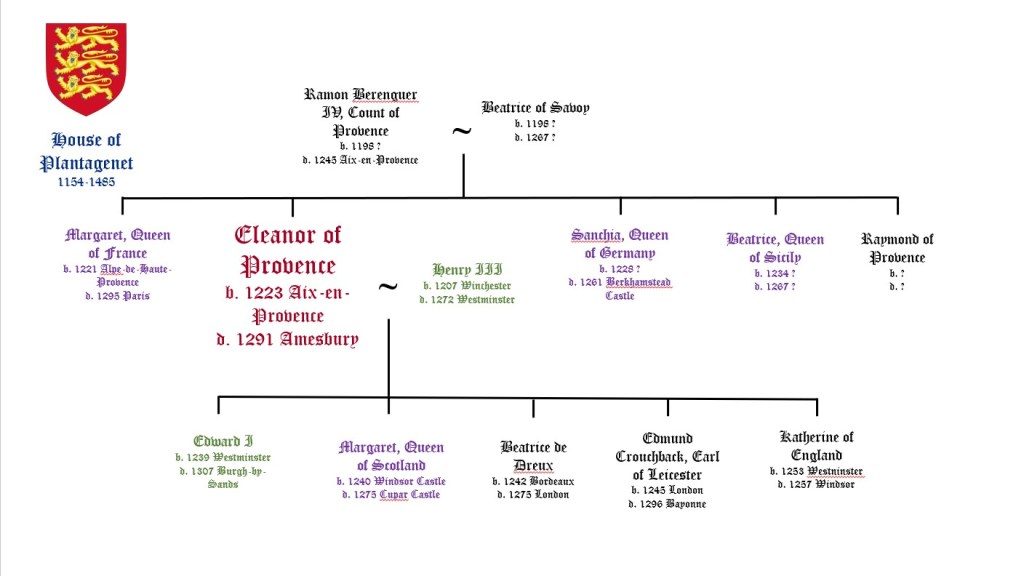
- Eleanor of Provence is born at Aix-en-Provence to Beatrice, daughter of the count of Savoy and Raymond Berenger V, count of Provence. Once it became clear that Beatrice would have no sons, it is likely Eleanor and her sisters were educated as a son would have been so they could manage their estates. [13, 22]
1234
- May 27: Eleanor is present for the marriage of her older sister Marguerite to the French king Louis IX. Marguerite had been attended to the ceremony by William of Savoy, but her new mother-in-law Blanche of Castile pays him to go home, not wanting him to influence her new daughter-in-law [13, 23]
1235
- October: Eleanor is visited in Provence by Richard le Gras and John of Gatesden, envoys from Henry III to regard her and open negotiations for her hand in marriage. This would be the second deputation, the first having described her as ‘of handsome appearance’. John of Gatesden would later become the first master of her wardrobe. [13, 14, 16]
- October 19: The marriage discussion for Eleanor’s hand, between her father Count Raymond and Henry III’s envoys are concluded, with Raymond providing a dowry of 10,000 marks, and Henry giving all the usual castles and cities which English kings give their queens, though in reality many of these are still in the hands of Isabella of Angouleme [23]
- November 23: Eleanor publicly pledges herself by an exchange of ‘verba de presenti’ to Henry III at the castle of Tarascon, with one of Henry’s ambassadors, Robert Mucegros, standing as his proxy. Legally this meant that Henry was engaged to two woman at once, the other being Joan of Ponthieu. Eleanor’s safe passage through France to the coast was signed by not only King Louis IX but his wife and Eleanor’s sister Marguerite, and Louis’s mother Blanche of Castile [3, 13, 14, 16, 19, 23]
- December: Eleanor leaves Arles on her way to England, bringing with her her uncle William of Savoy and 300 horsemen, as well as her attendants and distant relations, including her nurse and governess Lady Guillelma de Attelis who had been with her since she was a child [23]
- December 15: Eleanor repeats her exchange of marriage vows at Vienne to confirm the contract, overseen by her uncle William of Savoy, dean of Vienne Cathedral. As Eleanor and her party cross the territories controlled by Theobald, Count of Champagne, he pays for their travel expenses. They are escorted to the French coast by Eleanor’s sister Marguerite, her husband Louis IX and his mother Blanche of Castile [3, 13, 16, 22]
1236
- January 1: Eleanor is granted in dower the towns and vills of Glocester, Cambridge, Huntingdon, Droitwich, Kasingstoke, Andover, Cheltenham, Godmanchester, King’s Cliffe, Kingston, Ospringe, Lothingland, Bath and Worcester, should Henry die before both Eleaor and his mother Isabella of Angouleme [16]
- January 10: Eleanor’s party crosses the channel safely from Wissant, landing at Dover [13, 18, 23]
- January 14: Eleanor marries Henry III at Canterbury Cathedral. The service is conducted by Edmund of Abingdon, Archbishop of Canterbury. In Eleanor’s new household, she brings Willelma d’Attelens as her damsel, and is given the services of Robert Mucegros as her steward, John of Gatesden as the keeper of her wardrobe and Nicholas Farnham as her tutor. Upon Eleanor’s marriage, Laurence de Castellis is appointed as her first Keeper of Queen’s Gold, later replaced by one of Henry’s Exchequer clerks John Francis, who is paid £10 a year for this extra responsibility. The disposition of the Queen’s Gold would be in the discretion of the king until Eleanor took control of her own own wardrobe in the 1240s. The couple would formally consummate their marriage that same night, though Henry had still not received papal dispensation freeing him from his betrothal to Joan of Ponthieu [3, 13, 15, 18, 19, 23]
- January 20: Eleanor is crowned queen of England at Westminster Abbey. Henry spends £30,000 on Eleanor’s crown, clothing and gifts. Eleanor wears a mantle lined with ermine, garlands of gold and precious stones in her hair. She walks to the abbey beneath her canopy of state supported by two bishops, pausing at the door to say prayers to the Virgin Mary. She is anointed with holy oil before the altar, a blessed ring is placed on her finger and she is crowned with a crown of golden lilies by Edmund of Abingdon, Archbishop of Canterbury. After the ceremony they walk to Westminster Hall where the couple feast with their relatives and nobles. As part of the coronation ceremony, Eleanor intercedes with Henry on behalf of William de Panchehall, who had infringed upon forest law, which was granted. The following festivities last eight days. Henry spends so much on the coronation that when he asks for taxes, the nobles refuse and tell him to defray the costs himself. Eleanor’s dower after 21 January would include the cities of Worcester and Bath, the borough and castle of Gloucester, the boroughs of Cambridge and Huntingdon, the towns of Droitwich, Basingstoke, Andover, Cheltenham, Godmanchester, King’s Cliffe, Kingston, Ospringe and Lothingland, though she would not see any funds or rights in practice over her properties until Henry’s death [3, 14, 15, 16, 22, 23]
- January 21: Eleanor and the court remove from Westminster Palace to Merton Priory after the palace is flooded [3, 23]
- February 7: Eleanor and Henry are at Winchester [3]
- June 27: Eleanor and Henry are at Glastonbury on a tour of the West Country, possibly to see the tombs of Arthur & Guinevere [3]
- July 25: Eleanor is likely at Pershore with the court, where a grant is made to the abbess of Wilton in consideration of her having at the petition of Eleanor, granted to Mabel de Braybof for life two liveries in her house, that she and her successors be quit of receiving into their house any other nun at the petition of the said queen or otherwise during the life of the said queen, notwithstanding any privilege by reason whereof it belongs to the queen, as it is said, to make a nun in every religious house of the realm after her first coronation [6]
- October 13: Eleanor and Henry are at Westminster together to celebrate the feast day of Edward the Confessor. She is given an image of herself fashioned in gold to present as an offering at the shrine of the saint [3, 23]
- December 25: Eleanor and Henry celebrate the Christmas holidays at Winchester [3]
- December 27: Eleanor, Henry and the court remove to Westminster in readiness for the parliament [3]
1237
- March 22: Eleanor’s chamber are to be refurbished by brother John de Waverley, and the king’s bailiffs are ordered to be ‘counselling and aiding’ to him as he passes through their lands to purchase stone so that the work isn’t hindered (and Eleanor is not inconvenienced) [6]
- May 12: Eleanor is at Worcester Cathedral to observe the enthronement of Walter de Cantilupe, newly confirmed bishop of Worcester [24]
- September 22: Eleanor and Henry III meet with Alexander II of Scotland and Queen Joan, Henry’s sister, in York for a peace conference. At the conclusion, Eleanor and Joan return to the south together, and the pair travel to Canterbury, possible offering prayers for more children. Joan later refuses to return to Scotland and remains with Eleanor for the rest of the year [23]
- December 25: Eleanor and Henry celebrate the Christmas holidays at either Winchester or Westminster, sources differ, with Henry’s sisters Joan and Eleanor [3, 13]
1238
- January 6: Eleanor and Henry celebrate Epiphany at Westminster Palace [3]
- January 7: Eleanor’s sister-in-law Eleanor marries Simon de Montfort in secret at Westminster Abbey, though with Henry’s knowledge and tacit consent. This eventually causes a scandal as she had publicly made a vow of chasitity to bring her closer to god. [23]
- March 4: Eleanor’s sister-in-law Joan dies at Havering, Essex, with her brothers Henry and Richard with her. She is buried at Eleanor’s church at Tarrant in Dorset. [3, 23]
- September 9: Eleanor and Henry are at Woodstock. While they are in bed in Eleanor’s chamber, a man claiming to be the real king breaks into Henry’s chamber. Finding it empty he searches other rooms until the cries of one of Eleanor’s damsels alerts attendants and he is apprehended. Henry orders him to be taken to Coventry and there to be torn apart by horses, having previously given the man the benefit of the doubt for an earlier grievance. The man confesses to wanting to kill both the king and queen. [3, 23]
1239
- June 17-18: Eleanor gives birth to her first child, a son named Edward, at Westminster Palace. He would be known until his accession as Lord Edward. Eleanor is only 15 at the time of her labour. Henry has the clerks of the king’s chapel sing Christus Vincit and gives a £10 pension to Sybil Giffard for her care of Eleanor during her labour. Henry is not so generous with gifts sent by well-wishers, with the king sending back those he felt were not worthy of his son and demanding better [3, 13, 16, 18, 22, 23]
- June 22: Eleanor’s son Lord Edward is baptised, with his uncles Richard of Cornwall and Simon de Montfort standing as godfathers. The ceremony is performed by papal legate Otto [3]
- August 9: Eleanor attends her purification after the birth of Lord Edward. Henry orders 500 candles be carried in the procession, and 34 oxen for the feast. Henry unexpectedly bars his sister Eleanor and her husband Simon de Montfort, saying he was excommunicated and she had been defiled by him before marriage, and also for using his name as surety for a loan of 2,000 marks without the king’s knowledge. The couple flee to their house in Southwark, but Henry sends word after them they are to be evicted. After trying to plead with Henry, they flee to France, leaving their 9-month old son behind, who was likely placed in the royal nursery. Simon vows vengeance on Eleanor, believing the whole thing was her fault. [3, 13, 14, 16, 23]
1240
- April: Eleanor’s uncle Peter of Savoy arrives in England, having been granted the Honour of Richmond in Yorkshire, though he was not formally granted the title of earl. He encourages Eleanor to surround Prince Edward with other Savoyard relatives to increase her influence over both Henry and his heir [13, 23]
- April 1: Eleanor gives a pot and 2 cups of silver to Simon de Montfort as a peace offering, though they don’t meet in person, as he is only visiting England to raise money for his crusade and collect his son [3]
- September 29: Eleanor gives birth to her second child, a daughter named Margaret, as Eleanor is said to have invoked St. Margaret during her labour. The child is born at Windsor Castle, and Henry gives mother and child 12 ounces of gold each. In advance of the birth, Henry orders Westminster’s great hall and a second smaller hall to be filled with paupers to be fed at his expense ‘for the queen who is near her confinement’. [3, 16, 22, 23]
1241
- February 1: Eleanor’s uncle Boniface of Savoy is elected Archbishop of Canterbury, though he would not take up his seat for another 3 years [23]
- February 12: Eleanor is named as keeper of the castles of Montgomery, Shrewsbury, Bruges and Chester in the event of the king’s death, for her to use for their son Lord Edward or any other heirs [6]
1242
- April: Eleanor is seven months pregnant and Henry orders 102,000 poor folk to be fed in memory of his sister Isabella, and in intercession for Eleanor’s confinement [3]
- April 7-8: Eleanor is named keeper of the castles of Kenilworth, Dover, Canterbury and Rochester in the event of the king’s death, and if she cannot take possession personally, that they be handed to none but her uncles [6, 23]
- April 26: Eleanor is granted the wardship of the heir of the lands of Ralph de Tony, and with it to receive any rents accruing for her wardrobe [6]
- May 9: Eleanor, heavily pregnant, accompanies Henry III and Richard of Cornwall on their crossing from Portsmouth to Royan. [23]
- May 13: Eleanor and Henry disembark at Royan in Gascony, where she retires to La Reole for her confinement, but is forced to move on to Bordeaux due to ill-health [3, 16]
- June 25: Eleanor gives birth to her third child, a daughter named Beatrice, at Bordeaux. Henry’s lavish baptism festivities delay his march on Poitou, ultimately leading to a disastrous defeat at Tailleborg. A safe-conduct is issued for the bearers of the relics of Ste Quiterie going with the said relics to Bordeaux to the queen, and returning [The church of Aire-sur-l’Adour, dedicated to Sainte-Quitterie is c.100m south of Bordeaux, and the relics may have been brought from there to aid in her labour] [3, 16, 22, 23]
- July 17: Eleanor’s sister Sanchia is married by proxy at Tarascon Castle to Eleanor’s brother-in-law, Richard of Cornwall, as a way of keeping him on the royalist side after his frequent rebellions. [23]
- September: Eleanor and Henry are hosted in Bordeaux by King Louis IX in celebration of the truce between their countries, and they remain in France for a year, earning strong criticism [23]
1243
- May: Eleanor is still at Bordeaux with Henry when her mother Beatrice of Savoy arrives accompanying Eleanor’s sister Sanchia to her marriage to Richard of Cornwall [13]
- August 17: Some of the manors assigned to Eleanor in dower in 1236 are replaced with the county of Chester, Newcastle under Lyme and the advowson of Rochester Abbey, as well as the cities of Worcester and Bath. Eleanor may have arranged this as a way of placing them out of Richard of Cornwall’s hands, and keeping them for the Lord Edward’s eventual appanage [6, 16]
- November 14: Eleanor, her sister Sanchia, and her daughter Beatrice sail into Dover, Henry having gone ahead to make wedding arrangements. [13, 23]
- November 23: Eleanor’s sister Sanchia is married to Henry III’s brother Richard of Cornwall in Westminster Abbey. Eleanor and Henry attend both the ceremony and the feast afterwards. [14, 23]
December 25: Eleanor and Henry spend the Christmas holidays with Richard of Cornwall at his home in Wallingford [23]
1244
- August: Eleanor’s daughter Margaret is betrothed to Alexander, son of Alexander II of Scots [23]
1245
- January 16: Eleanor gives birth to her fourth child, a son named Edmund in London. The royal nursery is managed by Hugh and Sybil Giffard, assisted by Walter de Dya, a Savoyard, and two nursemaids, Alice and Sarah. Hugh is instructed to employ Richard the Harper to entertain the children [3, 22, 23]
- August: Eleanor’s father Raymond Berengar dies. He leaves the whole county of Provence, as well as some lands that were only on loan from Henry, to his youngest daughter Beatrice, who marries Charles of Anjou, brother to King Louis IX of France. Raymond leaves £6,667 in dowry to both Eleanor and her sister Marguerite but Charles refuses to pay it. Henry hears the news of his death first, and keeps the news from Eleanor until he can return from Wales and tell her himself [3, 16, 23]
1246
- January 8: Eleanor has two silver chalices made as gifts for the friars minor of Chester[10]
- January 31: Eleanor’s youngest sister Beatrice marries Charles of Anjou, younger brother to king Louis IX of France, and Eleanor’s sister Marguerite’s husband, bringing Provence closer to the French crown and completely disinheriting Eleanor of her dowry and her quarter of Provence [13, 23]
- February 19: The sheriff of Wiltshire is commanded to see that Eleanor’s chambers at Clarendon are completed before Whitsuntide, with a new fireplace to be installed in the upper storey [10]
- June 5: Ordered at Windsor, 20l 15s 10d to Robert de Monte Pessulano for electuaries [medicines that are carried in something sweet, like honey] provided for Eleanor and her family [10]
- June 17: Eleanor, Henry, Lord Edward and Richard of Cornwall witness the dedication of Beaulieu Abbey. Edward becomes sick and has to stay at the abbey for three weeks, with Eleanor refusing to leave her son’s side which so shocks the monks they depose their prior for permitting it [16, 23]
- August 27: Ordered at Woodstock, the sheriff of Southampton is to go to St. Giles’ fair and procure a palfrey for Eleanor’s buttery, and one each further for Roberga and Margery her damsels [10]
- Autumn: Eleanor’s sister Sanchia gives birth to her first child, a son who would die less than a month later [13]
- November 7: Eleanor is resident at Windsor castle, while Henry and the court are at Reading [10]
1247
- February 10: Eleanor is resident at Windsor, while Henry and the court are at Westminster [10]
- February 13: Eleanor’s chambers and chapel at Gloucester Castle are wainscoted and a new fireplace is installed [10]
- March 26: Eleanor buys seven horses at St. Edmund’s fair at a cost of 20l, with a further 28 marks on three pack-horses for her daughter Margaret, Dame Gwillelma and Mistress Ada [her damsels] and for 3 other horses, one each for her clerk of the wardrobe, her usher and her yeoman [10]
- May: Eleanor and Henry are at Woodstock where they receive Peter of Savoy, Eleanor’s uncle, who causes disgust among the barons by bringing a troupe of unknown young ladies specifically to marry them off to Englishmen [23]
- August 10: Eleanor has chapels created in Northampton and Geitinton castles for her personal use [10]
1248
- November 7: Eleanor receives 15 tuns of wine from Southampton while at Windsor. At any time the queen is separate from the king and court, she must pay for her own keep, apart from clothing and wine, which the king must provide [10]
- November 23: Eleanor receives 20 salted does from the New Forest ready for the Christmas feast [10]
- December 25: Eleanor and Henry celebrate the Christmas holidays in London, though they are unable to afford their usual festivities [23]
1249
- April 17: Eleanor is appointed guardian of Lord Edward and his lands in the event of the king’s death [23]
- October: Eleanor’s marriage to Henry, and specifically its validity after the business with Joan of Ponthieu, is the subject of a petition by Henry to Pope Innocent IV [23]
- November: Eleanor is present with Henry III at Canterbury for the enthroning of her uncle, Archbishop Boniface of Savoy [16]
- December 26: Eleanor’s sister Sanchia gives birth to her second child, a son named Edmund. Richard of Cornwall offers no celebration at the event. [13]
1250
- March 6: Eleanor probably takes the cross at the hands of her uncle Archbishop Boniface, intending to accompany Henry III to the Holy Land on crusade. However, nether of them would fulfil their vow, and the money raised for the expedition would be funnelled to other activities [3, 16]
- May 17: Eleanor is lent a copy of Chanson d’Antioch by the Master of the Temple, at Henry’s insistence. At the same time the couple cut back on household expenses, saving for their crusade (but at the same time having their apartments at Clarendon decorated with scenes of the Siege of Antioch and the duel of King Richard) [3, 10, 16, 23]
- December 29: Eleanor has her chamber re-tiled and has new windows fitted in the gallery of her chapel [10]
1251
- May 19: Eleanor narrowly escapes when Windsor Castle is struck by lightening and the chimney and hearth in her chamber collapse while she and her children are there [23]
- December: Eleanor and Henry III are present in York for the marriage of their daughter Margaret to Alexander III of Scotland. Eleanor and Henry are lodged in the Archbishop of York Walter de Gray’s palace. Eleanor wears a dress of samite trimmed with gold braid and mantles furred with ermine. The ceremony takes place secretly, early in the morning so as not to be the focus of hostility between English, Scots and French guests. At the feast which follows, 170 boar, 1400 deer, 7,000 chickens, 10,000 haddock, 25,000 gallons of wine and 70,000 loaves of bread were provided. Margaret would be attended to Scotland by Matilda de Cantilupe, widow of Henry’s household steward and by two barons, John Balliol and Robert de Ros, who would be responsible for her treatment and health while in Scotland. The festivities are spoiled by public arguments between Henry and Simon de Montfort about unpaid debts, with Eleanor eventually persuading Henry to pay up [3, 16, 23]
- December 25: Eleanor and Henry celebrate the Christmas holidays at York, joined by their daughter Margaret and her husband Alexander III of Scotland [23]
1252
- In this year, Eleanor buys 61 rings, 91 brooches and 33 belts, almost all of which would be given as gifts [16]
- February 25: Eleanor is at Reading where she summons Adam Marsh to discuss ‘matters touching the King and his heirs’, relating Lord Edward’s relationship with Henry III’s sister Eleanor and, more specifically, her husband Simon de Montfort. In none of Marsh’s involvement between Eleanor and the Montforts was Henry III involved or even informed. Ultimately de Montfort resigns his office and leaves for France, leaving his heavily pregnant wife behind [16, 23]
- March: Pope Innocent IV issues a pale bull confirming the validity of Eleanor and Henry’s marriage [23]
- August: Eleanor and Henry appear in a public court case arguing over which of them had the right to appoit an incumbent to the church of Flamstead. Eleanor wins, but it leads to a distinct cooling of their relationship [23]
- September 25: Eleanor and Henry are together at Windsor for a fortnight, after which point one of them would depart, though it is not known which [5]
- October 8: Eleanor is granted the wardship of the “lands late of Margery de Riperiis, countess of Devon, during the minority of Baldwin, son and heir of Baldwin de Insula, sometime earl of Devon, for the issues thereof to be delivered into her wardrobe for her expenses” [7]
- October 28: Eleanor’s clerk Robert del Ho is imprisoned by Henry III on charges of corruption. It is possible this was done as a punishment for Eleanor stepping beyond her proscribed role as wife and mother. Del Ho would be pardoned in December. [16]
- November 3: Eleanor is with the court at Windsor where she hears of the attack on Eustace de Lenn over the appointment of prior at St. Thomas’ Hospital in Southwark. De Lenn is an official of her uncle Boniface, and the attack is mounted by armed men hired by the de Lusignans. She naturally takes her cunle’s side [3, 16]
- November 4: Eleanor’s lands and queen’s gold are sequestered by Henry III in retaliation for her Savoyard family’s behaviour (and possibly for her own attitude towards them) and she is sent to Guildford, away from court [16, 23]
- November 18: Eleanor is summoned by Henry back to court at Clarendon [16, 23]
- November 27: Eleanor’s lands and queen’s gold are returned to her [16, 23]
- December 25: Eleanor and Henry celebrate the Christmas holidays at Winchester. The pair are in so much debt that they are provided with food and drink by the local citizens, with Henry spoiling the mood by taxing them 200 marks for his forthcoming journey to France [13, 16, 23]
1253
- January 1: Eleanor gives Henry’s de Lusignan half-brothers William and Geoffrey de Valence belts, and receives a gift of plate from Aymer de Lusignan as a sign of peace [3, 14, 16]
- January 5: Eleanor and Henry III celebrate the Feast of St Edward at Westminster [16, 23]
- January 12: Eleanor and Henry III are together at Windsor [16]
- February 26: Eleanor is alone at Windsor, Henry having left for Westminster, and she remains there alone until June, apart from two brief, overnight visits from Henry [5]
- February 27: Eleanor’s gift-giving of jewels on 1st January totals more than 260l [11]
- March 2: Eleanor is at Windsor where she receives 10 tuns of wine, while Henry and the court are at Westminster [11]
- June 1: Eleanor is named protector of the Lord Edward, of all lands in England, Wales, Ireland and Gascony until he comes of age, and as executor of Henry III’s will. The other executors are Richard of Cornwall, Aymer de Lusignan, and seven other men with Savoyard connections. Henry retains the right to elect to vacant bishoprics and castellans [16, 23]
- June 22: Eleanor is granted the keeping of the great seal, but would use the seal of the Exchequer while she acted as regent. [7, 16, 23]
- July 3: Eleanor is named governor of England, Wales and Ireland in Henry’s absence, with counsel from Richard of Cornwall. ‘The same day he makes arrangements for her to receive land worth £200 for the maintenance of her chamber’. Henry also states that ‘if the lot of humanity befalls the king in Gascony’, she is to take all the castles and lands into her hands for the use of Lord Edward during his minority. However, only Richard of Cornwall is permitted to confer to benefices, which may be payback for the incident with Aymer de Lusignan [3, 23]
- July 8: Eleanor is ordered to put the seal of the Exchquer into the hands of the head of the Chancery, William of Kilkenny [7, 16]
- July 16: Eleanor and Henry are at Portsmouth where he grants that she may freely make her will whenever she pleases to the amount of 3,000 marks above her personal possessions. He also orders the constable of Dover castle, Betram de Crioil, not hand it over to Lord Edward without Eleanor’s prior consent [7, 16]
- July 23: Eleanor is granted a significant extension to her dower including lands in Ireland in the event of Henry III’s death [16]
- August 3: Ordered at Portsmouth, that Eleanor and her sister Sanchia shall have the marriage of the heirs of their uncle Peter of Savoy [11]
- August 6: Eleanor and Lord Edward watch Henry depart from Portsmouth bound for Gascony. She is 5 months pregnant [13]
- August 12: Eleanor and her regency court are at Westminster [11]
- August 20: Eleanor and her regency court are at Mortlake [11]
- September 1: Eleanor and her regency court are at Kempton [11]
- September 6: Eleanor and her regency court are at Westminster [11]
- October 13: Eleanor observes the feast of St. Edward at Westminster [23]
- November 7: Eleanor begins to plan her Christmas feast, ordering the constables of St Briavels to permit the king’s huntsmen to take 60 does, 20 boars and 50 wild sows, to salt them all and to cut off the heads of the boars, and to transport them all to Eleanor at Westminster [11]
- November 23: Eleanor is at Westminster Palace where she signs a protection order for William de Ivelton, going to Gascony in the king’s service, just two days before going into labour [7]
- November 25: Eleanor gives birth to her fifth child, a daughter named Katherine, at Westminster palace. She is baptised the same day by her great uncle Archbishop Boniface and named for the Saint, who’s feast day it was. Eleanor’s valet William de Valers was tasked with taking the news of the birth to Henry in Gascony. Henry would make an offering of five lengths of gold cloth at Westminster in thanks for her safe delivery. Eleanor does not observe the usual period of lying in after the birth, and resumes her rule on the same day [3, 23]
- December 19: Eleanor orders 85 pairs of shoes be purchased of varying values and delivered to her almoner ready for the Monday before Christmas to distribute to the poor on that feast [11]
- December 27: Eleanor and Richard of Cornwall summon parliament to Westminster, requesting two knights from each county to represent their citizens. This is one of the earliest moves towards democracy in England [23]
1254
- January: Eleanor demands that all ships docking in London use her dock at Queenhithe, for which they pay heavy taxes. This move, among others, makes her increasingly unpopular [23]
- January 5: Eleanor is ‘churched’ after giving birth to Katherine. She is attended during the ceremony by her uncle Boniface of Savoy, Richard of Cornwall and Eleanor de Montfort [3]
- January 15: Eleanor prepares for the feast of St. Edward, ordering 27s 1d paid to the sheriffs of London for their purchase of 1,590 fowls and 50 partridges [11]
- January 20: Eleanor and her regency court are at Windsor [11]
- January 27: Eleanor calls a parliament. It would be the first time a woman acting as head of state calls and presides over a parliament in England [3]
- January 31: Eleanor and her regency court are at Westminster [11]
- February 11: Eleanor and Richard of Cornwall call a further parliament to meet at Westminster, but they are forced to write to Henry that there is very little aid to be had for his conflict in Gascony [23]
- February 12: Eleanor and her regency court are at Windsor [11]
- February 14: At Eleanor’s insistence, Henry creates his son Lord Edward Duke of Gascony and Earl of Chester, matching the income of 15,000 marks demanded by King Alphonso before he would permit the marriage between Edward and his half-sister Eleanor of Castile [23]
- February 14: Eleanor is with the royal court at Windsor where she writes to Henry III letting him know the outcome of the recent parliament; that the barons would only send help if the king of Castile attacked Gascony, and the clergy would grant no subsidy yet. She asks what the king wishes from the next parliament [12]
- March 14: Eleanor and her regency court are at Reading [11]
- March 16: Eleanor calls four men, Geoffrey de Langley, Ralph Dunion, Bartholomew Pecche and Stephen Bauzan to Westminster to become Lord Edward’s stewards for his newly granted appanage, with de Langley as superintendant [16]
- March 16: Eleanor and her regency court are at Marlborough [11]
- April: Eleanor is commanded to bring her son Lord Edward to Henry in Bordeaux [23]
- April 1: Eleanor and her regency court are at Windsor [11]
- April 28: Eleanor and her regency court is at Westminster [11]
- May 4: Eleanor pawns some of the crown jewels to Richard of Cornwall after parliament refuses to send aid to Henry unless Gascony is invaded [23]
- May 10: Eleanor and her regency court are at Mortlake[11]
- May 14: Eleanor’s son Prince Edmund is confirmed by Pope Innocent IV as King of Sicily, for which Henry will have to pay 135,000 marks. Eleanor is strongly in favour but the barons refuse to allow any taxation to pay for it [23]
- May 17: Eleanor and her regency court is at Windsor [11]
- May 17: Eleanor’s departure is delayed by fighting between the rival fleets of Yarmouth and the Cinq Ports, forcing her to travel instead from Portsmouth [23]
- May 24: Eleanor and her regency court is at Winchester [11]
- May 29: Eleanor is still jointly attesting patents with Richard of Cornwall on the day of her departure. Just before leaving she receives a letter from Henry forbidding her from coming, which she ignores. She sails together with Lord Edward and her uncle Archbishop Boniface of Savoy [3, 16, 23]
- June 11: Eleanor arrives in Bordeaux and is met by Henry, and they escort Lord Edward part of the way on his journey to marry Eleanor of Castile, though they don’t attend the ceremony, moving instead to Paris [14, 23]
- August: Eleanor, Henry and Joan of Ponthieu meet and dine together. Joan is the mother of Lord Edward’s intended bride, Eleanor of Castile, though she wouldn’t attend the ceremony [3]
- November 20: Eleanor and Henry are at Marmoutier when they receive news of Edward’s marriage earlier in the month, and they host a great feast in his honour, incurring further wrath from the barons for the extravagence [18, 23]
- December 9: Eleanor, Henry, Louis IX and Eleanor’s sister Marguerite enter Paris together. They would be joined by Eleanor’s sisters Beatrice and Sanchia, and their mother Beatrice of Savoy [3, 23]
- December 25: Eleanor and Henry are at Boulogne, hampered from sailing home to England by poor weather [3]
- December 27: Eleanor and Henry’s ship docks at Dover [23]
1255
- January 27: Eleanor and Henry make a state entrance into London, after which they demand a gift of £100, and fine the citienry of London 3,000 marks for allowing a prisoner to escape Newgate Prison [23]
- February 23: Eleanor’s crown and a ‘little crown of the king’ are among a large set of jewels pawned by Henry to his brother Richard of Cornwall [7]
- April 15: A full reckoning of Eleanor’s voyage to France is made as the court is at Westminster, including payment for 60 quarters of coal, 100 cartloads of brushwood, 20 quaters of salt, 30,000 eggs, 1,000 pounds of suet and lard, 1000 ells of canvas, 30 dozen chickens, 30 dozen fowls, 40,000 dishes, 100 cakes, 100 gallons of vinegar, 4,000 of cumin, 60 quarters of flour, 30,000 horseshoes and 60,000 nails [11]
- September: Eleanor is at Wark Castle with her daughter Margaret while Henry travels to Scotland to rectify the treatment of their daughter by the Scottish council. Eleanor remains there for a month recovering after the stress of the journey and worry over Margaret cause her to be dangerously ill. While there she receives 15 tuns of wine. [3, 11]
- October: Eleanor’s son Prince Edmund is crowned King of Sicily at Westminster Abbey. Henry then proclaims he will take the island from it’s current holders, the Hohenstaufen family [23]
- November: Eleanor is forced to borrow money from her tailor and other merchants to pay the ransom for her uncle Thomas of Savoy, imprisoned in Turin. Eleanor and Henry immediately cease all trade with northern Italy and arrest all Asti and Turin merchants within their borders. Eleanor’s mother Beatrice of Savoy closes the Alpine pass between Provence and Switzerland [13, 23]
- December 23: Eleanor waives her right to Queen’s Gold on fines made by the city of London for her lifetime, but without prejudice to the rights of her successors [15]
1256
- February 20: Eleanor’s chambers at Woodstock are refurbished, with repairs to the fireplace, creation of a penthouse between her kitchen and the king’s cellar, and to have an image made of St. Mary for her chapel [11]
- March 24: Eleanor’s daughter Katherine becomes seriously ill, and Henry III orders a silver image of her to be placed on the shrine of St. Edward at Westminster Abbey as an intervention [16]
- October 14: Eleanor is granted the wardship of the lands and heirs of the deceased Matthew de Fornellis, including the marriage of the heirs. [The lands are spread across Somerset, Dorset, Wiltshire, Hereford and Devon] [7]
- November 12: Eleanor’s daughter Katherine is staying at Windsor as an order is passed to Robert Russell, Eleanor’s sergeant, to take 20 marks for Katherine and her household in advance of the king and queen’s departure ‘without delay and without fail on sight thereof, postponing all other matters’ [11]
1257
- January 29: Eleanor is granted the wardship of the lands of the deceased Ralph de Valle Torta, including the marriage of his heirs and his widow, and to be paid a forfeit if the widow remarry without Eleanor’s consent [7]
- March: Eleanor is ill while resident at Windsor with her children, and Henry sends her 160 barrels of wine, per the order ‘is greatly in want of wine’ [3, 11]
- May 3: Eleanor’s daughter Katherine dies and Eleanor suffers a collapse, obtaining “no relief from medical skill or human consolation”. It has been suggested Katherine suffered from Rett syndrome, which only becomes evident after a typical birth and early development, and leads to a progressive loss of motor skills and language; she is described by Matthew Paris as ‘dumb and useless’. Katherine’s tomb, the first of Henry’s family to be interred at Westminster Abbey and the earliest recorded monument to a child in England, is topped with a silver effigy and 180 precious stones commissioned of Simon de Welles, though ultimately another mason would complete the project. Brother Richard of the Charing hermitage is paid 50s a year to say daily prayers for her soul. Her nurses Avice and Agnes are dismissed with gifts of 10 marks each [3, 23]
- June 4: Eleanor is granted a loan of 4,500 marks by the Florentine merchant firm Maynettus & Spire, which is backed by the religious house of Cirencester, Chertsey, Abingson, Hyde and Pershore [7, 16]
- October 8: Eleanor is present at St. Albans with her daughter-in-law Eleanor of Castile. Eleanor makes a gift of a rich cloak at the shrine of St. Alban in thanks for her recovery from illness [3, 23]
- December 18: Eleanor is present with Henry, Lord Edward and Simon de Montfort at the signing of a covenant at Westminster Palace allowing the marriage of Eleanor’s kinsman William, Marquis of Montferrat, and Isabel, daughter of Gilbert de Clare, duke of Gloucester [3]
1258
- February: Eleanor intercedes for the pardon of Geoffrey de Langley, supreme seneschal of Lord Edward’s English and Welsh lands, and who had allowed the Welsh rising two years earlier [16]
- May: Eleanor’s right to Queen’s Gold is specifically curtailed by the Petition of the Barons, suggesting she had allowed her sherriffs and bailiffs to push their luck in when and how much to exact [15]
- May 5: Eleanor is at Westminster Palace and gives a ruby ring to Thomas of Savoy’s brother in law, Cardinal Ottobuono [16]
- May 30: Eleanor gives the wardship of the lands and heirs of William de Birton, including the marriage of the heirs, to her cook, Philip la Hare [7]
- May: Eleanor tries to enrich her cousin Alasia through a post-mortem grant of lands, but is stopped by the new council. From this point she does everything she can to turn Henry and Lord Edward against the new regime [23]
- June 10: Eleanor’s lands and queens gold will henceforth be independently regulated by the council of barons, led by Simon de Montfort, which is demanded during the ‘Mad Parliament’. It also puts more stringent conditions in place to curb Henry’s spending and mismanagement of the country [23]
1259
- January: Eleanor is at Dover with Henry to welcome Richard of Cornwall and his new wife Sanchia to England [23]
- July 14: The tomb of Eleanor’s daughter Katherine is decorated with a new altar cloth with pearls [11]
- May: Eleanor’s sister Marguerite and uncle Peter of Savoy are formally selected as official mediators in the marriage negitiations of Beatrice and John of Brittany [1]
- October: Eleanor is travelling back to London and stays a night at St. Albans Abbey with John Maunsel, chief negotiator for the English crown in the matter of Eleanor’s daughter Beatrice’s marriage to John of Brittany, and the Bishop of Brienne, a negotiator for the Duke of Brittany [1, 3]
- October 13: Eleanor rushes from St. Albans to Westminster to be with Henry for the feast of St. Edward, even though she is unwell [23]
- October 18: Eleanor is probably present in the Queen’s Chapel at Westminster for the final negotiations for her daughter Beatrice’s mariage to the duke of Brittany’s son. The meeting was private, and circumvented the authority of the rulling council, infuriating the barons, led by Simon de Montfort, further [3]
- November 1: Eleanor and Henry celebrate All Saints Day at Westminster by feeding 390 paupers and by burning 230 of wax candles during the celebration [4]
- November 6: Eleanor and Henry leave Westminster for Dover [23]
- November 14: Eleanor and Henry leaves England for France to be present for the finalising of the peace treaty between the two countries, and to be present at the marriage of their daughter Beatrice. In open opposition to the mandate of the Oxford Parliament by which all wardships may only be disposed of by a 5-person council, Eleanor grants her steward Matthias Bezill the first available wardship of between £40-60. Eleanor takes with her a cache of 97 jewelled rings of varying values, of which 91 were given as gifts to individuals on the continent as a way of strengthening her circle of influence, and eight of these were given to Beatrice to give away, as a way of building her daughter’s network. One of the most expensive, a ruby ring worth £4, was given to the King of Navarre, presumably in the hope he would allow certain lands to be given to Eleanor’s daughter Beatrice as part of her marriage appanage. This ultimately was unsuccessful and other means had to be found [1, 14, 16, 23]
- November 24: Eleanor and Henry arrive at St. Denis, where they are met by King Louis IX [4, 23]
- November 26: Eleanor and Henry formally enter Paris [4, 16]
- December 4: Eleanor is present in Paris as the Treaty of Paris is signed by Henry and Louis IX, whereby Henry cedes his claims to Normandy, Maine, Anjou, Tourraine and Poitou in exchange for being recognised by the French crown as the rightful lord of Gascony, Cahors, Limoges and Perigord [23]
- December 25: Eleanor and Henry celebrate the Christmas holidays in Paris with Eleanor’s extended family, where they hear reports that Lord Edward is in Gascony and plotting against his father. In response, Eleanor begins strategic gift giving to build a network of supporters in case of conflict [3, 16, 23]
1260
- January: Eleanor and Henry III spend the month at the abbey of St. Denis, commiserating with Louis IX on the death of his son and heir Prince Louis [16]
- January 18: Eleanor returns to court in Paris, having spent the preceeding weeks apart from Henry since 29th December, though it is not recorded where she stayed, most likely she was with her sister Marguerite [4, 5]
- January 22: Eleanor and Henry attend their daughter Beatrice’s wedding to John of Brittany at Saint-Denis outside Paris. The young couple would accompany Eleanor and Henry back to England so John could be knighted by Henry on St. Edwards’ Day [1, 3, 16, 23]
- February 5: Eleanor and Henry are together at Arras, though her court would depart the next day [5]
- April 11: Eleanor and Henry spend the easter holidays together at Saint-Omer [23]
- April 20: Eleanor secures a loan of £500 from the merchants of Ypres to pay for an armed force she and Henry III feel may be necessary in dealing with the barons on their return to England [13, 16]
- July 25: Eleanor is at Westminster, where she gives rings to two knights of John de Harcourt, sent by Louis IX to ease tensions between Henry III and Simon de Montfort [16]
- August: Eleanor is at Marlborough when she writes requesting her ally John Maunsel be installed as Bishop of Durham. She is countered by Lord Edward, and the monks end up chosing their own candidate [23]
- August 9: Eleanor and Henry III are together at Windsor Castle [16]
- October 13: Eleanor is with Henry and her daughter Margaret at Westminster for the feast of St. Edward. Margaret would stay with Eleanor at Windsor for her confinement, wanting her first child, and Scotland’s heir, to be born in England. [3, 23]
- December 25: Eleanor and Henry celebrate the Christmas holidays at Windsor, with Richard of Cornwall. Sanchia cannot attend as she is unwell after her travels with Richard through Germany [13]
1261
- January: Eleanor is accused of using ‘women’s tricks’ to make Henry appeal to the Pope to absolve him from observing the Provisions of Oxford [23]
- January 13: Eleanor is at Windsor and gives a ring to Ingram de Fiennes, probably as a way of building an armed force with which to resist the Provisions of Oxford, the rings acting as a badge of fealty [16]
- February: Eleanor and Henry take refuge in the Tower while John Mansel Junior travels to Rome to seek a papal dispensation to void the Provisions of Oxford [13]
- February 28: Eleanor’s first grandchild is born at Windsor to Margaret Queen of Scots. The daughter is named Margaret. [23]
- Spring: Eleanor demands that any of Henry III’s de Lusignan relatives returning to England must first swear to her sister Marguerite that they would take no further action against her [16]
- April: Eleanor is with Henry at Winchester where they welcome home Lord Edward, whose loyalty seems to have swung back to his parents [23]
- June 4: Eleanor is at Sutton in Hampshire, travelling separate from Henry towards Winchester to meet with the Count of St. Pol, who receives rings for himself and his companions from her [3, 16]
- June 12: Eleanor is at Winchester with Henry III for the publication of the papal bulls absolving him from abiding by the Provisions of Oxford. The bull absolves the royal family and everyone else in the realm from their oaths to uphold the Provisions [3, 16]
- June 22: Eleanor and Henry III withdraw to the Tower of London having been warned of a growing force of reformers at Winchester [16, 23]
- July: Eleanor’s daughter Beatrice leaves England, taking a hoard of 70 rings from her mother for distribution to friends and allies on the continent [16]
- July 8: Eleanor requests protection with clause to a number of people in her household who travel with her to France, including Margaret of Provence, Claricia de Aubeny, Denise de Stoke, Sarra de Soleham, Ralph Barry and Alice de Luton [8]
- July: Eleanor and Henry travel to Paris where King Louis and Queen Marguerite promise them aid against Simon de Montfort and the barons. Eleanor entrusts the keeping of the crown jewels to her sister [23]
- July 30: Eleanor acts as go-between for Alexander of Scotland, his clerk William de Swinburn, and Henry III in the matter of 1,000l [8]
- October 14: Eleanor and Henry are again forced to retreat to the Tower [23]
- November 9: Eleanor’s sister Sanchia dies at Berkhamsted Castle, and is buried at Hailes Abbey. Her son Edmund is with her, but her husband Richard of Cornwall had already left and had been instructing the executors of her will to begin disposing of her property for more than a week before she dies. Eleanor could not attend her funeral as she and Henry are sheltering in the Tower from the barons [3, 13, 16, 23]
- December 25: Eleanor and Henry celebrate the Christmas holidays at Canterbury [13]
1262
- February: Eleanor writes to Lord Edward warning him that one of his stewards is cheating him of money. This is part of a pattern of interference from Eleanor in her son’s affairs to clear out servants and attendants she felt were a bad influence, eventually leading to her controlling all his finances, but making many enemies along the way [23]
- June: Eleanor takes charge of her uncle Peter of Savoy’s affairs in England when he travels back to his homeland [16]
1263
- January 22: Eleanor is at Westminster where she sues for the pardon of Richard de Stokelle who killed Robert le Wyte in self-defence [8]
- June: Eleanor and Henry withdraw to the Tower of London in fear at the uprising of the barons, who have been attacking and burning both royal and Savoyard lands. Eleanor is forced to pawn her jewels to the Templars to buy provisions. [16, 18, 23]
- June 24: Eleanor is present as a small deputation of Londoners bring a letter from Simon de Montfort demanding they remain loyal to the Provisions of Oxford, and she is credited with dissuading the king from agreeing [16, 23]
- June 29: Eleanor arranges for her Savoyard cousin Margaret and other ‘alien’ ladies to be escorted to safety in France under the care of John Mansel. Eleanor also quickly arranges for the capture and imprisonment of her nephew Henry of Almain who had been pursuing them. During peace negotiations, letters patent under Eleanor’s seal were required for Almain’s release as letters from Henry III alone were considered inadequate [16]
- July 13: Eleanor leaves the Tower alone by boat trying to reach the Lord Edward at Windsor but she is recognised and attacked from a bridge by Londoners pelting her with eggs, dirt and rocks. She is rescued by the city mayor Thomas FitzThomas and she is forced to take shelter in the Bishop of London’s house as Henry III refuses to admit her back into the Tower, for fear of letting in the mob as well. [16, 18, 23]
July 16: Eleanor and Henry III take up residence at Westminster after accepting the terms of peace from the barons. The treaty requires all castles to be in native English hands and all aliens to be expelled barring those approved by Englishmen [16, 19, 23] - August 1: Eleanor gives rings to more than forty foreign knights in Lord Edward’s entourage as they surrender Dover castle and leave for France, maintaining her sense of dignity and gratitude despite having lost the majority of her power [16, 23]
- August 5: Eleanor is granted permission to take venison on the London side of the Trent, to the use and reasonable estover [right to gather wood] of the said queen [8]
- September 23: Eleanor, Henry, Lord Edward and Prince Edmund cross to France in response to a summons from Louis IX, though they had likely been instrumental in arranging the summons as an excuse to leave the country. They are required to swear to their barons that they will return, but when mediation proves ineffective, Eleanor and Edmund remain in France in violation of their oaths [3, 18, 19, 20, 23]
- September: Eleanor remains well during an epidemic to hit the English court in France, though Henry III, Prince Edmund and John Mansell are taken seriously ill, and more than 60 people are killed. Henry himself makes an assignment of dower to Eleanor as he becomes ill [16, 17]
- September 29: Eleanor is staying at Saint-Maur-des-Fosses outside Paris, where she codifies an agreement with her mother Beatrice of Provence, that Beatrice will cede her manor of Havelin to Eleanor, and in exchange Eleanor will pay an annual rent to the Hospital of St. John of Jerusalem, which Beatrice founded [12]
- October 4: Eleanor has a private meeting with Louis VIII at Boulogne to plan for war [23]
- October 10: Eleanor’s dower is supplemented by a further £3,000 per year [23]
- November 22: Eleanor and her sister Marguerite succeed in having a papal legate appointed to negotiate between Henry III and the barons. Guy Foulquois, Cardinal-Bishop of Sabina is chosen, and his instructions from the pope make it clear he is on the side of the crown. [3, 17]
- December: Eleanor receives a papal dispensation absolving her from her oath to return to England with the rest of her family. Her son Prince Edmund stays with her, possibly as a way of keeping at least one heir to the throne out of Simon de Montfort’s reach [3]
1264
- January 23: Eleanor is probably present for the reading of the Mise of Amiens, Louis IX’s judgement on Henry and Simon de Montfort’s case. The crown is represented by the chancellor Walter Merton, while the barons under Simon are represented by Thomas Cantilupe, Simon himself unable to attend after breaking his leg. Louis quashes the Provisions and any statutes that have arisen out of them, and also ordanes that his ruling on this is an entirely separate matter from Magna Carta. Louis is described by the Tewkesbury chronicler as being ‘deceived and beguiled by the serpent-like fraud and speech of a woman; the queen of England’. [3, 13, 16, 19, 23]
- February 14: Eleanor is appointed, along with her uncle Peter of Savoy and John Mansell to receive in Henry’s name the money owed to Henry in the Treaty of Paris, and also to receive in Henry’s name the jewels the king deposited at the Temple in Paris, with power to dispose thereof as shall be most for his advantage and honour [8, 16, 23]
- May 7: Eleanor asks Alphonse, count of Poitou, to take possession of any English ships in ports in Poitou and give them to her for invasion force, though he refuses under French law. She then backtracks and asks that her messengers be heard when they ask for captains to volunteer. His reply is, to paraphrase, ‘I’ve told your sister my answer, but thanks for thinking of me’ [12, 16, 17, 23]
- May 14: Eleanor’s husband Henry and son Lord Edward raise a large army and meet the barons at the Battle of Lewes. The day goes against them, and Henry, his brother Richard of Cornwall, and son Edward are all captured. The barons order that Eleanor of Castile joins Henry in confinement, but Eleanor of Provence remained at large [14, 18]
- June 1: Eleanor is in Paris as she learns her husband and son have been captured at the Battle of Lewes. She immediately obtains the money owed her by Louis IX, as well as pawning the crown jewels to him and raising Edward’s feudal levies in Gascony to pay for her army [16, 17, 20, 23]
- June 3: Eleanor, while governing Gascony during Lord Edward’s imprisonment, returns a favourable verdict in a court case to the Gascons, in an effort to swing their loyalty to the English crown [17]
- June 4: Eleanor is forbidden by Henry at a parliament from raising any money for him. He also orders all the coastal ports to be armed against her invasion. This puts Eleanor in the position of having to openly go against her sovereign’s direct orders [23]
- August: Eleanor sells Henry’s rights to three bishoprics in Limoges, Cahors and Perigeaux for £5k to Louis IX, carefully wording the contract that she does this in agreement with the king’s advisors, and with a buy-back clause so they could be reclaimed [16]
- August: Eleanor amasses a huge invasion force mustered at Bruges and Damme, but she starts to run out of money to pay them. Eleanor’s choice not to launch the invasion is likely due to wanting to allow the papal legate Guy Fulquois time to find a peaceful resolution, since she had been one of the people to ask for his intervention [16, 20, 23]
- October 9: Eleanor borrows 2,500 marks from Henry of Castile, Eleanor of Castile’s brother, with Peter of Savoy standing surety for it. Peter also borrows heavily himself to help his niece [16]
- October: Eleanor delays her crossing while negotiations between the barons and Cardinal Foulquois deliberate, not wanting to make any move until the outcome. After storms scatter Eleanor’s ships, she finally runs out of money and her army deserts. Ultimately fearing what may happen to Henry and Lord Edward is she disobeys his orders, she abandons her invasion plans [17, 23]
- November 18: Eleanor receives a writ from Eleanor de Montfort “admonishing her not to alienate anything belonging to the crown”, presumably to stop any more arrangements like selling bishoprics to Louis IX. She also receives a letter from Henry III repudiating her actions over the bishoprics, though it was almost certainly dictated by Simon de Montfort. Copies are also sent to Louis IX, Eleanor’s sister Marguerite and their uncle Peter of Savoy [3, 8, 16, 23]
- November: Eleanor gets word to royalist knights at Bristol to try to rescue Lord Edward and Henry Almain from Wallingford Castle. They make an attempt, but are forced to pull back when his jailers threaten to catapult his body from the battlements. The prince and his father are afterwards removed to the greater security of Kenilworth [16, 23]
- December: Eleanor convinces the new pope Clement IV to issue a papal bull against the barons and send a papal legate, Cardinal Ottobuono di Fieschi, to deal with the situation. Fieschi is Eleanor’s uncle by marriage [23]
- December 25: Eleanor probably spends the Christmas holidays in Paris with Louis IX and her sister Marguerite [3]
1265
- January: Eleanor’s faithful servant and friend John Mansel dies, who she describes as “special and beloved” [3]
- January: Eleanor removes to Gascony to rule as Duchess and encourage the citizen’s loyalty. Being near Bordeaux also put her within easy reach of shipping and communication routes [16, 20]
- May 28: Eleanor arranges for her friend Maud de Braose to help Lord Edward escape. On hearing of the success of the plan, Eleanor pawns more of her jewels to send him money. [19, 23]
- August 4: Eleanor’s son Lord Edward meets the barons at the Battle of Evesham and triumphs, where Simon de Montfort is killed in the fray. His head and testicles are sent as spoils of war to Maud de Braose for her loyalty and help [18, 19, 23]
- October 5: Eleanor is in Paris, as her sister Marguerite promises in a letter to Henry that she will send her home to him [20]
- October 29: Eleanor lands at Dover from France, accompanied by Prince Edmund and the papal legate Ottobuono di Fieschi. She is met by Lord Edward, and they immediately travel to Canterbury where Henry and Richard of Cornwall are awaiting them [3, 14, 16, 18, 23]
- October 25: Eleanor is granted the keeping of London Bridge, and on the same day her son Prince Edmund is granted the now-vacant title of Earl of Leicester [3]
- November 28: Eleanor is at Westminster where she sues for the pardon of two of the rebels, Robert son of William de Sutton and Robert son of Roland de Sutton [8]
- December: Eleanor is with Henry III and Lord Edward at Northampton to discuss the surrenders of rebels at the Isle of Axholme [16]
- December 25: Eleanor, Henry and the court celebrate the Christmas holidays at Northampton [3, 23]
1266
- Spring: Eleanor is installed at Windsor Castle and acts as jailer as at least two high-profile rebels are sent to her for safekeeping. She also hosts her daughter in law Eleanor of Castile, and the cost of hosting and jail-keeping falls to her personally. She remains here while the royal court moves around the country dealing with the last pockets of rebellion [3, 16]
- March 20: The bishoprics which Eleanor sold to Louis IX during the rebellion are bought back with a fine by Henry [8]
- December 25: Eleanor and Henry are hosted for the Christmas holidays by Richard of Cornwall at Northampton [23]
1267
- January 4: Eleanor’s mother the Countess Beatrice of Provence dies at the Chateau de Menuet, which was also her place of birth [23]
- March 12: Eleanor is at Dover, taking control of the castle and port, provisioning them in case of attack by rebels on the continent. She remains there until July, buying supplies and collecting local rents to pay for men and munitions [16, 23]
- June 18: Eleanor’s son Prince Edmund is created the Earl of Lancaster, becoming the progenitor of the royal House of Lancaster that would rule until 1485 [23]
- September 23: Eleanor’s sister Beatrice dies in Sicily possibly after complications during labour. Eleanor and her sister Marguerite turn their attention to Provence, which they both feel they should have inherited [23]
1268
- May 17: Eleanor’s uncle Peter of Savoy dies. He leaves his Honour of Richmond to Eleanor and the rest to his Savoy nephews. Eleanor and Henry III, keen for these lands to revert to crown hands, turn them all over to Lord Edward’s care while inquisitions can be made. Although the Rape of Pevensey had originally been granted to Eleanor, Henry III changes his mind and grants it to Edward, though it has to be done under Henry and Eleanor’s seals together to show ‘testimony of her goodwill’. Eleanor will have 800 marks a year made up from the farms and mills of 19 different towns, the largest of 82l from Andover and 80l from Basingstoke, and the smallest of 7l 10s from one Agnes de Rouesdon. A notification is enrolled in May of the same year, begrudgingly stating that as Eleanor has proven her right to the honour, she may be granted the 800 marks, plus the 1,200l owed by Louis IX. In June of the following year, having established that those lands do not give 800 marks per year, the exact lands are revised, followed by some reorganisation as the new lands are already paying off annuities and debts to other citizens [9, 15, 16, 23]
- June 24: Eleanor’s sons Lord Edward and Prince Edmund take the cross at Northampton and join King Louis IX’s crusade [13]
- July 16: Eleanor is granted by the pope the daughter of Gilbert de Clare as a hostage for his good behaviour for three years. His other alternative is to commit his castle at Tonbridge to Henry of Almain for the same period. There is no record of his decision [9]
1269
- April 9: Eleanor’s son Prince Edmund marries Aveline de Forz in a ceremony at Westminster attended by Eleanor and Henry III. Aveline is heiress to the earldoms of Aumale and Devon, making Edmund very wealthy. Eleanor pays 1,000l for the right to marry the pair to the girl’s mother, Amice, countess of Devon [3, 9, 14, 16, 23]
- May: Eleanor’s cousin Constance marries Henry of Almain, Richard of Cornwall’s oldest son, at Windsor. Eleanor had arranged the marriage as a way of softening the Gascon nobility to the English crown. Henry would be murdered less than two years later while travelling to the Holy Lands by Simon de Montfort’s sons [23]
- July 10: Eleanor acts as executrix of the will of Ebulo de Montibus, who had travelled to France with her during the war, and had been rewarded with the governorship of Windsor Castle [9]
- August: Eleanor and Henry cross the Channel to France to discuss a possible crusade with Louis IX and Queen Marguerite. The two couples agree to set out for the Holy Land in a year’s time [23]
- October 13: Eleanor is present at Westminster Abbey for the its rededication, and for the translation of the bones of St. Edward the Confessor to a new shrine behind the high altar [23]
1270
- May: Eleanor is specifically left out of arrangements made for Lord Edward’s crusade: a series of castles are put into his hands under the care of his supporters so if Henry III dies while his heir is away, there will be a smooth transition of power, with Richard of Cornwall having overall control, as well as custody of Edward’s children. This is likely to be because anti-foreign sentiment is still rife in the country, rather than a comment on Eleanor’s abilities [16]
- September 5: Eleanor is at Bampton, where she appoints Stephen de Fuleburn, hospitaller and John de Bosco as her proctors and messengers in Ireland to collect the outstanding tenth she has been granted and which she has been “in no small degree troubled about the collection thereof” [9]
- September 10: Eleanor’s custody of London Bridge is renewed for a further 6 years, despite her having made no repairs to it in the past 6 years, and the strong opposition of the residents [3, 23]
- September 16: Eleanor is at Woodstock when it is ordered that the men of the farms Eleanor receives money from in exchange for the honour of Richmond, Andover, Basingstoke, Kingston and Colchester, pay their due to her on pain of loss of liberty at her hands [9]
1271
- Spring: Eleanor is appointed by Edmund “to his place and power in England, so that she be over all his stewards, attorneys, bailiffs, constables, receivers and other ministers, with full authority to sell or lease his lands and to contract loans for his use”. As Edmund was not the heir presumptive, Eleanor’s status as an ‘alien’ did not factor as strongly [9, 15, 16]
- August: Eleanor’s grandson John dies while in the care of Richard of Cornwall at Wallingford Castle [3]
August 3: Ordered at Wesminster, Eleanor is granted licence to draw up her will, due to the many changes to her estate. On the same day she arranges a loan of 1,000 marks from her brother-in-law Richard of Cornwall for Edmund’s use while on his crusade [9, 16] - December 11: Eleanor is at Clarendon where she requests licence for the prior and convent of Maiden Bradley “that they shall have for ever their house at Totehull by the houses of William le Knight quit of all livery of the king or his stewards, marshals and other bailiffs, so that none of these or of the king’s household in harness be lodged therein without their special licence” [9]
- December 25: Eleanor and Henry celebrate the Christmas holidays at Eltham, though the celebrations are marred by the news Henry’s brother Richard of Cornwall had been paralysed by a stroke. Eleanor takes charge of her grandchildren who had been with him and installs them at Windsor, as Henry is starting to show signs of senility [23]
1272
- April 2: Eleanor’s brother in law Richard of Cornwall dies at Berkhamsted Castle and is buried at Hailes Abbey next to his second wife Sanchia. Lord Edward’s children are officially placed in Eleanor’s care [16]
- October: Eleanor requests the custody of lands of the later Henry Percy and Henry Fleming, which together with her custody of the lands of John de Grey, would amount to £1k per year, or approximately the annual expenditure of her wardrobe when she is apart from the king. The rentals from these lands would constitute the entirety of the financial support from the king of the queen, unless the lands provided less than their estimates, in which case Henry would make up the difference. If they made more, Eleanor would pay the surplus to Henry. [15]
- October 23: Eleanor is again granted custody of Windsor Castle as Henry III’s health fails. She also orders an extent of all her land holdings, presumably to make sure she was in as safe a position as possible should Henry die [16]
- November 16: Eleanor’s husband of 36 years, Henry III, dies at Westminster Palace. His illness is not sudden, so it is likely she is with him. A riot over mayoral elections is audible outside his window. He leaves the management of the country in the hands of the Gilbert de Clare, 7th Earl of Gloucester until Lord Edward should return from crusade. Henry requests his heart should be buried at Fontevrault with his mother Isabella of Angouleme, though as it did not make it to the abbey until 1292, it is possible Eleanor kept it with her [3, 14, 16, 23, 24]
- November 17: Eleanor one again receives Henry’s great seal for safekeeping [23]
- November 20: Eleanor’s husband Henry III is interred in Westminster Abbey in the tomb which, until the saint’s translation to other housing, had been occupied by Edward the Confessor. On the same day Eleanor summons a council to the Temple and has her son Lord Edward proclaimed king by the Earl of Gloucester. On the king’s death, Eleanor’s debts amounted to £20,000, or £14.5m in today’s money [16, 23]
- December: Eleanor’s son Prince Edmund returns from crusade and accompanies her to Windsor to be with her grandchildren [23]
1273
- July 5: Eleanor re-founds the hospital of St. Katherine by the Tower in Henry III’s honour [24]
- August 23: Eleanor is finally granted her £4,000 dower, having been assigned the paltry sum of 10 marks per day by Edward’s interim council [16, 23]
- September 24: Eleanor leaves Windsor for Guildford, presumably to tour her newly acquired land holdings. She would remain at Guildford with her grandchildren through the autumn and early winter [16]
1274
- August 2: Eleanor takes her grandchildren by Edward I and Eleanor of Castile, Henry and young Eleanor, as well as her grandson by her daughter Beatrice, John Brito, to Canterbury to welcome home their parents [3]
- August 19: Eleanor is present for the joint crowning of her son Edward I and Eleanor of Castille at Westminster Abbey. All of her remaining family is present, including her daughter Margaret of Scots [3, 16, 23, 24]
- October 16: Eleanor’s grandson Henry dies at her estate in Guildford, probably in her care. She would found a Dominican priory in the city in his honour [3, 16, 18]
1275
- January 10: Eleanor is granted permission by Edward I to make a will of all her movable goods and possessions [24]
- February 26: Eleanor’s daughter Margaret of Scots dies at Cupar Castle from an unknown cause. She is buried at Dunfermline Abbey [16, 23]
- March 24: Eleanor’s daughter Beatrice dies from complications during pregnancy while visiting her mother. Eleanor would act as executrix for her estate [3, 16, 23]
- April 13: Eleanor’s sister-in-law Eleanor de Montfort dies at Montargis. Queen Marguerite intercedes on her behalf for the safety of her remaining children, but Edward I imprisons them anyway. Her heart is buried at St. Antoine, near Paris [3]
- April 18: Eleanor visits St. Albans where the townspeople beg her to intercede for them against the abbot, presenting her with a petition to stop the abbey’s monopoly on corn grinding and cloth fulling. Eleanor intercedes, but the case goes for the abbey anyway [23]
1276
- January: Eleanor receives a grant, possibly at her own request, that no Jew may stay in any town she holds in dower, meaning she could legally expel them from all her lands [23, 24]
- June 16: Eleanor attends the translation of the remains of Richard Wych to a shrine behind the high altar at Chichester Cathedral. They had been close friends and he had been a source of spiritual guidance to her [16, 23]
1280
- May: Eleanor begins renovations to her accommodations at Amesbury Abbey before moving in, requiring 10 oaks to be felled for her use in the first instance, followed by a further 27 from crown estates before she was done [16]
- August 26: Eleanor is at Gillingham where she writes to her son Edward I, enquiring how she might reply to her sister Marguerite who, in short, is sick of there being all talk and no action over their rights to Provence [12]
- October: Eleanor travels to Macon in Burgundy to meet her sister Queen Marguerite, who is still trying to regain their Provencal lands. They begin to raise troops with their Savoyard relatives to take the county by force [23]
1282
- February 15: Eleanor uses her own seal on the marriage contract between her granddaughter Eleanor and Alfonso of Aragon, while the girl stays with her at Guildford, as she hadn’t yet one of her own [16]
- July 8: Eleanor is at Waltham where she writes to her son Edward I asking for his help in the continuing issue of her and her sister Marguerite’s rights to Provence, and she, somewhat presumptuously, encloses a letter she has already written for him to sign and send [12]
- August 26: Eleanor is at Gillingham, where she writes to her son Edward I for help for her uncle Philip of Savoy in his dealings with Otto of Burgundy, that count having reneged on some business dealings, and hoping that the threat of Edward becoming involved with encourage him to act more honourably. [12]
1283
- March: Eleanor requests the prioress of Amesbury Abbey write to Eleanor of Castile to ask when her daughter Mary will be joining the convent. Eleanor of Castile refuses, though early the next year Edward I would overrule her and Mary and her older sister Eleanor of Brittany would join the abbey [23]
1285
- August 15: Eleanor’s granddaughter Mary, along with 13 other noble-born girls, is dedicated to God, against her mothers’ wishes, and joins Amesbury Priory, though it is clear she has no vocation and makes regular trips away from the abbey to see her family [23]
1286
- January 23: Eleanor is promised by Edward I that if she choses to formally take the veil, he will guarantee her English and Gascon estates for at least another year, as well as various castles for her lifetime, presumably so she can continue to pay down her debt. It has been suggested removing to Amesbury was a show of piety, and that she, like her granddaughter Mary, had no real vocation. [16, 23]
- May 13: Eleanor accompanies Edward I and Eleanor of Castile to Dover before they cross to Wissant to meet with King Philip IV of France [23]
- July 7: Eleanor enters Amesbury Abbey in Wiltshire, having spent several years making appropriate adaptations and improvements to her living quarters. Her granddaughters Mary and Eleanor of Brittany had already entered to keep her company, along with 20 other young ladies of rank. Amesbury Priory was a daughter house of the monastery in Fontevrault, Saumur, and had 16 lay brothers, 6 chaplains and a prior to support the work of the prioress and her household of 76 nuns. [3, 14, 16, 19, 22, 23]
1289
- October 12: Eleanor receives Edward I and Eleanor of Castile at Amesbury Priory for a fortnight [23]
1290
- January: Eleanor receives a New Year’s gift of cheese from Eleanor of Castile [23]
- April 17: Eleanor receives Edward I and Eleanor of Castile at Amesbury Priory for a conference with the Archbishop of York and others about a possible crusade. The king also takes the opportunity to ask his mother’s advice about the marriages of his daughters Margaret and Joan [23]
- May 11: Eleanor’s husband Henry III is moved to a new tomb next to the Edward the Confessor shrine [3]
- July: Eleanor requests a commission of oyer and terminer to assess whether any of her bailiffs or stewards had ever mishandled her estates or behaved inappropriately towards her vassals [16]
- September: Eleanor advises Edward I not to take his son and heir the Lord Edward to Scotland as the poor climate made her ill when she visited, but rather leave him safely in the south, to which he agrees [23]
- November 28: Eleanor’s daughter-in-law Eleanor of Castile dies, and Edward I decides to inter her next to Henry III, taking the spot originally intended for his mother [3]
1291
- June 24/25: Eleanor dies at Amesbury Priory. The nuns embalm her and keep her in a ‘secret’ place until Edward I can return and give final instructions. Eleanor had publicly declared she would be buried at Westminster Abbey alongside Henry III, and the nuns of Amesbury’s mother-house at Fontvrauld ask if she can be sent to them for burial. Her final request was that her heart be buried with her daughter Beatrice, and the rest of her remains to stay at Amesbury [3, 14, 16, 18, 19, 22, 23]
- September 8: Eleanor is finally buried in front of the altar at Amesbury Priory. Edward I and Prince Edmund are in attendance, as well as a large gathering of nobles and clergy. Her heart is encased in gold and sent to the London church of the Franciscans. A cedar of Lebanon tree now marks the spot of her burial. The nuns would continue a daily celebration of her memory for the next 36 years. They had been promised a yearly remittance of £100 for this purpose, but the nuns would still be petitioning for the money in 1329 [3, 14, 16, 23]
References
- Armstrong, A. S. (2018) Sisters in cahoots: female agency in the marriage of Beatrice of England and John of Brittany, Journal of Medieval History, 44:4, 439-456
- Badham, Sally & Oosterwijk, Sophie (2012) The Tomb Monument of Katherine, Daughter of Henry III and Eleanor of Provence in The Antiquaries Journal, 92, PP. 169-96
- Baker, Darren (2019) The Two Eleanors of Henry III: the lives of Eleanor of Provence and Eleanor de Montfort. Yorkshire, Pen & Sword History.
- Carpenter D. (2003) The Meetings of Kings Henry III and Louis IX. In: Prestwich M, Britnell R, Frame R, eds. Thirteenth Century England X: Proceedings of the Durham Conference. Boydell & Brewer; 2005:1-30
- Carpenter, D. A. (2007) The Household Rolls of King Henry III (1216-1272) in Historical Research, v. 80 n. 207, pp. 22-46.
- Deputy Keeper of the Records (1906) Calendar of the Patent Rolls preserved in the Public Record Office: Henry III AD 1232-1247 [v. III]. London, HMSO
- Deputy Keeper of the Records (1908) Calendar of the Patent Rolls preserved in the Public Record Office: Henry III AD 1247-1258 [v.IV]. London, HMSO
- Deputy Keeper of the Records (1910) Calendar of the Patent Rolls preserved in the Public Record Office: Henry III AD 1258-1266 [v.V]. London, HMSO
- Deputy Keeper of the Records (1913) Calendar of the Patent Rolls preserved in the Public Record Office: Henry III AD 1266-1272 [v.VI]. London, HMSO
- Deputy Keeper of the Records (1937) Calendar of the Liberate Rolls preserved in the Public Record Office; Henry III Vol III AD 1245-1251. London, HMSO
- Deputy Keeper of the Records (1959) Calendar of the Liberate Rolls preserved in the Public Record Office; Henry III Vol IV AD 1251-1260. London, HMSO
- Epistolae (n.d.) Eleanor of Provence at https://epistolae.ctl.columbia.edu/woman/76.html accessed 14 November 2025
- Goldstone, Nancy (2010) Four Queens: the Provencal sisters who ruled Europe. Great Britain, Weidenfeld & Nicolson
- Hilton, Lisa (2008) Queens Consort: England’s medieval queens. London, Weidenfeld & Nicholson
- Howell, Margaret (1987) Notes and Documents: The Resources of Eleanor of Provence as Queen Consort, in English Historical Review, v. 102 n. 403, pp. 372-393
- Howell, Margaret (2001) Eleanor of Provence: queenship in thirteenth-century England. Oxford, Blackwell
- Jobson, Adrian (2012) The First English Revolution: Simon de Montfort, Henry III and the Baron’s War. London, Bloomsbury
- Norton, Elizabeth (2009) She Wolves: the notorious queens of England. Stroud, The History Press
- Norton, Elizabeth (2011) England’s Queens: the biography. Stroud, Amberley Publishing
- Waag, Anais (2017) The Letters of Eleanor and Marguerite of Provence in Thirteenth-Century Anglo-French Relations in Thirteenth Century England XVII, Proceedings of the Cambridge Conference, 2017 , pp. 111 – 128
- Waag, Anais (2019) Gender and the Language of Politics in Thirteenth Century Queens’ Letters in Historical Research, v. 92 n. 256 pp.288-304
- Weir, Alison (2002) Britain’s Royal Families: the complete genealogy. London, Pimlico
- Weir, Alison (2020) Queens of the Crusades: England’s medieval queens. London, Jonathan Cape
- Wilkinson, Louise J. (2023) ‘Eleanor of Provence: caring consort and controversial queen’ in Norrie, A. et al (2023) Norman to Early Plantagenet Consorts: power, influence and dynasty. Palgrave MacMillan.
 Anglica Regina
This is a fantastic post Kate – a rollicking good read! Your attention to details and referecning is impressive.
LikeLike