
Very much in need of the intercession of endowed prayers for her soul – Matthew Paris
If that lady offended the Lord in many things, she did much to please him – Saint-Maixent
Marlborough, June 18 2025
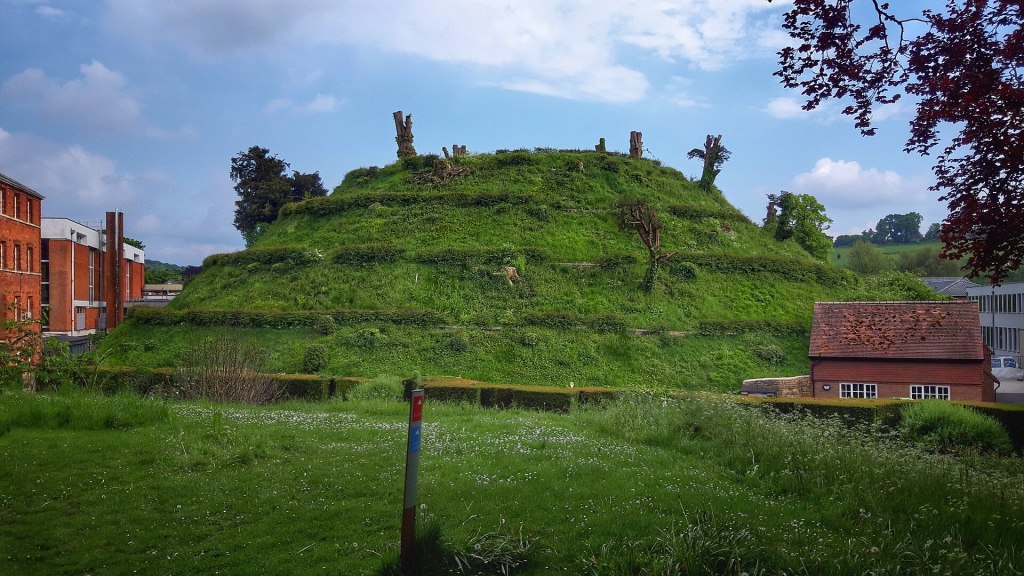
In the absence of an actual place I know that was meaningful to Isabella of Angouleme, I have come to Marlborough to see the mound, likely the site of the castle where she stayed on and off during her time with John, and which incidentally was part of the English queens’ dower for centuries, and now I’m in the lady chapel of St. Peters church just next door to do my pseudo-gather (I’m sorry Isabella, I’m not going all the way back to Fontevraud for you!). I still feel pretty guilty for the shabby way I treated her when I gathered Eleanor of Aquitaine, but I was very new to this and I hope I’ve done her proud now.
So. Isabella. Coming off Elizabeth of York its interesting comparing their personalities. Elizabeth is all front, all appropriate performance while Isabella – she is all id. She’s almost another Caroline of Brunswick, but smarter and angrier. At 12 years old, or more likely 10, she would even then have understood that she was living with her future husband Hugh IX de Lusignan – emphasis on future – and learning his family’s ways when she is abruptly removed by her father and told she will shortly – tomorrow – be marrying the king of England. Sudden, massive change, hasty marriage, journeying away from home and lavish coronation where she is stripped to be anointed with holy oil in a ceremony that promises much – equality, respect, power – and delivers none of it. For a few years she lives with John, and given his temperament it is unlikely he would have controlled himself with her. When things with France or the nobles start heating up she is sent to live with John’s first wife Isabella of Gloucester in Winchester for a year or two, and then returns to her husband and her wifely duties. She provides a male heir, Henry, and for the first time is granted her queen’s gold in reward, likely the first time in her marriage she had any money of her own. More children follow, but things are so tense politically that most of her confinements are accompanied by an armed guard and there are frequent removals for her safety, from castle to castle. Earlier in her marriage she is at Chinon being besieged and she begs John to rescue her: John, fearing for his own skin, waits at Le Mans and outsources her rescue to some hired henchmen. He never would have left it to mercenaries had it been his mother. But through no fault of her own, Isabella lacked the political and emotional resources that Eleanor could command.
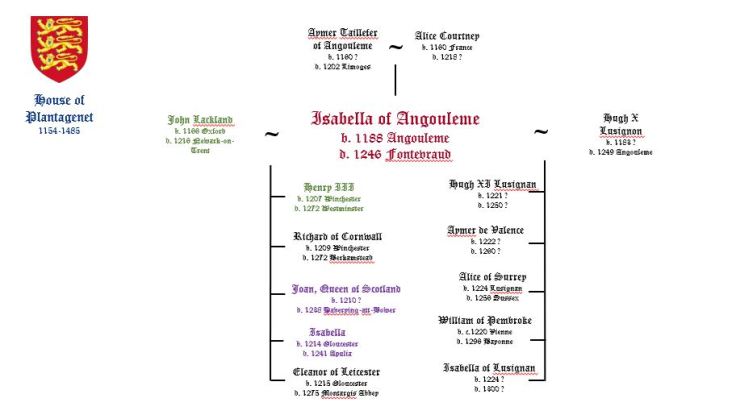
For 16 years she lived with an ineffectual narcissist and learned all the worst possible lessons from him. We see no evidence of her wielding even passive influence as his queen, but by the time of his death, she is thought to be beautiful, but with a sharp tongue and a thirst for power. As far as I can see she does exactly one (1) queenly thing in her whole life: on hearing of John’s death she grabs her son Henry and races to Gloucester Cathedral to have him immediately crowned, using a piece of her own jewellery as the true crown was lost by John in his retreat from the French. And then, that grand maternal and dynastic service done, the nobles of England quite wisely exclude her from all future business to do with her son or the throne. It wasn’t because she was a woman. Henry’s regent and protector William Marshall knew Eleanor of Aquitaine very well. The objection was to THIS woman. She was fierce and indomitable but only in her own interests, and her second life in France proved her detractors right. She takes up her position as countess in Poitou, but expecting to be treated as though she were still queen. She marries the one man in all of France that will cause the most trouble to her son, but writes to tell him ‘I did it all for you’. And lets not forget that this man is Hugh X de Lusignan: son of her former betrothed, and the actual betrothed of her own young daughter Joan, whom Isabella holds hostage against the payment of her dowry by the English council. She spends the next 30 years ping-ponging between the French and English crowns and somehow letting her husband be seen as the guilty party for the scrapes she gets them into. All of this climaxing with her (allegedly) plotting to poison the king of France after some imagined slight, and having to retreat to sanctuary at Fontevraud Abbey, where she spends the rest of her life cloistered as a nun.
She seems to have had an absolute belief in her rights as former queen of England, she believed herself to be all-powerful and forever in the right by sheer force of will and for much of her life that force convinced everyone else too, including her son who could never quite believe the stories his councillors were telling him. She was a firebrand, she demanded what was due to her and literally waged war in her rage to achieve it and keep it. She must have been charming and intelligent to get away with it for so long, and she must also have been beautiful even as an older woman, because her husband did some very foolish things to maintain access to her bed. She was a spoilt, devious child in a woman’s body and her legend lived on in the hoard of de Lusignan relatives she unleashed upon England after her death, causing merry havoc for Henry for decades. She must have been cackling in her grave! Isabella of Angouleme, Queen of England, I honour you.
The Life of Isabella of Angouleme (or what we know of it)
We have yet another queen whose dates are all over the map. There is a lot of scholarly conjecture around her year of birth, but to my mind, it doesn’t really matter if she was 12 or 8, pretty much the same difference. There is also some significant drift in regnal years, so I’ve done some tidying up to make sure events follow on from each other. The final note is that a lot of authors seem to enjoy making bold claims about Isabella getting her full dower lands restored to her, so that comes up several times, but I think in reality she never actually had hold of the full estate before Henry III started granting it away again.
1188
- Isabella is born to Aymer, Count of Angouleme and Alice de Courtenay. It is possible her birth was as late as 1192, but she was described as twelve years old in 1200 because that was the legal age of marriage [12, 20]
1200
- Isabella is betrothed to Hugh IX of Lusignan, and is sent to live in his uncle Raoul’s household until she is old enough to be married [12]
- May: Isabella and John exchange formal betrothal vows. Isabella and Hugh IX of Lusignan had also exchanged marriage vows and were formally maried although due to Isabella’s age Hugh had not ‘espoused’ her. No record of the dissolution of this marriage exists [19]
- Summer: Isabella meets John for the first time during his progress through Poitou. John secretly arranges for Hugh of Lusignan to be sent to England while he negotiates with Count Aymer for Isabella’s hand [12]
- August 23: Isabella is informed by her parents that she is to be married to John [12, 13]
- August 24: Isabella marries John of England in Bordeaux Cathedral. The marriage is witnessed by the Bishops of Burgundy, Saintes, Perigaux, Limoges, Angouleme and Waterford, who all sign a document testifying to the legality of the marriage. Isabella’s marriage portion at her wedding amounts to around £400 per year, made up of the cities of Bauge, Beaufort-en-Vallee, Chateau-du-Loir, La Fleche, Niort, Saintes, Saumur and Trou, many of which were part of the dower of Berengaria of Navarre, who is given 2,000 marks in exchange. Niort and Saintes were granted possibly as a snub to the de Lusignans, and in reality remain in the hands of Eleanor of Aquitaine. Many of these were immediately re-taken by the Capetian kings of France [9, 12, 13, 15, 19, 20, 21]
- August: One day after assigning Niort to Isabella, John gives it to William Cocus for an annual rent of £200. During John’s reign, Isabella would not see the income from any of the lands assigned to her [19]
- October 8: Isabella is crowned queen of England, alongside John in a joint ceremony at Westminster Abbey, presided over by Hubert Walter. She stands under a concealing canopy so she can strip to the waist and be anointed with holy oil, suggesting she would be able to exercise vice-regal powers, though in reality she would have almost none. [12, 13, 15, 20, 21]
- November: Isabella is at Marlborough Castle while John travels north for the funeral of Bishop Hugh [21]
- December 25: Isabella and John celebrate the Christmas holidays at Guildford [12, 21]
1201
- Easter: Isabella and John travel to Canterbury on a pilgrimage to the shrine of Thomas a Beckett [21]
- April: Isabella and John are at Exeter and Wells [21]
- May 13: Isabella and John sail from Portsmouth to France in separate ships [21]
- May 31: Isabella and John are installed at chateaux Gaillard, and are joined by the French king Philip Augustus [21]
- June 1: Isabella and John visit the French king Philip Augustus in Paris, and are presented with gifts and champagne [21]
- December 25: Isabella and John celebrate the Christmas holidays at Caen [21]
1202
- June 16: Isabella’s father Aymer dies in Limoges. On his death, John appoints Bartholomew de Puy as governor of Angouleme to control its lands in his interest, and de Puy holds that position until John’s death [10]
- Summer: Isabella and John travel to Angouleme, where the barons and knights swear fealty to her as Countess of Angouleme, though it would be her mother, the Dowager Countess Alice, who would rule in her name [21]
- December 25: Isabella and John celebrate the Christmas holidays at Caen [21]
1203
- January 23: Isabella is besieged while staying at Chinon castle. She sends word to John to rescue her, but fearing that it would make him vulnerable, he waits at Le Mans castle, and sends hired merceneries led by Peter de Preaux to rescue her instead [10, 13, 21]
- December 6: Isabella and John sail from France to Portsmouth 13, 21]
- December 25: Isabella and John celebrate the Christmas holidays at Canterbury [13, 21]
1204
- April: Shortly after Eleanor Aquitaine’s death, Isabella is assigned some of her estates including Exeter, Ilchester, Malmesbury, Chichester and Queenhithe, Waltham, Berkhamsted, Rockingham and the whole county of Rutland, as well as towns in Normandy. She is also promised that if any of her French estates are lost through conflict with France, they would be replaced by lands in England. In fact, they had already been overrun and retaken by the French. [18, 19]
- May 5: Isabella is briefly granted the rights to Queen’s Gold. Not long after, John sends her to live in Isabella of Gloucester’s household at Winchester, where he pays £80 per year for their joint upkeep [10, 21]
- December 25: Isabella and John celebrate the Christmas holidays at Holme Castle, near Tewkesbury [21]
1205
- May: Isabella’s lands in Rutland are granted away by John to Ralph de Normanville and his heirs; no substitute is given [18, 19]
1206
- April: Isabella receives a gold cup, foundered from 3 gold marks John recieved from his Jewish lenders. John had been holding back Isabella’s Queen’s Gold for his own use, and would occasionally grant such gifts as tokens to placate her [19]
- June 1: Isabella and John cross cross the Channel to France [21]
- November: Isabella is formally recognised as the Countess of Angouleme, after her father’s death in 1202 [20]
- December 12: Isabella and John sail from France to Portsmouth [21]
- December 25: Isabella and John celebrate the Christmas holidays at Winchester. This would be where she would conceive her first child [21]
1207
- April 22: Isabella is at Clarendon for the Easter holidays, and around this time John provides her with a gilded saddle and harness, and among others items, half an otter skin [21]
- September: Isabella is in her confinement at Winchester [21]
- October 1: Isabella gives birth to her first child, a son named Henry, at Winchester Castle. John is present at the castle for the birth. [10, 20, 21]
- November: Isabella looses access to the queen’s gold again: an order is issued by John that henceforth all Queen’s Gold would be accounted for in the King’s treasury [19]
- November 22: Isabella has access to her queen’s gold, after John orders it to be administered separately from his own income. This is likely the first time in her marriage she had any source of personal income, and was possibly a kind of reward for providing John with an heir [10]
1208
- December 25: Isabella and John are at Bristol Castle for the Christmas holidays [21]
1209
- January 5: Isabella gives birth to her second child, a son named Richard, at Winchester Castle. He is baptised by Peter des Roches, Bishop of Winchester, despite the entire county being under a papal interdict. His nurse is named Eva, and for the first seven years of his life he remains with his mother. [10, 20, 21]
1210
- June: Isabella is begged to intercede on behalf of Maud, wife of William de Braose. John has demanded that she give up her son as a hostage, and Maud offers 400 head of white cattle to Isabella if she would change her husband’s mind. There is no written outcome of the plea, but mother and son are imprisoned in Corfe Castle and starve to death [21]
- July 22: Isabella gives birth to her third child, a daughter named Joan, at Gloucester. She is sent to be raised at Romsey [10, 20, 21]
1214
- Spring: Isabella gives birth to her fourth child, a daughter named Isabella. Her nurse is named Margaret Bisset. [20, 21]
- February 2: Isabella, with John, her mother Alice and their children Richard, Joan and Isabella, set sail from Portsmouth to France to treat with the Lusignans [10, 21]
- Isabella’s lands in Saintes are granted away by John to their daughter Joan as part of her marriage portion to Hugh de Lusignan X. No substitute is given [18]
- May 25: Isabella is present for the peace between John and Hugh of Lusignan at Parthenay. In exchange for Hugh protecting Angevin lands in Poitou, his son Hugh X will marry Isabella’s daughter Joan. The princess is immediately handed over to the Lusignan family to be brought up in one of their households [21]
- June 17: Isabella and John are at Angers [21]
- October 1: Isabella and John sail from Poitou for Dartmouth [21]
- November 3: Terric the Teuton is ordered to ensure Isabella’s safe passage under armed escort from Freemantle via Reading to Berkhamsted for her fifth confinement [19, 21]
- December 3: Isabella is ordered to remove to Gloucester for her safekeeping by John, who is being threatened by the barons to revolt against him. [There is some confusion as to whether she is there for her safety, or actually held against her will] [9, 19, 21]
- December 25: Isabella spends the Christmas holidays at Gloucester [21]
1215
- March: Isabella gives birth to her fifth child, a daughter named Eleanor, at Gloucester [20, 21]
- May: Isabella is escorted to Winchester for her safety in light of the barons taking London. Isabella stays with her son Prince Henry, and is joined later by John [19, 21]
- May 5: Isabella’s lands are confirmed by John, but with the possibility of needing to make exchanges if war breaks out, in response to his barons withdrawing their fealty from him [9]
- May 27: Isabella is staying at Marlborough Castle when John orders fish especially for her, particularly roach and small pike [9]
- August: Isabella is sent to Corfe Castle for her safety as the First Baron’s War escalates. She and Prince Henry are guarded by the castle’s custodian Peter de Maulay, who was also Prince Richard’s guardian. John also has a man placed in Isabella’s custody who had signed Magna Carta. He has sufficient trust in his wife to allow her to hold his hostages. This had happened on numerous occasions before with young sons of wayward barons being forced to act as pages for the Queen and serve at her table. [21]
1216
- May 20: Isabella is staying at Bristol Castle when she hears news of the invasion by the Dauphin Louis and his progress into London [13]
- Summer: Isabella is at Bristol [19]
- July: Isabella is at Corfe Castle where she receives John, who is in the middle of a constant battle for the country after the French invade, led by Philip Augustus’ son Louis, and take London, Winchester and other cities [21]
- October 18: Isabella’s husband John dies of dysentry at Newark Castle. His last act is to entrust the care and regency of his son Henry to William Marshall. Isabella’s whereabouts when she hears the news of his death are unknown, possibly Bristol, Devizes or Corfe. John is later buried at Worcester [9, 12, 13, 20, 21]
- October 28: Isabella arranges for the hasty coronation of her eldest son as Henry III at Gloucester Cathedral. As the crown jewels had been lost by John, Henry is crowned wearing one of Isabella’s gold collars. He is crowned by Bishop Peter of Winchester, assisted by the Bishops of Exeter and Worcester. The feast that follows is attended by Isabella, five knights, and many abbots and priors. [11, 12, 13, 21]
- November 1: Isabella is finally granted her dower lands by the minority council. Her son Henry III, at just 9 years old, writes to the Abbot of Waltham Abbey demanding payment be made to Isabella what she is owed, and apologises at not yet having a great seal, instead using that of his justiciar, William Marshall [4, 21]
1217
- February: Isabella receives a papal grant of protection [2]
- March 23: Isabella receives royal letters of protection, without term, from her son Henry III [4]
- April 5: Isabella is granted the castle at Exeter by her son Henry III, having written to Robert de Courtenay demanding it be handed over and his mother be received honourably [4]
- June: Isabella, having no political role and experiencing difficulties in securing her property, plans to return to Angouleme, leaving her children in England. [12]
- July 23: Isabella’s son Henry III writes to the counts, barons and citizens of Poitiers requesting they receive her honourably and allow her to enjoy her dowry in their lands [4]
- August: Isabella is staying with her son Henry III at Windsor when she takes part in peace talks with Herve, Count of Nevers on behalf of the French Dauphin Louis, who is still in England after his failed attempt to take the English crown [21]
- August 13: Isabella is granted the castles of Melpins and Bordeaux, currently in the hands of Reginald of Pontus [4]
- August 13: Isabella is granted the fees from stables across Devon, payable by Robert de Courtenay, and those of Somerset, payable by Peter de Maulay, as part of her dowry [4]
- September 18: Isabella stands with William Marshall and the Papal legate Gualo Bicchierei on the banks of the River Thames, shouting across to the French Dauphin Louis and his advisors standing on the opposite bank, conducting further peace talks. Ultimately Louis is forced to concede and the Treaty of Lambeth ends the conflict [21]
- September 18: Isabella is at Merton Priory for the conclusion of the peace with Louis VIII of France [11]
- December 2: Isabella is granted Queenhithe in London for three years [4]
1218
- Isabella, believing that Bartholomew of Puy, mayor of Angouleme, is plotting against her, strips him of his title and property, and takes his two sons as hostage [11]
- July: Isabella successfully negotiates with the pope to receive the sacrament by her personal chaplain during the general interdict [2, 9]
1219
- February 12: Isabella’s mother Alice de Courtenay dies [21]
- March 17: Isabella is excommunicated by the Bishop of Saintes, possibly as a result of the dispute over Bartholomew de Puy, or because she continues to demand the reinstatement of her dower lands of Saintes and Oleron. [21]
- April: an indult (papal mandate overriding local ecclesiastical authority) is issued ” to Isabella, queen of England, that no one without special apostolic mandate shall pronounce against her sentence of interdict or excommunication, notwithstanding the sentence which the bishop of Saintes is said to have pronounced”. This essentially gives her personal exception from the interdict, allowing her to receive the sacrament from her personal chaplain. This privilege is normally reserved for monarchs [2, 9]
- June: Isabella writes to the Bishop of Norwich regarding being instructed by the minority council to reinstate Batholomew de Puy. She refuses to give back his sons until she is sure he means her no harm, and threatens them with dire consequences if she is ‘removed from our son’s council’ [21]
- July: Isabella is presented with letters from her son’s minority council, by Bartholomew of Puy, directing her to reinstate him and his property. It is not known if she obeys. [11]
1220
- February 7: Isabella is instructed to receive the fidelity of the newly elected Bishop of Limoges and hand over the royalties which she owes him, and which both she and Hugh de Lusignan have been witholding, by her son Henry III [4]
- Spring: Isabella marries Hugh de Lusignan X. Her daughter Joan is currently living in his household as she had been betrothed to Hugh. Isabella then refuses to give back her daughter to Henry III, holding her as a hostage until her dower lands have been fully granted, along with 3,500 marks which Isabella claimed John bequeathed her on his deathbed. The joining of Isabella’s lands to Hugh is exactly the situation which John tried to avert in 1200 by marrying Isabella. [12, 20, 21]
- May: Isabella writes to her son’s minority council regarding her marriage to Hugh de Lusignan “…it was proposed that he should take a wife in France; which if he should do, all your land in Poitou and Gascony, and ours too, would be lost. We, therefore, seeing the great danger that might arise if such a marriage should take place, and getting no support from your councillors, have taken the said Hugh, count of La Marche, to be our lord and husband…”. At the same time, she informed the councillors that she would be very happy to return her daughter Joan to England, who had been raised in Hugh’s household since they were betrothed, if they would reinstate her dower lands. This leads to a stalemate between England and Angouleme, with Henry drafting in the Pope to try to fix it, though throughout the letter, he describes Joan as being held in the custody of Hugh, either suggesting he is misinformed, or has more regard for Isabella than is justified. [4, 11]
- September 25: Isabella and Hugh X are threatened with excommunication by the Pope for not complying with Henry III’s wishes that Hugh come to England and bring his sister Joan with him [21]
- September 29: Isabella’s dower lands in Rockingham are granted away to Richard de Redvers [8]
- October: Isabella receives a letter from the Pope, astonished at her imprisonment of Bartholomew de Puy, ordering her to free her hostages and restore his sons and castles. Isabella’s response is not known [2]
- November: Isabella’s daughter Joan is escorted to the French coast by Hugh X [21]
November 1: Isabella’s husband, and most likely Isabella herself, are at Merpin besieging the castle held by Henry III, to which Henry writes to the citizens of Cognac complaining of his behaviour and asking their help [4]
1222
- April: Possibly as a result of Isabella’s marriage to Hugh X, which displaced her own daughter Joan who had been betrothed to him, and the refusal to send her back to Henry III’s minority council, Isabella is granted her full dower. [11, 19]
1223
- June 16: Isabella’s lands and estates in Wilshire are granted away to Thomas of Cirencester by her son Henry III [8]
- October 15: Isabella’s lands at Queenhithe in London are granted away to Thomas of Cirencester by her son Henry III [8]
1224
- April 23: Isabella’s daughter Eleanor marries William Marshall, son of the regent William Marshall who died in 1219, and becomes Countess of Pembroke [20]
- June: Isabella and Hugh X ally with the new French King, Louis VIII, against Henry III, in exchange for Saintes, Oleron and Bordeaux. The English council counter with the lands and money she is still owed, but she refuses. [21]
1226
- May: Isabella’s lands in Poitou are confiscated by Henry III and given to Henry’s brother Richard Duke of Cornwall, in response to Hugh X renewing his fealty to the French king. [21]
- November: Isabella and Hugh X ignore an invitation to attend the coronation of the new French king, Louis IX, mostly because they felt constantly attacked in their lands by the French army. [21]
- December 18: Isabella is granted the city of Niort as part of her dower for her lifetime and that of any of her direct heirs, after which it will be returned to the English crown [5]
- December 18: Isabella receives a letter from her son Henry III, letting her know that she may have the 3,500 marks she claims was bequeathed to her by John on his deathbed, if she can find anyone who was at John’s death to corroborate her story [5]
1227
- Isabella’s final lands remaining in England, including estates in Exeter, Ilchester, Wilton, Kenton, Edrichston, Wick, Lefton, Maumesbury, Waltham and Queenhithe, are all granted away into the keeping of Thomas of Cirencester, presumably held on behalf of Richard Duke of Cornwall. The assignment is meant to be temporary for in reality lasts for years [5, 9, 18]
1228
- May 15: Henry III writes to the Bishop of Vasa and Dean of Saint Severin of Bordeaux, who have until now been investigating the spiritual legality of Isabella’s marriage to her own daughter’s betrothed, and requests they make no further inquiries [5]
1235
- May: Isabella’s marriage to Hugh de Lusignan, and its potential as ‘spiritual incest’ is still being investigated by Pope Gregory IX, at Henry III’s instigation [9]
- July 20: Isabella’s daughter Isabella marries Frederick II of Sicily at Worms Cathedral, and becomes Holy Roman Empress and Queen of Sicily, Italy and Germany [20]
1236
- February 8: Isabella receives special mention in the truce between Henry III and Louis IX of France, ‘the king is not to implead or to vex H[ugh] count of La Marche and Isabel his wife, the king’s mother, at any time during the truce’ [6]
- April 13: Isabella and Hugh promise military aid to Thibaut, count Palatine of Champagne against the French crown, which ultimately fails [9]
1238
- January 7: Isabella’s daughter Eleanor marries Simon de Montfort, 6th Earl of Leicester in secret at Westminster Abbey [20]
1241
- June: Isabella leaves her marital home when her husband Hugh of Lusignan pledges his fealty to Louis IX’s brother without informing her. Hugh follows her to Angouleme and begs her forgiveness and eventually the couple are reconciled [12]
- December 25: Isabella and Hugh X are at Poitiers for the Christmas holidays, staying with Alphonse, Count of Poitou. The couple announce to their host they are withdrawing their support, believing him to be a usurper of Isabella’s son, Richard, Duke of Cornwall’s, rightful title. On leaving the count, they set fire to their lodgings assigned to them and head for Lusignan [21]
1242
- February 28: Henry III sends 3,000 marks via two couriers to Isabella and Hugh X with instructions they are to do with it what they please, presumably in anticipation of Henry’s invasion of France [6]
- May: Isabella meets her son Henry III for the first time since she left for France, and greets him ‘very sweetly’ as he and his army come to challenge the French. Ultimately the rebellion would fail due to Henry not raising enough troops and the Poitevin nobles being too faint-hearted. Richard of Cornwall blames Hugh of Lusignan, and Hugh blames Isabella, claiming he never wrote letters, signed by him, encouraging Henry in the first place [9, 21]
- July 26: Isabella and Hugh X renew their fealty to the French King, having given their eldest son Hugh XI as a hostage of their good intent. Louis’s price for their forgiveness is the loss of their pensions and the town of Saintes, and they have to agree to fight with Louis against Henry III [9, 21]
- Winter: Isabella is accused of attempting to poison the French king. If found guilty, the punishment would be torture followed by being drawn apart by four horses. She attends the court but on recognising one of the witnesses she flees [12, 21]
1243
- March: Isabella and Hugh draw up a division of their estates between themselves and their children, possibly hoping the French crown will allow the children to keep their estates [9, 19, 21]
- Summer: Isabella flees from her family and claims sanctuary at Fontevrault Abbey, while her husband Hugh X and their children are seized. Hugh offers trial by combat against Alphonse of Poitou to prove Isabella’s innocence but Alphonse refuses. Isabella, on hearing this, takes the veil officially at Fontevrault, planning to spend the rest of her life as a nun [21]
1245
- July: Isabella, in an enquiry into the marriage of one of her children by the Holy See, is referred to as ‘the wife of the count of La Marche’, a sign that she is being taken less seriously by those who know her after taking the veil at Fontevraud [9]
1246
- June 2: Isabella authorises a letter to the French king Louis IX asking that her sons by Hugh be allowed to take possession of her lands, which he does permit, and their eldest son becomes Hugh XI. [9, 19, 21]
- June 4: Isabella dies at Fontevraud Abbey, having never left it since claiming sanctuary there. In her will she leaves 1,000 marks to the abbey, including 100 to pay for a chantry priest. She requests her body be interred in the common ground with the other nuns. Her funerary effigy is in wood showing her ‘habited in a camise, fastened with a fibula, a robe, and a loose mantle; she also has a wimple and veil. The whole of these effigies have been elaborately painted and gilt…’. Henry III orders the English court into mourning but only for three weeks, but does provide 50s a year for a chaplain to celebrate divine service for her soul. Matthew Paris says of her that she is ‘very much in need of the intercession of endowed prayers for her soul…’ [6, 7, 9, 12, 19, 21]
References
- Ashley, Maurice (1972) The Life and Times of King John. London, Weidenfeld & Nicholson
- Bliss, W. H. (1893) calendar of entries in the papal registers relating to Great Britain and Ireland. Vol 1; AD 1198-1304. London, HMSO
- Cazel, Fred A. & Sidney Painter (1952) ‘The marriage of Isabelle of Angouleme’ in The English Historical Review Vol 67:263 (April 1952) pp.233-235
- Deputy Keep of the Records (1901) Patent rolls of the reign of Henry III preserved in the Public Record Office: AD 1216-1225. London, HMSO
- Deputy Keeper of the Records (1903) Patent rolls of the reign of Henry III preserved in the Public Record Office: AD 1225-1232. London, HMSO
- Deputy Keeper of the Records (1906) Patent rolls of the reign of Henry III preserved in the Public Record Office: AD 1232-1247. London, HMSO
- English statues at Fontevrault’ (1867) in The Gentleman’s Magazine, April 1867, pp440-446. London, Chatto & Windus
- Henry III Fine Rolls Project (https://finerollshenry3.org.uk/home.html) accessed 14.06.2025
- Jordan, William Chester (1991) ‘Isabelle d’Angouleme, by the grace of God, queen’ in Revue beige de philologie et d’histoire, vol 69:4, 1991, pp821-852
- McQuinn, Kristen (2021) The Two Isabellas of King John. Yorkshire, Pen & Sword Books
- Norgate, Kate (1912) The Minority of Henry III. London, Macmillan & Co.
- Norton, Elizabeth (2011) England’s Queens: the biography. Stroud, Amberley Publishing
- Norton, Elizabeth (2017) She Wolves: the notorious queens of England. Stroud, The History Press
- Presutti, Sac. Petrus (1888) Regesta Honorii Pape III iussu et munificentia Leonis XIII Pontificis Maximi ex Vaticanis archetypis Vol 1. Rome, Vatican Press
- Richardson, H. G. (1946) ‘The marriage and coronation of isabelle of Angouleme’ in The English Historical Review Vol 61:241 (Sept 1946) pp.289-314
- Richardson, H. G. (1950) King John and Isabelle of Angouleme in The English Historical Review, Vol 65:256 (July 1950) pp.360-371
- Stein, Robert M. (2017) ‘Royaumes sans frontieres: the place of England in the Long Twelfth Century’ in Fenster, Thelma (2017) The French of Medieval England. London, Boydell & Brewer
- Storey, Gabrielle (2024) The Dowers of the Angevin Queens: a comparative study in De Medio Aevo, 14 (1), 2025: 57-68.
- Vincent, N. (1999) ‘Isabella of Angouleme: John’s jezebel’ in Church, S. D. (1999) King John: new interpretations. Woodbridge, Boydell Press
- Weir, Alison (2002) Britain’s Royal Families: the complete genealogy. London, Pimlico
- Weir, Alison (2020) Queens of the Crusades: Eleanor of Aquitaine and her successors 1154-1291. London, Jonathan Cape.
 Anglica Regina
Thanks for the fascinating post and photos. 🏄♂️
LikeLike