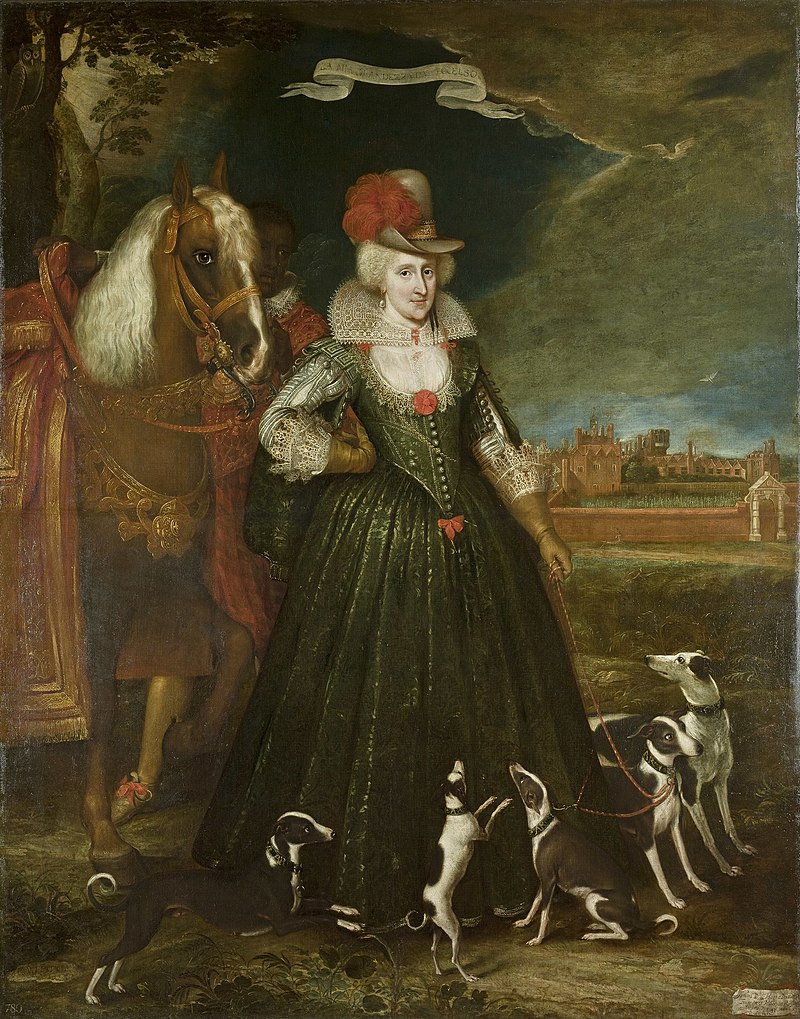
La mia grandezzo dal eccleso (My power is from the most high)
Westminster, March 14th, 2025
I seem to be flip-flopping between big, dynamic queens and those who have been mostly overlooked. Anna’s career, and the two ways that we understand her are so clearly split, with her time in Scotland marked by almost constant turmoil and her rule in England more passive – so maybe that’s why the prevailing view of her as vapid and empty is what the English at the time saw. It didn’t occur to me to read a Scot-written biography: something to consider for future queens.

Anna was one of the few women to be crowned queen of two countries: Eleanor of Aquitaine had the crown of France and then of England, but not at the same time. The Empress Matilda was Empress of the Holy Roman Empire before she tried her hand back home, but she arguably never actually got her hands on it. But Anna was crowned queen of Scotland, and then as if she found a taste for it or wanted the matching set, she took England as well. The years of her Scottish tenure seem to have been an endless round of battles and factionalism which must have been exhausting after being brought up at the relatively stable Danish court. But she was hardy. She survived the first attempted crossing, the short rations when she finally got here (not a single lodging had been made ready for her), the multiple attacks by Bothwell and his supporters, in the face of an increasingly paranoid and wimpish James, and then planting her flag and refusing to be mollified or moved when it came to the custody of her son, who was removed from her probably within days of her giving birth, and who was handed to a powerful lord with instructions not to let her have him. It probably didn’t matter who the actual custodian was, but Mar took the full force of her displeasure. She wasn’t gracious or yielding, she kept banging on the door, turning a simple domestic arrangement into an international incident, with Elizabeth’s spies sending concerned letters up and down the country informing on what new trouble Anna was causing. And despite both James and Elizabeth’s exasperation, and whole host of agents, advisors, ambassadors, lords and ladies, she was, as the Venetian ambassador described her, unendurable. Through sheer force of will, and a terrifying determination to do damage to herself in her cause, she won. She reclaimed her son, she bested Mar, and she turned her royal progress through England into a triumphant piece of theatre. We won’t ever know which account to believe, whether she genuinely miscarried at Stirling Castle through stress, or whether she induced it herself, but the outcome was decisive. And no matter what version of her the English would see over the next 16 years, James would never be able to forget of what she was capable.
And then there’s her English career, which looks loose and pretty on the outside, but still held some substance. She gathered a core group of culturally inclined and influential women around her, and together they patronised a huge number of artists, writers and architects, including her favourite, Samuel Daniel, but also including Ben Jonson, Inigo Jones and William Shakespeare. Her Christmas masques are seen superficially as a powerful woman pandering to herself, but she used them skilfully to centre herself and her court as equal to or better than the king’s. She danced in blackface, in one of Elizabeth’s old dresses cut off at the knees, six months pregnant, focusing all attention on herself at the progenitrix of a new dynasty. She could communicate with her whole body that while James could sleep with as many women and men as he pleased, she was the one literally creating the royal house of the future in front of their eyes. By carefully curating her appearances with her son Henry, she could again highlight their relationship, their dynamic, their shared tastes, while all James was interested in was hunting and eating.
She had 9 good years with Henry before his death in 1612, and her retreat into her own failing health and company are understandable. It feels like her health became the lynchpin around which she revolves towards the end, taking spa trips and progresses, and with less performance and extravagance. I wonder if the younger son Charles felt left alone, he never had the same kind of relationship with Anna as Henry did, she couldn’t even attend his investiture as Prince of Wales due to her health, or her grief. Maybe he had come to terms with being the spare, but he isn’t my concern. He’s Henrietta Maria’s problem. He at least was with her at the end to hear her will, although ‘your property, may I have them’ is a little tart. James was off hunting at Theobalds, as he seems to be for most important events, but he also died there, so there’s that.
I really love the later portrait above: Anna’s wardrobe accounts suggest that the majority of her dresses were white, but this is a rich, forest green, and she’s standing in control of her animals and servants, making it clear she isn’t just rich but powerful. Her hand on her hip is a typically male stance, and the fact that she had herself painted showing the right side of her face meant that this couldn’t be mistaken for a companion to any portrait of James: it stands alone, as she does, mistress of her domain. There is 40 years of experience, of keeping on her toes and probably some regrets. She looks real to me here, which can be missing from from earlier representations.
Anna survived attacks and censure, lived in a treacherous court known for casual murder, multiple miscarriages and a husband who made no attempt to hide his preferences, but unlike many other survivors who’s only reward was more struggle, Anna emerged from it to live out her tenure in relative safety (plague notwithstanding) and comfort, and to fully inhabit the role of queen and woman as she chose them to be. She was fierce, and belligerent and unforgiving, but she was also dynamic, resolute and generous. Anna of Denmark, Queen of England, I honour you.
The Life of Anna of Denmark (or what we know of it)
Many of the entries here are from diaries or exchequer accounts which don’t always write about an event on the day it happened, so there may be some drift in dates
1574
- December 12: Anna is born to Sophie of Mecklenberg-Gustrow and King Frederick II of Denmark at Skanderborg Castle. According to the custom in Denmark, Anna is sent with her older sister Elizabeth to be raised by their grandparents the Duke and Duchess of Mecklenberg in Gustrow, Germany, where they remain for 4 years. [4]
1577
- April 12: Anna’s mother Sophie gives birth to her third child, a son named Christian. 1 week after his christening he is sent to live with Anna and Elizabeth in Gustrow. [4]
1584
- June 15: Anna, along with the rest of the royal family, ministers, nobles and citizens kneel and repeat the oath of allegiance to her brother Christian as King Frederick’s elected successor. [4]
1588
- April 4: Anna’s father King Frederick II of Denmark dies at Antvorslev Castle after experiencing stomach pains while swimming. After the funeral, Anna, her mother and sisters move to Copenhagen so the Queen Mother can advise the council on Christian’s upbringing [4]
1589
- June: Anna’s family is visited by Lord Keith, Earl Marischal, Lord Dungwall and John Skene on behalf of James VI of Scotland with a suit for Anna’s marriage. The journey was funded by a loan from Elizabeth I, who was angry when she found out what the money had actually been used for [4]
- August 20: Anna is married by proxy to James VI at Kronborg Castle, with George Keith, 5th Earl Marishal standing as his proxy [1]
- September 1: Anna sails for Scotland on the Gideon, escorted by 13 war ships. They hit seas so rough the ship springs a leak, letting in 2ft of water into the hold, and Anna narrowly avoids being crushed by a loose canon rolling free on deck. Eventually believing it to be the work of witches, the admiral turns the fleet back to land in a Norwegian fjord [4]
- October 10: Anna’s letters to James explaining their brush with death land via a Danish ship in Scotland [4]
- November 23: Anna is married in person to James VI at the Old Bishop’s Palace in Oslo. She wears her original dress, miraculously saved from the sea crossing. As they drive from the church, James arranges for four African slaves to dance ahead of their carriage, though they later die of pneumonia. A large banquet is held at Akerhus, though it was less lavish than hoped for as crops were scarce. The couple move onto Copenhagen to visit the Danish royal family, spending Christmas and New Year with the King of Sweden [4]
1590
- January 21: Anna is re-married to James VI at Elsinore Castle according to Lutheran rites [4]
- March: Anna and James VI visit Tycho Brahe’s observatory on the island of Hveen [4]
- April 21: Anna and James VI set sail from Denmark and again experience severe weather on the voyage [4]
- May: Anna and her fleet land at Leith. She is greeted by jubilant citizens, a speech by James Elphinstone and a presentation of the members of the King’s Council. The couple remain at the Old Custom House for five days while Holyrood House is made hospitable. [4]
- May 6: Anna makes her formal entrance into Edinburgh, riding in a silver carriage brought from Denmark. A new palace structure is erected at St. Giles ‘adorned with the queen’s ancestry and the arms of Denmark, as well as the freedoms and arms of all past Scottish queens’. [4, 14]
- May 17: Anna is crowned Queen of Scotland at the abbey church of Holyrood, according to Protestant rites, though some misgivings were had over the anointing of oil. As part of the coronation, Anna takes the oath ‘…that I withstand all papistical superstitions and ceremonies and rites contrary to the word of God and I will procure peace to the kirk of God within this kingdom’. [4]
- May 19: Anna progresses through Edinburgh again, finishing with the magistrates presenting her with the key to the city [4]
- December 25: Anna and James VI spend Christmas at Holyrood House. Over the holiday, they are both attacked by intruders led by the Earl of Bothwell, after he is held before the council for witchcraft. Bothwell escapes and is publicly proclaimed a traitor. [4]
1592
- June 28: Anna and James VI are attacked again by Bothwell and c.300 of his followers at Falkland Palace. James barricades himself in his room. After five hours of siege the attackers flee taking all of Anna’s horses to prevent pursuit. [4]
- August: Anna is suspected of being involved in the escape of a traitor, John Wemyss. Anna’s Danish maid, Margaret Vinster, had the man brought to Anna’s room while she slept and helped him abseil out of her window. [4]
1593
- June 8: Anna writes to Elizabeth I with ‘sundry conventional expressions of friendship’ in response to Elizabeth’s request that she be reconciled with the chancellor [6]
- June 10: Anna and members of her court visit the banished Countess of Huntly at Leith [6]
- July 10: Robert Bowes writes to Lord Burghley that the dispute between Anna and the chancellor over her dower lands at Dunfirmline have been resolved with all lands being transferred to Anna. [6]
- July 14: Robert Bowes writes to Lord Burghley that the matter of Anna’s dower lands will be the first item of business at the next parliament [6]
- July 20: Anna’s lands are confirmed by parliament and she rides to Musselburgh to take possession [6]
- July 24: Anna and James VI are attacked for a third time by Bothwell. James tries to escape into Anna’s room but it has been locked, leading both to panic. Bothwell professes his loyalty and is pardoned, and Anna and James appear to the public from her balcony to assure them all is well. Bothwell is then pronounced a traitor and he flees north and then to France [4]
- August 16: Anna and her court follow James VI to Inchmeryn for the hunting [6]
- August 16: Robert Bowes writes to Lord Burghley describing the continuing division between Anna’s faction and the chancellor, using her code name of Tripolis, and the chancellor’s of Menelaus [6]
- October 9: Anna is at Holyrood House, and it is reported that she is with child [6]
- November 23: Anna is described in a letter to Lord Burghley that she is “of late has been so stung with the venom and deceit of papists that she will no more suffer them to come near her” [6]
- December 22: Robert Bowes writes that Anna and James VI intend to spend the night of 11th January at Edinburgh and hold parliament, part of which will be to raise a tax of £50,000 to cover Anna’s furniture and expenses [6]
1594
- February 19: Anna gives birth to her first child, a boy named Henry Frederick, later to be Prince of Wales. Queen Elizabeth I stands as godmother, with the Earl of Sussex standing as her proxy [4]
- April 14: Anna is at Stirling, still ill, presumably from her labour, and angry with James that he has used money allotted to her as her marriage portion to pay for guards to search for Bothwell, leaving almost nothing to pay for Henry’s christening [6]
- August 30: Anna’s son Prince Henry is christened at Stirling Castle. He is immediately named Baron of Renfrew, Lord of the Isles, Earl of Carrick, Duke of Rothsay, Prince & Great Steward of Scotland, as well as being knighted. There follows a state banquet and pageant. [4]
- November 2: Anna is strongly advised against travel as she is suspected of being with child again [6]
- November 26: Anna’s cousin the Duke of Luneburg visits Scotland on his way to Denmark from Malta and dines frequently with James VI, and hoping to visit with Anna [6]
1595
- February 12: Anna is reportedly reconcilled with Mar, allowing him to kiss her hand at James VI’s insistence. Attempts are made to bring her into the company of Mar’s mother the Dowager Countess, so she can be further convinced, but Anna instead returns to Edinburgh to attend the wedding of the daughter of one of her men, Peter Young [6]
- March 4: Anna is reported to have formally asked for the keeping of Prince Henry and the castle at Edinburgh, supported by the lairds of Buccleuch and Cessford, to James VI’s great annoyance. [6]
- March 15: Anna is reported to have left off her requests to have custody of Prince Henry, saying she will ‘refer all to the king to do as he pleases’ [6]
- March 22: Anna and James stay at Stirling Castle with Prince Henry [6]
- March 25: Anna receives a gold and crystal tablet containing a crucifix and story of the Passion from James Morton, a Jesuit who is captured landing in Scotland and brought to the royal court for questioning, sent by Cardinal Caitanus of Rome [6]
- April 3: Anna rides to Linlithgow Castle, and the next day on to Stirling Castle, accompanied by Sir George Hume [6]
- April 10: Anna’s son Prince Henry is reported to be sickly on accout of a change of milk or possibly of his nursemaid, and that he should have been ‘spentt’ by this time [possibly weaned?] [6]
- April 24: Anna and James VI travel to Dunfermline [6]
- May 5: Anna is taken ill while at Linlithgow Castle, to the point she cannot attend the wedding of Patrick Lyon, Lord Glamis and Anna Murray [6]
- May 16: Anna is reported by Robert Aston that she continually enquires of Elizabeth I’s good estate, shows her affectionate goodwill towards her, and requests a portrait of her [6]
- May 25: Anna and James VI are together at Linlithgow Palace. An argument between them regarding the custody of Prince Henry is reported by one of Robert Cecil’s agents. [4]
- May 28: Anna is reported to be with child again, though she denies it to Robert Cecil’s agent Roger Aston when asked [6]
- May 30: Anna leaves Linlithgow Palace with her ladies to visit Stirling Castle and her now 15-month old son Prince Henry, at James VI’s urging. However she is taken ill on the journey and is forced to turn back. [4]
- June 1: Anna and James VI attend the wedding of Patrick Lyon, 9th Lord Glamis and Anna Murray, at Stirling Castle [6]
- June 2: Anna is taken ill while riding to Linlithgow Castle, being heavily pregnant, and the blame is laid with those who let her go in such a state. She sends for James VI, who visits her. There are reports that she ‘is parted with childe’, but without evidence [6]
- July 8: Anna is reported to be staying at Edinburgh and resisting visiting James VI at Stirling, wanting to continue the discussions about the custody of Prince Henry but reluctant to leave her supporters in the capital. She is described as ‘something craised’, and James starts to resolve not to go to her, resulting in a stalemate [6]
- July 10: Anna is finally confirmed in her dower lands exactly as desired by herself and the Danish ambassadors, with a short delay for inclusion of legal language expected in a Danish contract [6]
- July 14: In a letter to Robert Bowes in England, John Colville seems to implicate Anna and her supporters in an attack made upon Stirling Castle, meant to discredit the strength of the Earl of Mar to protect Prince Henry. The attacker was killed, and none of the lords were directly involved. Anna remains at Edinburgh and is described as ‘still thought to be diseased’, continuing to disobey James VI’s summons [6]
- July 26: Anna is at Edinburgh when James VI finally relents and comes to her, having received a letter certifying that she is genuinely sick by the evidence of the ‘Mistress of Ochiltree and sundry other gentlewomen’. She puts her case to him for the removal of Prince Henry from Mar’s care. He is reported to have replied ‘my harttt, I am sorry you should be presuaded to move me to thatt wich wil be the destrocsion of me and my blod’ [6]
- August 1: Anna travels by river from Edinburgh to Falkland Castle, having been first requested then threatened by James VI. [6]
- August 15: Anna and James are at Falkland together and seem to be, publicly at least, in better spirits. They hear a sermon from Patrick Galloway on the duties of man and wife towards each other, after which she takes some time to speak with him and listen to his advice. [6]
- August 15: Anna is reported by Roger Aston to being kept wherever James VI is, so that her former conspirators cannot have such easy access to her. Anna is also enjoined in a letter by her mother to obey James in all things, brought in person by Margaret Vinstarr, Lady Logie [6]
- August 25: Anna writes directly to Elizabeth I pleading for the recompense of a man who has been twice impoverished by English piracy and has waited 8 years for justice [6]
- December 15: Anna is able to visit Prince Henry at Stirling Castle ‘who is noted to be but a weak child’ [4]
1596
- August 19: Anna gives birth to her second child at Dunfermline Castle, a daughter named Elizabeth later to become Queen of Bohemia. Queen Elizabeth I stands as godmother [4]
- November 28: Anna’s daughter Princess Elizabeth is christened at the chapel royal at Holyrood House. Again the child is removed to be brought up by Lord Alexander Livingstone and his wife. This causes some controversy as his wife Helen is Catholic. James VI is so keen to save money on the christening a disappointing daughter that he asks guests to bring food for the feast [4]
1597
- July: Anna appoints George Herbert as her personal jeweller. She would spend £48k on his work in the first decade of James’ reign, and she would often pawn her jewels back to him when in need of money [4]
1598
- December 24: Anna gives birth to her third child, a daughter named Margaret [1]
1600
- March: Anna’s daughter Margaret dies of an unrecorded disease. She is buried in Holyrood Abbey [1]
- November 19: Anna gives birth to her fourth child, a son named Charles who would later become King of England as Charles I. He is baptised the same day as he is so weak. James VI personally pays the midwife, Janet Kinloch, £26-13. Charles is removed and sent to be raise by Alexander Seaton, Lord Fyvie and Constable of the Palace. [4]
1602
- January 18: Anna gives birth to her fifth child, a son named Robert Bruce, later to become Duke of Kintyre. At his baptism a month later James presents Anna with a pointed diamond [4]
- May 27: Anna’s son Robert dies aged 4 months [1]
1603
- April 5: Anna says farewell to James VI in Edinburgh High Street as he starts his journey south to accede to the English throne as James I. Anna does not travel with him as she is heavily pregnant. However, she immediately travels to Stirling Castle with a group of sympathetic nobles to try to reclaim her son from the Dowager Countess of Mar. Anna is refused admittance on James I’s direct orders. [4]
- May 10: Anna is reported to have ‘went to bed in an anger and parted with childe’ by Scottish contemporary recorder David Calderwood [15]
- May 18: Anna is reported by the Venetian ambassador Scaramelli as being Catholic, and as having leave to raise the Princess Elizabeth likewise. Publicaly she is generally described as Lutheran based on her Danish upbringing. He also reports on her behaviour at Stirling, saying she ‘flew into a violent rage and fury, and four months gone with child as she was, beat her own belly, so that they say she is in manifest danger of miscarriage and death.’. James sends her a typical letter reproving her for ‘froward, womanly apprehensions’. Ultimately Anna triumphs: Mar hands Prince Henry to the Duke of Lennox, who pass him to his mother. [5, 15]
- May 19: Anna and Prince Henry travel from Stirling escorted by the Duke of Lennox. It is reported by a French noble visiting from the court of Henri IV that Anna brought with her on her journey a box containing the miscarried child, in case she met with rumours that the episode had been feigned. [4, 5]
- May 23: Anna arrives at Edinburgh with Prince Henry, staying at Holyrood House to make preparations for their journey. They are joined there by Princess Elizabeth [4]
- May 31: Anna and Prince Henry drive in a new coach, and escorted by a breakaway faction of English ladies who had not been granted leave to attend the queen by the English Council, to St. Giles Cathedral. Prince Charles remains in Scotland for his health. [4, 5]
- May: Anna receives a letter from Secretary Cecil, assuring her of his support against the Earl of Mar, and that had he been aware of the situation, he would have intervened on her part [3]
- June: Anna’s progress south into England takes so much longer than expected that a further sum of £600 has to be released by the Exchqeuer to cover her expences, on top of the original £2k [8]
- June 3: Anna arrives at Berwick and resides at the house of Sir Ralph Gray for four days [13]
- June 7: Anna and her party arrive at Alnwick, and stays the night in the home of Mr Wytherington [13]
- June 8: Anna and her party arrive at Newcastle, and reside in the home of a Mr Talbot [13]
- June 9: Anna and her party arrive at Durham, and reside in the home of the Bishop of Durham [13]
- June 10: Anna and her party arrive at Darlington, and reside in the home of Sir Thomas Lasbelle [13]
- June 11: Anna and her party arrive at Thornton Bridge, and reside in the home of a Mr Strickland [13]
- June 11: Anna and her party arrive at York where she is welcomed by the lord mayor. As she is being shown the city the mayoress offers her spiced wine but Anna asks instead for beer. She resides for the night in the home of Lord Burghley and stays for four nights [4, 13]
- June 15: Anna and her party arrive at Pontefract and reside in the home of Sir Thomas Stanhope [13]
- June 16: Anna and her party arrive at Doncaster [13]
- June 17: Anna and her party arrive at Worksop and reside in the home of the Earl of Shrewsbury, remaining for 2 nights, during whcih she shows herself in public in James I’s honour, it being his birthday. She gives Lord Cecil’s young son a jewel which she ties in his ear in person, and watches the dancing of Prince Henry, Lord Cecil’s son and other children of the same age. [13, 16]
- June 19: An order is issued to the Duke of Lennox and Earls of Shrewsbury and Cumberland, for surpressing disorders in Anna’s court, and forbids persons not in attendance on Anna, the Prince Henry or Princess Elizabeth, to follow the court [3]
- June 20: Anna and her party arrive at Newstead and reside in the home of Sir John Byron [13]
- June 21: Anna and her party arrive on the outskirts of Nottingham and reside at Wollaton Hall, guests of Sir Percival Willoughby [13]
- June 22: Anna and her party arrive at Ashby de la Zouch, and reside in the home of the Earl of Huntingdon [13]
- June 23: Anna and her party arrive at Leicester, and reside in the home of Sir William Skipwith [13]
- June 24: Anna and her party arrive at Market Harborough, and reside in the home of Sir Thomas Griffin [13]
- June 25: Anna and her party arrive at Holdenby House, in the crowns’ hands. While there Anna is gifted a Venetian mirror with a gold frame ste with diamonds by the departing French ambassador M. de Rosny [13, 16]
- June 27: Anna and her party reach Easton Neston in Northamptonshire. Reported by Dudley Carleton, throughout her long journey Anna ‘gave great contentment to the world in her fashion and courteous behaviour of her people’ [4, 13]
- June 28: Anna and her party arrive at Mursley and reside at Salden House, home of Sir John Fortescue [13]
- June 29: Anna and her party arrive at Great Missenden, and reside in the home of Sir William Fleetwood [13]
- June 30: Anna and her party arrive at Beaconsfield and reside in the home of Lady Tasborough. They then move directly to Windsor, having been met at Althorpe by James I, so he could conduct his wife and son to their new home. Anna and her train managed to cover more than 30 miles per day, and the speed was considered too great for the Princess Elizabeth, who followed on some days behind, and for some sections of her train, who could not all be accommodated on the small coaching roads. On arrival at Windsor, no pageantry was performed and the royal train went quietly into the castle as the plague was raging nearby. [13]
- July 2: Anna is greeted by her son Prince Henry in his new garter robes having been invested as a Knight of the Garter. The Duke of Lennox and Anna’s brother King Christian (in absentia) are also invested during the same ceremony [4]
- July 21: Anna is present at Hampton Court Palace as James I creates a group of new peers [16]
- July 25: Anna is crowned queen of England at Westminster Abbey. Anna and James sail from Whitehall stairs to Westminster, and then go by foot to the Abbey. Due to a plague outbreak, the number of attendees had been cut, with Earls only permitted to bring 16 attendants, and barons and bishops only 10. Anna has her own procession, with her sceptre and crown carried by two earls. She wears a dress of crimson velvet with her hair lose on her shoulders, with a plain gold coronet. She causes some offence when she declines the sacrement, strengthening public opinion that she was leaning towards Catholicism. [4]
- September 18: Anna travels to Winchester to avoid the plague but it continues to spread [4]
- October: Anna appoints Sir Robert Sidney as her Lord Chamberlain, against the wishes of James I and Robert Cecil. Their preferred man, Sir George Carew is granted the Vicechamberlain position [5]
- October 6: Anna and James I move to Wilton House, where they are reunited with Prince Henry [4]
- October 11: Anna produces a private masque with her ladies at home in Winchester for the entertainment of Prince Henry [5]
- December 25: Anna, James I and the court spend Christmas at Hampton Court Palace [4]
1604
- January 6: Anna attends a ‘masquerade of certain Scotchmen’ in honour of the visit of Christophe de Harlay, ambassador extraordinary from the court of Henry IV of France at Hampton Court Palace [5]
- January 8: Anna presents the masque ‘The Vision of the Twelve Goddesses’ at Hampton Court Palace, with Anna playing the part of Pallas Athene, virgin warrior and goddess of wisdom. The production costs £2.3k and Anna alone wears jewels worth £100k, as well as the ladies appropriating some of the late Elizabeth I’s dresses as costumes. Anna’s own costume was cut short, barely reaching below the knee, leading Dudley Carleton to comment ‘…but we might see a woman had both feet and legs, which I never knew before’ [4, 10]
- February 27: A warrant is issued through the exchequer to order Charles Anthony, engraver of the Mint to engrave a great seal of silver, a signet of gold, and a council seal of silver, for Anna [3]
- March 12: Anna, James I and Prince Henry travel to the Tower of London to begin their long delayed drive through London. While there, James asks that a group of mastiffs be put into the cage of the Towers’ lions to fight. When only one survives, Prince Henry asks that it be taken to St. James’ Palace where it can be tended to. The party are entertained during their drive with various performances, including a Danish march played as they pass along Fleet Street. [4]
- May 10: A grant is issued by Anna to William Gomeldon and Daniel Bachelor of a chest of arrows, cast up as a wreck within her manor of Portland [3]
- July 20: A grant is issued to John Wolfgang Rumler of the office of Apothecary to Anna, Prince Henry, and the rest of the royal children, for life [3]
- August 14: Anna and the court meet Spanish envoys on barges on the Thames in advance of Anglo-Spanish peace talks. James was hunting and would not return for 5 days. Prince Henry dances at the accompanying feast, and is presented with a Spanish horse and saddle [4]
- August 30: In an anonymous letter to the Board of Green Cloth, the Constables of Henley refuse to furnish carts for removal of Anna’s household, except upon warraant from the High Constable of Amesbury [3]
- August: Anna’s son Prince Charles joins her in London, being put into the care of Sir Robert and Lady Elizabeth Carey. They Carey’s take excellent care of the weak boy, refusing to implement his father’s treatments such as cutting the tendon under his tongue to force him to speak properly, and putting his ankles in irons to strengthen them [4]
- September 6: A warrant is issued to pay £1,400 to Peter Vanlore for a necklance of pearl, sent by Anna to the Constable of Castile’s wife [3]
- September 6: A warrant is issued to pay £1,000 to John Spilman for a tablet of diamonds with Anna and James I’s pictures, given by the her to the Constables of Castile and £260 for a jewel sent by her to the Count Arembegh [3]
- November: Anna’s younger brother Ulric arrives in London. Both Anna and James I are pleased to see him as Anna is eternally homesick and James I enjoys having a drinking companion. During his visit Sir Walter Cope reports that Anna wishes to see a new play with her brother but has seen them all, however Burbage’s men agree to ‘revive an old one called Love’s Labours Lost’. Ulric would remain at court until the following June, by which time he had somewhat outstayed his welcome [4]
1605
- January 15: Anna and the Duke of Holstein are hosted at a feast by the Earl of Southampton and Viscount Cranborne. Many of the court attended the Temple masques in disguise. [3]
- February 7: A warrant is issued for payment to Lady Walsingham, Mistress of the Robes, of £200 ‘towards the charges of the queen’s lying down’ [3]
- March 6: Anna, Prince Henry and Prince Charles are conveyed safely, by the council and great ladies, to Greenwich, where “she is pleased with the Earl of Suffolk’s order of her lodgings” for her lying in [3]
- March 9: In a letter between Viscount Cranborne and Sir Thomas Lake, Anna is reported to have complained “she is cajoled by corrupt servants into pressing the king for suits for other men’s advantage, in which she has no interest” [3]
- April 8: Anna gives birth to her sixth child, a daughter named Mary, at Greenwich Palace. James I presents Anna with a new bed for her lying in, at a cost of £15,593-14-8 [4, 5]
- April 8: In a letter to James I, Henry Brooke sends congratulations on the safe delivery of Anna, and begs him to signalize the birth of the royal babes by pardoning offenders [3]
- May 5: Anna’s daughter Mary is christened in the chapel royal at Greenwich Palace by Archbishop of Canterbury. She is carried to the ceremony by the Countess of Derby, and LadyArbella Stuart and the Countess of Northumberland stood godmother, with Anna’s brother Duke Ulrich of Holstein as godfather. After the ceremony, her name and descent are proclaimed, as James I watches from a side window. [4, 5, 16]
- May 19: Anna is ‘churched’ after the birth of Princess Mary, during which she attends a sermon in the chapel royal, then formally greets James I with obeisance and an embrace. She then escorts James I back to his door, as a good subject, then returns to her own appartments. [16]
- May 20: A warrant is issued to pay Arnold Luls £1,550 for jewels supplied by him and Ph. Jacobson, and bestowed on Anna at the Princess Mary’s christening [3]
- July 15: Anna attends a feast given in honour of the visit of Prince Ludovic, ambassador from the Holy Roman Emperor Rudolph II, by James I, with bear-baiting and bull-baiting after the meal. [16]
- August 27: Anna accompanies James I and Prince Henry on a state visit to Oxford, where she is gifted two pairs of Oxford gloves with a gold fringe, and a gold standing cup valued at £40. In the evening they witnesse the masque ‘Albion’, in which dance half a dozen men who were mostly naked, which was ‘much misliked by the queen and her ladies’ [16]
- August 30: Anna witnesses Samual Daniel’s play ‘Arcadia Reformed’ while at Oxford [16]
- October 20: Anna and James I are entertained at Hanwell House by Sir Anthony Cope, and later visit Sir William Pope at Wroxton for hawking and bear-baiting, and they are presented with Sir William’s infant daughter for blessing [16]
1606
- January 27: Anna is reportedly hidden in a secret compartment of the Tower of London to hear the arraignment of the ‘Gunpowder Plotters’, along with Prince Henry and James I. [16]
- March: Anna’s debts to various creditors amounts to £4,067-15-1 1/2 [3]
- June 22: Anna gives birth to her seventh child, a daughter named Sophie, who is immediately baptised and dies a day later [4]
- June 25: Anna’s daughter Priness Sophia is carried in a black-shrouded coffin by barge to her internment at Westminster Abbey. After Sophia’s death, Anna makes the decision to have no more children and keeps a separate court to James I, only appearing together on state occassions and holidays [4]
- July: Anna receives a visit from her brother King Christian of Denmark as she recovers from her seventh labour [4]
- August 3: Anna returns to public view after her lying in for the birth of Princess Sophia [5]
- August 4: Anna attends the tilting display put on by James I and her brother King Christian of Denmark [16]
- August 10: Anna, James I and Prince Henry attend a dinner with her brother King Christian of Denmark, after which they take to barges to survey the fleet, where they are hailed by a 2,300 canon salute [16]
- August 11: Anna’s brother King Christian hosts the royal family on board his flagship the Three Crowns at Gravesend before leaving for Denmark. He gives Anna his portrait set in diamonds as a leaving gift. [4]
- December 31: A payment is made from the Exchqeuer for a great laver, weighing 975oz, four chandeliers, with pricks, weighing 133oz, eight other chandeliers, three posnets, two ladles, one boiling pot, one perfume pan, and one chamber pot, being all of silver, with their respective weight and value, amounting to 1,796oz, worth £598-16-8, for the use of Anna, Prince Henry and Prince Charles [8]
1607
- May 26: Anna is described by the Venetian ambassador Nicolo Molino thus ‘…all she ever does is beg a favour for someone. She is full of kindness for those who support her, but on the other hand, she is terrible, proud, unendurable to those she dislikes’ [5]
- July 16: Anna refuses to attend a feast given by the Guild of Merchant Taylors for the Netherlands State General, also refusing any of their members access to her, taking her brother King Christian’s view that the Netherlands is an illegal state in rebellion against it’s true government in Spain [5]
- September 16: Anna’s daughter Princess Mary dies after a month-long illness. James I sends Robert Cecil with his condolences to the queen. Anna insists on an autopsy, and Mary is interred with her sister Princess Sophia in Westminster Abbey. [4]
- November 23: Anna is presented with the first part of a treatise on Aurum Reginae (Queen’s gold) by William Hakewill [3]
- December 30: In an appendix to Exchequer spending, four parcels from an inventory that were given by James to Anna are itemised, including ‘one little cup of unicorn’s horn with a cover of gold set with two pointed diamonds and three pearls pendant, being in weight 7.5oz; a small ewer of gold, enamelled, weighing 21.5oz; one salt of gold with a branch having nine sapphires and eight serpents tongues, weighing 13oz; and a chess-board of crystal, garnished with silver gilt, the men of topaz and crystal, garnished with silver gilt in a case covered with velvet’ [8]
1608
- January 10: Anna produces the masque ‘The Masque of Beauty’ at the Whitehall banqueting hall, written by Ben Jonson, in which she takes the role of Harmonia. As on previous occasions, Anna causes some diplomatic difficulties by expressly inviting the ambassadors from Spain and Venice, and excluding the ambassador from France. James is so angry he leaves for a hunting trip without speaking to her. Anna wears a jewelled collar inherited from Mary Tudor, adorned with the letters P and M given to the late queen by her then husband Philip II, as a further gesture of friendship to the Spanish. [4, 10, 12]
- January 10: A warrant is issued to pay Humphrey Fludd, Abraham de Kendar and two others, a sum not exceeding £3,200 for jewels and pearls for New Year’s tide, for the use of Anna, the Princess Elizabeth and Prince Charles [3]
- September 27: Anna dines with Sir Henry Lee, who gives a suit of armour worth £200 to Prince Henry [3]
- December 11: Anna attends a function at Whitehall, wearing a ‘dove-coloured taffeta gown striped with black and white silk and adorned with lace’, a dress later given as a gift to Bridget Annesley, chamberer of Anna’s bedchamber [12]
1609
- January 1: Anna receives a number of petticoats as New Year’s gifts, including from Lady Margaret, Countess of Nottingham, Mary Gargrave, one of her maids of honour, from her Lord Chamberlain, Robert Sidney, from Thomas Howard, Earl of Suffolk and from James I. [12]
- February 2: Anna produces ‘The Masque of Queenes’ at the Whitehall banqueting hall, written by Ben Jonson with designs by Inigo Jones. Anna takes the role of Bel-Anna, Queen of the Ocean. The masque costs nearly £5k. Prince Charles dances with the daughter of the French ambassador, who is the only ambassador invited, to which Anna remarks ‘she is resolved to trouble herself no more with masques’ [4, 10]
- March 3: A warrant is issued to pay Anna 12d per cwt on Muscovado and 10d per cwt on St. Thomas’s sugars or paneles imported, by way of compensation for a reduction of the import duties on sugar leased by her [3]
- May 6: Anna receives a letter from her Usher John Elhpinstone begging for her help. Pleads his urgent necessities: her intercession has not prevailed to obtain for him any recompense for 15 years spent in her service, he has been compelled to sell his land in Scotland and his horses, also to pawn the jewels received from her and the King of Denmark; and his unhappy brother’s great offence shuts out all hope of advancement through him [3]
- August 8: A grant is issued by the Exchqer to pay William Kindt, a Dutchman, the sum of £600 for one tablet of gold, garnished with 250 diamonds, with a pendant diamond, the same tablet containing the pictures of Anna, James I, Prince Henry, Princess Elizabeth and Prince Charles [8]
1610
- June 16: Anna attends her son Prince Henry’s investiture as Prince of Wales. Due to James I’s jealousy, Henry was forced to walk to the ceremony instead of arriving on horseback [4]
- June: Anna produces the masque ‘Tethys Festival’ as part of the celebrations of Prince Henry’s investiture as Prince of Wales. Anna takes the part of Tethys, daughter of Uranus and Princess Elizabeth plays the Nymph of the Thames, her first masque appearance. The celebration can be seen not only as a centring of her son, but centering her own relationship to him as the progenitrix of the new dynasty. She wears ‘…one maskinge gown bodies seagrene taffeta imbroydered alover with smale silver spangell ace in works, skerts white cloth silver imbroydered alover with gold spangell lace’ [4, 5, 12]
- September 24: Anna attends the launch of the new warship Prince Royal. James I is absent due to eating ‘a surfeit of grapes’. The weather is against the launch of the ship and it becomes stuck between the sluice gates and the mud. Anna, Princess Elizabeth and Prince Charles leave but Prince Henry stays until the ship is freed by the returning tide, near midnight [4]
- December 24: A warrant is issued to pay John Wolfgang Rumler, apothecary, £879-13-6 for physical and odoriferous parcels, provided for Anna, Prince Henry, Prince Charles and Princess Sophia, deceased [3]
1611
- February 3: Anna produces the masque ‘Love Freed from Ignorance and Folly’, written by Ben Jonson, with Anna appearing as the Queen of the Orient. The masque is delayed so it can be performed in the presence of the visiting French ambassador, Marshall Laverdin, who then had to delay his own departure to attend and not to insult Anna. Anna wears ‘one maskeinge gown of satten, ye bodies Jaggs and tagges of white sattne imbroydery verye riche with gold purle plaett and owes, ye skerts of grasse green satten imbroydered with silver owes alover cutt rounde belowe with peakes and scollops and edged with a silver frenge Linde with greene Sarcenett’ [4, 5, 12]
- July 21: Anna is reported by the Venetian ambassador Antonio Foscarini as inclining ‘to the Spanish infanta, of whom she thinks very well’ as a match for Prince Henry. At the same time her wardrobe accounts note a resurgence in Anna wearing more Spanish-fashioned gowns with large sleeves, possibly in sign of her wishing to impress and influence the Spanish agents. [12]
- August 29: A grant is issued to Anna of the manor and park of Oatlands, Surrey [7]
- October 3: Anna cancels her planned Christmas masque on the death of Margaret of Austria, queen consort of Phillip III of Spain, while in childbirth. [5]
- October 5: Dr Theodore Mayerne writes that Anna’s general health is good, her local affection [sic] improving and that he wishes to stay with her till she is well [7]
- November 30: Anna reportedly says in reply to James I claiming she loves nobody but dead pictures that ‘she is more contented with her pictures than he with his great employments’ [7]
1612
- January 1: Anna, James and Prince Henry are invited to stand as godparents to the infant son of Sir Henri de Gunderrot [12]
- January 14: Anna’s debts, to a sum of £26,526-19-4 are charged to be paid ‘as soon as possible’ by the Privy Seal to ‘divers artificers of London’ [7]
- January 25: Anna’s further debts, amounting to £16,526-19-47 are charged for payment by the Privy Seal [7]
- February 17: A warrant is issued to pay £1,500 to Peter James, merchant, for a ‘jewel in the form of a rose set about with four diamonds’ delivered to Anna [7]
- March: Anna visits the Earl of Salisbury, Robert Cecil, every other day throughout his final illness. He would die in May of that year [4]
- May 13: Anna hears of the death of her brother, King Christian of Denmark, and she and her ladies wear white taffeta in mourning for a week until the error is corrected [7]
- July 23: Anna, James I, Prince Henry, Princess Elizabeth and Prince Charles are together at Theobalds [7]
- October 16: Prince Frederick Henry, Count of the Palatinate, lands as Gravesend, in advance of discussions of his possible marriage to Anna’s daughter Princess Elizabeth [4]
- October 30: Anna and James I attend a fete held by Prince Henry at Woodstock [4]
- November 12: Anna’s oldest son, Prince Henry, dies, likely from typhoid fever. He has been weak and pale during the summer and in October had fainted. He is treated for a ‘tertiary fever’ from night swimming in the Thames, and given a cordial made personally for him by Sir Walter Raleigh, currently imprisoned in the Tower, to no avail. Anna remains at Somerset House, alone in a darkened room, and in the months afterwards, ambassadors and visitors are warned not to offer their condolences or mention Henry’s passing for fear of upsetting her. Princess Elizabeth had tried to visit her brother in disguise but had been stopped for fear of contagion. [4, 5, 7]
- December 7: Anna’s son Prince Henry is buried in a state funeral at Westminster Abbey. Anna is not able to attend as she is suffering from gout, and James I refuses to go as he hates funerals. Prince Charles takes the role of chief mourner [4]
1613
- February 11: Anna, Lady Bedford and the Countess of Derby stand as godmothers to the Countess of Salisbury’s daughter [7]
- February 14: Anna is present for the wedding of her daughter Princess Elizabeth to Prince Frederick Henry of the Palatinate in the chapel royal at Whitehall. Anna wears jewels worth £400k to the ceremony [4]
- February 15: Anna and Princess Elizabeth watch from a window at the banqueting house at Whitehall as Count Frederick entertains onlookers with his tilting skills [4]
- April 10: Anna accompanies Princess Elizabeth by barge from Whitehall to Greenwich [4]
- April 14: Anna finally says farewell to her daughter Princess Elizabeth, after a few failed attempts, at Rochester Castle before her voyage to Germany [4]
- April 30: Anna and her court arrive in Bath after a slow journey via Windsor and Reading. While taking the treatment for her gout and arthritis, she is surprised by some of the gases given off by the spring water catching fire. She then insists on using the newer bath intended for the poor and ‘they never regained the use of it’ [4]
- June 4: Anna sets out from Bath, having been revived by her treatments, and journeys to Bristol where she is met by the lord mayor and stays four nights at Sir John Young’s house [4]
- June 6: Anna attends a service at Bristol Cathedral accompanied by the Bishop of Bath & Wells, James Montague [4]
- June 7: Anna is entertained by a water pageant on the River Severn during which an English ship attacks and defeats two Turkish galleys [4]
- June 8: Anna departs from Bristol, driving along crowd-lined streets. She is reported to say ‘I never knew I was a queen til I came to Bristol’ [4]
- July 1: Anna is presented with a casket of rock crystal by the ambassador extraordinary of Savoy, the Marquis de Villa, and Prince Charles receives a suit of Milanese armour [7]
- July: Anna and James I are hunting at Theobolds. Anna accidentally shoots James’ favourite hound Jewel. The next day on finding out it was Anna that had loosed the shot, James gives her a dimon worth £2k in reconciliation [4]
- September 22: The Spanish Ambassador sends a report on the English court, reporting that Anna ‘leads a quiet life, not meddling with business and is on good terms with the king’ who is ‘too fat to be able to hunt comfortably’ [7]
- December 26: Anna is present at the wedding of Robert Carr, Earl of Somerset and Lady Frances Howard at Whitehall. Anna did not want to attend, feeling Lady Howard had been indecent in seeking a divorce from her first husband but agrees when James I gives her Greenwich Palace. The whole cost of the wedding was met by James, and Anna took part in a masque on the wedding night. [4]
1614
- February 3: Anna produces the masque ‘Hymen’s Triumph’ in celebration of the wedding of her friend Lady Jean Drummond and Robert Ker, Lord Roxborough. Anna does not perform in the production. The festivities last a week during which Anna hosts all the nobles who waited at the wedding, but would not allow herself to be served or approached by any of the King’s favourites [4, 5]
- July 22: Anna is briefly reunited with her brother King Christian of Denmark who arrives unexpectedly at Somerset House [4]
1615
- February: Anna orders Sir John Spilman to Whitehall to discuss pawning her jewels for a loan, £3k eventually being forthcoming [7]
- April 4: Anna is reported to be in danger of suffering from dropsy [7]
- April 23: Anna attends James I in his bedchamber and begs that he make George Villiers a gentleman of the bedchamber. She had been pursuaded against her will to intervene by George Abbot, Archbishop of Canterbury, as a way of removing Robert Carr from his position as the king’s favourite. James agreed but his hand shook so much holding his sword, Anna steadies it herself. Anna would later refer to Villiers as her kind dog. [4]
- July 10: Anna intercedes on behalf of playwright Samuel Daniel, allowing him to form a company of youths to perform comedies and tragedies in Bristol, named the Youths of Her Majesty’s Royal Chamber of Bristol, and also to pay his arrears of 2 years [7]
- August 24: Anna, James I and Prince Charles are reunited at Windsor having completed their various summer progresses [7]
- October: Anna convinces James I not to give a general pardon to Robert Carr after he is accused of stealing jewels and various other crimes, despite James already having demanded it in front of the privy council [5]
1616
- March 24: Anna’s debts and income are analysed and she is put on an annual budget of £9k to allow her to clear some of her arrears [7]
- May: Anna is praised in a papal brief by Pope Paul V for her religious zeal [4]
- July 20: Anna and some of her ladies are set upon by angry crowds in London, mistaking the carriage for that of the disgraced Lady Frances Howard [7]
- August 27: Anna, James I and Prince Charles are together at Woodstock for the hunting, James killing ‘2 or 3’ great stags [7]
- November: Anna’s son Prince Charles is invested as Prince of Wales, though she cannot attend personally due to ill health. The officiating Bishop of Ely accidentally calls Charles ‘Prince Henry’ [4]
1617
- January 18: Anna holds an audience with Lady Anne Clifford, who is being pressured by her husband to sell some of her family inheritance to pay his debts. Despite direct pressure from James I, Anna tells her not to entrust herself to him ‘lest he should deceive her’. Lady Clifford holds firm and keeps her inheritance. [5]
- March 14: Anna accompanies James I to Theobalds and onto Ware as he travels to Scotland for the first time since the death of Elizabeth I. Anna hopes to be named regent in his absense but the honour goes to the Lord Keeper, Francis Bacon. [4]
- March 15: Anna is appointed to a 6-person council to rule England during James I’s absence. The council generally meets at Greenwich for her convenience. [5]
- September 29: Anna attends the marriage of John Villers, younger brother of George now Earl of Buckingham, and Frances Coke at Hampton Court Palace. Again, Anna would rather not have attended and cited her poor health but was compelled by James I. [4]
- December 22: Anna hosts an audience with Catholic priest Horatio Busino, who comments that ‘her majesty’s costume was pink and gold with so expansive a farthingale that I do not exaggerate when I say it was four feet wide in the hips’ [12]
- December 25: Anna and James are at Theobalds for Christmas, though they are both in poor health and Anna is too ill to watch the masque put on by Prince Charles, ‘Pleasure Reconciled to Virtue’, written by Ben Jonson [4]
1618
- January 10: Anna is described as being ‘in a languishing condition’ and Princess Elizabeth makes overtures to come home to visit [7]
- January 14: Anna’s absence from festivities is noted by correspondents, claiming ‘Christmas was very dull’ as a result [7]
1619
- March 1: Anna requests the door to her bedchamber at Hampton Court be locked against the crowd of courtiers come to pay their last respects, though the Countess of Derby, Elizabeth de Vere remains. At midnight she is attended by Dr Mayerne, Dr Atkins and Dr Turner, then left alone with her Danish maid Anna. As she has no will, Prince Charles asks her ‘your properties madam, can I have those?’ and ‘your debts and your servants, am I to take charge of them?’, both of which she answers ‘yea’. The Bishops of London asks her if she were one with God, to which she answers ‘I renounce the mediation of all saints and my own merits’, after which she dies. It is likely she dies of congestive heart failure, from which she suffered during the last few years of her life. In accounting for her personal belongings, John Chamberlain commented that her ‘…jewells are valuablie rated at £400,000 sterling, her plate at £90,000, her redy coine 80,000 Jacobus peeces, 124 whole pieces of cloth of gold and silver, besides other silks, linen..’ and that ‘for quantitie and qualitie…[it was] …beyond any Prince in Europe’. [4, 12]
- March 9: Anna’s coffin and funeral effigy, made by Maximillian Colt for £19, are laid in state at Denmark House in a black-hung 9ft square canopy. The effigy is painted to represent Anna’s true face, and its clothing was stuffed to giver her a more lifelike appearance. It is dressed in one of Anna’s purple velvet robes with an ermine surcoat, with a crimson gown trimmed with ermine and miniver, both of which were specially mended and restored for the occasion. A sceptre was held in its hands, a crown on its head, and its head rested on a crimson velvet cushion [14]
- May 13: Anna is driven through London attended by a lengthy funeral processon, with the Countess of Arundel as the chief mourner. Prince Charles proceeds the hearse. Anna is buried in the Henry VII chapel at Westminster Cathedral. James does not attend, prefering to hunt at Theobalds. It would be 14 years before Charles I would pay the £197 debt for having Anna embalmed. [4, 8]
References
- Anne of Denmark Wikipedia page [https://en.wikipedia.org/wiki/Anne_of_Denmark] accessed 07.03.2025
- Norton, Elizabeth (2011) England’s Queens: the biography. Stroud, Amberley Publishing
- Green, Mary Everett (1857) Calendar of State Papers Domestic: James I 1603-1610. London, HMSO
- Williams, Ethel Carleton (1970) Anne of Denmark. London, Longman
- Barroll, Leeds (2001) Anna of Denmark, Queen of England: a cultural biography. Pennsylvania, University of Pennsylvania Press
- Public Record Office (1898) Calendar of the state papers relating to Scotland and Mary, Queen of Scots, 1547-1603 preserved in the Public Record Office, the British Museum, and elsewhere in England v.11
- Green, Mary Everett (1858) Calendar of state papers, domestic series, of the reign of James I : in the State Paper Department of Her Majesty’s Public Record Office. London, HMSO
- Devon, Frederick (1836) Issues of the Exchqeuer: being payments made out of his majesty’s revenue during the reign of King James I. London, John Rowdell
- Field, Jemma (2020) Anna of Denmark: a late portrait by Paul van Somer (c1577-1621). The British Art Journal, Vol. XVIII, No. 2, p.50-55
- Lewalski, Barbara Keifer (1993) Anne of Denmark and the subversions of masquing. Criticism, vol. 35, Issue 3
- Wilks, Thomas (1997) Art collecting at the English court from the death of Henry, Prince of Wales to the death of Anne of Denmark. Journal of the History of Collections, 9:1 pp.31-48
- Field, Jemma (2017) The wardrobe goods of Anna of Denmark, queen consort of Scotland and England (1574-1619). Costume, 51:1 (2017) pp.3-27
- Brayshay, Mark (2004) Long-distance royal journeys: Anne of Denmark’s journey from Stirling to Windsor in 1603. The Journal of Transport History, 25:1
- Murray, Catriona (2020) The queen’s two bodies: monumental sculpture a the funeral of Anna of Denmark, 1619. Sculpture Journal, 29:1 pp.27-43
- Theil, Sara B. T. (2018) Wielding the maternal body: Queen Anna of Denmark performs blackface pregnancy. Shakespeare Studies, 2018, pp156-160
- Harrison, G. B. (1941) A Jacobean Journal: being a record of those things most talked of during the years 1603-1606. London, George Routledge & Sons
 Anglica Regina
Leave a comment