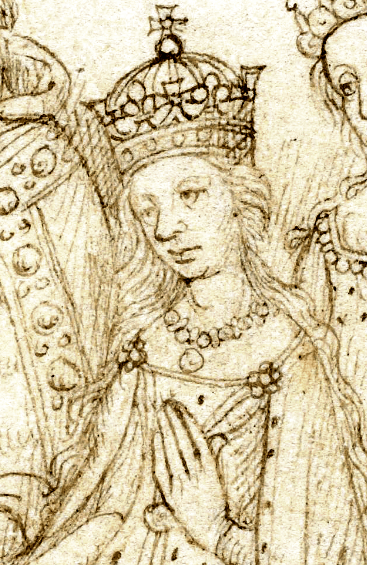
Westminster, October 2nd, 2024
Its funny to me how emotional I still get, even for such a light-touch as Katherine. The descriptions of her tomb don’t really tell you where to find her – she’s in Henry V’s chantry, but they always say that’s in Henry VII’s chapel. It isn’t. In reality it sits over Henry V’s tomb, above Edward the Confessor’s shrine, up a pair of spiral staircases inside an elaborately carved H-shaped room. I asked a verger for directions (so much easier to explain in England) and he first explained it wasn’t open to the public but pointed out Henry V’s tomb which it sits above. He said access was forbidden on health and safety grounds – the steps have been worn so much from hourly walks up and down by the monks to say perpetual masses that they’re no longer actually steps, just a bit of a lumpy slide – but he took me right into Edward the Confessor’s shrine, along with a school group, to get as close as possible. We had a chat about Katherine, trading facts, the opening of her casket and joked about Pepys kissing her, and then came back down. I’m sure it was a small thing to him but I was so touched at his going out of his way to help me. I did ask about visiting the crypt (there are few down there with only plaques upstairs) but he said no-one goes down there except the abbey architect on instruction from the king. Noted.
Katherine. I feel I may have given you short shrift, but only because so has posterity. You are remembered as a prize for our perfect king Henry V, but even though I know you were more than a trophy (you had to be, you lived 36 years as a thinking feeling human being) I have struggled to find you, the real you, under the superficial patina of history.
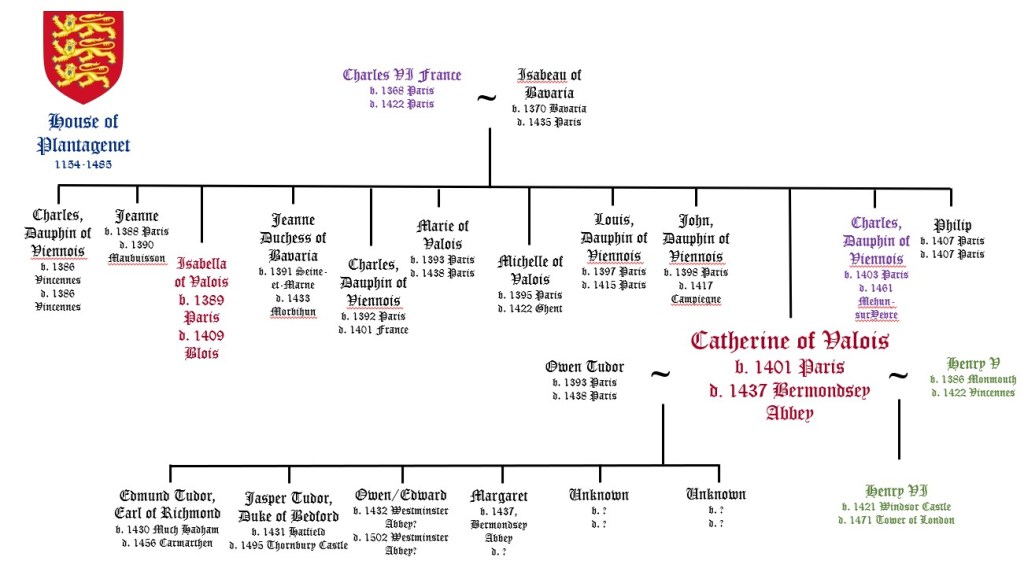
Katherine was the 10th of 12 children born to Charles VI of France, and more importantly, Isabeau of Bavaria. If I was looking for character, I need look no further than Katherine’s mother for determination, strength of will and fearlessness in the face of adversity (only some of which she caused herself). What an influence to be raised under, so between her mother the lioness and her father the violent schizophrenic, what personality did these two forces shape her into? We don’t really know, and I get the sense that until the French routing at Agincourt, no-one really bothered with her but once surrender was likely, they needed a marriageable daughter to sweeten the pot and keep the Valois name going. Her older sister Isabella would have no more of England, seeing Henry as the reason her own husband Richard II was dead. All the other girls were accounted for, leaving Katherine. She’s reported as viewing Henry as as much of a heroic figure as the English did, but I think this is a bit of wishful thinking. It may have been enough to be a queen and not be stuck in the Hotel St. Pol with her lunatic father any more. Possibly to Henry she was a necessity, a required line in the Treaty of Troyes. Interesting that usually a treaty would have been clear that the Valois crown would pass to Henry AND Katherine’s heirs, maintaining the bloodline but this treaty allowed for any heirs of Henry with any wife, or one of his younger brothers should no children be forthcoming (daughters were also allowed, breaking French succession law). No wonder Isabeau was reviled for agreeing to it.
It was likely a sense of ‘you’ll do’ on both sides. They marry, and Henry immediately departs to continue laying waste to ‘France’s enemies’, possibly feeling that he’d brought his army all this way it would be a shame not to make full use of it. Eventually the royal party heads for England where Katherine is crowned. Some authors have used Henry’s absence from the coronation feast as evidence of his apathy towards her, but it seems to be the custom for monarchs not to attend coronations, as they would inevitably upset the hierarchy and draw focus, and it would have been a good time for Henry to start planning his progress to screw more money out of his nobles for the war. They weren’t together the whole time, with Katherine following her own more sedate path, but she re-joined Henry at Leicester where they celebrated Easter, and where she likely conceived her first child (that makes it sound like she managed the whole thing alone!). Henry disappears back to France leaving Katherine to almost immediately disobey him and have her lying-in at Windsor. She should have listened to him. Having left the ‘Worst King in English History’™ she follows Henry to France with men and money.
They had a pretty pragmatic relationship: he helps her childhood friend out of a sticky patch with a passport, she gives him gold from her dowry for the war. Against her own brother. All queens who marry across borders have to face this quandary eventually and I don’t know what the answer is. Are they educated to give themselves to their husbands and never look back? Are they expected to essentially become spies or secretly work to bring about change from within? (Henrietta-Maria, looking at you). The dauphin, and there were a few even in her short lifetime, would probably have been barely known to her and the fact that he was fighting against both her mother and husband probably carried some weight. I wonder if the fact that it would be her son on the throne of France and not her brother’s, that even as a lowly daughter, 10th of 12, she would rise above Charles, would that have mattered to her? Whatever she was feeling it didn’t last. Henry died (of dysentery of all things, not so much the spotless warrior prince now are you?) and whatever his feelings towards her, they were never recorded. The regency of France to one brother, the regency of England to another, two nobles to care for and educate his son, and Katherine? Not even afforded an official place in the funerary procession, just part of the public throng following on behind.
Widowhood. It must have been a strange and lonely time for her following Henry’s death. Demoted to ‘king’s mother’, having her infant son carried away from her to sit in parliament, and eventually away from her altogether when he was given his own household with other noble children. Households: she would, I think, have known Owen by now. Did he watch while she flirted with Beaufort and incur the wrath of Gloucester? In the play Henry VI part 1 he’s portrayed as the epitome of nobility and honour but he seems to have been a bit of a power-hungry twat in reality. Something about Katherine rubbed him the wrong way. What was it? Did he take a crack at her after Henry’s death, did he think marrying her would solidify his tenuous position as not-quite regent? Did he resent her upkeep, her superfluous position, her initial control, or at least proximity to, the young king? Whatever it was he saw her and her money & influence as a threat and he went to pretty drastic lengths to bring her down a peg, passing a bill of attainder against her which didn’t name her directly but may as well have. It didn’t make it through the Commons, and was never enrolled as law so it wasn’t legally binding, but it had the desired effect of frightening off any potential suitors. She is said to have chosen Owen Tudor because he literally had nothing to lose.
It took me a long time of considering Katherine and being frustrated by her personal absence from the record, but eventually I realised she is another Anne Neville. Just instead of that one defining moment of individualism coming at the start of her queenship, it came at the end. No matter how lonely or starved of affection she may have been, she didn’t have to remarry. She had a home she enjoyed in Hertfordshire, she had wealth and status. She consciously moved towards Owen, there was something in him that answered something in her, and while we can only speculate what it was, she is there, the real Katherine, her wants, her needs and her core personality, in that choice.
Depending on which sources you believe, Katherine and Owen had between three and six children and had a presumably happy life for the 6 or 7 years they were left alone, until the Disney villain Gloucester stuck his nose in again and had her arrested (in the name of the king, you understand, it was nothing personal on his part). A pregnant Katherine is hauled off to Bermondsey Abbey where she gives birth to her fourth or sixth child, who may or may not have survived. She likely developed septicaemia and died there shortly after, far from either place that had been her home. Henry VI did right by her and had her honourably interred, though its interesting that on the tomb she is described as Henry V’s wife, not Henry VI’s mother.
She lived a relatively short and uneventful life. She was won, dismissed, stepped around and controlled by forces more powerful than herself. But like Anne of Cleeves, she also seems to have weathered her personal storms and made the best of things. Katherine you will likely never be known or understood, but you were there, and you were real and, if only by accident, you managed legendary status as the grandmother of the greatest royal dynasty in English history, a rank and fame the vicious Gloucester could only dream of. Katherine of Valois, Queen of England, I honour you.
The Life of Katherine of Valois (or what we know of it)
I have had to make greater use of Wikipedia for Katherine as my local library doesn’t have many biographies of the Valois dynasty, but they are least referenced so you can find your way to the truth.
1401
October 27: Katherine is born at Hotel Saint Pol, Paris to King Charles VI of Frances and Isabeau of Bavaria [2]
1402
July 1: After his first bout of insanity, Katherine’s father Charles VI grants her mother, Isabeau of Bavaria, the authority to essentially rule in his stead, should he become unwell again. [11]
1403
February 22: Katherine’s mother Isabeau gives birth to her 11th child, a son named Charles. He would eventually rule as Charles VII [5]
1404
During an attack of bubonic plague in Paris, Katherine and her younger siblings are removed from the Hotel St. Pol by their mother Isabeau, possibly to the castle at Melun. [9]
1405
Winter: Katherine’s father’s mental illnesses reaches such a state that he cannot be trusted near the queen Isabeau, and he is provided with a concubine, Odette de Champdivers. The queen continues to see him during his returns to lucidity. [11]
1406
June 29: Katherine possibly attends the betrothal ceremony of her older brother John of Tourraine and Jacqueline of Bavaria at Compiegne [9]
1407
November 10: Katherine’s mother Isabeau gives birth to her twelfth and final child, a son named Philip who dies within days [5]
December 15: Katherine and her siblings wait upon Valentina, wife of the murdered Louis, Duke of Orleans, as she meets with the king and his council to investigate the crime. [9]
1409
Katherine and her siblings are sent to Mont St. Michel by their mother Isabeau to pray at the shrine for the health of their father[11]
September 13: Katherine’s older sister and former queen of England, Isabella, dies in childbirth [9]
1413
May: A riot breaks out in the streets of Paris, led by the Duke of Burgundy against the unpopular Queen Isabeau. Neither she nor her children are to be found, and she possibly took Katherine and her younger siblings again to the castle at Melun. [9]
1415
December 18: Katherine’s brother, Louis the dauphin, dies aged 18 years old, likely of tuberculosis. He is succeeded by their brother John of Touraine. [9]
1417
April: Katherine’s brother John of Touraine the dauphin, dies. Many suspect it to be poisoning by their mother Isabeau. He is succeeded by their brother Charles of Blois. [9]
May: Katherine’s mother is imprisoned and stripped of her household and wealth by Bernard of Armagnac. Katherine is likely with her sister Marie at a convent in Poissy during this period. [9]
1418
January: Katherine’s mother Isabeau, having been released, proclaims herself regent of France at Troyes, naming her ally the Duke of Burgundy as her Governor. Katherine’s brother Charles the dauphin is in the custody of his mother-in-law Yolande of Anjou [9]
1419
May 29: Katherine meets Henry V for the first time at a meeting of the English and French courts. Katherine’s father Charles VI is confined during a period of poor mental health, so her mother Isabeau attends with the Duke of Burgundy on Charles’ behalf. There is some squabbling over Katherine’s dowry, as her sister Isabella’s dowry and jewellery had never been recovered after she was widowed, and the discussions break down by July [9, 15]
August: Katherine and her family remove to Troyes for safety as Henry V resumes his military campaign by sacking Pointoise [15]
October 27: Katherine’s 18th birthday [2]
December 2: In the terms of the truce between Henry V and Charles VI, Katherine would be married without dowry, and Henry and his heirs would succeed to the French crown, bypassing Katherine’s brother the dauphin Charles of Blois, who had recently been implicated in the murder of the Duke of Burgundy [9]
1420
May: The Treaty of Troyes is signed, signalling peace between England and France, which includes the terms of marriage for Katherine to Henry V of England. Katherine would be granted 40,000 ecus in lands and money in England per year, and a further 20,000 ecus of land and coin in France per year on Henry’s death. The treaty also allowed that his heirs did not necessarily have to come from Katherine, but could be of a later wife, or if he had no heirs, his oldest surviving brother would inherit. English law allowed for the heirship to be transmitted via a female line, or for a queen regnant to inherit, but French law did not, and such a transmission had been expressly forbade in law: the treaty undid this law, should Henry V have only female heirs. [7]
June 2: Katherine and Henry V are married at St. Peter’s Church in Troyes, following the French marriage service and customs. Katherine is granted a new personal household consisting mainly of English noblewomen and headed by Margaret Holland, Duchess of Clarence and sister-in-law of Henry V. Katherine would also bring three French noblewomen with whom she could more easily converse. After two days of wedding festivities, Henry and his army, with Katherine and Isabeau in attendance, march on Paris [9, 15]
Winter: Katherine is referenced in the monk John Lydgate’s poem in Troy Book, describing her as having ‘grace emprentid in hir wommanhede’ [12]
December 2: Katherine and her mother Isabeau enter Paris a day after Henry V and Charles VI, and spend the Christmas holidays there, despite intense cold and starvation in the populace. [9]
December 27: Katherine leaves Paris with Henry after he receives an urgent message calling him back to England [9]
1421
January 6: Katherine and Henry arrive at Rouen where the townspeople present her with gifts [9]
February 1: Katherine and Henry’s fleet arrives at Dover, where they are greeted by the townspeople, and carried from their ships to shore by the barons [9]
February 23: Katherine is crowned queen of England at Westminster Cathedral by the Archbishop of Canterbury Henry Chichele. There follows a banquet, from which Henry is required to be absent, with Katherine in the seat of honour flanked by the Archbishop and James, King of the Scots, who was being held captive for ransom by Henry, and who it is reported fell in love with Katherine from this point. The table is decorated with a banner reading ‘par marriage pur, ce guerre ne dure’ [by pure marriage, this war does not last] [2, 7 & 9]
March 1: Katherine’s childhood friend Jacqueline, titular queen of Holland, Hainault and Zeeland is granted a passport by Henry V to travel first to Calais and then across to England. In recompense for Henry’s kindness, Catherine donates £1,333 to his war campaign. [9]
March 23: Katherine and Henry are re-united after his progress through the West Country and spend Easter at Leicester [2]
October 27: Katherine’s 20th birthday [2]
December 6: Katherine gives birth to her first child, a son named Henry, at Windsor, despite Henry V specifically requesting that she not have her lying in there, as he believed no lucky king of England had been born there. The relic, known as the Lord’s Foreskin, had been sent from France to sit in her chamber and help proceedings. The baby was baptised within a few days, with Henry’s uncle Henry Beaufort and brother John, Duke of Bedford standing as godfathers and Jacqueline of Hainault as his godmother. [2, 9]
1422
May 21: Katherine arrives at Harfleur with 1,000 men to reinforce Henry’s army, having left her son behind in the care of Elizabeth Ryman [9]
May 26: Katherine arrives at Paris, escorted by James, King of the Scots, to be reunited with Henry V and her mother Isabeau. [9]
May 30: Katherine formally enters Paris with Henry, with two ermine cloaks carried ahead of her signifying her queenship of two countries. While in Paris, Katherine and Henry had rooms in the Louvre [7, 9]
June 12: Katherine and Henry, along with both English and French courts remove to St. Denis, and then to Senlis outside Paris. While at Senlis he begins exhibiting symptoms of an illness he had contracted during his siege of Meaux. [9]
July 7: After trying to continue while ill, Henry removes to Vincennes to recover. A doctor is sent for from England and processions are arranged to pray for his recovery. Henry does not send for Katherine, and she remains at Senlis. [9, 15]
July 8: Katherine’s older sister Michelle of Valois dies aged 27 in Ghent [17]
August 31: Katherine’s husband Henry V falls sick with dysentery during the siege of Meaux, and dies, leaving his infant son Henry as his heir. Henry chose not to name Katherine as regent of either country during his son’s minority, nor did he even leave his son in her care. His brother the Duke of Bedford is named guardian of his son and regent of France, and his brother Humphrey of Gloucester is regent of England. To avoid his corpse rotting in the summer heat, the flesh was stripped from his bones and his skeleton was carried to St. Denis where it laid in state. [2, 9]
September 24: Katherine arrives at Rouen and meets Henry’s funeral cortege [9]
October 5: A commission is granted to Henry Bromley, Henry VI’s sergeant at arms, to arrange for ships to carry the corpse of Henry V and the now Queen Mother, Katherine, from France to England [6]
October 5: Katherine and the funeral cortege leaves Rouen towards Calais, lead by Henry’s brother John of Bedford and James, King of the Scots. Katherine is said to have been part of the mass of followers behind the procession. [9]
October 22: Katherine’s father Charles VI dies, leaving her son Henry VI of England also king of France [9]
November 6: Katherine is granted all the rights of the manor of Whittechirche in Oxford for life as part of her dower [6]
November 7: Katherine’s husband, Henry V, is laid to rest near to Edward the Confessor in Westminster Abbey. Katherine would live at Windsor Castle with her son, Henry VI, just 11 months old. Around this time, Owen Tudor became a part of her household as the keeper of her wardrobe [9]
November 9: Katherine is granted 23l per year for life from the subsidies on the sale of cloth in the city of London [13]
1423
February 13: Katherine likely attends the wedding of her friend James, King of the Scots to Lady Joan Beaufort, at Southwark Cathedral. [9]
October 20: Katherine is granted 60l a year for life from the subsidies on the sale of cloth in the city of Bristol [13]
November 18: Katherine continues in Henry VI’s household, and travels with him as he is taken to the opening of parliament, despite a tantrum halting proceedings the day before [9]
December: Katherine and her son Henry spend Christmas at Hertford Castle, which had been given to her as part of her marriage settlement [9]
1424
January: Katherine and Henry’s household remove back to Windsor Castle. [9]
July 1: at the request of Katherine, the Great Council awards the manor of Coombe in Surrey to the prior and convent of Merton, as long as they celebrate divine service in their church for the good estate of the king and his mother while alive, and for their souls after death as well as Henry V, Henry IV and Katherine’s father Charles. [6]
November 8: A grant of 20l a year and the manor of Oldeshorham in Sussex is confirmed to Elizabeth Ryman, who had been commanded to travel to France to work for Katherine during the later stages of her pregnancy and then to take care of the infant Henry VI, (presumably as mid-wife and wet-nurse) which she had done without recompense and which has now made her unfit for labour. [6]
1425
February 26: Katherine is granted by the Great Council the inn in the City of London, formerly held by the Earl of March, during that earl’s son’s minority, provided she pay for the upkeep to buildings and gardens [6]
1426
December: Katherine and Henry spend Christmas at Eltham Palace [9]
1427
December: Katherine and Henry spend Christmas at Eltham Palace [9]
1427-1428
A bill of attainder is passed in parliament stating that should any queen dowager marry without the king’s consent, her husband would forfeit all lands and titles, though their children would suffer no punishment. However, as the bill was never ratified by the House of Commons, or entered into the rolls, it was essentially invalid, and was merely a propaganda tool to stop any wayward potential husbands from getting involved with Katherine. The bill was later cut out of the informal rolls, probably sometime in the 17th century. It would seem this bill was mainly the work of Humfrey, Duke of Gloucester, who had recognised the likelihood of Katherine marrying Edmund Beaufort, one of his sworn enemies and used the bill to stop it. She is said (without reference) to have told him in reply ‘Then I shall marry a man so basely, yet so gently born, that my lord regents may not object’ [8, 9]
December: Katherine and Henry spend Christmas together, but at an unknown location. As Henry was now 7 years old, as decreed by the great council, he would live in his own household separate from his mother. [9]
1428
March 1: A commission is granted to John Petylysden to gather and transport carpenters, sawyers, stone-cutters, plumbers and other labourers to Ledes Castle for the repair of the hall and other houses, at Katherine’s expense [6]
April: Katherine joins Henry to celebrate Easter at Hertford Castle, and later at the Abbey of St. Albans [9]
1429
November 6: Katherine’s young son Henry is crowned as Henry VI at Westminster Abbey. By this time Katherine has retired from court almost entirely and is living on her estates in Hertfordshire, and has kept Owen Tudor within her household. [9]
December 12: Katherine is granted 53l per year for life from the Welsh lands of the recently deceased earl of March [14]
1430
Katherine gives birth to her second child, a son named Edmund Tudor, at Much Hadham Place, Hertfordshire. He would be created earl of Richmond in 1452, and would be father to the future Henry VII. [3]
1431
October 27: Katherine’s 30th birthday [2]
November: Katherine gives birth to her third child, a son named Jasper Tudor, at Hatfield House, Hertfordshire [4]
December 16: Henry VI is crowned king of France in Paris. Katherine does not attend, either because it was not Henry’s ancestry through her that played the strongest part in the royal narrative, or because she was still recovering from her third pregnancy. The coronation was in spite of Katherine’s brother, Charles of Blois having been already crowned king of France at Rheims [7, 9]
1432
Katherine gives birth to her third child, a son variously known as Owen or Edward, and widely believed to have become a monk at westminster Abbey [10]
1433
Katherine gives birth to her fourth child, possibly a daughter named Jacina or Iacina, and who may have later married into the Grey de Wilton family [10]
September 27: Katherine’s older sister Joan, Duchess of Brittany dies aged 42 at Morbihan [16]
1434
February 5: Katherine is granted 80 marks a year for life from the castle and cantred of Buelt, a debt owed to the exchequer by Roger de Mortuo Mari [14]
1435
September: Katherine’s mother, Isabeau of Bavaria, dies at the Hotel Saint Pol in Paris [5]
1436
Summer: Katherine is arrested on the orders of her son the king, but more likely on the orders of Humfrey of Gloucester, and sent to the Benedictine Abbey at Bermondsey [9]
1437
January: Katherine gives birth to her 5th child, a daughter named Margaret. Sources differ as to her fate, either dying very soon after birth or becoming a nun and dying in early adulthood. [9, 10]
January 3: Katherine dies, most likely of septicaemia from her last pregnancy. Before dying she dictates her will to her son Henry, asking that he take care of her children ‘in tender and favourable fulfilling of mine intent’. Her body lay in state in St. Catherine’s Chapel at the Tower of London [9]
February 18: Katherine is laid to rest in the Lady Chapel of Westminster Abbey, following a royal funeral. Henry VI provided an alter tomb for her on which she is described as the widow of his father. [9]
References
- Catherine de Valois [https://en.wikipedia.org/wiki/Catherine_of_Valois]
- England’s Queens: the biography by Elizabeth Norton (2001). Stroud, Amberley Publishing
- Edmund Tudor, 1st Earl Richmond [https://en.wikipedia.org/wiki/Edmund_Tudor,_1st_Earl_of_Richmond]
- Jasper Tudor [https://en.wikipedia.org/wiki/Jasper_Tudor]
- Isabeau of Bavaria [https://en.wikipedia.org/wiki/Isabeau_of_Bavaria]
- Calendar of patent Rolls, 1 Henry VI, 1422-1429 (1901). Norwich, HMSO
- Two Kingdoms, One King: the treaty of Troyes 1420 and the creation of a double monarchy of England and France by Anne Curry [https://eprints.soton.ac.uk/63719/1/Two_Kingdoms_One_King_The_Treaty_of_Troyes_1420_.pdf]
- The Lost Statute of 1427-8 or How to Solve a Problem like Queen Katherine by Simon Payling [https://historyofparliament.com/2020/12/08/the-lost-statute-of-1427-8-or-how-to-solve-a-problem-like-queen-katherine/]
- The Sister Queens: Isabella and Catherine of Valois by Mary McGrigor (2016), Stroud, The History Press
- Owain Tudor [https://biography.wales/article/s-OWAI-TUD-1400]
- Isabeau of Bavaria, Queen of France (1385-1422): the creation of an historical villainess by Rachel Gibbons [https://www.jstor.org/stable/3679229?read-now=1&oauth_data=eyJlbWFpbCI6ImthdGVwYXJyNzdAZ21haWwuY29tIiwiaW5zdGl0dXRpb25JZHMiOltdLCJwcm92aWRlciI6Imdvb2dsZSJ9&seq=1#page_scan_tab_contents]
- Queen Katherine and the Secret of Lydgate’s ‘Temple of Glas’ by J. Allan Mitchell, 2008 [https://www.jstor.org/stable/43630595?read-now=1&seq=1#page_scan_tab_contents]
- Calendar of Close Rolls Preserved in the Public Record Office, Henry VI V. 1 [https://babel.hathitrust.org/cgi/pt?id=mdp.39015066070072&view=1up&seq=40]
- Calendar of Close Rolls Preserved in the Public Record Office, Henry VI V. 2 [https://babel.hathitrust.org/cgi/pt?id=mdp.39015066344675&view=1up&seq=21]
- Henry V by Keith Dockray (2004) Stroud, Tempus Publishing
- Joan of France, Duchess of Brittany [https://en.wikipedia.org/wiki/Joan_of_France,_Duchess_of_Brittany]
- Michelle of France [https://en.wikipedia.org/wiki/Michelle_of_Valois]
 Anglica Regina
Leave a comment