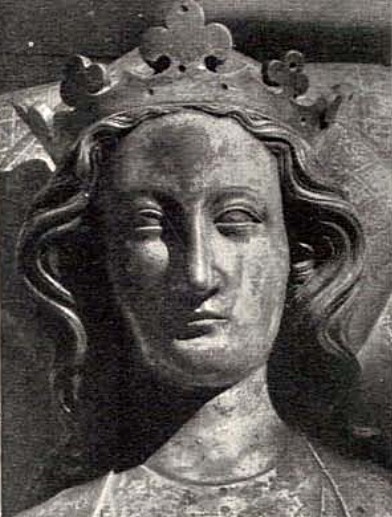
She crept up on me. Having embarrassed myself by asking to be let through to the Edward chapel (it’s Henry) I was dodging tourists then suddenly there she was. I mean, I couldn’t see her, not properly. She’s quite high, and her effigy, though still gold, is slender and behind a grill. I’d been thinking about her all morning, but more about her tomb than her. I didn’t know it, because its been two years since my last gather, but for some reason being here, the event, is more of a focus than acknowledging her as a woman.
Eleanor may be the most purposeful consort I’ve gathered so far. Caroline had purpose, but it was to be loved and petted. Eleanor might have been purposeful at anything, whatever it was Edward needed. She was raised at a cultural court by a father who was a skilled tactician, not only at battle, but at the administration that had to follow. You can’t just plant a flag in a town you’ve besieged and expect everything to work afterwards. Her father spent a huge amount of time taking care of his new acquisitions, making them work, adapting where necessary. Whether he intended it or not, he set a very positive, dynamic example for his daughter. I don’t think she was ever going to spend her days hunting and sewing. The first year married to Edward seems to have set the tone for their whole relationship. His land and people were important, and he expected her to be by his side assisting, understanding, counselling.
With other queens I’ve had to take some time to consider what she felt, who she was behind the queen mask, but I think Eleanor simply was. She had an innate gift for administration and used it to make herself and the crown one of the largest landowners after years of dissipation. She’s described as avaricious – a man who achieved the same would be described as savvy. She is criticised for not caring for her children, yet she provided lavishly for them, mourning their passing with gifts to the abbeys when they were interred. As was common to the age, she allowed them to be raised separately until they had passed the dangerous years of early childhood, after which she had them educated well, as she had been, and Edward’s decision to pass the crown to his daughters instead of his brother is a strong indicator of his faith in her as a mother of strong women. She is criticised for not being charitable. She gave as much if not more, in gifts and alms, but because she didn’t do it personally, it’s like she didn’t do it at all.
As with all of these women, she wasn’t perfect. That straight-forward Eleanor-ness meant she was generous to her friends and those in her service as long as they were of use. She dared the censure of the Archbishop of Canterbury for profiting by usury through her business dealings with the Jews. She didn’t care how it looked, they were useful to her – but as soon as the political tide turned, she expelled the Jews from her estates and cut off from their business without a second thought. She created an atmosphere where her bailiffs were afraid to disappoint her, meaning their dealings with her tenants might be underhanded, corrupt, even violent, and more than one tenant was found to have been hard done by, conned or plain stolen from when an inquest into her land dealings was held after her death.
For all this, she and Edward seem to have been well balanced. They were hardly ever apart, with Eleanor being almost constantly pregnant for most of their married life. But whatever toll this took on her, Edward fathered no bastards and even adapted his court schedule to meet her needs as a landowner, touring her properties constantly apart from their crusade and the knocking into line of the Welsh. From his household accounts we know he paid a ‘ransom’ at the end of lent – Eleanor’s ladies held him captive until he paid up, when they would release him so he could return to his wife’s bed, and we also know that the first Lent after Eleanor died, he paid the old ransom again in her memory. And the crosses. Originally this trip was going to be a pilgrimage from Lincoln via the 12 stopping sites but that would have been too expensive on fuel. But even thought 8 have been demolished and most people don’t know what the others are for, what a grand and eloquent tribute to her relationship to her husband and his to her. Even her coffin – she was laid in state visible (after her embalming) so she could be seen by her people. For a year after her death, he would give alms to anyone who approached him, had tens of thousands of prayers said in her name. He only remarried when it became politically expedient (though that’s another queen and another story) and he kept a crystal and jade chess set he had given to her, to remember their quiet evenings together for over 30 years.
As with some other less well-remembered consorts, evidence of who she was is best seen in the void they leave behind. Eleanor was intelligent, driven, generous though unforgiving, would suffer discomfort when it pleased her, but only when it pleased her. She did not care about her ‘name’, and made decisions some saw as unwise but when it came to the job of being queen, she turned up every single day and gave everything she had until her last breath. Eleanor of Castille, Queen of England, I honour you.
Eleanor of Castille’s Life (or what we know of it)
1241
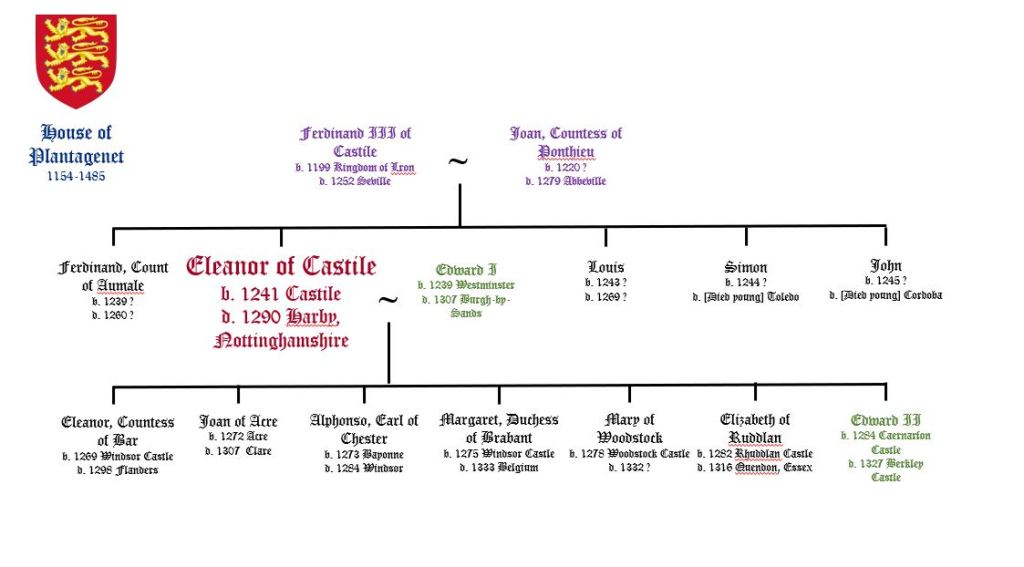
- November: Eleanor is born in Valladolid, Castille, Spain to Ferdinand III of Castille and his wife Joan/Jeanne, Countess of Ponthieu [2]
1243
- Eleanor’s mother Joan gives birth to a son, Louis, who does not live long [1]
1244
- Eleanor’s mother Joan gives birth to a son, Simon, who does not live long [1]
1245
- Eleanor’s mother Joan gives birth to a son, John, who does not live long [1]
1246
- November: Eleanor probably attends the funeral of her grandmother Berengaria, at Las Huelgas Abbey [2]
1248
- 22 December: Eleanor takes part in the formal procession into Seville after it’s capitulation to her father Ferdinand III [2]
1249
- December: Eleanor probably attends the wedding of her older brother Alphonso to Violente at Valladolid [2]
1250
- 5 August: Eleanor is granted permission to marry anyone within the fourth degree of consanguinity by special dispensation, issued by Pope Innocent IV [6]
1251
- November: Eleanor’s 10th birthday [1]
- Eleanor’s grandmother Marie of Ponthieu dies, and Eleanor’s mother Joan becomes Countess of Ponthieu [1]
1252
- 30th May: Eleanor’s father, Ferdinand III of Castille, dies of dropsy and is buried in Seville Cathedral. He is succeeded by his son Alfonso X. Eleanor, and the rest of his family, is at his side when he dies. He would be canonised in 1671. [2]
- Late May: Eleanor’s marriage to Edward of Caernarfon and dowry is negotiated in Castile by John Maunsel and the Bishop of Bath on behalf of Henry III, and her brother Alphonso X. Eleanor would bring no dowry, but Alphonso would cease his claim to Gascony, saving the English crown a vast outlay. [6]
1253
- July: Eleanor is almost betrothed to Theobald II of Navarre, which would have made it easier for her half-brother Alphonso X to claim Gascony, but the match is opposed by Theobald’s mother. [6]
1254
- 8 February: John Mansell & Peter Aigueblanche return to Castile with an offer of £1k per year dower for Eleanor, to increase by 500 marks on Edward of Caernarfon’s accession. The bond between Henry III and Alphonso X would also be strengthened by a marriage between Eleanor’s half brother and Henry’s daughter Beatrice. [2]
- 20 July: Edward of Caernarfon assigns the towns of Stamford an Grantham, the manor of Tickhill and the castle of the Peak to Eleanor as part of her dower. [2]
- 1 November: Eleanor marries Edward of Caernarfon, son of Henry III of England, at Las Huelgas, Burgos, Spain [1]
- 11 November: Eleanor and Edward of Caernarfon are at Vittoria in Spain on their route to Gascony [2]
- 21 November: Eleanor and Edward of Caernarfon are at Bayonne, with Edward now ‘reigning’ as lord. They would spend the following year travelling through the area. [2]
1255
- 29 May: Eleanor gives premature birth to her first child, a daughter known as Anonyma who dies almost immediately. The child is buried at Bordeaux Priory. [2/6]
- 17 August: Eleanor and Edward of Caernarfon are recalled by Henry III, who commands them to transfer their court to Ireland [2]
- October: Eleanor arrives at Dover with a large retinue, including her half brothers Sancho and Enrique, but only everyday clothes. She is gifted 100 marks by Henry III to improve her wardrobe. She is placed in the custody of Reginald de Cobham at Dover Castle [2/4]
- 17 October: Eleanor arrives in London, being received at the city gates by Henry III [2/6]
- 29 November: Eleanor is joined at Westminster by Edward of Caernarfon, newly arrived from Gascony, and the couple soon remove to Windsor where she would be based for the next few years [6]
- December: Eleanor intercedes on behalf of Garcia Martinez, a Jew, charged with murder. Henry III pardons him. [2]
1256
- Whitsun: Eleanor is probably present at a tournament to honour Edward of Caernarfon’s return to England, held at Blyhe in Nottinghamshire [2]
1257
- Eleanor permits mortgages to be raised on her propertIes at Stamford, Grantham and Tickhill to fund Edward of Caernarfon’s campaign in Wales [2]
- October: Eleanor attends a pilgrimage to St. Albans with her mother-in-law Eleanor of Provence, following an illness [2]
1258
- September: Eleanor attends the consecration of Salisbury Cathedral with her mother-in-law Eleanor of Provence [2]
1259
- Eleanor’s 18th birthday [1]
- 1 January: Eleanor is at Mortlake where she receives a knight of the Viscount at Bearn, to whom she gives sapphire rings [2]
1260
- November: Eleanor is pardoned by Henry III for hunting and killing 8 hinds without permission at St. Briavel’s Castle, Gloucestershire [2]
- December: Eleanor is probably with Edward of Caernarfon as he and his retinue arrive in Gascony [2]
1261
- July: Eleanor and Edward of Caerarfon leave England for Gascony [2]
- 27 October: Eleanor’s half brother Sancho, Archbishop of Toledo, dies aged 28 [1/4]
- November: Eleanor’s 20th birthday [1]
- November: Eleanor gives birth to a second child, a daughter named Katherine, while the couple are in Gascony [2]
1262
- 14 July: Eleanor accompanies her father-in-law Henry III, her mother-in-law Eleanor of Provence and Edward of Caernarfon to France to meet with King Louis and attend parliament. In the September both Henry and Edward fall seriously ill so the negotiations have to be postponed [6]
1263
- February: Eleanor and Edward of Caernarfon return to England bringing an army of mercenaries which Eleanor has raised from her mother’s lands in Ponthieu [6]
- March: Eleanor is installed at Windsor while Edward of Caernarfon prepares to advance into Wales [2]
- October: Eleanor is at Windsor as Edward of Caernarfon and Henry III arrive to garrison it [2]
1264
- April: Eleanor is granted the manor of Ashford in the Peak at Edward of Caernarfon’s insistence, probably to provide for her subsistence at Windsor while he is campaigning [2]
- 16 June: Eleanor is granted by Edward of Caernarfon the custody of Windsor Castle, where she resides with her daughter Katherine [4]
- 17 June: Henry III countermands Edward of Caernarfon order granting Eleanor Windsor Castle and she is ordered to remove to Westminster, under instruction from Simon de Montfort, as a way of minimising Eleanor’s influence and her ability to command her foreign troops [4/6]
- September: Eleanor’s daughter Katherine dies [2]
- 3 October: Eleanor’s daughter Katherine is buried at Westminster Cathedral. Eleanor has to borrow money to pay for the funeral. [4]
- 7 December: Eleanor goes into confinement for her third pregnancy [4]
1265
- January: Eleanor gives birth to her third child, a daughter named Joanna [1]
- January: Eleanor’s incomes from her lands is stripped after Simon de Montfort annexes all of Edward of Caernarfon’s properties [2]
- January: Eleanor intercedes with Henry III to grant an exemption to jury service for a petitioner [2]
- 3 February: Eleanor is churched after the birth of her daughter [2]
- March: Eleanor is granted the wardship of Cecily de Fortibus and through her, 3 manors and their rents [2]
- April: During Edward of Caernarfon’s captivity, Eleanor is unable to access her rents and is forced to borrow money from Hugh the Dispenser [2]
- April: Eleanor’s manors received through the wardship of Cecily de Fortibus are seized by the barons and again she is forced to borrow money for her expenses [2]
- 30 April: Eleanor is granted the manor and hundred of Somerton. It is likely she requested this manor as it was held by her Fiennes relatives [2]
- 4 August: Edward of Caernarfon routes Simon de Montfort and his followers at Evesham, effectively ending the Barons’ War and freeing Eleanor [2]
- 7 September: Eleanor’s daughter Joanna dies and is buried at Westminster Abbey. Henry III donates a cloth of gold for her tomb. [2]
- 18 September: Eleanor is granted the manor of Barwick in Somerset as part of the distribution of spoils. After the manor is taken back, she writes a letter requesting two other manors instead, but is careful not to seem covetous [2]
- 30 September: Eleanor is granted the manor of Haselbuy in Somerset in response to her letter [2]
- October: Eleanor and Edward of Caernarfon are reunited, though at what location is unknown [2]
- 13 October: Eleanor is probably with Edward of Caernarfon and Henry III at the Feast of the Confessor at Westminster Abbey [2]
- 17 October: Eleanor is granted manors at Bakewell, Haddon and Codnor in Derbyshire, all close to her existing property at Ashill [2]
- 30 October: Eleanor and the rest of the royal family are resident at Canterbury [2]
1266
- February: Eleanor is granted the manors of Pitney and Wearne in Somerset, near to Somerton [2]
- 13 July: Eleanor gives birth to her fourth child, a son named John, at Windsor Castle. London workers have a day’s holiday in celebration [2/4]
- 24 August: Eleanor is churched after birth of John
- October: After the dictum of Kenilworth, all rebels are granted their lands back on payment of a fine, meaning Eleanor loses all her recently acquired manors [2]
1268
- April: Eleanor is granted the debts of William FitzWilliam of Hartnell, which he owed to Jacob son of Moses of Oxford [2]
- 6 May: Eleanor gives birth to her fifth child, a son named Henry, while at Windsor Castle [4]
- December: Henry III pays to have Eleanor and her ladies outfitted to match the queen Eleanor of Provence [2]
1269
- 18 June: Eleanor gives birth to her sixth child, a daughter named Eleanor, while at Windsor Castle [4]
- October: Eleanor attends the translation of Edward the Confessor’s body to its new tomb at Westminster Abbey [2]
- December: Eleanor is with the royal family at Windsor for Christmas [2]
1270
- 7 August: Eleanor and the Crusaders are at Portsmouth wating for fair weather to cross the channel [2]
- 20 August: Eleanor and the Crusaders eventually cross at Dover [2]
- 9 November: Eleanor and the Crusaders arrive at Turin to find Louis IX, the head of the Crusade, has died from dystentery and his heir, Philip III is still recovering. Fighting against the Sicilian rebels had already finished, but the rebellion had included Eleanor’s brother, Fadrique [2]
- 14 November: The entire fleet of French Crusader ships is destroyed while at anchor in a huge storm. The French contingent decides to return to France. The English fleet, anchored elsewhere, was unaffected. The decision was made to winter in Sicily and press on to the Holy Land in the Spring, the delay contributed to by Eleanor’s being pregnant, though the date of its birth and identity are not known, though it is believed the child died shortly after Eleanor’s arrival at Acre. [2]
1271
- 9 May: English Crusaders arrive at Acre. It is likely that while staying here, Eleanor commissioned her clerk Richard to translate and bind a copy of Vegetius’ De Re Militarii for Edward [2]
- 3 August: Eleanor’s son John dies while in the custody of his uncle Richard Earl of Cornwall at Wallingford Castle. He is buried at Westminster Abbey. When news reached Eleanor and Edward of Caernarfon, Edward does not go into mourning, suggesting the loss was felt only moderately, and Eleanor was already pregnant again [2/4]
- Eleanor gives birth to her seventh child, a daughter possibly named Juliana, while in Palestine [1]
- November: Eleanor’s 30th birthday [1]
1272
- 2 April: Richard Earl of Cornwall dies, who was the appointed custodian of Eleanor and Edward of Caernarfon’s children. In his absence, Eleanor’s mother-in-law Queen Eleanor of Provence takes over their care. [2]
- May: Eleanor gives birth to her eighth child, a daughter named Joan of Acre [2]
- April/May: Edward of Caernarfon refuses the terms of the peace with Baibars, and refuses to vacate Acre with the other crusaders. As a result Baibers ordered Edward’s assassination. [2]
- 17 June: Eleanor’s husband Edward of Caernarfon is stabbed by Baibers’ assassin, who is killed by Edward in the struggle. [2]
- 18 June: Edward of Caernarfon, fearing for his life after the attack, makes his will. There are a variety of stories around Eleanor’s role in his recovery, some suggesting she is lead away weeping, others that she personally sucks out the poison and infected matter, saving his life. There are no strictly contemporary reports. [2]
- 22 September: Eleanor and Edward of Caernarfon leave the holy land for Sicily, arriving in October or November [2]
- 16 November: Henry III dies, after a long period of ill health [2]
1273
- January: Eleanor receives a letter from the Pope asking her to bring the new Edward I to Rome [2]
- 5 February: Eleanor and Edward I arrive at Rome [2]
- 20 May: Eleanor and Edward I arrive at Reggio. The slowness of their return may be because Edward was ill again. [2]
- June: Eleanor and Edward I part on the road home, likely because of Eleanor’s pregnancy [2]
- 26 July: Eleanor is in Limoges, where the townspeople ask for Eleanor’s intercession against their viscountess. Edward I provides military support, which Eleanor directs, and victory is secured. Shortly after Edward himself arrives at Limoges [2]
- 8 September: Eleanor and Edward I arrive at Gascony and take care of some local political business [2]
- 9 October: While staying in Aquitaine, Edward I arranges for Eleanor’s daughter Eleanor to be married to Alfonso of Aragon. At the time Eleanor was 4 years old and Alfonso nearly 8. At the same time an arrangement is made for Eleanor’s son Henry to marry Juana of Navarre, though this never comes to fruition. [4]
- 24 November: Eleanor gives birth to her ninth child, a son named Alphonso, while at Bayonne in Gascony. The name suggests the closeness between Eleanor and her brother, and also between her brother and Edward I. During the meeting, as Alphonso stands as godfather to his new nephew, Eleanor asks him to discuss her dower with Edward [2]
1274
- 27 February: Eleanor receives as a gift 16 oaks for timber for repairs to her houses at Longbeniton [5]
- June/July: Eleanor and Edward I at are Ponthieu, where Eleanor is reunited with her mother for the first time since her wedding. On their departure, their daughter Joan of Acre is left in her grandmother’s care [2]
- 2 August: Eleanor and Edward I finally arrive at Dover [2]
- 19 August: Eleanor and Edward I are jointly crowned at the newly refurbished Westminster Abbey. Eleanor wears a simple, unbelted robe and her hair long, with a simple gold circlet. The robe would have hidden her latest pregnancy. During the ceremony she is anointed with holy oil, and crowned with a wreath of golden lilies. She is required to bow before Edward, and the proclamations are about limiting her influence and encouraging her production of heirs. [2]
- 21 August: Eleanor, Edward I and the royal court moved to Kempton on the river Thames to relax [2]
- 14-17 October: Eleanor’s son Henry dies at Guildford in Surrey, nursed by his grandmother Eleanor of Provence. He is bured at Westminster Abbey [2/4]
- 8 November: Eleanor is granted the lands and heirs of Nicholas de Haversham, during his heirs minority, and the right to their marriage [3]
- 28 November: Eleanor’s brother Felipe dies, aged 47 [4]
- 26 December: Eleanor is granted the lands and heirs of John le Poer, during his heirs minority, and the right to their marriage [3]
1275
- January: Eleanor and Edward I return from the peregrinations at the New Forest, where they also attend the wedding of Edward’s brother Edmund to Blanche of Artois [2]
- 10 February: Eleanor is granted a remission of her debts incurred during her pilgrimage to the holy lands, with the rents from her lands for five years after her death going to pay those debts, unless they are paid off before in which case the lands and rentals revert to the crown. [3]
- 18 February: Eleanor is granted the debts of Norman de Arcsy which he had incurred to Hagin, Jew of London and Jacob de Oxonia, Jew, for a total of £413 [3]
- 15 March: Eleanor gives birth to her tenth child, a daughter named Margaret, while at Windsor Castle. She resides there in her older brother Alfonso’s household. [4]
- 27 June: Eleanor is granted all the debts owed to the king by Alan of Arundel and all his heirs [3]
- 28 July: Eleanor grants to her servant Richard de la Garderobe the serjeanty of the sea-shore of Bristol for his many years of service to her [3]
- October: Eleanor’s dower settlement is revised to £4,500 per year across estates in England and Gascony [2]
- 15 October: Eleanor’s sale of the custody of lands of Gayelard de la Mote is ratified [3]
- 13 November: Eleanor is granted land to the value of £60 per year from the ownership of Norman de Arsey in lieu of her paying his debts to Hagin and Elias, Jews of London [3]
1276
- 10 January: Eleanor is granted 30 live does from Odyham Park to restock her deerpark at Langley [5]
- 20 january: Eleanor is granted a moiety of houses in Melkstrete in London, previously in the ownership of Master Mosseus, jew of London [3]
- 21 January: Eleanor is granted a further messuage in Melkestrete, London, also in the ownership of Master Mosseus, Jew of London [3]
- 5 February: Eleanor grants to Albreda the custody of the heirs of the manor of Sinbury in recognition of her service to Eleanor [3]
- 7 April: Eleanor has confirmed a grant to Stephen Cheynduyt to hold the houses in Melkestrete, formerly in the possession of master Mosseus, Jew of London [3]
- 1 May: Eleanor is granted the manors of Kamel and Kingesbury with their oxen, ploughs, corn and other goods [3]
- 1 May: Eleanor gives birth to her eleventh child, a daughter named Berengaria, while at Kempton near London [4]
- 26 May: Eleanor is appointed custodian of the king’s houses in Southampton [3]
1277
- 15 September: Eleanor’s brother Fabrique is executed for rebellion by her older brother Alfonso X [4]
- 25 September: Ambassadors from King Rudolf Habsburg of Germany arrive at the English court to discuss a marriage between Eleanor’s daughter Joan of Acre and King Rudolf’s second son Hartmann. Edward I offers 10,000 marks as dower, and a wedding date is set for 8 September the same year. Due to illness and outbreak of war, the wedding is delayed, followed by Hartmann’s death by drowning in 1281. [4]
1278
- 3 January: Eleanor gives birth to her twelfth child, a daughter who is not named and does not survive [4]
- 24 January: Letters are received from Jan I of Brabant exploring the idea of a marriage between his son Jan and Eleanor’s daughter Margaret, or if that is not satisfactory, then their next oldest daughter. [4]
- Easter: Eleanor and Edward I translate the bodies of Arthur and Guinevere to new tombs at Glastonbury Abbey. The bodies are wrapped in silk and re-interred, minus their skulls [2]
- June: Eleanor’s daughter Berengaria dies [4]
- August: Eleanor lays a foundation stone for herself and another for her son at the founding of the abbey of Vale Royal in Cheshire [2]
- 9 November: Eleanor is probably with Edward I at Rhuddlan Castle when he receives the submission of Llewellyn after the Welsh revolt [2]
1279
- 11 March: Eleanor gives birth to her thirteenth child, a daughter named Mary, while at Woodstock near Oxford [4]
- 16 March: Eleanor’s mother Joan of Ponthieu dies at Abbeville, leaving massive debts. Eleanor becomes Countess of Ponthieu. Eleanor and Edward I charge Edward’s younger brother Edmund to go and hold Ponthieu in Eleanor’s name. From this date Eleanor begins using the Pontevin arms in her crest [2/4]
- 23 March: Eleanor is granted the lands and heirs of Henry Dyve, during his heirs minority, and the right to their marriage [3]
- 9 April: Eleanor holds an enquiry into the proposed marriage of one of her ladies in her lying-in chamber [2]
- 21 April: Eleanor is granted all the wines of the king’s right at the port of Sandwich, to be delivered to Leed’s Castle [5]
- 13 May: Eleanor and Edward I depart from Dover for Ponthieu [4]
- 23 May: Eleanor’s claim to Ponthieu is recognised at the Treaty of Paris, ratified by Edward I and Philip III of France, despite some objections from her relatives. Eleanor and Edward spend some time touring their new properties and appointing custodians [2]
- 19 June: Eleanor and Edward I arrive back in England after surveying the county of Ponthieu [4]
1280
- 25 June: Eleanor arbitrates a dispute between Walter, Bishop of Exeter and Edmund, Earl of Cornwall: she personally pays 100 marks towards the replacement of cattle stolen from Walter, and Walter agrees therefore to take no further action. Witnessed at Odiham. [5]
1281
- 5 July: Eleanor is granted all the fines and possessions of all felons within the hundreds of Somerton and Horethorne in Somerset [5]
- 9 September: Eleanor’s son Alphonso is betrothed to Floris V of Holland’s daughter Margaretha [4]
- November: Eleanor’s 40th birthday [1]
1282
- July: Eleanor and Edward I, accompanied by their daughters Eleanor and Joan, arrive at Rhuddlan Castle as Edward tries to subdue the Welsh [4]
- 7 August: Eleanor gives birth to her fourteenth child, a daughter named Elizabeth, while at Rhuddlan Castle in Denbighshire [4]
- 6 September: Eleanor is churched following the birth of Elizabeth [4]
1283
- 5 April: Eleanor intercedes on behalf of Thomas le Normant who is acquitted of owing £30 after 6 prisoners escape his custody at the Tower of London [5]
- 27 August: Eleanor and Edward I narrowly escape a fire at Caergwrle Castle in Wales [4]
1284
- 4 April: Eleanor’s half-brother Alfonso X dies, aged 62, and is succeeded by his son and Eleanor’s nephew Sancho IV of Castile [4]
- 25 April: Eleanor gives birth to her fifteenth child, a son named Edward, while at Caerarfon Castle in Gwynedd. It is likely the location was chosen deliberately as a continued expression of Wales being English territory [2]
- 19 August: Eleanor’s son Alphonso dies at Windsor Castle, aged 10 years, possibly due to drinking contaminated water. His heart is buried at Blackfriar’s Abbey in London, his body at Westminster Abbey. Eleanor and Edward I were too far from London to attend the funeral [2/4/6]
- September: Eleanor and Edward I are staying at Acton Burnell, with the royal nursery transported there and lavish preparations made for their comfort, possibly a sign of the parents’ grief [2]
- 1 November: Eleanor and Edward’s 30th wedding anniversary [4]
1285
- 11 January: Eleanor receives the lands of John, son of Richard di Hispania, as he ‘has been entirely an idiot from his birth’ so they can be ket safe in her hands for his heirs [5]
- 10 April: Edward I starts negotiations with Floris V of Holland for a marriage between Eleanor’s daughter Elizabeth and Floris’ son Jan in lieu of the match made for the late Alphonso [4]
- 4 May: Eleanor and Edward I progress through London from the Tower of London to Westminster Abbey, on foot, carrying the Cross of Neith in celebration of their victory over the Welsh [2]
- 15 August: Eleanor’s daughter Mary enters Amesbury Priory as companion for her grandmother Eleanor of Provence, along with 13 other aristocratic daughters. The whole royal family is present, though her taking the veil aged 6 was against her mother’s wishes [2/4]
1286
- March: Eleanor falls ill, and a mensura, a ritual candle the same height at the subject is lit as a remedy [2]
- 13 May: Eleanor and Edward I leave England from Dover so Edward can negotiate the peace between Alfonso X of Aragon and Charles of Anjou. Edmund of Lancaster is named keeper of the realm in their absence [4]
- July: Eleanor is given a crystal and jasper chess set by Edward I for the fest of the Trinity. On her death he would reclaim it in remembrance of her. [2]
- December: Eleanor and Edward I spend Christmas at Saint Macaire priory near Bordeaux. Eleanor is gifted chargers, a hound and a quantity of cheese by members of the court. [2]
1287
- 29 May: Eleanor gives a gold cloth to Bordeaux Priory marking the anniversary of the death of her first child, who was buried there [2]
- June: Eleanor suffers another period of ill-health, so a second mensura is lit and two page boys are paid to stand watch over it [2]
- December: Eleanor is recorded as suffering from a ‘double quartan fever’, possibly as a result of contracting malaria [2]
1289
- 9 March: Eleanor is presented with a lion and a lynx by Otho de Grandison, as a gift on his release from captivity. The two beasts are added to the menagerie at the Tower of London [2]
- 12 August: Eleanor and Edward I return to England, landing at Dover, and are welcomed by their children [2/4]
- 6 November: Treaty of Salisbury arranges the betrothal of Eleanor’s son Edward of Caernarvon and Margaret ‘the maid’ of Norway [4]
1290
- February: Eleanor gives £100 to Blackfrairs Abbey for the preparation of her burial chapel, and purchase stone for her tomb [2]
- 17 April: As part of the marriage preparations for Eleanor’s daughter Joan of Acre and her fiancee Gilbert de Clare, Edward I signs a document outlining the succession should he have no surviving male heirs. On the understanding Gilbert de Clare will swear fealty to Edward of Caernarvon, but should he die, he will swear fealty to Eleanor of Windsor, Eleanor’s oldest surviving daughter, and her heirs. Thus Edward I specifies he would prefer the kingdom to pass to his daughter, than to his brother and nephews. The bride and her maids have only repaired dresses rather than new, possibly because the wedding had been expedited as a result of Eleanor’s failing health [2/4]
- 30 April: Eleanor’s daughter Joan of Acre marries Gilbert de Clare, 30 years her senior. Gilbert surrenders all his lands to Edward I before the wedding, and they are then granted back to the couple jointly afterwards, giving precedence of inheritance to Joan’s children with Gilbert over his existing family. [4]
- June: Eleanor and Edward I, while on tour, stay in Thurrock, the home of William Tonel, who would craft her tomb effigy [2]
- 24 June: Eleanor and Edward I attend the wedding of Roger Bigod and Alicia Hainault at Havering at Bower [4]
- 3 July: Eleanor’s daughter Margaret of Windsor marries Jan of Brabant at Westminster Abbey [4]
- July: Eleanor’s son Edward of Caernarfon sends medicines to her mother, knowing her to be in poor health [4]
- 8 September: Eleanor’s daughter Margaret uses her mother’s seal to enclose a joint letter from her and her husband, knowing that her own would not yet be recognised [4]
- 20 November: Eleanor and the royal party arrive at Harby in Nottingham after a series of painfully slow journeys of only a few miles each day due to Eleanor’s poor health. They rest in the home of local justice Richard de Weston. [2]
- 28 November: Eleanor dies, sometime in the evening, possibly as a result of contracting malaria or from heart disease, reports vary. After receiving the last rites, she requests an inquest be made into her land holdings, and if any land had been wrongfully taken that it be given back. She is closely attended at the end by Edward I and her household. [2]
- 2 December: Eleanor’s body is eviscerated and embalmed and received to lie in state in Lincoln Cathedral, with her body dressed in loose robes with a crown and sceptre, exposed to view [2]
- 3 December: Eleanor’s viscera are interred at Lincoln Cathedral [2]
- 4 December: Eleanor’s funeral cortege leaves Lincoln and makes its way to London over the following 9 days. The towns where the cortege rests – Grantham, Stanford, Geddington, Hardingstone, Stony Stratford, Woburn, Dunstable, St. Albans and Waltham – as well as Charing Cross all have large commemorative crosses erected by Edward I [2]
- 17 December: Eleanor’s body is buried at Westminster Abbey, with the funeral conducted by the Bishop of Lincoln [2]
- 19 December: Eleanor’s heart is deposited at Blackfriar’s Abbey for interment with her son Alphonso’s. Every Tuesday for the year after her death Edward I would give alms to anyone who approached him, 47,000 masses were said during the first six months, and anyone who said the Pater Noster and Ave Maria in Eleanor’s name was granted a 40 day exemption from penance. [2]
References
- Wikipedia (various relevant pages)
- Eleanor of Castille: the shadow queen by Sara Cockerill, published by Amberley Publishing in 2016
- Calendar of Patent Rolls, Edward I 1272-1281, published by the Public Record Office in 1901
- Daughters of Edward I by Kathryn Warner, published by Pen & Sword History in 2021
- Calendar of Close Rolls, Edward I, 1272-1279, published by the Public Record Office in 1900
- Queens of the Crusade: 1154-1291 by Alison Weir, published by Ballantine Books in 2021
 Anglica Regina
Leave a comment