Westminster 18th January 2020
The train ride this morning was so beautiful. There was fog, and I left early enough for it still to be dark for half the journey. At sunrise there was this little weak pastel smudge of orange on the horizon one side of the train so you could see the outline of trees and hills and the other side of the train was still in night-time. The fog made everything mysterious but soft focus, like it had been dusted with icing sugar. There were deer, and the odd pheasant. I tried to imagine what it will be like to have whole days of this in a months time. I will likely go quietly insane.
So here I am again. I can just see the corner of Anne’s tomb from where I’m sitting, and though I know it is unwarranted all I feel is sadness. Star Trek tells us that it is possible to do nothing wrong and yet still fail, and that is life. I feel like that applies to Anne. Given the givens, she did not stand a chance of a happy marriage, and that she lived for 17 years after her marriage without too much stress, relatively speaking, is a miracle. It is almost impossible not to compare her to my next queen, Caroline of Brunswick, who’s character gushes off the page in a flood of half comedic half tragic drama, while Anne, despite my research, remains done to rather than doing: spoken of rather than speaking. I am too far removed to be able to look at events in her early life and extrapolate what she must have been like. In the 16th century the German court segregated the sexes, so Anne spent her days in a separate part of he castle with her mother and sister, only seeing specific males at specific times. The court was also strict about suitable pastimes for ladies, so Anne never learned music, dancing, singing or languages beyond her own. She was educated in household management and needlework. The idea that such a woman could hold a candle to to the coquettes Henry was surrounded by is ludicrous, though by no means her fault.
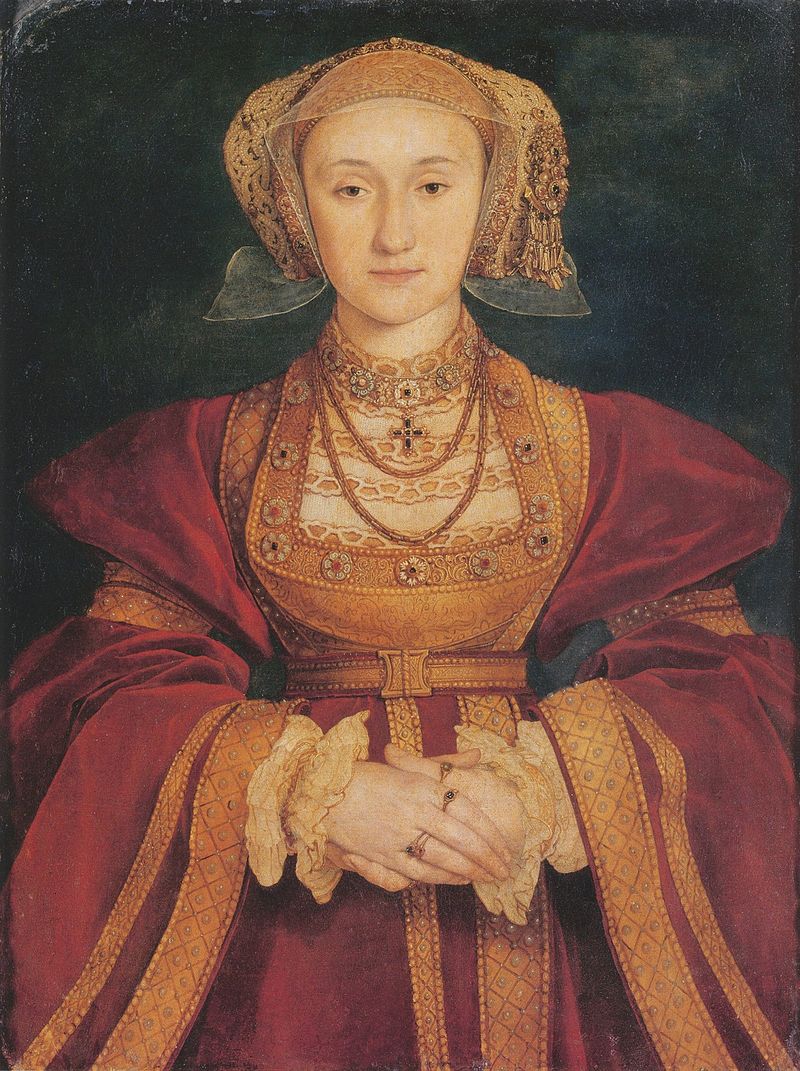
The decision to take Anne was made before Henry saw the portrait: it was a marriage of political expediency, allowing Henry to ingratiate himself with the German Lutherans against the pope and the holy Roman emperor. He was kidding himself: all Europe knew what he was like and that his break with Rome had little to do with religion. Henry was so desperate he took her with no dote, excusing the 100,000 florins since her brother was too poor from his war preparations. How much did who Henry was matter to Anne? She was Catholic, probably reserved, unused to male company or fashion conscious courts. Perhaps as she lived under the rule of her mother and brother it was neither here nor there that they be exchanged for a husband. It was expected. We do know that she set out to please and to learn. While waiting for the weather to clear at Calais she asked to be instructed in Henry’s favourite card game, sent, and invited the visiting dignitaries to dine with her, quite controversial request given their response. Though she mainly spoke through an interpreter, she learnt English quickly. While staying at Rochester she enjoyed the bear baiting, enjoyed it enough to be put out when Henry – in ‘disguise’- intruded unannounced. That Anne didn’t recognise him clearly pricked his ego and deflated his romanticism, but I share Heather Darsie’s view that given there are no contemporary accounts of Henry complaining about her appearance its safe to assume, given his returning to her the next day, that the first meeting was no more awkward or unsuccessful as any two betrothed nobles meeting for the first time. She was gracious, easy to please and obedient. Her clothes were off-putting to the English who were used to swan necks and heaving bosoms but that was easily rectified.
What were those three months like? They stayed at Hampton Court palace until Easter, together and despite Henry’s love for the pretty young things, we was also desperate to secure his legacy so he would have tried to consummate the marriage. Anne was tall and lean, so the idea that she was flabby with hanging skin doesn’t fit. But by Anne’e description also it seems their relationship was chaste, which to paraphrase one commentator, if we look at Henry’s litter of bastards, is chastity really likely? Whatever happened, or didn’t, by April an annulment was already on the table before the privy council. Again, Darsie’s arguments about the worsening situation in Germany is more plausible than any of Henry’s later excuses. Henry didn’t want to get dragged into a war, which meant his marriage to Anne was a liability. Did she know? Officially word was brought to her about the possible illegality of her marriage when the annulment had already virtually been completed. Did no news filter through to her, did none of her ladies dare to let her in one what, among the upper echelons, must have been an open secret? Whatever she knew or didn’t know, her response was more measured and regal than anything Henry could have hoped – or pulled of himself. She put herself in the hands of God and Henry, signing her letter ‘daughter of Cleves’.
As queen of England she lasted six months, not the longest but not the shortest. and for fear of upsetting her brother, Anne is adopted as sister, given houses and an income – which she supplements through that time honoured queenly activity of selling beer – and blends into the background of court life. It occurs to me that Anne, along with Catherine of Aragon, Mary and Elizabeth was subject to the frequently changing reality that Henry created around him. Anne become the beloved sister. Catherine was buried as the Princess of Wales. Mary and Elizabeth were either legitimate or not depending on what was politically or sexually convenient at the time. Henry’s whole reign was spent willing the world to fit his desires, straining to shape reality to his ego. Given the violent and tragic ends of the other five wives, to me Anne is the true survivor. While Henry lived she had her own home and income. She was welcomed at court, mostly because she knew how to conduct herself (embarrassing Katherine Howard by remaining on her knees to her former lady in waiting makes me proud!). Only after Henry’s death did life become harder. King’s ‘aunt’ is a much less tenable situation than king’s sister. Edward was not a gracious nephew, taking back houses, refusing to pay her annuity. That Anne’s brother Wilhelm had to send ambassadors to remonstrate with Edward speaks to his neglect. And then Mary. As Catholics they could so nearly have been close but Anne’s name being connected with Elizabeth and Wyatt meant that, again, through no fault of her own she became political dynamite. She didn’t allow it to effect her demeanour – or she knew she couldn’t afford to – keeping up respectful and obedient correspondence with Mary and trusting her to execute her wishes when drawing up her will, Mary’s chosen burial location for Anne of inside the wall surrounding the Edward the Confessor’s shrine is possibly the least she could do while still doing something.
After all this I’m still not sure who Anne was. I worry this is the fate of Annes – Neville, Bohemia and now Cleves. History seems to have happened to and around them. That Anne was surprised by Henry’s forward behaviour at Richmond tells me she knew what was due her as duchess and future queen of England. That she tried to shape herself to him tells me she knew her responsibilities as well. She may not have known how babies are made but she knew how to bring a presumptuous young pretender down a peg or two. She had the strength to accept what she couldn’t change and make the best of a bad situation. She surprised everyone after the annulment by generally enjoying life and perhaps finding pleasure in her new freedom – both from family and husband. She could be her own person. I am only sad that whoever that person was has never been captured. Whoever that was, she was doubtless strong, resilient, patient, demanding of her due, persistent and loyal. Anne of Cleves, Queen of England, I honour you.
Paddington, later…
Reading back on a gather invariably makes me tear up again! I was in the abbey for an hour and a half, long enough to give haughty looks to loud colonial tourists during two prayer interludes. While I am not a Christian, I do feel that respecting and taking part in the life of a functioning church is required since I am getting such a good deal out of my season ticket. And, pompously, it makes me feel like I have more of a right to be there than the people who just treat it as a sight to see. Such a snob. I had determined to do some arctic shopping rather than the now traditional cheese orgy…fromorgy? I was sorely let down – the alleged Bad Rhino big chap store turned out to be two racks of t-shirts and a solitary coat at the back of a Yours. I tried many coats but none of them were right – they fit but they didn’t scream tundra warrior. Back to the internet.
FYI, a fight appears to be breaking out in the Costa I’m in between a customer who wanted a vegan sandwich but seems to have picked up one with ham and now thinks that there’s some conspiracy to make her eat the ham, the manager who keeps saying if its vegan its vegetarian, a third guy who is trying to explain what vegan ham is and bunch of other people shouting ‘call the police’ on the sandwich vandal. Its all very Latin. The police have arrived and there’s a chorus of descriptors being yelled…why no-one else noticed she was wearing Christmas pudding pyjamas is beyond me…like that’s the first thing you notice. It was certainly a crash course in really bad customer service. Anyway back to me. so I still don’t have a suitable coat. I’ll have to go for one of the less inspiring ski options. I’m so tired I have nothing else in me. The next gathering will be on the second to last day of the railway odyssey. Counting down as of now.
The Life of Anne of Cleves (or what we know of it)
1515
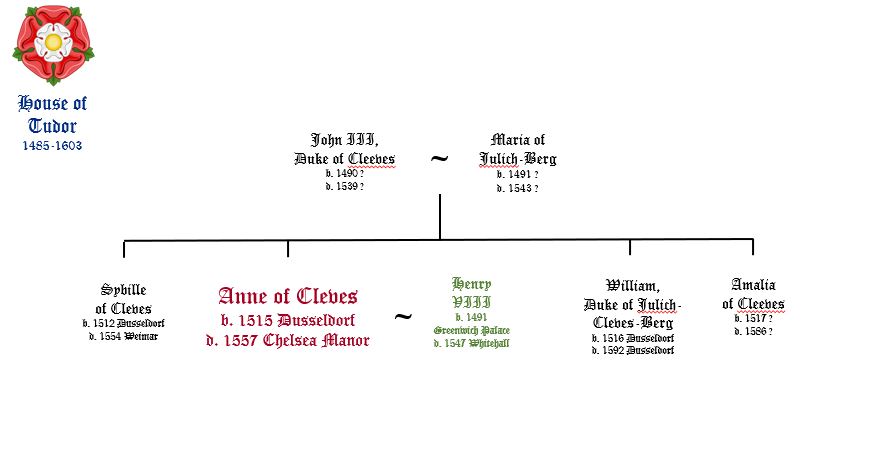
- 28 June: Anne born, probably in Dusseldorf, to John III, Duke of Cleeves and Maria of Julich-Berg. Her given name is Anna von der Mark, Duchess of Julich-Cleves-Berg
1516
- 28 July: Anne’s mother Maria gives birth to her third child, a son named Wilhelm, Duke of Julich-Cleeves-Berg
1517
- 17 October: Anne’s mother Maria gives birth to her fourth child, a daughter named Amalia of Cleves
1527
- 9 February: Anne’s sister Sybilla marries Johann Friedrich of Saxony
- 13 June: Anne is betrothed to Francis, heir of Antoine, Duke of Lorraine, in a joint marriage treaty with her sister Sybilla
1531
- 28 June: Anne’s 16th birthday
1536
- 28 June: Anne’s 21st birthday
1538
- Autumn: Portraits of Anne, Amalia and Wilhelm are painted by Barthel Bruyn the Elder
1539
- January: Thomas Cromwell’s agent Christopher Mount vists the Clevians and sends word of the appearance of the eldest daughter back to England
- 6 February: Anne’s father John III, Duke of Cleves dies, leaving his 22 year-old son Wilhelm, Duke of Julich-Cleves-Berg as his heir
- 10 March: Henry VIII instructs his ambassadors to Cleves to request in-person sight of the lady Anne
- 11 August: Henry’s ambassador Nicholas Wootton writes from Cleves that the council is ‘willing enough to publish that the Lady Anne is not bound by any covenants made by the old Duke of Cleves and the duke of Lorraine, but is free to marry as she pleases’. He describes Anne thus: ‘she occupieth her time most with the needle…she can reede and wryte…Frenche, Latine, and other language she hath none, nor yet she cannot singe nor pleye enye instrument, for they take it heere in Germany for a rebuke and occasion of lightnesse that great ladies shuld be lernyd or have any knowledge of musike. Her wit is good and she will no doubt learn English soon when she puts her mind to it’.
- September: the ambassadors from Cleves request that since Anne’s brother is relatively poor and preparing for war, that he can offer no dote, and therefore expect no dowry of Henry. They expect he will simply treat her well. Arrangements are made for Anne to travel via land rather than by sea for fear her complexion would suffer, and she would be vulnerable to attack from the Holy Roman Empire
- 4 September: Anne, her mother Maria and brother Wilhelm all consent to the marriage treaty with Henry VIII
- 4 October: The marriage treaty between Anne and Henry VIII is signed in London by the Archbishop of Canterbury, Thomas Cromwell and others. Anne came from Cleves at her brothers’ expense, with an initial dote of 40,000 florins on the wedding day and a further 60,000 within a year. She would receive as dower lands to the value of 20,000 florins as long as she remains in England. If they had no children and Henry VIII pre-deceased her, she would be free to go home with a pension of 15,000 florins. The succession of Saxony would go to Anne if her sister Sybilla and her husband die without issue.
- 6 October: Anne’s dote is set at 100,000 florins, on the understanding it will not be paid. Her dowry is set at 20,000 florins, or the equivalent of 5,000 marks sterling
- 27 October: A passport bearing the seal of Charles V, Holy Roman Emperor is issued to Anne for her journey to Calais. Her route took her through Dusseldorf, Berg, Cleves, Ravenstein, Tillberg, Hoogstraten, Antwerp (where she was feted by English merchants living there), Skeyn, Polken, Bruges, Oudenberg, Newport, Dunkirk, arriving to a gun salute in Gravelines on 11 December
- 4 December: Cromwell arranges for Anne’s new household to include a total of 88 people including a governess of her gentlewomen, pages, a steward, a master of forests, a secretary, chaplain and others
- 11 December: Anne arrives with her retinue in Calais, greeted by Thomas Seymour and others
- December: Anne spends the Christmas holidays in Calais, delayed from crossing to Dover by bad weather. While in Calais, Anne asks through the ambassador if anyone will teach her Henry’s favourite card game and is taught to play ‘Sent’. She also requests some of the nobles who had met her would sit with her at supper which was initially declined but they relented and her demeanour was described as ‘like a princess’
- 22 December: Anne is described as ‘so good and gentle to serve and please’ by Anne Bassett, in writing to Lady Lisle
- 27 December: Anne makes the crossing from Calais to Deal, received by the Duke and Duchess of Suffolk, and taken to Dover Castle to rest. She then travels on to Rochester Castle
1540
- 1 January: Anne is visited at Rochester By Henry VIII and according to Ambassador Olisleger, he comes with about 10 companions, dressed in plain clothes. Henry presents Anne with a gift ‘from the king’ and they dine together. Henry stays overnight at Rochester and has breakfast with her, then leaves. Anne departs for Deptford later that day. It is not known at what point Henry made himself known to her. According to another account, Henry arrived with no more than eight attendants in plain clothes, bursting into her chamber at which she was very surprised, but received them graciously on her knees at which Henry raised her up and kissed her. They dine together that night and the following morning.
- 3 January: Anne officially meets Henry VIII at Black Heath, they then ride together to Greenwich attended by a large company of ladies, including the Princesses Mary and Elizabeth. While there, Henry signs letters patent to partially satisfy her dower
- 6 January: Anne and Henry VIII are married in Henry’s chambers at Greenwich, officiated by Thomas Cranmer, Archbishop of Canterbury
- 11 January: Anne and her retinue enjoy watching jousting, after which many of her company prepare to leave for Cleves
- 18 January: £1,405 16s 5d in gifts and money is given to the orators of Saxony and Cleves, and others, who accompanied Anne to England
- 4 February: Anne travels with Henry VIII from Greenwich to Westminster via the Thames so she could be presented to the city
- 7 February: Cardinal Farnese in a letter to Paul III describes Anne as ‘old and ugly’ and that Henry made her dress after the French fashion, but that she is ‘worthy and Catholic’.
- 26 February: Dr Olisleger presents Henry VIII with a statement by Clevian chancellor Grogrhoff demonstrating that the pre-contract between Anne and Francis of Lorraine has been terminated, though the langauge was ambiguous enough to the English that it could be open to interpretation
- March: Anne moves to Hampton Court palace. She and Henry remain there until Easter. Later in March, Anne’s brother-in-law Johann Friedrich writes to Henry asking if he still wishes to be part of Schmalkaldic League, leading the charge against Roman Catholicism in northern Europe. However, Henry’s focus is more on military alliance, with little interest in the questions of religion the League was founded on, which puts off Johann Friedrich
- 23 April: Anne’s brother-in-law is suggested as one of the new Knights of the Garter but ultimately is not included
- 28 April: The subject of the disolution of the marriage between Anne and Henry is raised at Parliament
- 30 April: Anne enjoys the May Day festivities while staying at Westminster. The week long festivities involved many banquets and suppers with the king and court
- 10 June: Thomas Cromwell, the architect of the marriage between Anne and Henry is stripped of his office and arrested on accusations of treason. As relations break down between Anne’s brother Wilhelm and Emperor Charles V it becomes clear that war is likely between the United Duchies and the Holy Roman Empire. Henry’s marriage to Anne is now a dangerous political liability, putting England at odds with Charles and dragging them into a war they are not prepared for
- 21 June: Anne’ s brother Wilhelm concludes a peace treaty with Francis I of France, allying themselves against the Empire
- Late June: A secret council begins collecting (or creating) evidence proving the invalidity of Anne’s marriage to Henry, including what could be described as a wilful mis-reading of the pre-contract cancellation between Anne and Francis of Lorraine. There are descriptions of Anne’s body allegedly spoken by Henry to Cromwell suggesting she was no virgin. In the next breath, the excuse of non-consummation is used to maintain diplomatic relations with Anne’s brother, so she is free to remarry. Henry himself in his deposition claims on first meeting Anne he liked her so ill he was sorry she had come. This is supplemented by depositions of various nobles who claim to recollect conversations with Henry when he discussed his dislike of Anne
- 24 June: Anne is removed to Richmond Palace, alledgedly due to the threat of the plague in London
- 26 June: In a list of spoils from monasteries, Anne is described as ‘the lady Anne of Cleves’
- 29 June: A list of questions and tasks is put before the council regarding the legality of Henry’s marriage to Anne
- 30 June: Thomas Cromwell writes a letter to Henry VIII revising his experience of the first meeting between Anne and Henry, stating that Henry had been displeased with her looks and demeanour. That Henry immediately asked his counsellors to investigate the validity of the marriage. That Henry’s ultimate motive for questioning the marriage was not wanting to make Anne’s brother Wilhelm side with either France or the Empire. That Henry had complained of Anne’s body being off putting and that he had not been able to consummate the marriage. This letter stands as the factual account of their relationsip ever since, but was written the day after Cronwell was arrested with a death sentence hanging over him and under instruction from the Dukes of Norfolk and Suffolk
- 4 July: Henry VIII instructs his agent Pate to encourage the Emperor Charles V to quash any rumours or slander regarding the dissolution of his marriage with Anne
- 6 July: Clergy of England are instructed to determine the validity of Anne’s marriage to Henry. All depositions are sworn under oath. No one speaks on Anne’s behalf, including Anne. Henry’s commission to investigate his marriage is communicated to Anne via a translator. They explain she should reply either verbally or in writing. She replies verbally that she is ‘content always with your majesty’. The same day ambassador Marillac writes to Montmerency that he suspects some diminution of love between Henry and Anne as she has been sent to Richmond, allegedly from fear of the plague though there have been no outbreaks in London, and if there was, Henry would have followed closely behind, as he had promised
- 8 July: Henry VIII instructs his ambassadors at the Imperial Court to question the Cardinal of Lorraine about Anne’s pre-contract with his nephew Francis. He alleged a concern that any children he had with Anne could be declared illegitimate because of it. He requests that his agents make it appear the question is not coming from him
- 9 July: A judgement of nullity is witnessed, on the grounds of a pre-existing contract between Anne and Francis of Lorraine. Henry VIII is declared free to re-marry, as is Anne
- 11 July: Anne writes to Henry having heard of his concerns about the marriage, leaving the decision in the hands of God. She signs herself ‘daughter of Cleves’ rather than as queen
- 12 July: Henry replies to Anne’s letter, pleased to adopt Anne as his sister and sends 500 marks as a fraternal gift. She was to be granted £4,000 per year, and Richmond and Blechingley palaces, among others, for her comfort and so she could be close to Henry. He also requests Anne’s acquiescence in a second letter, this time in English, as her first had been in German so that she might more accurately record her thoughts. From this point on, all correspondence with her brother and mother would be handed over to Henry or his agents.
- 13 July: Henry VIII instructs the earls of Suffolk and Southampton and Thomas Wriothesley to obtain further written evidence from Anne that she understands and consents to the annulment to ‘prevent her from swerving from her conformity’ or ‘saying hereafter that she did it ignorantly’
- 21 July: Anne is visited by Dukes of Suffolk and Southampton, and Thomas Wriothesley, with a gift/bribe from Henry VIII of jewellery. Anne returns to Henry their wedding ring, asking that it be broken in pieces. She writes in German to her brother, a letter which may have been dictated to her, letting him know she was well and healthy, that Henry ‘uses her with more liberality than she or her brother could wish’ and that her body ‘remaineth in the integrity which I brought into this realm’. On the same day provisions are made for Anne in her new role: she will be considered the king’s sister, and above all others in the land apart from the King, the Queen, and the King’s children; she is given an income of 800 nobles, and a further 500l for her officers; Richmond and Blechingley manors; money and furniture to support her until her income settles; clothes, jewels and officers. While living at Richmond she orders more than 200,000 gallons of beer and procures a licence to export, presumably augmenting her dower income
- Late July: four men are commissioned and paid 32s for four days’ work riding between Augustine Friars’ house, the Tower and Westminster collecting furniture for Anne, suggesting some of the late Thomas Cromwell’s household goods were recycled for Anne’s new status as sister
- 17 August: Anne receives correspondence from Wilhelm which she at first refuses to give to her receiver-general, Wymond Carew, who is charged with reading and copying all her correspondence. Eventually she capitulates but Carew reports she ‘is bent to do me displeasure’.
- 3 September: Anne is described in a letter between Charles de Marillac and Francis I of France as being far from disconsolate after the disolution of her marriage, but is joyous and takes ‘all the recreation she can in diversity of dress and passtime’
- 1 October: Charles Marillac writes in a letter to Philip de Montmerency that a rumour was circulating the English court that Henry VIII was thinking of reclaiming Anne as his wife, or at very least, as a lover
- 4 October: In a letter to the privy council, English ambassador Richard Pate described the opinion of the Clevians regarding Anne being set aside, saying Henry had many obloquies said against him and that they wanted Anne back, or hoped Henry would reconsider
- 11 October: In a letter between Marillac and Montmerency, the rumours are mentioned about Henry thinking of repudiating Katherine Howard and taking back Anne, due to the belief that Anne was pregnant, but this had been proved untrue
- 1 November: In a letter between Charles Marillac and Philip de Montmerency, Anne is described as being ‘no more talked of than if she were dead’
- 31 December: Anne is staying at Richmond for the Christmas holidays, where she receives gifts from Henry VIII, adding to the rumours that he will take her back
1541
- 3 January: Anne visits Katherine Howard and Henry VIIIat Hampton Court with gifts of two richly dressed horses. When she meets the queen she remains kneeling. She stays to dine and dance with them both that night. Katherine re-gifts a gold ring and two dogs from Henry to Anne. Anne departs the following day
- 9 January: Anne becomes a denizen of England, on condition she does not leave the country without licence
- 12 January: Ambassador Chapuys writes to Holy Roman Emperor Charles V that Anne has been recalled to Richmond, where she seems happier, and as Katherine Howard is not yet pregnant, rumours abound of a reconcilliation: he doubts it but if true, he will indirectly thwart it
- February: In a letter to Henry Bullinger, Richard Hilles writes of the published bill dissolving the marriage between Anne and Henry: “the preamble is false, that the commonality have had doubts about the marriage, for no man would have dared to utter them…false also that the lords and commons petitioned the king to refer the matter to the clergy, for none of them would have dared utter a word about it till they saw the king’s affections were transferred to young Katherine…as to the reply of the [archbishop] of Canterbury…that they found Anne of Cleves was still a maid, that is a likely thing indeed! Who, judging of the king by his fruits, would believe him so chaste?”
- 14 June: Anne’s brother Wilhelm marries Francis of France’s niece Jeanne d’Albret, cementing their alliance
- 10 July: Anne former betrothed, Francis of Lorraine, marries Christina of Denmark. Henry VIII orders his ambassadors not to attend to show he believes the marriage to be unlawful
- November: Henry VIII begins the process of repudiating Katherine Howard, re-ignting the rumours that he will return to Anne
- 5 December: At a meeting of the Privy Council, one Frances Lilgrave is committed to the Tower for slandering Anne, and by extension, the king
- 6 December: Sir Anthony Browne and Sir Ralph Sadleyr, while examining witnesses in the trial of Katherine Howard, hear testimony from one Jane Ratsey who is quoted as saying: “that the lady Anne of Cleves should be delivered of a fair boy, and whose should it be but the King’s Majesty’s, and gotten when she was at Hampton Court?”. This being the slander that Frances Lilgrave is committed for
- 7 December: Sir Anthony Browne and Sir Ralph Sadleyr, while examining witnesses in the trial of Katherine Howard, write to the council stating :” the matter touching the lady Anne of Cleves is to be ‘groundly examined’ for the king is informed that she has indeed had a child and imputes a default in her officers for not informing him”
- 9 December: The Privy Council send for the officers of Anne’s household, as well Dorothy Wingfield, of her privy chamber to investigate the matter of her having a child
- 11 December: Horsey, Anne’s steward, is called before the Privy Council to answer questions about Anne and Henry VIII’s relationship
- 12 December: Earl of Southampton, at Olisleger’s prompting, writes to Henry in support of a reconciliation with Anne. Olisleger also encourages Thomas Cranmer, Archbishop of Canterbury as well as appearing before the Privy Council. He is not successful
- 14 December: Clevian ambassadors meet with Henry VIII’s council to discuss his remarrying Anne
1542
- 1 January: Anne visits Henry VIII at Greenwich where they exchange gifts
- 26 February: Henry’s agent in France, Paget, writes to say that a pamphlet in the name of Anne has been published, sympathetic to her and not to Henry. The French king agrees to stop the printing and retrieve any extant copies
- March: Anne falls ill with Tertian fever, similar to malaria. Henry VIII sends a physician to care for her, and she recovers in a month
- 12 July: Francis of France declares war on the Holy Roman Empire, including Anne’s homeland of Cleves and the United Duchies
- 29 August: After the imperial forces lay waste to Duren and its castle, Anne’s mother Maria dies of grief
1543
- 16 March: Ambassador Chapuys reports that Anne has been at court for three days, though the king did not make much of her
- June: Anne receives the Lady Mary at Richmond, who enjoys her stay well enough to make gifts of money to Anne’s servants
- Late July: Anne welcomes Henry VIII to dine at Richmond, where he tells her of his recent marriage to Kathryn Parr. Her reaction is not recorded
1544
- 8 January: Henry VIII writes to the Duke of Prussia that a white osprey that was given to him by the Duke was re-gifted to Anne, and that he is surprised she did not write to thank him
- June: Anne makes the Lady Mary a gift of Spanish silks
- June: Henry VIII grants to Anne the manor of Thornedon in Essex, formerly belonging to the late Thomas Cromwell, the priory of Clatercote and various woodlands and advowsons
- September: Henry VIII grants to Anne lands in Butsleham Montague and Cokeham, Berkshire
- November: Henry VIII grants to Anne a close called Almener in Abbotisley, Hunts, between the close of Queen’s College Cambridge and the highway which previously belonged to St. Neots priory
1545
- June: Henry VIII grants Anne the manor of Halifax in Yorkshire and all it’s attendant lands that were in the ownership of the late Thomas Cromwell
- 28 June: Anne’s 30th birthday
1546
- 28 March: Cornelius Skepper, counsellor to the Holy Roman Emperor writes to say that Anne has been at court for some time, leaving on this day, and has been well treated
- 23 May: It is reported by one John Dymock, commisary, that Anne had been taken in again by Henry, and that she had born two children of him
- June: Anne is granted a passport for two ambling horses and two brace of greyhounds to be sent to her brother Wilhelm
- 18 July: Anne’s brother Wilhelm marries Maria of Austria, Charles V’s niece
- August: Anne attends a reception for the Admiral of France in London. This is her last recorded meeting with Henry VIII
1547
- 28 January: Anne’s former husband, Henry VIII, dies. His son Edward ascends to the throne as Edward VI
- 1 April: Anne’s sister-in-law Maria asks ‘in what reputation stands the widow of the late king, and the daughter of Cleves’ of her ambassadors. The answer is ‘not a word’.
- April: Anne petitions Edward VI for an increase in her allowance after he takes back one of her palaces for his own use
- November: Anne petitions the king to request the release of her brother-in-law Johann Friedrich at the same time as her sister Sybilla makes the same request. Edward VI makes a request of Charles V but the request is denied
1548
- 3 June: Anne is forced to surrender Richmond Palace to Edward VI for his use. He is forced to spend several thousands of pounds repairing after Anne’s neglect – or not being able to afford its upkeep
1549
- December: Anne’s brother Wilhelm sends his ambassadors to Edward VI’s court to beg for Anne’s pensions to be paid her
1552
- August: Anne is forced to petition the Privy Council for funds, the request denied until the King returned to London. By this time Anne’s household has been sliding into debt for some years
1553
- January: Anne writes to Lady Mary complaining of a forced property exchange, having to give her lands at Bisham for those at Westthorpe
- 30 September: Anne rides with Lady Elizabeth behind Queen Mary on her way from the Tower to Westminster, and attends Mary’s coronation banquet
- 1 October: Anne dines with Mary and Lady Elizabeth after Mary’s coronation
- October: Anne begins to try to have her annulment from Henry VIII overturned, which would, after Kathryn Parr’s death, make her the Queen Dowager and bring her much greater comfort and financial stability. The desire is never realised
- October: Anne is reported by the Spanish ambassador to have spoken directly with Queen Mary, suggesting Archduke Ferdinand of Austria as the most fitting husband for her. He is the brother-in-law of Anne’s brother Wilhelm. In November Mary announces her decision to marry Philip of Spain, son of Charles V, Holy Roman Emperor
1554
- 21 February: Anne’s older sister Sybilla dies
- February: Anne is reported by the Spanish ambassador Renard to have been involved in some way in Wyatt’s Revolt, though nothing is ever proved. Anne’s relationship with Queen Mary does not recover from this suspicion
- 4 August: While staying at her house at Hever, Kent, Anne writes to Mary thanking her for some favour done, of her desire to see Mary and Philip, and wishing her ‘joy and increase of children’
1555
- 28 June: Anne’s 40th birthday
1556
- 5 August: Anne’s brother Wilhelm writes directly to Mary requesting the dismissal and expulsion from England of Anne’s cofferer and two other servants, on the advice of Count von Waldeck who had previously been living at Anne’s expense and resented the cofferer trying to reign in Anne’s household spending. Wilhelm also writes asking Philip to intervene, who is happy to do so
- 17 September: Anne’s cofferer, Jasper Brockhouse and three other servants from her household appear before the Privy Council, against Anne’s wishes. They are given one week to depart from her household, and less than two months to leave the country
1557
- Spring: Anne becomes increasingly unwell from an abdominal complaint and removes to her manor at Chelsea for greater comfort
- 29 April: Anne is reported by Sir Thomas Cornwaleys as being stubborn about another forced property exchange. Her attitude seems to be blamed on her servants, in particular her new cofferer Robert Freston
- 12 July: Anne prepares her last will and testament. She requests that her step daughter Queen Mary will oversea the payment of her debts. She leaves her best piece of jewellery to Mary and her second best to Elizabeth, on the understanding Elizabeth will accept Anne’s maid Dorothy Curzon into her household. Anne bequeaths to each of her servants a years’ wages and enough black cloth for a mourning gown and hood each.
- 16 July: Anne dies at Chelsea Old Manor, most likely from cancer
- 4 August: Anne is interred at Westminster Abbey, the location chosen by Mary. Her funeral is in the Catholic tradition, officiated by the Bishop of London and the Archbishop of Westminster
References
- Darsie, Heather R (2019) Anne, Duchess of Cleves: the king’s beloved sister. Stroud, Amberley Publishing
- Fraser, Antonia (2011) The Six Wives of Henry VIII. London, Weidenfeld & Nicholson
Anne of Cleves’ letter to Henry VIII on hearing the news of the annulment of their marriage, 1540
Pleaseth your most excellent majesty to understand that, whereas, at sundry times heretofore I have been informed and perceived, by certain lords and others of your grace’s council, of the doubts and questions which have been moved and found in our marriage; and how hath petition thereupon been made to your highness by your nobles and commons, that the same might be examined and determined by the holy clergy of this realm; to testify to your highness by my writing, that which I have before promised by my word and will, that is to say, that the matter should be examined by the said clergy; it may please your majesty to know that, though this case must needs be most hard and sorrowful unto me, for the great love which I bear to your most noble person, yet having more regard to God and his truth than to any worldly affection, as it beseemed me, at the beginning, to submit me to such examination and determination of the said clergy, whom I have and do accept for judges competent in that behalf. So now being ascertained how the same clergy hath therein given their judgement and sentence, I knowledge myself hereby to accept and approve the same, wholly entirely putting myself for my state and condition, to your highness’ goodness and pleasure; most humbly beseeching your majesty that, though it be determined that the pretended matrimony between us is void and of none effect, whereby I neither can nor will repute myself for your grace’s wife, considering this sentence (whereunto I stand) and your majesty’s clean and pure living with me, yet it will please you to take me for one of your most humble servants, and so to determine of me, as I may sometimes have the fruition of your most noble presence; which as I shall esteem for a great benefit so, my lords and others of your majesty’s council now being with me, have put me in comfort thereof; and that your highness will take me for your sister; for the which I most humbly thank you accordingly.
Thus, most gracious prince, I beseech our Lord God to send your majesty long life and good health, to God’s glory, your own honour, and the wealth of this noble realm. From Richmond, the 11th day of July, the 32nd year of your majesty’s most noble reign.
Your majesty’s most humble
Sister and servant,
Anne, the daughter of Cleves
 Anglica Regina