
London, November 2nd, 2019
I am faced with my first Queen failure. I booked my tickets a month ago. I reviewed where Caroline of Ansbach was interred. I reminded myself of the bus route to the Abbey. I did not check that the Abbey would be open to visitors today. I am ashamed. I’ve decided that today will stand as my travelogue and I will formally gather Caroline when I come back in a few weeks for Philippa of Hainault. The steward at the gate was very kind and patient, he will spend the whole day turning visitors away. I asked about services since we’ve already proved I am a hypocrite when it comes to the Queens, but evensong isn’t until 3pm and I wouldn’t have time for the service and get back for the train at 4.30. I was so excited, I got a little teary as I walked up looking at the towers. Granted, because of my chest infection I am getting a little teary at nice wallpaper, and porridge, but still. And now whatever emotion I feel for Caroline will be tinged with sad greys.

So. Caroline. Who were you? In contrast to Anne Neville, my last gather, her personality is pretty clear. Is that just because she reigned later when we kept better records? I don’t think so. I sense that when I come to someone like Isabella of France her personality will explode off the page. Unlike those big, dominant women, Isabella of France, Eleanor of Aquitaine, Isabella of Angouleme, her personality, her upbringing seems to have allowed her to perfectly mould herself to your husband’s, becoming exactly what he needed without losing herself. That worldliness must have come from her guardian Queen Sophia. What an influence she must have been. Surrounded by artists, scientists, philosophers, but at the same time to have the example of an intelligent queen consort to emulate. When George came courting it seems likely she knew who he was…how quickly did she sum up his character and decide which parts of her own to swallow? He thought she was delightful, but we also know what kind of man he was, so I imagine what she swallowed was quite a lot. Sophia would have been aware of the situation in England, if Caroline was not, and would have made her ward understand the likely course of events leading, hopefully, to her becoming Queen of England if you were to marry this happy-go-lucky chap in his ridiculous disguise.
It wasn’t a complete act – when Queen Anne died and Caroline followed George I to England, she and George made a significant effort to assimilate and the English loved them for it. They were dedicated to each other, and despite being a loving mother, she was a mother of her time. When the question arose, stay with your children or go into exile with your husband, there was no question at all. Through the years at Leicester House and the rogue court I like to think the men and women who dared social rejection for Caroline’s company did so not only because she would one day rule, but because she made it worthwhile. Her intelligence, her wit – in fact in those drawing rooms and visits she built her court before it was needed, ready to ascend in the second George I died. Which she did.
There was nothing ostentatious about her influence. George II had a series of mistresses, often more than one at a time but she had his respect, and that of his ministers and more than that I think she respected him enough not to be seen to be obviously controlling, just giving a gentle nudge in the right direction. Its funny how trust and respect can be expressed. When George II returned to Hanover every summer, she was his regent, even when a grown Frederick might have taken her place. When George went to the birth of his bastard son and his mistress was caught in flagrante delicto with a young military officer, it was Caroline he appealed to for advice and counsel.
Given her intellectual gifts I find it hard to understand how the situation with Frederick and Augusta came about, but she married into a stubborn family, gave birth to stubborn children and no doubt stood by George II’s decisions. What did she feel about her children? Frederick refused to assimilate and took after his distant, martial grandfather. The ridiculous business of dragging Augusta around London in the middle of labour says a lot about him: maybe if he had come to England with his parents, they might have influenced him for the better. And her daughter Anne, marrying late and gallivanting around between London and Holland following some determination of her own until Caroline sent her packing. Were she understanding of their choices, could she at least see how they ended up as they did?
And in the end what greater testimony to her place in the hearts of her family that she died while her husband, the King of England, slept on the floor at the foot of her bed, not wanting to miss one second of her ebbing life. She was intelligent, inquisitive, dutiful, a little spendthrift, able to solve national problems but not those closer to home, dedicated, creative and more than a little sneaky. She were a patient, quiet, force to be reckoned with. Caroline of Ansbach, Queen of England, I honour you.
The Life of Caroline of Ansbach (or what we know of it)
1683
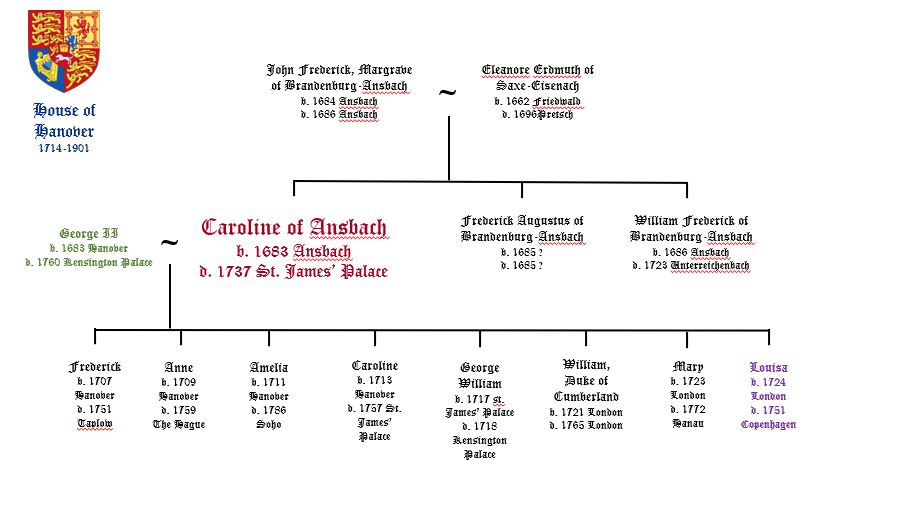
- 1st March: Wilhelmina Charlotte Caroline is born in Ansbach to Margrave John Frederick and Eleanore Erdmuthe of Saxe-Eisenach
1685
- 3rd January: Caroline’s mother Eleanore gives birth to her first son, Frederick Augustus
- 30th January: Caroline’s brother Frederick Augustus dies
1686
- 8th January: Caroline’s mother Eleanore gives birth to her second son, William Frederick
- 22nd March: Caroline’s father John Frederick contracts smallpox and dies
1692
- 17 April: Caroline’s mother Eleanore marries John George IV, Elector of Saxony and moves her household to Dresden, though Elenore cannot compete with John George’s mistress, so they later move to Pretsch.
1694
- 22nd April: Caroline’s father-in-law John George IV contracts smallpox and dies alongside his mistress
1696
- 9 September: Caroline’s mother Eleanore dies, and is buried at Freiburg Castle. Caroline and her brother William Frederick are taken into the care of their half-brother George Frederick II at Ansbach.
1703
- Caroline’s guardian George Frederick II dies, and while her brother remains at Ansbach, Caroline removes to Berlin to be raised by Frederick III of Brandeburg and his wife Sophie Charlotte of Hanover, friends of her mother Eleanore
1704
- Caroline receives an offer of marriage from Archduke Charles of Austria, which she declines as she is Lutheran and he Roman Catholic, despite the King of Prussia and various others trying to convince her otherwise.
1705
- 21st January: Caroline’s guardian and friend Sophie Charlotte contracts a chill after extensive travel and dies of pneumonia at Herrenhausen. Caroline returns to her brother’s palace at Ansbach. He supports her decision not to marry the Archduke Charles.
- June: Caroline’s cousin, Prince George Augustus, travels to Ansbach in disguise to assess Caroline as a potential bride. They get along and he returns to his father having supposedly fallen in love at first sight. It is likely Caroline was aware who he was, and adjusted her approach and conversation accordingly.
- July: Caroline’s engagement to Prince George Augustus announced, after securing her approval.
- 2nd September: Caroline and Prince George arrive at Hanover, where they are married at Herrenausen chapel. Prince George is observed to sleep through the wedding ceremony
- September: Caroline and Prince George set up their household at Leine Schloss, in apartments formerly occupied by Prince George’s mother, the disgraced Sophia Dorothea
1707
- 20 January: Caroline gives birth to her first son, Frederick Lewis. He is christened privately in Caroline’s bedchamber. Before going into labour, Caroline withdrew from her friends and family, and her secrecy led to gossip that a healthy boy had been substituted for a sickly girl in order to secure the Hannover claim to the English throne. After Frederick Lewis’ birth, Queen Anne of England bestows various titles on George, including Baron Tewkesbury and Duke of Cambridge, and awards him precedence over all other English peers. Prince George’s father George Louis is insulted by his son’s preferment, resulting in an insult to Queen Anne precipitating her refusing to invite any of the family to England.
- July: Caroline contracts smallpox, which later develops into pneumonia. Prince George attends to her, catching smallpox himself in turn.
1708
- Summer: Caroline and Frederick are left behind as Prince George joins the war against the French under the Duke of Marlborough.
1709
- 22nd October: Caroline gives birth to her second child, a daughter named Anne, later the Princess Royal, in honour of Queen Anne
1710
- 30 May: Caroline gives birth to her third child, a daughter named Amelia, also known as Emily
1712
- 30 May: Caroline gives birth to her fourth child, a daughter named Caroline
1713
- 25th February: Caroline’s guardian Frederick III of Brandenburg dies in Berlin
1714
- 31 July: Caroline’s second-cousin by marriage, Queen Anne of England dies. Prince George’s father George Louis becomes George I of England.
- 21 September: Caroline’s husband Prince George is invested as Prince of Wales.
- October: Caroline and her daughters set out from Herrenhausen for The Hague, accompanied by her brother, with whom it was likely to be her final meeting. They land at Margate in mid-October, met by Prince George, and they set up their household at St. James’ Palace.
- 29 October: Caroline watches the coronation of George I at Westminster Abbey. As there is no queen consort she does not take part in the procession. During the ceremony a stand collapses in St. James’ Yard killing ten spectators. Later Caroline and the royal family attend the Lord Mayor’s Day.
- 30 October: Caroline and Prince George open the final ball of the coronation festivities
1715
- Winter: Caroline contributes to relief for underemployed watermen during the freezing of the Thames, from her own funds.
1716
- January: Caroline sues for clemency for three lords involved in the Jacobite rebellion. While only one is spared, her mercy is noted by the populace
- July: Caroline removes her household to Hampton Court in preparation for her confinement
- October: Caroline travels back to St. James’ on doctor’s orders. After a difficult labour during which she catches a chill, a child is stillborn.
1717
- Summer: Caroline is announced to be expecting another child
- 20 October: Caroline gives birth to her fifth child, a son named George William, the name chosen by George I.
- 28 November: Caroline’s son George William is christened in her bedchambers at St. James’ Palace. After the ceremony the Duke of Newcastle mistakenly believes Prince George has challenged him to a duel for interfering on the King’s behalf
- 2 December: caroline is granted sole charge of her children after George I orders Prince George to quit St. James’ Palace. Instead, Caroline leaves with her husband, leaving the children with the Countess of Buckenburgh. Later the King permits Caroline to re-join her children as long as she neither sees nor communicates with her husband. To this, Caroline replies that her children were ‘grains of sand’ compared to Prince George and that she would go into exile with him. Caroline and Prince George surrender their children to the King and remove to Leicester House. All courtiers are forbidden to call on them.
1718
- 17 February: Caroline’s second son, George William becomes ill from the smoky London air. Caroline and Prince George are granted leave to visit him in time to be with him as he dies. He is buried in Henry VII’s chapel at Westminster Abbey
- May: Caroline and Prince George remove to Richmond House for the summer. Caroline, who is expecting another child, miscarries during a thunder storm.
1719
- November: Caroline waits on George I on his return from Hanover to congratulate him on his safe return. Prince George is absent form this civility.
1720
- 23 April: Caroline’s husband and father-in-law are reconciled at St. James’ Palace
- 24 April: Caroline and George I are reconciled in the young princesses chambers at St. James’. However, the King keeps custody of the children, and Caroline and Prince George are still excluded from all royal palaces
1721
- 15th April: Caroline gives birth to her sixth child, a son named William, later styled Duke of Cumberland
1722
- April: Caroline has her daughters Amelia and Caroline inoculated against smallpox. The princess had previously begged for the lives of six condemned criminals to be spared on the condition they be test subjects for the new process. The following year the same treatment is given to Prince Frederick
1723
- 7th January: Caroline’s younger brother William Frederick dies at Unterreichenbach
- 22nd February: Caroline gives birth to her seventh child, a daughter named Mary, at Leicester House
1724
- 7th December: Caroline gives birth to her eight child, a daughter named Louisa, at Leicester House. During this labour Caroline suffers from an umbilical hernia which would contribute to her death 13 years later.
1725
- Caroline’s eldest daughter Anne is sought in marriage by King Louis XV of France but his stipulation she must convert to Roman Catholicism means the plan is never completed.
1726
- 13 November: Caroline’s mother-in-law Sophie Dorothea dies at Ahlden. Caroline and Prince George are forbidden by the King from wearing mourning.
1727
- 10 June: Caroline’s father-in-law George I dies at Osnabruck Castle.
- 14 June: Caroline and OPrince George receive the news of the king’s death. They hold the first court of their reign at Leicester House, and a week later their court removes to Kensington Palace.
- 11 October: Caroline is crowned queen alongside her husband, George II at Westminster Abbey. Her dress is embellished with £2.5m in jewels and her train is carried by her daughters Anne, Caroline and Amelia. The coronation is followed by a banquet at Westminster Hall of 130 dishes. After the feast they withdraw to St. James Palace. Later they attend a further banquet at the Guildhall consisting of 279 dishes.
1729
- January: Caroline’s eldest son Frederick is invested as Prince of Wales, though he is given no personal money and is forbidden by George II from making any kind of progress through the country.
- May: Caroline is named Regent as George II returns to Hanover. Five days after George II’s departure, Caroline holds her first council at Kensington Palace. During his absence she averts a diplomatic crisis with Portugal and all but concludes the Treaty of Seville, ending the long dispute between England and Spain and regaining Gibraltar as a British dominion.
- 12 September: Caroline relinquishes the regency as George II returns home
1732
- May: Caroline is appointed Regent as George II travels to Hanover. During this time she makes an effort to exercise mercy with convicted criminals, reducing or commuting sentences where possible. She also attempts to have legislation brought against abuses in the penal system, though it comes to nothing.
1733
- November: William IV, Prince of Orange arrives in London in advance of his wedding to Caroline’s eldest daughter Anne. The day before the ceremony while attending divine service he collapses with pneumonia.
1734
- 14 March: Caroline’s eldest daughter Anne, Princess Royal, marries William IV of Orange at the Chapel Royal, St. James’ Palace. ‘This is the Day’, composed by Handel from text written by Anne from Psalms 45 and 118 is sung. They honeymoon at Kew before returning to London, then departing from Gravesend for Holland and setting up their household at Leeuwarden.
- Summer: Caroline’s daughter Anne, expecting her first child and determined it should be born on English soil returns in secret to Kensington, against her husband’s wishes. She is convinced and later ordered back to Holland by both William IV and George II.
- October: Caroline is gravely ill with the gout and hernia and though she struggles through George II’s birthday festivities, she then keeps to her chambers for a month
1735
- April: Caroline’s daughter Anne is forced to admit her pregnancy is phantom and despite her pleas Caroline orders her to remain in Holland.
- Summer: Caroline is appointed Regent as George II returns to Hanover. This angers their son Prince Frederick who felt the honour should be his. George II begins to restrict Caroline’s powers as regent and second guesses some of her decisions, which she deals with equably. However he does confer with her constantly about his new mistress, Amelia Sophie van Walmoden. During this regency, Caroline has constructed the Merlin’s Cave and Hermitage at Richmond. She can’t afford them personally, so Walpole allows her secret grants from the Treasury.
1736
- 25 April: Princess Augusta of Saxe-Gotha arrives at Greenwich in advance of her wedding to Caroline’s son Prince Frederick at the private chapel at St. James’. Frederick is the only member of the royal family to meet her on her arrival.
- May: Caroline is appointed Protector of the Realm as George II returns to Hanover to be present for the birth of his child with his mistress Amelia Sophia. Prince Frederick and Augusta are once again prohibited from making any progresses through the country. While in Hanover George II’s mistress is caught in an intrigue with a young military officer. George II writes to Caroline to ask her advice.
- September: Caroline gives her support to the Gin Act, imposing £1 tax per gallon on all spirits. Her coach is surrounded by a chanting mob as a result. Caroline also tries to exercise clemency on John Porteous, who fired shots into a crowd as a convited criminal escaped hanging. Durng the brief reprive she orders, a mob breaks him out of jail and lynches him. Caroline repsonds to this usurpation of her authorty by vowing to make Scotland ‘a hunting ground’.
1737
- 15 January: Caroline personally nurses George II back to health when he becomes dangerously ill after his delayed sea-crossing home from Hanover.
- June: Caroline receives word from her son Prince Frederick that Princess Augusta is pregnant, expecting in October.
- July: Caroline, George II, Prince Frederick and Princess Augusta remove to Hampton Court Palace for the princess’ confinement. In secret, Frederick has Augusta driven back to St. James’, during labour. She gives birth to her first daughter. Later in the day Caroline and George II visit mother and child at St. James. Nine days later Caroline visits again – it would be the last time they would meet.
- 10 September: In response to Prince Frederick’s deceit and treatment of Princess Augusta, George II evicts Frederick and his family from St. James’ once Augusta is fit to travel. Their royal guard is stripped and all their furniture confiscated. Any peer or minister who visits them in exile will be excluded from the court. They take up residence at George and Caroline’s old home, Leicester House.
- October: Caroline and George II remove to St. James’ in time for George II’s birthday celebrations
- 9 November: Caroline, while overseeing the renovation of her private library, experiences extreme internal pains. Despite barely being able to stand she goes ahead with their planned drawing room event. By that evening she is in a high fever. She is given various remedies and bled several times, and the King is concerned enough that he sits up all night with her. He also forbids Prince Frederick from visiting her. Despite her reticence, Caroline permits surgery to be performed to repair the umbilical hernia, but it is too late for the damage to be repaired. She asks for all her children to be present, except for Frederick.
- 20 November: Caroline takes her leave of the King believing her time to be short. She dies at 10pm; her daughter Amelia is by her, and the King is asleep on the floor at the foot of her bed.
- 16 December: The royal family, minus Prince Frederick, attend a simple service in Caroline’s room at St. James. The following evening she is laid to rest in Henry VII’s chapel at Westminster Abbey.
References
- Van der Kiste, John (2013) King George and Queen Caroline. Stroud, The History Press
 Anglica Regina
Leave a comment