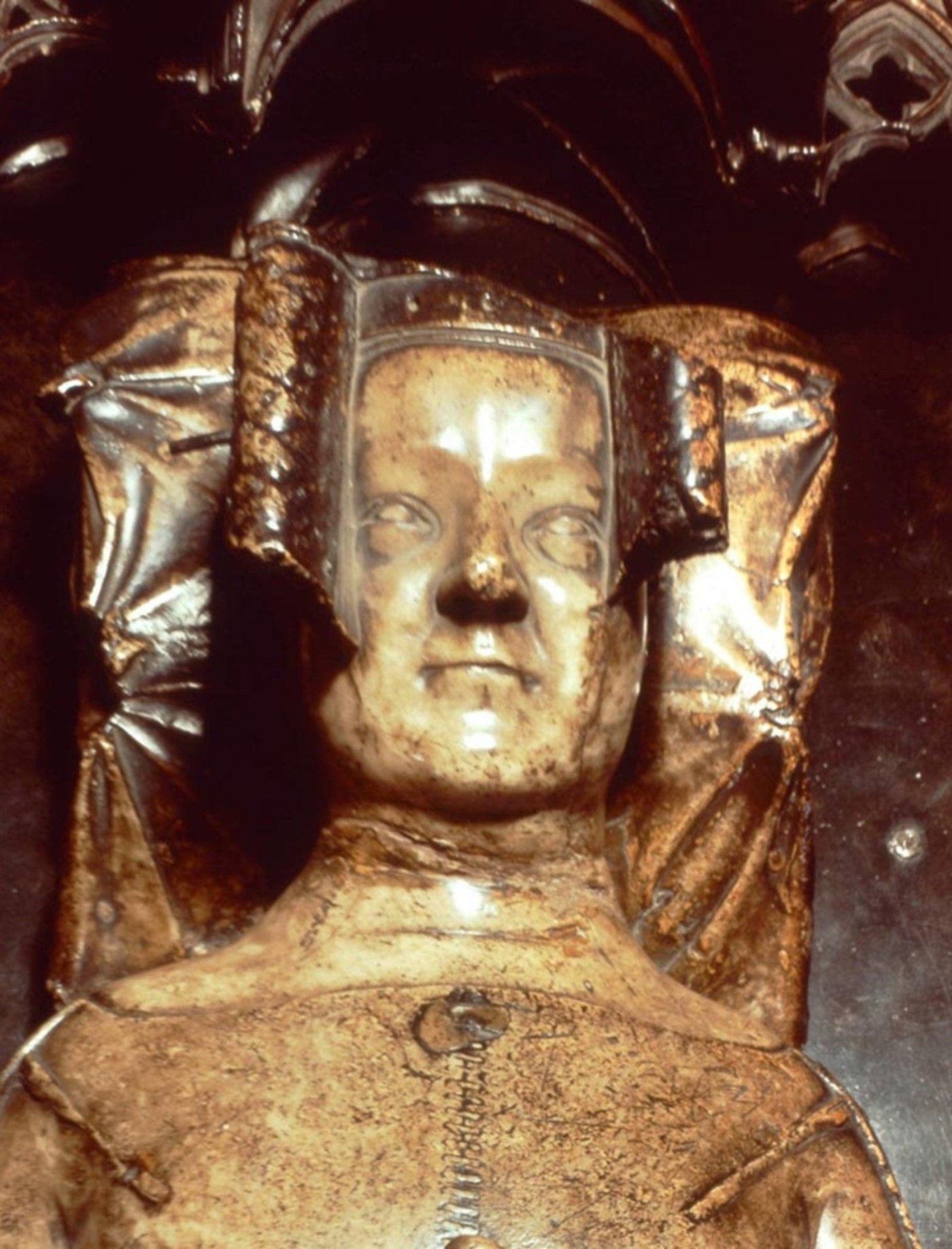
Westminster, November 30th 2019
Getting here is almost mundane now! Apart from the perpetual worry I’ll have a repeat performance of last time and I won’t be able to get in, it all went smoothly. I have gathered Caroline of Ansbach – a bit weird given all she has is a marble tile on the floor of the Lady Chapel and even as I stood over it taking a moment people kept walking on it. There were no friendly looking vergers to ask if its ever possible to visit the actual crypt. Perhaps when I’ve gathered all the queens who are down there I could make one grand gathering trip.
But today is about Philippa of Hainault, and I feel guilty because since I researched her I have also researched two other queens and I admit to having trouble recalling the facts of her life. On my way into the abbey I was pondering that she belongs to a sub-set of queens who married a prince very much under their mother’s control. Anne Neville and Margaret of Anjou. Isabella of Angouleme and Eleanor of Aquitaine. Philippa of Hainault and Isabella of France. The women who never moulded themselves but expected the world to mould to them. Strong, opinionated, martial, not always thoughtful or diplomatic. Demanding, headstrong. Those queens most likely to be described as ‘unwomanly’. Philippa was the daughter of Jeanne de Valois, daughter and sister to successive French kings. When Jeanne made a lengthy journey to visit elderly relatives, it was only the 10 year-old Philippa who accompanied her. It suggests their relationship was close, close enough that Philippa would have learned not only how to manage a household, but probably an attitude as well. I wonder how much of a gamble the marriage to Edward of Westminster seemed to Philippa and her family, or how much of a gamble it took to ally with Isabella. It is suggested that Edward chose Philippa but they were both barely 14 years old and he was under the complete control of Isabella so they almost certainly had no say in the matter. After the coup that deposed Edward II and created Edward III, after the ridiculously expensive wedding that left Yorkshire craftsmen begging for repayment and started a lifelong career of living beyond her means, after the executions and suspicious deaths, Philippa was whisked away to London and her own household to mature, and must have realised pretty quickly she was queen in name only. She was permitted none of her dower lands or money and had to survive on what was doled out to her while Isabella and Roger Mortimer plundered the country during their illegitimate regency. Was she ever close enough to Isabella to view her as a role model? Or was she just an amorphous power, out of sight, the only evidence of which was the control she exerted. I love that literally the first thing Philippa did after the arrest of Mortimer and the putting away of Isabella was to go shopping! In her case, she sent men to the great market fairs to purchase all the things she had been deprived of for the last few years, and according to her accounts she never stopped.

It feels like the end of Isabella and Roger is the end of the beginning. Once Edward was in control, things began to happen, both for the country and them as a couple. Edward’s claim to the French throne meant years of touring Holland, Belgium and northern France looking for support and that doesn’t seem to have slowed their family down. John of Gaunt and Lionel of Antwerp were both conceived and born on the road. That she followed Edward on his mission, or that he kept her with him, speaks to a bond forged in their teens, possibly in the face of their joint powerlessness. I chose not to see it as a reflection on Philippa that she wasn’t named regent, instead leaving the infant Edward of Woodstock as nominal keep of the realm under a council of nobles. You only have to count their children, surviving or not, to see they went beyond the simple expedient of heir and spare. They were a unit, a combined force. In whatever way was available to them, they loved each other. And there was respect. Philippa was seen as an expert in childbirth; during Blanche of Lancaster’s first pregnancy, which would result in Edward’s first legitimate heir, Philippa is personally drafted in as midwife to make sure everything goes smoothly. John of Gaunt’s name is bandied liberally through medieval histories as the start, the spring from which flows the next hundred years of kings but it was of Philippa that he was born. She is the root of that great oak. And not only of our own dynasty, but through John’s marriage to Constance of Castille , she is the ancestress of Katherine of Aragon.
Like Caroline of Ansbach, Philippa died in pain, but more importantly she died with her husband and at least some of her children around her. For her era, she lived a long and fruitful life; saw the arrival and departure of many children and was honoured with multiple namesakes and god-children. Described as the mother of too many sons, not for her was the pain of seeing them at each other’s throats like Eleanor of Aquitaine, or seeing them wasted and murdered like Margaret of Anjou. She created a family that would continue to influence the whole of Europe for centuries. Quiet ad obedient, yet demanding when the mood took her, compassionate, dedicated to her husband and his cause without letting go of her birth family, a lover of the finer things having been deprived of them for so long. Occasionally greedy and ill-advised but ultimately cherished and respected. Philippa of Hainault, I honour you.
As a side note, I’m recognising a sense of guilt at leaving the abbey. As though I don’t want to leave them. Most of these women will not get a second glance from the majority of visitors, mine is the only attention they will get. I don’t want to leave them alone.
Paddington, later…
My days in the capitol are getting lazier. After Philippa I wandered around to a likely looking bus-stop and caught a bus to Borough Market and bought my body weight in cheese. Seriously. The first piece I bought, some L’Etivaz, was £13. I also got a gin and some pastries and a venison burger because that was exactly what I wanted before I even knew I could have it. And then I started back for the station. The tickets are cheap, but it makes for a very short day. I had no chance at all for geocaching which means I carried this vibrating cow trackable around all day for no reason. And I’m knackered. After one flight of stairs form the platform to the ticket hall I felt exhausted and a bit woozy. Nether of my current boots are comfortable any more, time for an upgrade. I’m falling asleep as I write this. There’s every chance I’ll overshoot Taunton and wake up in Plymouth.
The Life of Philippa of Hainault (or what we know of it)
1314
- January-February: Philippa of Hainault is born in Valenciennes to William I, Count of Hainault and Jeanne de Valois, Countess of Hainault
1323
- Philippa’s mother gives birth to Isabella of Hainault
1324
- 26 February: Philippa probably travels to Cologne to attend the double wedding of her sisters Margarethe and Johanna
- 5 July: Philippa probably attends the wedding of Charles IV of France and his third wife Jeanne d’Evreaux at Annet-sur-Marne
1325
- Philippa’s mother gives birth to a son, Louis
- 1 December: Philippa travels with her mother to Paris to spend time with Charles of Valois, Jeanne’s father, as he is in poor health
- 6 December: Philippa and her mother Jeanne arrive in Paris and stay with the Bishop of Cambrai for a night
- 9 December: Philippa and her mother Jeanne visit Charles of Valois at Perray-en-Yvelines near Rambouillet. He dies a week later and is buried in Paris on 20th December, attended by Philippa and Jeanne
- December: Philppa and her mother Jeanne spend the Christmas holidays in Paris, probably at Hotel Osteriche, owned by Philippa’s family
1326
- 4 January: Philippa and her mother Jeanne arrive home in Hainault
- 11-12 January: Philippa and her family receive a visit from Marie d’Evreaux, sister of the new Queen of France
- 11 May: Philippa probably attends the coronation of Jeanne d’Evreaux as Queen of France in Paris. Edward of Windsor and his mother Queen Isabella of England were also present and it is likely they met
- 27 August: Philippa and Edward of Windsor are betrothed in person at Mons in Hainault. As Edward II is in opposition to the betrothal, and Edward of Windsor is already betrothed to the Infanta of Castille, the betrothal is not lawful
1327
- January: Edward II of England abdicates in favour of his son, Edward of Windsor, after the invasion and coup by Queen Isabella
- 1 February: Edward of Windsor is crowned Edward III at Westminster Abbey. Edward II is now known as Sir Edward of Caernarfon and put under house arrest at Berkley Castle in Gloucestershire
- February: Philippa probably attends jousts arranged by her father at ‘s-Gravenzande in Holland
- 4 August: Philippa is probably present at Le Quesnay as her mother receives envoys from England
- 30 August: Papal dispensation for the marriage of Philippa to Edward III is issued by Pope John XXII as they are second cousins
- September: Papal dispensation for the betrothal of Philippa and Edward III is received
- October: Philippa is with her parents at Valenciennes as celebrations for her forthcoming marriage begin
- October: Philippa takes part in a proxy-marriage ceremony, officiated by the Bishop of Coventry and Lichfield
- 2 December: Philippa and her retinue depart from Hainault
- 16 December: Philippa and her retinue embark at Wissant and sail for Dover
- 22 December: Philippa and her retinue arrive in England, arriving in London just before Christmas
1328
- Philippa’s younger brother Louis dies
- 23 January: Philippa and her retinue arrive in York
- 24-25 January: Philippa and Edward III are married by William Melton, Archbishop of York, as the new Archbishop of Canterbury had not yet been consecrated. The couple are married in Malton’s private apartments. More than £2,000 was borrowed from Italian lenders just for Philippa’s jewels. Two petitions were presented by the poor and tradesmen of York complaining they had been ruined through non-payment of wedding debts, one of which was turned down flat. On Philippa’s marriage and accession to the throne she also becomes Lady of Ireland, Duchess of Aquitaine, Countess of Chester and Ponthieu, though she was not granted the right to any of these titles until her own coronation in 1330, probably as a result of Queen Isabella’s determination to maintain power. Immediately after the wedding Philippa travels to London to live in a separate household.
- 1 February: Philippa’s maternal uncle, Philip of Valois accedes to the French throne as Philip IV after the death of Charles IV of Frances without male issue. Philippa’s mother-in-law Queen Isabella sends envoys to Paris registering Edward III’s right to the French crown, but the coronation goes ahead regardless
- 1 April: Philippa dictates a letter begging for the release of a prisoner while staying at Eltham in Kent
- 15 May: Edward III confirms his promise of a dowry for Philippa, settling £15,000 on her
- 23 November: Philippa receives gifts from the mayor, sheriffs and aldermen of London on the event of her marriage including 12 pigs, 12 swans and 2 barrells of sturgeon
1329
- 16 April: Philippa is finally granted an annuity of 1,000 marks as an interim payment. Up to this point she had no money of her own
- 26 May: Philippa and Edward III depart for France to pay homage to the new French king for their lands in Aquitaine and Ponthieu. Philippa goes as far as Dover, where Edward gives her a crown worth 200 marks.
- 10 June: Philippa is reunited with Edward III on his return from France
- 21 September: Philippa and Edward III are at Gloucester as rumours begin to circulate that Edward II is alive and living at Corfe Castle in Dorset
- September: Philippa conceives her first child, either at Gloucester of Worcester
- 20 October: Philippa is present at a jousting tournament held at Dunstable, Bedfordshire
- October: Philippa experiences difficulties during her first pregnancy, and as a result the court settles at Kenilworth Castle until January 1330
1330
- 12 February: Philippa is finally granted her first lands: the lordship of Glamorgan, the manor of Loughborough in Leicestershire and the town and castle of Pontefract in Yorkshire
- 18 February: Philippa is cornwed queen of England at Westminster Abbey in a shortened ceremony out of respect for her heavily pregnant state. The couple retire to Windsor Castle after the ceremony
- March: Philippa and Edward III retire to the palace of Woodstock in Oxfordshire
- 15 June: Philippa gives birth to her first child, a son named Edward and later known as Edward of Woodstock
- 24 June: Philippa’s 16th birthday
- 1 November: No longer beholden to Queen Isabella for her finances, Philippa sends agents to the great fairs of Boston and St. Ives to purchase Flemish and Italian cloth
- December: Philippa, Edward III, Queen Isabella and Prince Edward spend Christmas at Guildford in Surrey. Philippa is granted her proper annual dower of £3,000 plus an additional £1,000 and her lands including the city and castle of Bristol, town and castle of Knaresborough, towns and castles of Devizes and Marlborough
1331
- January: Philippa is assigned £4,000 of dower lands, including Pontefract, Knaresborough, Tickhill and High Peak, previously in the hands of Isabella of France
- 25 February: Philippa’s sister-in-law Eleanor of Woodstock, 12 year old daughter of Edward II becomes part of Philippa’s household
- 15 April: Philippa is staying at Sturry in Kent
- Summer: Philippa’s mother Jeanne, sister Johanna and brother-in-law Willen visit the English court. Celebratory tournemants are held, during which the stand the Queen and ladies were sat on collapsed. Philippa intercedes with Edward III on behalf of the carpenters, and rides around the site calming the spectators
- 14 July: Philippa attends the wedding of one of her ladies, Helen, to Robert Mauley
- 22 July: Philippa and Edward III are in the city of Lincoln
- 23 August: Philippa and Edward III are at Rockingham Castle, Northamptonsnhire
- September: Philippa conceives her second child
- 30 November: Edward III sends envoys to Philip VI of France concerning a journey to the Holy Land, and to open the negotiations on the marriage of Edward of Woodstock and Philip’s daughter Jeanne
- December: Philippa and Edward spend the Christmas holidays at Wells in Somerset
1332
- March: Philippa founds a chantry with three chaplains in Suffolk to celebrate divine service for the soul of Alix, her paternal aunt
- May-June: Philippa gives birth to her second child, Isabella, at Woodstock in Oxfordshire
- 8 October: Philippa and Edward III arrive at Clipstone hunting lodge in Nottinghamshire
- Winter: Philippa and Edward III spend the winter at Knaresborough and Pontefract Castles
1333
- 12 February: Philippa is at Pontefract where she sends letters to the Chancellor of England, John Stratford appointing attorneys to the exchequer
- March: Philippa is granted a further 500 marks to supplement the income of her household…it is not enough!
- 4 April: Philippa and Edward III are at Kanresborough when Philippa begs for the life of a thief, Agnes of Scarborough, to be pardoned after stealing a coat and 3 shillings
- April: Philippa conceives her third child
- May: Philippa and Edward III set out for the north of England, staying a night at Durham Cathedral where they agree to sleep apart out of respect for the patron Saint Cuthbert. Later Philippa was not permitted to remain at all and had to remove to Durham Castle, allegedly in her nightclothes. While Edward III continued his journey, Philippa remained at Bamburgh Castle
- 15 August: Edward III announces his intention of going on a pilgrimage
- 23 September: Philippa’s mother Jeanne visit the English court for a month at Philippa’s expense
- 19 December: Philippa gives birth to her third child, a daughter named Joan, at the Tower of London
1334
- December: Philippa and Edward III spend the Christmas holidays at Roxburgh in Scotland
1335
- May: Philippa attends a meeting of Parliament called by Edward III
- 21 July: Philippa entrusts John de Laundes with a gold ring, a velvet robe and assorted jewels and asks him to transport them to London. He is robbed and murdered on the road
- December: Philippa and Edward III spend the Christmas holidays at Newcastle upon Tyne
1336
- April: Philippa and Edward III are at the Tower of London, where Philippa conceives her fourth child
- July: Philippa rests at Rockingham in Northamptonshire while Edward III continues north on a campaign in Scotland
- 2 September: Philippa summons a council including the Archbishop of Canterbury, 7 bishops and other lords and knights to discuss the issue of Scotland
- 5 September: Philippa is absolved by Pope Benedict XII after she uses her brother-in-law Ludwig of Bavaria’s correct title of Holy Roman Emperor, even though he has been excommunicated several times
1337
- January: Philippa gives birth to her fourth child, a son named William, at Hatfield. The prince dies within a few days and is buried at York Minster on 10th February
- March: Philippa creates Edward of Woodstock Duke of Cornwall, the first time the title of Duke has been bestowed on an Englishman separate to their French land holdings
- 7 June: Philippa’s father Willem of Hainault and Holland dies after a long illness, possibly gout. Her mother Jeanne becomes a nun at Fontanelle, later becoming abbess
- December: Philippa and Edward III spend the Christmas holidays at Guildford in Surrey and at the Tower of London
1338
- January: Philippa’s debts to Bardi of Florence bankers rises to £4,500, which is several millions in today’s money
- February: Philippa conceives her fifth child
- 8 March: Philippa and Edward III are at Langley Manor in Hertfordshire when she writes to Paolo Montefiore to prepare passage for them both overseas. They would spend the next two years travelling around northern Europe, looking for allies against Philip VI. They take their daughters with them but leave 8 year old Edward of Woodstock at home as nominal regent
- 22 July: Philippa, Edward III and their daughters arrive in Antwerp. While staying there their house burns down, forcing them to flee to St. Bernard’s abbey in their nightclothes. They also receive a visit from Philippa’s sister-in-law Eleanor of Woodstock and her husband Reynald II of Guelders
- 29 November: Philippa gives birth to her fifth child, a son named Lionel, at St. Michael’s Abbey in Antwerp.
1339
- 6 January: Philippa is purified after Lionel of Antwerp’s birth
- June: Philippa conceives her sixth child
1340
- 26 January: Edward III is proclaimed King of France at Ghent
- 6 March: Philippa gives birth to her sixth child, a son named John, at Ghent. He is to be known as John of Gaunt
- June: Philippa travels to Ghent and stays on board the ‘Thomas’ to congratulate Edward III on his victory over the French at the sea battle of Sluis
- Summer: Philippa and Edward III set up a separate household for their younger children, overseen by Isabella de la Mote, and sent back to England for their safety. Philippa and Edward III remain on the continent
- September: Philippa conceives her seventh child
- December: Philippa and Edward III spend the Christmas holidays at Reading
1341
- 31 January: Philippa stays at Langley in Hertfordshire
- 18 March: Philippa removes to Windsor Castle
- 5 June: Philippa gives birth to her seventh child, a son named Edmund, at Langley. Edward III grants Philippa all the lands of the late Duke of Brittany for the sustenance of his five younger children. Edmund would remain in his mothers custody until he is 13 years old
- 23 July: Philippa awards the advowson of a Westmorland church to Robert Eaglesfield after he founds Queen’s College Cambridge in her name
1342
- 21 January: Philippa’s son John of Gaunt is made Earl of Richmond, though Philippa herself is at Langley while the ceremony takes place at Castle Rising
- 11-12 February: Philippa is at Dunstable for the great tournaments celebrating the betrothal of her son Lionel of Antwerp to Elizabeth de Burgh
- March-June: Philippa gives birth to her eight child, a daughter named Blanche, at the Tower of London. Blanche does not live more than a few months and is buried at Westminster Abbey in February 1343
- May-August: Philippa’s brother Willem of Hainault and Holland visit the English court to take part in the jousting tournaments. He and his sister would not meet again.
- 15 August: Philippa’s son Lionel of Antwerp marries Elizabeth de Burgh. All Elizabeth’s Irish lands are placed in Philippa’s hands for safekeeping
- November: Philippa is granted official custody of all her children except Edward of Woodstock, as well as Lionel of Antwerp’s wife Elizabeth de Burgh
1343
- 28 February: Philippa is staying at Westminster Abbey
- April-May: Philippa’s eldest son Edward of Woodstock is invested as Prince of Wales
- 13 August: Philippa is staying at Reading Castle
- 4 November: Philippa is staying at Langley Castle
1344
- 30 January: Philippa is staying at Reading Castle
- 20 March: Philippa is staying at Marlbrough Castle in Wiltshire
- 24 June: Philippa’s 30th birthday
- 10 October: Philippa gives birth to her ninth child, a daughter named Mary, at Bishop’s Waltham in Hampshire
1345
- 5 February: Philippa and Edward III attend the wedding of Richard Fitzalan, Earl of Arundel and Eleanor of Lancaster
- 17 September: Philippa is at Westminster when she intercedes with Edward III on behalf of Cicely le Clere, convicted of theft and sentenced to death. Edward III agrees to defer the death sentence on account of Cicely’s pregnancy.
- 26 September: Philippa’s brother Willem of Hainault and Holland is killed in battle near Staveren in Friesland. This leads to extensive tensions regarding to inheritance of his lands. By English law it should be split between the four remaining sisters, including Philippa, but by continental law it passes whole to Philippa’s eldest sister, Empress Margarethe.
- 10 October: Philippa is with Edward III at Westminster when she writes to the mayor and aldermen of London asking for a small tower on the banks of the Thames to be given to her. She is politely rebuffed.
- December: Philippa and Edward III spend the Christmas holidays at Woodstock in Oxfordshire
1346
- 15 January: Philippa, Edward III and Queen Isabella attend the funeral of Isabella’s uncle Henry of Lancaster, at Leicester
- 23 February: Philippa and Edward III visit Edward of Woodstock at Berkhamstead
- 1 May: Philippa and Edward III are staying at Guildford
- 31 May: Philippa is with Edward of Woodstock at Reading
- 14 July: Philippa is staying at Southwick in Sussex
- 20 July: Philippa gives birth to her tenth child, a daughter named Margaret, at Windsor
- August: Philippa’s uncle Charles of Alencon and her first cousin Louis de Chatillon are killed at the Battle of Crecy, where Edward III and Edward of Woodstock deliver a decisive victory over the French.
- 10 September: Philippa sets out for the continent to join her husband and son. Lionel of Antwerp is left as nominal ‘Keeper of the Realm’
- 21 September: Philippa arrives at Calais
- October: Philippa meets her eldest sister Margarethe at Ypres
1347
- January-February: Philippa is staying at Calais with her son Edward of Woodstock
- 12 October: Philippa and Edward III return to England
1348
- February: Philippa is with Edward III at Westminster when she successfully requests pardons for five men accused of murder
- 23 April: Philippa’s eldest son Edward of Woodstock is the first member knighted into newly created Order of the Garter.
- May: Philippa gives birth to her eleventh child, a son named William, at Windsor. The prince dies shortly after his birth and is buried at Westminster Abbey
- 24 June: Philippa is purified after the birth of her son William
- June: Philippa’s daughter, Joan of Woodstock, dies of the plague in Gascony en-route to her marriage to Pedro of Castille
- 15 July: Philippa is with Edward III at Westminster when she grants Piers de Routh custody of Sandal Castle in Yorkshire
- 9 December: Philippa is staying at Otford in Kent, joined by Edward III later in the month to spend the Christmas holidays together
1349
- 1 July: Philippa is staying at Devizes Castle in Wiltshire
- 8 October: Philippa is staying at Sheen Palace in Richmond
- December: Philippa and her family spend the Christmas holidays at Havering-atte-Bower manor
1350
- 3 March: Philippa and Edward III are staying at Croydon
- 22 May: Philippa is staying at Colchester Castle
- 22 August: Philippa’s maternal uncle King Philip VI of France dies. He is succeeded by Philippa’s first cousin, King John II
- 10 October: Philippa is staying at Mortlake
1351
- 12 January: Philippa is staying at Reading Castle
- 25 February: Philippa is staying at Westminster
- 7 August: Philippa is staying at Henley on Heath
- 28 August: Philippa is staying at Chertsey
1352
- Spring: Philippa and Edward III attend the wedding of Maud of Lancaster to Philippa’s nephew Wilhelm of Bavaria. Philippa’s eldest sister and Wilhelm’s mother, Empress Margarethe also attends – it is likely this is the last time the sisters met
- 7 March: Philippa’s mother, Jeanne de Valois dies, and is buried at Fontanelle Abbey
1353
- December: Philippa and Edward III spend the Christmas holidays at Eltham in Kent
1354
- 6 March: Philippa is staying at Colchester Castle
- April: Philippa conceives her twelfth and last child
- 23 May: Philippa is with Edward III at Westminster when she requests a licence for the priory of St. Frideswide in Oxford to enlarge their house
- 24 June: Philippa’s 40th birthday
- December: Philippa and Edward III spend the Christmas holidays at Hamstead Marshall in Berkshire
1355
- 7th January: Philippa gives birth to her twelfth child, a son named Thomas, at Woodstock in Oxfordshire.
- April-May: Philippa and Edward III receive news that Edward III’s sister, Eleanor of Woodstock had died. She is buried at Deventer Abbey
- 1 July: Philippa’s youngest son, Thomas of Woodstock, is named guardian of the realm while Edward III and his four older sons go on a military campaign in France
- 16 August: Philippa’s son Lionel of Antwerp and his wife Elizabeth de Burgh have a daughter, Philippa, the first of Queen Philippa’s legitimate grandchildren
- October-November: Philippa is staying at Westminster
1356
- 11 March: Philippa’s uncle, Jan van Beaumont, dies
- 23 June: Philippa’s oldest sister, dowager Empress Margarethe dies at Le Quesnoy Castle of infectious tuberculosis. She is buried at Valenciennes
- 19 September: Philippa’s eldest son, Edward of Woodstock, wins a decisive victory over the French at the Battle of Poitiers, capturing King John II of France and bringing him to England. John would be held under house arrest in a series of English castle and would never return to France
1357
- 26 October: Philippa and Edward of Woodstock accompany Edward III to visit with the now elderly Queen Isabella
- December: Philippa and Edward III spend the Christmas holidays at Bristol Castle and Marlborough Castle in Wiltshire
1358
- 22 February: Philippa and Edward III are staying at Westminster
- April: Philippa and Edward III are at Windsor for St. George’s day and the celebrations for the Order of the Garter
- July: Philippa is staying at Marlborough in Wiltshire
- Summer: Philippa falls from her horse while hunting, resulting in a broken shoulder blade. She would suffer considerable pain for the rest of her life and could never go hunting again
- 22 August: Philippa’s mother-in-law Queen Isabella dies at Hertford Castle
- 24 November: Philippa and Edward III meet Queen Isabella’s funeral cortege as it arrives in London
- 27 November: Queen Isabella is buried at Greyfriars in London
- November: Philippa and Edward III attend the wedding of their granddaughter, 4 year-old Philippa to 6 year-old Edmund Mortimer, grandson of the executed Roger Mortimer
1359
- 19 May: Philippa’s son John of Gaunt marries Blanche of Lancaster at Reading Abbey. On the same day, Philippa’s daughter Margaret of Windsor marries John Hastings
- 6 June: Philippa is staying at Reading Castle
- June: Philippa appoints Richard Ravenser as her receiver, and decades of debt and poor management of her lands and finances begin to improve
1360
- 9 January: Philippa is requested by Edward III to oversee the final months of pregnancy of their daughter-in-law Blanche of Lancaster
- 31 March: Philippa’s daughter-in-law Blanche of Lancaster gives birth to a daughter, Philippa
- May: Philippa’s finances and household are merged with the King’s, but it would take several more years for her massive debts to be paid off
- 26 July: Philippa is awarded a further £2,000 to maintain her household
- 23 August: Philippa is staying at Havering-atte-Bower in Essex, remaining until October while Edward III and his sons depart for Calais to sign the Treaty of Bretigny
1361
- March: Philippa’s daughter, Mary of Waltham marries John de Montfort the younger, heir to the duchy of Brittany. Both she and her sister Margaret of Windsor die within the year.
- April: Philippa, Edward III and all their children attend the funeral of Henry of Grosmont at Leicester
- 10 October: Philippa’s eldest son Edward of Woodstock marries his cousin, Joan of Kent, daughter of Edmund of Woodstock who had been executed for trying to free Edward II
1362
- 9 June: Philippa’s eldest son, Edward of Woodstock is invested as Prince of Aquitaine. He and his wife Joan depart for France. Philippa would never see her son again
- September: Philippa’s sister-in-law Joan of the Tower dies, and is buried ay Greyfriars in London
1363
- February: Philippa’s daughter-in-law Blanche of Lancaster gives birth to her second child and Philippa’s second grandchild, Elizabeth
- 6 August: Philippa is staying at Rockingham in Northamptonshire when she makes a grant giving Robert atte Hethe custody of Odiham park in Hampshire in case of her death. She begins to frequently include such phrases in her grants, suggesting her health was poor and she did not expect to live long
- December: Philippa’s daughter-in-law Elizabeth de Burgh dies in Dublin, and is buried at Bruisyard Abbey in Suffolk
- December: Philippa spend the Christmas holidays at Windsor
1364
- 12 January: Philippa is staying at Eltham in Kent
- 9 April: Philippa’s cousin, King John II of France dies in English custody at the Savoy Palace. He is succeeded by his eldest surviving son, Charles V
- 24 June: Philippa’s 50th birthday
- 1 December: Philippa is staying at Windsor
1365
- 27 January: Philippa’s daughter-in-law Joan of Kent gives birth to her first child, Edward, at Angouleme
- 27 July: Philippa’s oldest daughter Isabella of Woodstock marries Enguerrand VII de Coucy, 1st Earl of Bedford
1366
- 12 September: Philippa has in her retinue one Philippa Chaucer, wife of Geoffrey Chaucer
1367
- 9 January: Philippa’s daughter-in-law Joan of Kent gives birth to her second child, Richard of Bordeaux
- January: Philippa is seriously ill, enough that Edward III commissions the construction of her tomb for Westminster Abbey
- 15 April: Philippa’s daughter-in-law Blanche of Lancaster gives birth to a son, Henry Bolinbroke
1368
- April: Philippa’s son Lionel of Antwerp sets sail for Milan to marry Violante Visconti. Philippa would not see her son again
- June: Philippa’s son, Lionel of Antwerp marries Violante Visconti at Milan
- 12 September: Philippa’s daughter in law Blanche of Lancaster dies, and is buried at Westminster Abbey
- 17 October: Philippa’s son Lionel of Antwerp dies and is buried at Pavia, later being transported to England an re-interred at Bruisyard
- 1 December: Philippa sends an envoy to Louis, Count of Flanders to open negotiations for a marriage between her son, John of Gaunt, and Louis’ daughter Margarethe of Flanders. The marriage does not come about.
- December: Philippa, Edward III and their children spend the Christmas holidays at Windsor Castle
1369
- January: Philippa’s son, Edmund of Langley, leaves England for Aquitaine to lend support to his brother Edward of Woodstock
- June: Philippa’s son John of Gaunt leaves England for Picardy to take up his captaincy and forestall a French invasion of England
- 22 June: Philippa intercedes on behalf of Alice Marchant of Somerset, convicted of stealing goods worth 23 shillings. Her death sentence is deferred until she had given birth, but Philippa successfully begs Edward III to spare her life. Several other petitions and intercessions are dated this day, suggesting Philippa had been unwell up until this point and could not conduct the business
- 15 August: Philippa dies of an apparent oedema at Windsor Castle after a decade of pain and ill-health. Edward III and her son Thomas of Windsor are by her side
- 9 January: Philippa is afforded a state funeral and interred at Westminster Abbey. The solemnities last 6 days with her funeral cortege travelling from Windsor via Kingston-on-Thames, St. Mary Othery in Southwark, St. Paul’s Cathedral and finally to Westminster Abbey. Edward III grants Philippa’s Franciscan confessor 40 marks a year for the saying of divine service in Philippa’s honour
References
- Warner, Katherine (2019) Philippa of Hainault: mother of the English nation. Stroud, Amberley
 Anglica Regina
Leave a comment